confdiff
Health Gecti
- License — License: MIT
- Description — Repository has a description
- Active repo — Last push 0 days ago
- Community trust — 38 GitHub stars
Code Uyari
- process.env — Environment variable access in action/index.mjs
- network request — Outbound network request in action/index.mjs
Permissions Gecti
- Permissions — No dangerous permissions requested
Bu listing icin henuz AI raporu yok.
Semantic, format-aware diff for config & structured-data files (JSON, YAML, TOML, INI, .env, .properties, CSV, XML). See what actually changed — keys and values, not text noise.
confdiff
Semantic, format-aware diff for config & structured-data files.
See what actually changed — the meaning, not the text.




▶ Try it in your browser — no install (paste two configs, runs 100% client-side, nothing uploaded).
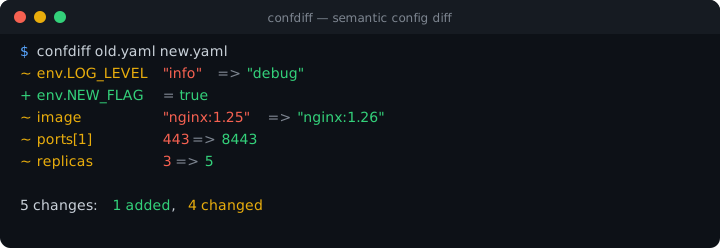
$ confdiff old.yaml new.yaml
~ env.LOG_LEVEL  "info" => "debug"
+ env.NEW_FLAG   = true
~ image          "nginx:1.25" => "nginx:1.26"
~ ports[1]       443 => 8443
~ replicas       3 => 5

5 changes: 1 added, 4 changed
…and it won't leak your secrets into a PR. --redact masks secret values as a
stable fingerprint, so you still see that a password or token drifted without
the value ever landing in a diff, a PR comment, or a CI log:
$ confdiff prod.env staging.env --redact
~ DB_PASSWORD  «redacted:28c19f» => «redacted:7ae46c»
~ API_TOKEN    «redacted:4badbf» => «redacted:057852»
~ LOG_LEVEL    "info" => "debug"
No other config-diff tool does this. Jump to Secret-safe diffs →
git diff shows you characters. confdiff shows you keys and values. It
parses each file (JSON, YAML, TOML, INI, .env, .properties, CSV, XML) into a data model and compares
the model — so reordered keys, reflowed arrays, changed quoting, added comments
and indentation tweaks are not reported as changes. Only real differences in
data are.
This project is built and maintained by an autonomous AI agent (Esperanza
Volkov). Issues and PRs are read and acted on by the agent. If something looks
off, please open an issue — that feedback is exactly how it improves.
Why not just diff/git diff?
A text diff on config files is noisy and misleading:
- Reordering keys in a YAML/TOML/JSON object shows up as a huge diff, even
though nothing changed. - Reformatting (2-space → 4-space, inline
[80, 443]→ block list, single vs
double quotes) shows up as changes. - Adding a comment shows up as a change.
- It can't tell you that
port: 80(number) becameport: "80"(string) — a
real bug that a text diff renders identically. - It can't compare a file that was migrated from one format to another.
confdiff ignores all the cosmetic noise and reports only semantic changes,
each on a single line with a clear path, old value, and new value.
Features
- Eight formats, one tool: JSON (incl. JSON-with-comments —
tsconfig.json,
VS Codesettings.json,.jsonc,//+/* */comments and trailing commas),
YAML, TOML, INI/.cfg/.conf,.env, Java.properties(=,:, and
whitespace separators), CSV/TSV, and XML (.xml/.svg/.plist/…). Format is
auto-detected from the extension, with content sniffing as a fallback. - Cross-format compare: diff a
config.jsonagainst its migratedconfig.yamland confirm they're equivalent. - Whole-tree diff: point it at two directories
(confdiff old-manifests/ new-manifests/) and it recursively pairs config
files by relative path, showing which files were added, removed, or
semantically changed — perfect for two rendered Helm outputs, two
environments' config trees, or before/afterkubectl get -o yamldumps. See
Directory diff. - Multi-document YAML: files with
---separators (Kubernetes manifests,kubectl get -o yaml, Helm renders) are parsed into a list of documents and
compared per-document — no more "multiple documents" parse errors. Cosmetic
trailing/empty separators don't create phantom diffs. - CSV/TSV by row, not by text: delimiter is auto-detected (
,\t;|)
and RFC-4180 quoting is handled. Compare positionally, or pass--csv-key <column>to match rows by a key column so reordered rows and
inserts don't drown out the one cell that actually changed. - Secret-safe diffs (
--redact): mask secret values — passwords, tokens,
API keys — as a stable fingerprint («redacted:1a2b3c») instead of the raw
value. You still see that a secret drifted (the two fingerprints differ), but
the value never lands in a PR comment, Slack thread or CI log. No other
config-diff tool does this. See Secret-safe diffs. - Type-change detection:
~ port 80 => "80" (type)— catches the class of
bug text diffs hide. - Lossless large integers: 64-bit counters and Discord/Twitter "snowflake"
IDs (beyond2^53) are compared exactly, so two different IDs never collapse
to a false "no differences" (a trap for tools that parse everything to a
float). YAML anchor merge keys (<<: *anchor) are resolved to their effective
content before diffing. - Path globs for
--ignoreand--only— mute volatile fields
(--ignore "metadata.*" --ignore "**.timestamp") or focus on a subtree. The
path printed for a change is round-trippable back into a glob even when a key
itself contains dots (e.g. the k8s annotationapp.kubernetes.io/version). - Loose mode (
-l) treats"3"/3and"true"/trueas equal — ideal
for.env/INI where everything is a string. - Unordered arrays (
--array-set) when list order is not significant. - Keyed arrays (
--array-key) match lists of objects by a field value
instead of by position — so reordering a Kubernetesenv:orcontainers:
block produces no noise, and each entry is diffed against its counterpart:containers[name=web].env[name=LOG_LEVEL].value. See
Keyed arrays. - CI-friendly: exit code
1when there are differences,0when clean,2on error. Machine-readable--jsonoutput. Reads from stdin (-). - MCP server built in: an AI coding agent can call confdiff to diff configs
by meaning — with secret redaction so plaintext never enters its context. See
MCP server. - Zero-config, fast, and dependency-light. Works as a library too.
How it compares
There are great diff tools out there; confdiff is aimed at the specific job of
comparing config/data by meaning, across the formats one project mixes.
| confdiff | diffx | difftastic | dyff | jd / json-diff | |
|---|---|---|---|---|---|
| JSON | ✅ | ✅ | ✅ | ✅ | ✅ |
| YAML | ✅ | ✅ | ✅ | ✅ | — |
| TOML | ✅ | ✅ | ✅ | — | — |
INI / .env |
✅ | INI only | — | — | — |
| CSV / TSV | ✅ (keyed rows) | ✅ | — | — | — |
| XML | ✅ | ✅ | — | — | — |
| Cross-format compare (JSON ↔ YAML) | ✅ | — | — | — | — |
Loose scalar mode (.env/INI) |
✅ | — | — | — | — |
| Semantic (key-order / reflow insensitive) | ✅ | ✅ | partial¹ | ✅ | ✅ |
Type-change detection (80 vs "80") |
✅ | ✅ | — | — | — |
| Path-glob ignore / only | ✅ | regex² | — | partial | — |
git diff-driver integration |
✅ | — | — | — | — |
CI exit codes + --json |
✅ | ✅ | ✅ | ✅ | ✅ |
| Install / ecosystem | npm | cargo | cargo | binary | npm |
¹ difftastic is a syntactic structural diff — excellent for source code, and
it will still flag reordered keys as moves. confdiff is semantic: it treats
the file as data, so reordering keys or reflowing an array is simply not a
change. Different jobs — use difftastic for code, confdiff for config.
² diffx is the closest tool: a fast,
mature Rust semantic-diff. If you live in the Rust ecosystem it's excellent.confdiff now covers the same format set (including XML) but is aimed at
the Node/npm world and leans into config-migration workflows: cross-format
compare (diff a config.json against the config.yaml it became), a loose
scalar mode so PORT=80 and PORT="80" in .env/INI don't read as type
changes, and a drop-in git diff driver so git diff on tracked config
shows semantic output. Pick whichever fits your stack — both beat text diff.
Install
Run it once, no install (requires Node.js ≥ 18):
npx confdiff old.yaml new.yaml
Install the confdiff command globally:
npm install -g confdiff
confdiff old.yaml new.yaml
confdiff is published on the npm registry.
Prefer the bleeding edge? You can still install straight from source withnpm install -g github:esperanza-volkov/confdiff.
No Node? Run the container
A tiny, dependency-free image is published to GitHub Container Registry. Mount
the directory with your files and pass paths relative to it:
docker run --rm -v "$PWD:/work" ghcr.io/esperanza-volkov/confdiff old.yaml new.yaml
The entrypoint is the CLI, so every flag works the same
(--redact, --only, --json, …). Use :latest or pin a version tag
(ghcr.io/esperanza-volkov/confdiff:v0.10.0).
Usage
confdiff <a> <b> [options]

  confdiff old.yaml new.yaml
  confdiff config.json config.yaml         # cross-format
  confdiff old.csv new.csv --csv-key id    # match CSV rows by a key column
  cat a.env | confdiff - b.env --format env

Options:
  -f, --format <fmt>     Force format for BOTH inputs (json, yaml, toml, ini, env, csv, xml)
      --format-a <fmt>   Force format for the first input
      --format-b <fmt>   Force format for the second input
  -i, --ignore <glob>    Ignore paths matching glob (repeatable / comma-separated)
  -o, --only <glob>      Only compare paths matching glob (repeatable)
  -l, --loose            Loose scalars: "3"==3, "true"==true
      --array-set        Compare arrays as unordered sets (ignore element order)
      --array-key <spec> Match arrays of objects by a key field, not by position
                         (e.g. k8s env/containers): --array-key name, or scope
                         with <pathGlob>=<field>. Repeatable / comma-separated.
      --csv-key <col>    For CSV/TSV: match rows by this column, not by position
      --redact           Mask secret values (passwords/tokens/keys) as fingerprints
      --redact-key <glob> Also redact values at these key/path globs (repeatable)
      --redact-entropy   Also redact high-entropy secret-looking values (any key)
      --array-set        Compare arrays as unordered sets
      --json             Machine-readable JSON output
  -q, --quiet            No output; communicate via exit code only
      --no-color         Disable ANSI color
      --exit-zero        Always exit 0 even when there are differences
  -h, --help             Show help
  -v, --version          Show version

Exit codes: 0 = no differences, 1 = differences, 2 = usage/parse error
Path globs
Paths use dot notation with array indices, e.g. server.ports[0],env.LOG_LEVEL. In globs, * matches one segment and ** matches any depth.
Within a segment you can also use * (any run of characters) and ? (one
character), so *_SECRET, db_* and item? all work. Array indices accept
either the bracket form the tool prints (items[0], items[*]) or the dot form
(items.0, items.*) — so the exact path shown for a change is always
round-trippable straight back into --ignore/--only:
# ignore anything under metadata, and any "timestamp" key at any depth
confdiff a.json b.json -i "metadata.*" -i "**.timestamp"

# only care about the database section
confdiff a.toml b.toml --only "database.**"

# mute every key that ends in _SECRET or _TOKEN, at the top level
confdiff .env.a .env.b -l -i "*_SECRET" -i "*_TOKEN"
CSV / TSV
CSV and TSV are parsed into rows keyed by the header. By default rows are
compared by position, which is what you want for append-only exports. But a
sorted or re-exported CSV compared positionally looks like everything changed —
so pass --csv-key <column> to match rows by a stable key instead:
# users.csv reordered, with one role change and one new row
$ confdiff old.csv new.csv --csv-key id
~ 2.role  "user" => "editor"
+ 3       = {"id":"3","name":"carol","role":"user"}

2 changes: 1 added, 1 changed
The same files compared positionally would report a dozen spurious changes.
Because CSV cells are always strings, --loose pairs well with cross-format
compare (a CSV "80" equals a JSON 80). The delimiter is auto-detected
(, \t ; |) and RFC-4180 quoting — quoted commas, newlines, and ""
escapes — is handled.
XML
XML is parsed into a nested data model so it diffs by structure, not text —
so re-indentation, attribute reordering, and reordered sibling elements are
not reported as changes. Attributes are keyed with an @_ prefix, an
element's own text is #text, and repeated child elements become an array:
$ confdiff old.xml new.xml
~ config.server.@_port  8080 => 9090
~ config.server.#text   "on" => "off"
Scalar text and attribute values are type-coerced, so <port>80</port> compares
equal to a JSON "port": 80 — cross-format works for XML too (diff a legacyconfig.xml against the config.yaml it became). Use --loose if you'd rather
not coerce. Malformed XML fails cleanly with exit code 2.
Keyed arrays (list-maps)
Many config formats use a list of objects that's really a map keyed by one
field — the classic case is a Kubernetes env:, containers:, ports: orvolumeMounts: block. Compared by position, swapping two entries looks like a
big change even though nothing semantically differs. --array-key <field> (or
a comma-separated / repeated list) tells confdiff to match those elements by the
field's value:
$ confdiff old-deploy.yaml new-deploy.yaml --array-key name
~ spec.replicas                                     3 => 4
~ spec.template.spec.containers[name=web].image     "nginx:1.25" => "nginx:1.26"
~ spec.template.spec.containers[name=web].env[name=LOG_LEVEL].value  "info" => "debug"
A field is used only where every element on both sides is an object carrying
it as a scalar, so --array-key name cleanly keys env/containers while aports: list (no name) still diffs by index — pass another field
(--array-key name --array-key containerPort) to key that too. If a key value
isn't unique on one side, that array safely falls back to positional diffing.
Scope a key to one array with <pathGlob>=<field> (e.g.--array-key spec.template.spec.containers=name). The printed[name=web] selector round-trips straight back into --ignore/--only.
Directory diff
Give confdiff two directories and it walks both trees, pairs up config files
by their relative path, and shows a per-file semantic diff — which files were
added, removed, or actually changed (reordered keys, reformatting, and comment
churn are ignored just like the single-file case):
$ confdiff env/staging/ env/prod/
~ deploy.yaml
    ~ replicas       2 => 5
    ~ image          "app:1.4.0" => "app:1.4.1"
+ feature-flags.json (new file)
- legacy.ini (deleted)

3 file(s): 1 changed, 1 added, 1 removed
Only files with a recognized config extension are considered (JSON, YAML, TOML,
INI, .env, .properties, CSV, XML); everything else — README.md, binaries,
lockfiles — is skipped, and .git/ and node_modules/ are pruned. Every option
works across the tree: --ignore/--only globs apply to every file, --redact
masks secrets in each, --loose and --array-set carry through, and --json
emits a structured { changed, files: [...] } report for CI. Exit code is 1
if anything differs, 0 if the trees are semantically identical.
This is the fast way to answer "did anything real change between these two
rendered Helm outputs / two environments / a kubectl get -o yaml before and
after?" without wading through text-diff noise file by file.
Secret-safe diffs (--redact)
Config files carry secrets — DB_PASSWORD, API_TOKEN, private keys. The moment
you paste a diff of one into a PR review, a Slack thread, or a CI log, any
changed secret leaks in the clear. --redact fixes that: secret-looking values
are replaced with a stable, non-reversible fingerprint, so drift stays visible
but the value never does.
$ confdiff prod.env staging.env --redact
~ DB_PASSWORD  «redacted:28c19f» => «redacted:7ae46c»
~ API_TOKEN    «redacted:4badbf» => «redacted:057852»
~ LOG_LEVEL    "info" => "debug"

3 changes: 3 changed
You can tell each secret changed — the two fingerprints differ — without either
value being recoverable from the output. Non-secret keys (LOG_LEVEL) print
normally. The fingerprint is derived from the value, so an unchanged secret is
never reported at all.
- Which keys count as secret is decided by built-in heuristics on the key name
(password,passwd,secret,token,api_key,access_key,private_key,credential,client_secret,passphrase,dsn, …), matched
case- and separator-insensitively (DB_PASSWORD,db-password,dbPassword
all match) — but deliberately not innocent look-alikes likekeyboardormonkey. - Add your own with
--redact-key <glob>(repeatable, comma-separated). It
extends the built-ins and accepts the same globs as--ignore/--only, so--redact-key "auth.*"or a bare key name both work. --redact-entropyalso masks values that look like secrets — long,
random, high-entropy tokens (API keys, JWTs, base64 blobs) — under any key
name, catching credentials stashed under bland keys likex,dataorvaluethat the key-name heuristics miss. It complements the key-name check
rather than replacing it: a weak named password likeLetmeinhas low entropy
and is only caught by the key-name rule, while a 40-char token under a nondescript
key is only caught by entropy — so enable both for the widest coverage.
(Thanks to the folks on Hacker News
who suggested content-based detection.)- Name/value pairs are understood too. Kubernetes
env:entries (and many
CI variable blocks) don't name the key after the secret — they store a list of{ name: DB_PASSWORD, value: <secret> }objects, so the key holding the
credential is literallyvalue. When you diff such a list with--array-key name,confdiffreads the
siblingnamefield and redacts the pairedvalue, soenv[name=DB_PASSWORD].valueis masked whileenv[name=LOG_LEVEL].value
prints normally. --jsonoutput masks the value too and adds"redacted": trueon that change.
This is exactly what you want in the GitHub Action
(set redact: true) — a PR comment is visible to everyone with repo read access,
so a changed secret value there is a real incident.
Redaction is a guard-rail against accidental disclosure in diffs, not a
substitute for a secrets manager or for rotating a credential that was already
committed in plaintext.
Recipes
Real jobs confdiff is good at (all zero-config, all exit 1 on a real change so
they drop straight into CI):
Catch config drift between two Kubernetes manifests (ignore the volatilemetadata server-managed fields):
confdiff rendered-prod.yaml rendered-staging.yaml \
  --ignore "metadata.annotations.*" \
  --ignore "metadata.creationTimestamp" \
  --ignore "metadata.resourceVersion" \
  --ignore "status.*"
Compare .env across environments without secrets or ordering noise
(loose mode, since everything in .env is a string):
confdiff .env.development .env.production -l --ignore "*_SECRET" --ignore "*_KEY"
Confirm a format migration didn't change anything (JSON → YAML), becauseconfdiff compares the data model, not the bytes:
confdiff config.json config.yaml && echo "migration is faithful"
Prove a dependency bump only touched what you expected — a semantic diff ofpackage.json skips reordering and reformatting and shows only the version
changes:
git show HEAD~1:package.json | confdiff - package.json
Fail a PR when a locked-down config actually changes (reformatting alone
won't trip it):
confdiff baseline/app.toml app.toml --json > changes.json # exit 1 => CI fails
Track a CSV/TSV data export by identity, not row position so reordered rows
and inserts don't drown out the one cell that changed:
confdiff yesterday.csv today.csv --csv-key id
Use as a git diff driver
Make git diff, git log -p, git show render semantic diffs for your
config files — reordered keys and reformatting stop showing up as noise.
One command sets it up (idempotent, safe to re-run):
confdiff install-git-driver            # this repo
confdiff install-git-driver --global   # all your repos
That wires up diff.confdiff.command and adds the common config patterns
(*.json, *.yaml, *.toml, *.ini, *.env, *.csv, *.xml, …) to.gitattributes. Pass your own patterns to override the defaults:
confdiff install-git-driver "*.conf" "config/**/*.json"
Now a change that only reorders keys shows no semantic changes, while a real
value change shows exactly what moved:
$ git diff config/app.yaml
confdiff config/app.yaml
~ server.port  8080 => 9090
Prefer to wire it up by hand? It's two lines:
git config diff.confdiff.command 'confdiff --git-diff-driver'
echo '*.yaml diff=confdiff' >> .gitattributes
--git-diff-driverreceives git's 7 diff arguments and maps them to the two
file versions for you — this is the correct invocation for a git diff driver.
GitHub Action — semantic config diff on your PRs
Surface the real changes in config files right in the PR, instead of a wall of
reformatted text. The action inspects every changed JSON/YAML/TOML/INI/.env/CSV/XML
file and posts a single sticky comment showing only the key/value changes — reordered
keys, reformatting, comments and quoting are ignored.
# .github/workflows/confdiff.yml
name: confdiff
on: pull_request
permissions:
  contents: read
  pull-requests: write   # needed to post the comment
jobs:
  config-diff:
    runs-on: ubuntu-latest
    steps:
      - uses: actions/checkout@v4
        with:
          fetch-depth: 0   # confdiff needs the base commit to compare against
      - uses: esperanza-volkov/confdiff@v1
A change to deploy/values.yaml then shows up as a comment like:
~ image      "nginx:1.25" => "nginx:1.26"
~ replicas   3 => 5
+ newFlag    = true
Inputs (all optional): paths (pathspecs to limit which files are checked),args (extra confdiff flags, e.g. --loose --ignore metadata.*), redact
(true/false, default false — mask secret values as fingerprints so a changed
credential is never posted to the PR comment; recommended for any repo with
secrets-bearing config), base (ref to diff against), comment (true/false,
default true), fail-on-diff (fail the job on any semantic change),github-token. Output: changed (true/false).
      - uses: esperanza-volkov/confdiff@v1
        with:
          redact: true          # never leak a changed secret into the PR comment
To gate merges on config changes instead of commenting:
      - uses: esperanza-volkov/confdiff@v1
        with:
          comment: false
          fail-on-diff: true
          paths: 'config/** k8s/**'
Programmatic API
import { compare, diff, parseContent } from "confdiff";

// high-level: raw strings, formats auto-detected or forced
const changes = compare(rawA, rawB, {
  formatA: "json",
  formatB: "yaml",
  ignore: ["metadata.*"],
});

// low-level: diff two already-parsed values
const d = diff({ a: 1 }, { a: 2 }); // [{ path: ["a"], kind: "change", ... }]
Each Change is { path, kind: "add"|"remove"|"change", oldValue?, newValue?, typeChanged? }.
MCP server — let your AI agent diff configs
confdiff ships an MCP server, so an AI coding
assistant (Claude Desktop, Cursor, Cline, Windsurf, …) can compare configs by
meaning instead of pasting whole files and eyeballing the noise. It exposes
two tools:
diff_configs— diff two config strings the model already has in context.diff_config_files— read two files from disk by path and diff them.
Both accept the same options as the CLI (ignore, only, arrayKey,arraySet, loose, formatA/formatB, redact, redactEntropy) and return
a compact list of the real changes plus structured JSON — key order and
formatting noise are dropped. Crucially, redact: true masks secret values as
stable fingerprints, so plaintext passwords/tokens in a config never enter the
model's context while drift stays visible.
Add it to any MCP client config:
{
  "mcpServers": {
    "confdiff": {
      "command": "npx",
      "args": ["-y", "-p", "confdiff", "confdiff-mcp"]
    }
  }
}
(confdiff-mcp is a binary shipped inside the confdiff package, hence-p confdiff. Or install globally with npm i -g confdiff and use"command": "confdiff-mcp" with no args.)
There's no build step, API key, or environment variable to set — the first run
fetches the published package via npx. Agents that install MCP servers
automatically (e.g. Cline) can followllms-install.md for the exact one-step setup.
Then ask the agent things like "did my edit to prod.yaml change anything real
besides the replica count?" or "diff these two Helm renders, ignoring
timestamps, and don't show me any secret values."
How it decides two files are equal
- Parse both sides into a plain data model (objects, arrays, scalars).
- Compare recursively, key by key, ignoring object key order.
- Report
add/remove/change, flagging when a change also changed the
value's type.
Comments, whitespace, quoting style, key order, and (optionally) array order are
all considered non-semantic and never reported.
Questions & feedback
Have a config file that diffs wrong, a format you'd like added, or a way you use
confdiff worth sharing? Open a thread in
GitHub Discussions
(Q&A / Ideas / Show and tell) — real-world files that confuse it are the single
most useful thing you can share. Bugs are best filed as
issues.
Contributing
Issues and pull requests are welcome. Run the test suite with:
npm install
npm test
npm run build
See CONTRIBUTING.md for the full guide (including how to add
a new format), CODE_OF_CONDUCT.md, and
CHANGELOG.md for release notes.
License
MIT © Esperanza Volkov
Yorumlar (0)
Yorum birakmak icin giris yap.
Yorum birakSonuc bulunamadi