Saki-Panel
Health Warn
- License — License: Apache-2.0
- Description — Repository has a description
- Active repo — Last push 0 days ago
- Low visibility — Only 6 GitHub stars
Code Fail
- network request — Outbound network request in apps/daemon/src/clash-core.ts
- process.env — Environment variable access in apps/daemon/src/config.ts
- Hardcoded secret — Potential hardcoded credential in apps/daemon/src/errors.ts
- network request — Outbound network request in apps/daemon/src/identity.ts
Permissions Pass
- Permissions — No dangerous permissions requested
No AI report is available for this listing yet.
Next-gen AI-native server ops panel with an in-workspace SRE agent. Crash self-healing, safe rollbacks, Docker/game servers, and local Ollama support.
Saki Panel
A server ops panel with an agent that can see, change, and run.
High-risk work waits for your OK. Crashes get a fingerprint, a reviewed patch, and a rollback if it happens again.



English · 简体中文
Why Saki? · Saki · Watch · Panel · Quick Start · Architecture · Deploy
Saki Panel is a web console for instances, nodes, files, terminals, and permissions. Saki is not a sidebar chatbot — it reads live status, logs, metrics, and the file tree, then acts inside the same workspace.
You can tell it:
- Restart the Node service on node-02 and tail the last 50 lines.
/varis filling up. Find what's using space and ask before deleting anything.- Update the Minecraft server. Back up the world first.
Local models via Ollama or LM Studio work with no API key. Cloud providers and GitHub Copilot are optional.
Why Saki Panel? (Comparison with Alternatives)
Existing tools are great at what they do: MCSManager excels at lightweight game hosting, 1Panel manages Linux web servers, Pterodactyl dominates commercial multi-tenant game hosting, and aaPanel handles traditional web stacks.
However, they all remain passive, manual tools. When a process crashes at 3 AM, they either restart it blindly into a crash loop or wait for a human to dig through thousands of lines of logs.
| Dimension | MCSManager | 1Panel | Pterodactyl | aaPanel | Saki Panel |
|---|---|---|---|---|---|
| AI Ops Agent | None (manual only) | Basic chatbot / App store only | None | Cloud-only external widget | In-workspace SRE agent: inspects live logs, files, CPU/RAM, and runs scoped tools |
| Crash Self-Healing | Blind restart loop, manual log digging | Basic Docker restart policy | Basic container restart policy | Process manager restart loop | Saki Watch: Fingerprints errors, drafts patches, waits for OK, auto-rollback on recurring crash |
| Local LLM & Privacy | None | Manual external container setup | None | Commercial cloud API only | Zero-config Ollama & LM Studio (100% offline & private, zero API key needed) |
| Safety & Guardrails | Standard RBAC | Linux/Docker permissions | Docker container sandbox | Standard root execution | 4-level risk approvals, mandatory confirmation on high-risk writes, daemon-level command blockers |
| Supported Workloads | Processes, Docker, Game servers | Docker & Web stacks | Docker containers only | Heavy web hosting (LNMP/LAMP) | 9 native types (CLI, Node, Python, JAR, Docker/Compose, plus Minecraft & Steam) |
| Game Server Experience | Tailored for game servers | Needs generic Docker, lacks game consoles | Dedicated game server eggs | Basic shell terminal | Native Minecraft console color parsing, Steam dedicated servers, pinpoint crash diagnosis |
| Cluster & Multi-Node | Panel + Daemon | Single-node by default, multi-node in enterprise | Panel + Wings (powerful) | Paid cloud central manager | Panel + Ultra-light Node Daemon, instant token pairing, zero complex networking |
| Setup & Complexity | Easy (Node.js) | Easy (Go + Docker) | Complex (PHP/Laravel + MySQL + Redis + Go Wings) | Easy, but modifies host environment | Simple & Fast (Fastify 5 + React 19 + SQLite, snappy & lightweight) |
Summary:
- If you need commercial, multi-tenant game server hosting with strict billing: Pterodactyl is the industry standard.
- If you primarily need a traditional Linux web server with Nginx reverse proxies: 1Panel is solid.
- If you want an AI-native server panel with a 24/7 autonomous SRE, versatile support for processes/Docker/games, and safe self-healing rollbacks: Saki Panel is built for you.
Screenshots
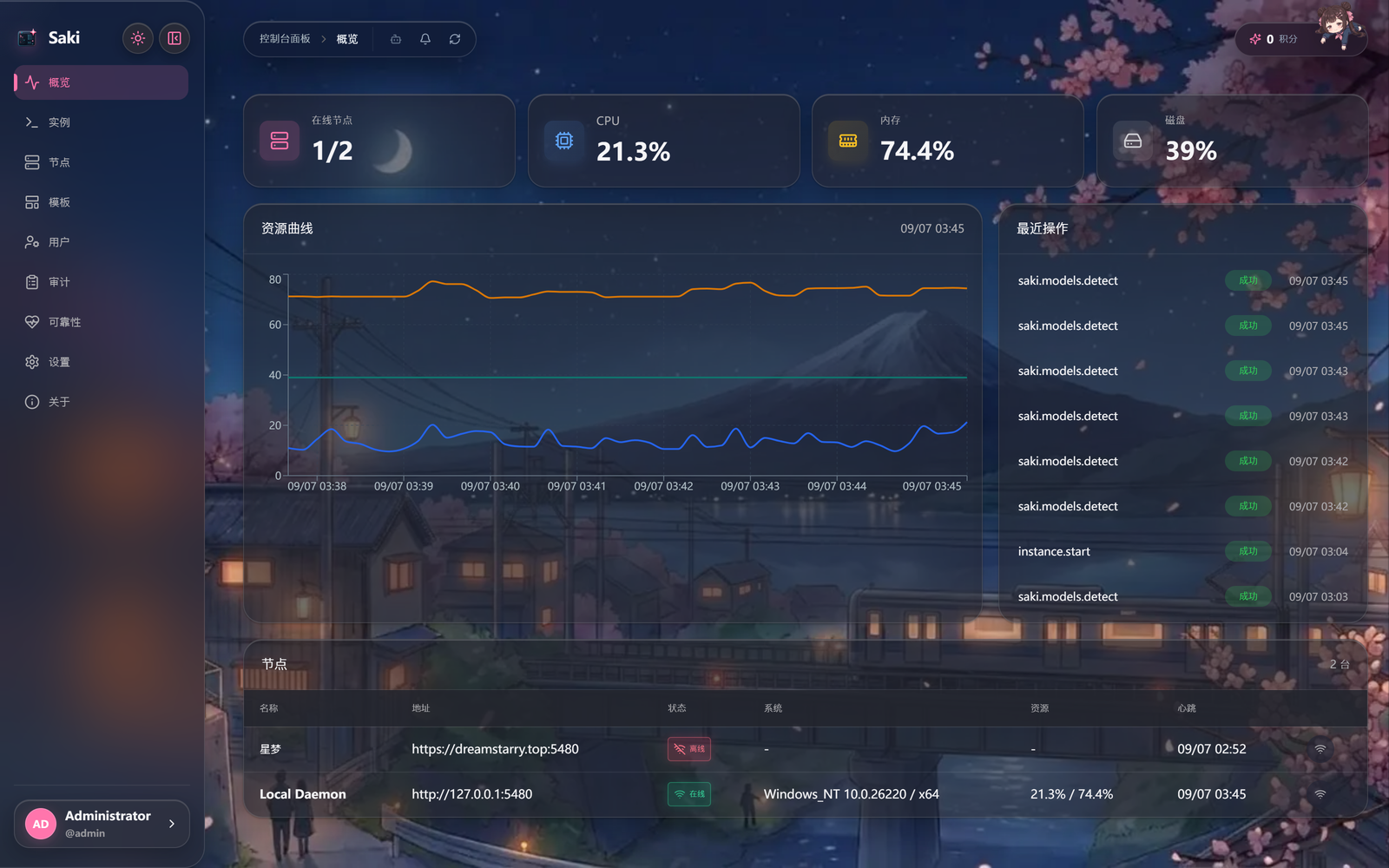
Dashboard — cluster overview, CPU / memory / disk, resource curves, node health, and recent audit:
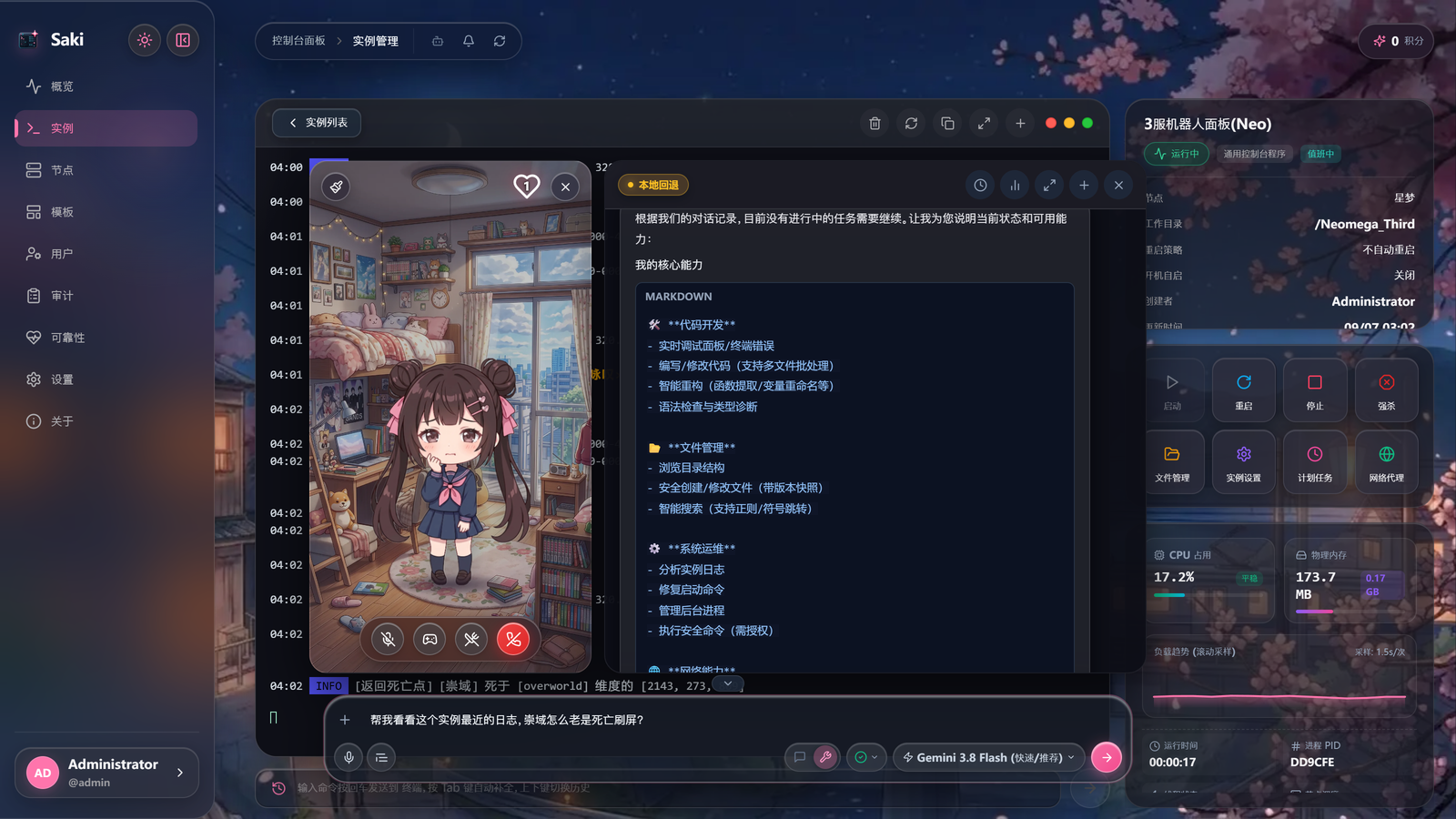
Saki on the logs — the agent works inside the same workspace: live instance logs behind, Saki chat in front, asked to find out why a player keeps dying:
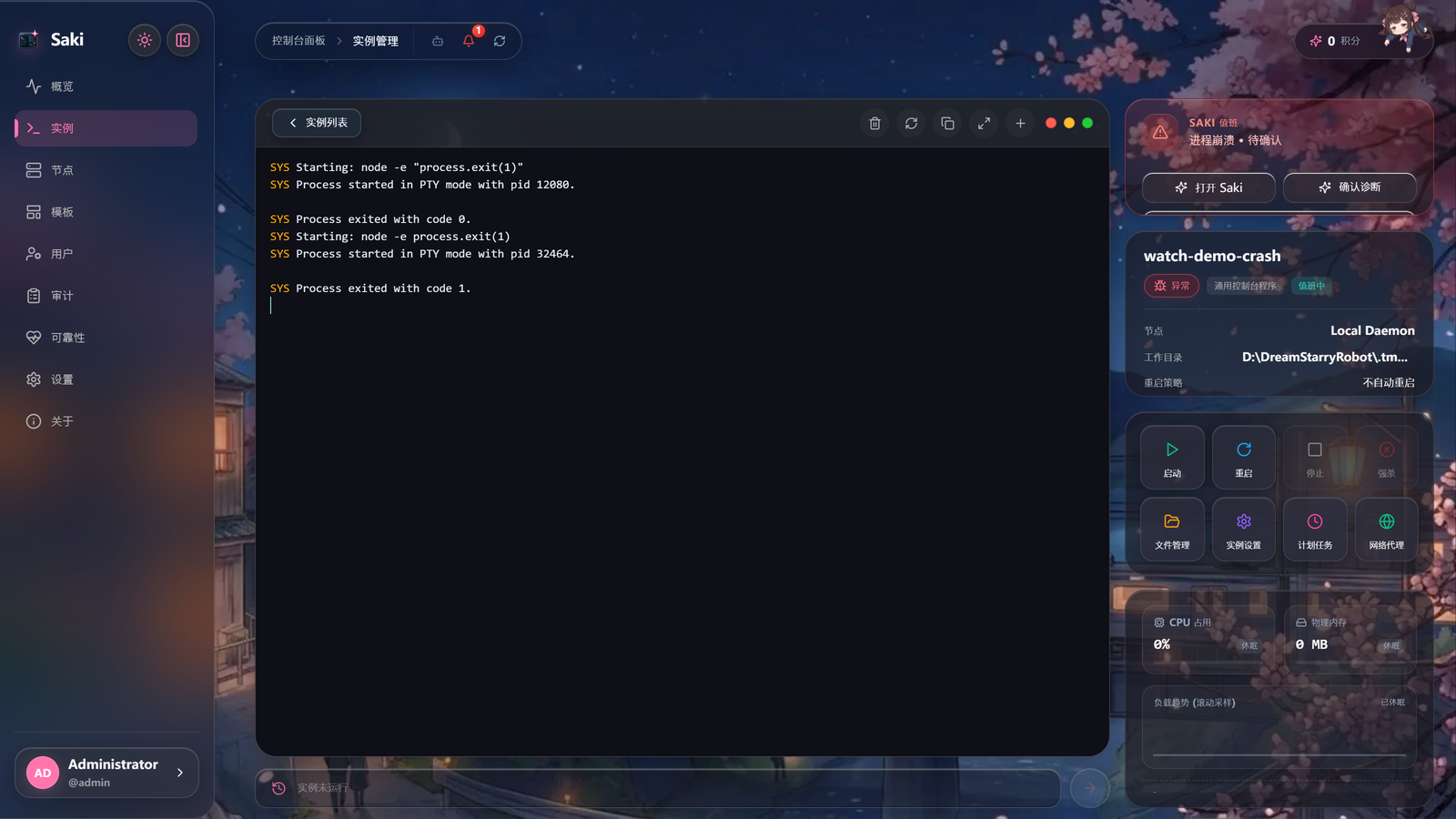
Saki Watch incident — a watched instance exits with code 1, the daemon fingerprints it, and diagnosis waits for your confirm:
Saki
| Context | Instance state, stdout/stderr buffers, file trees, CPU / memory / disk. No copy-paste. |
| Actions | Start / stop / restart, read and edit files, run commands — scoped to the workspace. |
| Approvals | Four risk levels. High-risk needs an explicit confirm. Critical commands are blocked in the daemon. |
| Skills & MCP | Recurring runbooks as Skills. External tools over MCP. |
| Input | Screenshots, log files, and text attachments in chat. |
| Guards | Detects repeated output, stuck tool loops, and runaway turns. XML, Qwen, Hermes, and native JSON tool calls. |
Local, no cloud
SAKI_PROVIDER=ollama
SAKI_MODEL=llama3.2
SAKI_OLLAMA_URL=http://localhost:11434
Or pick OpenAI, Anthropic, DeepSeek, Qwen, Gemini, MiniMax, Zhipu, Moonshot, Doubao, or GitHub Copilot in Settings.
Saki Watch
When a watched instance exits unexpectedly:
- Incident — Daemon records the exit and groups it by error fingerprint. No model call yet.
- Confirm — You start diagnosis from the incident banner or the notification bell.
- Scoped run — Agent reads logs and files. No shell, no deletes, no startup-command edits.
- Review — Proposed diffs wait for you before anything is written.
- Verify — Service restarts. Same crash again → files roll back to the pre-patch checkpoint.
Panel
- Dashboard — Cluster overview, CPU / memory / disk, node health, recent audit.
- Instances — Nine types, restart policies, logs, and process probes.
- Terminal — xterm.js over WebSocket, reconnects on drop, Minecraft color codes.
- Files — Browser, CodeMirror 6 editor, upload / download, zip / tar / rar / 7z in the background.
- Databases — SQLite, MySQL / MariaDB, PostgreSQL, Redis. Schema, rows, and queries in the panel.
- Nodes — One lightweight daemon per machine. Panel talks to them with node tokens.
- Tasks — Cron for commands, restarts, and maintenance, with run history.
- Access — RBAC, session timeout, login rate limits, full audit log.
- Templates — Reusable start commands, env, and deploy params.
Instance types
| Type | For |
|---|---|
generic_command |
Any CLI process |
nodejs |
Node apps and package scripts |
python |
Scripts and virtualenvs |
java_jar |
JARs and Minecraft server jars |
shell_script |
Bash / shell |
docker_container |
Single containers |
docker_compose |
Compose stacks |
minecraft |
Dedicated MC servers, console parsing |
steam_game_server |
Steam dedicated servers |
Quick Start
Requires Node.js ≥ 22.13 and npm ≥ 9.
git clone https://github.com/EthanChan050430/Saki-Panel.git
cd Saki-Panel
npm install
npx prisma db push --skip-generate
npm run dev
Platform scripts under scripts/ also handle port conflicts:
| OS | Script |
|---|---|
| Windows | scripts/windows/start-dev.ps1 |
| Linux | bash scripts/linux/start-dev.sh |
| macOS | scripts/macos/start-dev.command |
| Service | URL |
|---|---|
| Web | http://localhost:5478 |
| Panel API | http://localhost:5479 |
| Daemon | http://localhost:5480 |
Default login: admin / admin123456
Change JWT_SECRET, ADMIN_PASSWORD, and DAEMON_REGISTRATION_TOKEN before anything is reachable from the network.
Architecture
┌──────────────┐   HTTP / WS + JWT    ┌──────────────┐   HTTP / WS + token   ┌──────────────┐
│     Web      │ ◄──────────────────► │    Panel     │ ◄──────────────────► │    Daemon    │
│  React 19    │                      │  Fastify 5   │                      │  Fastify 5   │
│  Vite 6      │                      │  Saki Agent  │                      │  Node agent  │
│  :5478       │                      │  :5479       │                      │  :5480       │
└──────────────┘                      └──────────────┘                      └──────┬───────┘
                                                                                   │ spawn
                                                                                   ▼
                                                                            ┌──────────────┐
                                                                            │  Instances   │
                                                                            └──────────────┘
| Layer | Role |
|---|---|
| Web | Console and Saki chat. React 19, Vite 6, CodeMirror 6, xterm.js. |
| Panel | Auth, database, RBAC, audit, Saki. Fastify 5, Prisma 6, SQLite. |
| Daemon | Process, files, terminal, metrics on each machine. |
| Shared | Types and contracts. |
apps/web        frontend
apps/panel      API + Saki
apps/daemon     node agent
packages/shared types
prisma/         SQLite schema
Deploy
Docker Compose
export JWT_SECRET="your-secure-random-secret"
export ADMIN_PASSWORD="your-strong-admin-password"
export DAEMON_REGISTRATION_TOKEN="your-daemon-token"

docker compose build
docker compose up -d
Split public hosts:
export PANEL_PUBLIC_URL="http://your-server-ip:5479"
export WEB_ORIGIN="http://your-server-ip:5478"
export PANEL_CORS_ORIGINS="*"
export VITE_API_BASE_URL="http://your-server-ip:5479"

docker compose build --no-cache panel web
docker compose up -d
systemd
sudo cp scripts/linux/saki-panel.service /etc/systemd/system/
sudo cp scripts/linux/saki-panel-daemon.service /etc/systemd/system/
sudo systemctl daemon-reload
sudo systemctl enable --now saki-panel
sudo systemctl enable --now saki-panel-daemon
Commands
npm run dev          # panel + daemon + web
npm run dev:panel
npm run dev:daemon
npm run dev:web
npm run build
npm run check        # typecheck all workspaces
npm run db:push
License
Apache License 2.0. See LICENSE.
Copyright 2024-2026 DreamStarryRobot Contributors
Reviews (0)
Sign in to leave a review.
Leave a reviewNo results found