chiefofstaff
Health Pass
- License — License: MIT
- Description — Repository has a description
- Active repo — Last push 0 days ago
- Community trust — 122 GitHub stars
Code Pass
- Code scan — Scanned 12 files during light audit, no dangerous patterns found
Permissions Pass
- Permissions — No dangerous permissions requested
No AI report is available for this listing yet.
Your engineering chief of staff: runs Copilot, Codex and Claude agents as one team, follows work to done, learns to work like you, and brings you only the decisions. Local, open source. Try: uvx chiefofstaff --demo

Chief of Staff
Your engineering chief of staff.
The more it works for you, the more it works like you.
It runs Copilot, Codex and Claude as one team whose agents talk to each other, follows every piece of work through to done, reaches you wherever you are, and brings you only the decisions.




English · 简体中文
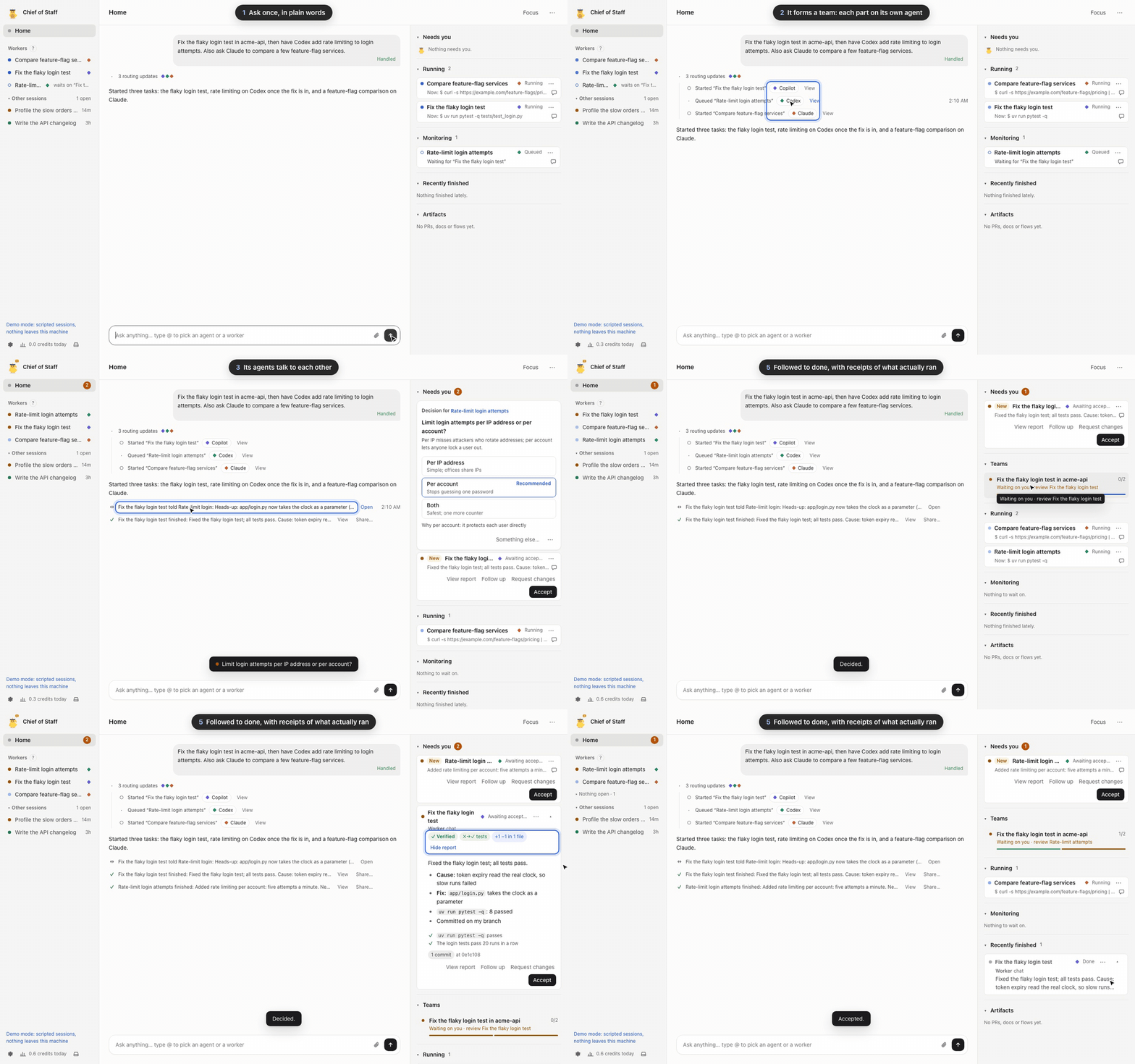
The real app in demo mode, 21 seconds. Full quality (MP4)
Try it in 10 seconds
uvx chiefofstaff@latest --demo   # scripted agents: no sign-in, nothing leaves your machine
uvx chiefofstaff@latest          # with Copilot CLI, Codex CLI or Claude Code signed in
No uv? pipx run chiefofstaff --demo works too. The browser opens by itself.
What it does
- Learns to work like you, and from its own mistakes. It picks up how you write (your Slack
messages, PR reviews, commits) and what you keep asking for: a habit you said three times or
more is usually kept at once (one click undoes it), the rest wait for your OK. When a worker
fixes a failing test, it proposes a check that fails on the mistake and passes on the fix:
proved on both, so that mistake is caught next time. - A team whose agents talk to each other. One request becomes parts, each worker on its own agent and
worktree. They tell and ask each other directly, wait on each other's results and share your
decisions; a live team page shows the plan. Or run one task on two agents and compare. - Sees it through to done. It keeps your PRs moving: when CI fails or reviewers comment, the
same worker prepares the fix or the replies for your OK (Keep my PRs moving). Slack threads
and PRs it follows go straight to their worker, check-backs watch long runs, and the Watchdog
nudges stalled work. - Reach it from anywhere. React 🤖 to any Slack message to hand it over, or send work from
any app with a hotkey. When you're away, what needs you comes to you (a Slack DM, say), and
you answer right there. - Only decisions reach you. One card per question, with options and a recommendation.
Workers that hit the same question share it, and your one answer reaches all of them. Every
result comes with receipts: the tests, commits and diff it saw, not just what the agent says. - Never acts as you without your OK. It drafts Slack replies and PR reviews in your voice and
sends them only when you say so. No worker can comment, review, merge or close on GitHub as
you, push tomain, or force-push or delete someone else's branch. - Share in one link. A finished result becomes an encrypted link that expires, opened in
any browser; whatever looks private is flagged for you to remove first. - The basics. Copilot CLI, Codex CLI and Claude Code, mixed per task on the subscriptions you
already have; when one hits its limit, new work starts on the next. It continues sessions you
started in a terminal. Local, open source (MIT).
What you stop doing
| Before | With Chief of Staff |
|---|---|
| Watching five terminal tabs to see which agent is stuck | One chat. Every task shows its live step; stalled ones get nudged |
| Copying context from one agent to another | Workers tell each other what changed, in their own words |
| Answering the same question for three agents | One card; your answer reaches every worker that asked |
| Trusting "all tests pass" | Receipts: the commands it ran and their exit codes, its commits, its diff |
| Re-checking every PR for red CI and new comments | The fix or the replies, prepared in the same worker, waiting for your OK |
| Writing every reply and review from scratch | Drafts in your voice, sent when you say so |
| Losing the afternoon when an agent hits its limit | New work starts on the next agent you have |
How it works
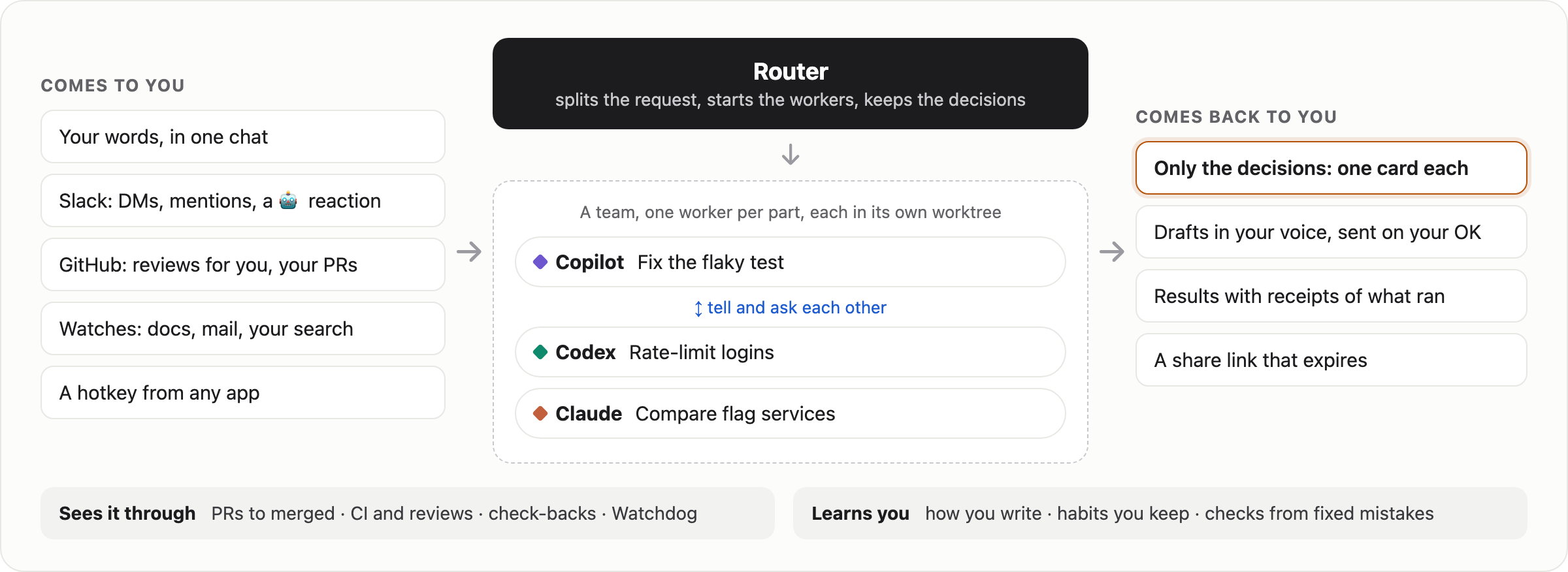
You talk to one session, the Router. It splits your request and starts a worker per part, on
the agent you name for it (or the one Settings picks), each in its own folder and git worktree,
and keeps the decisions.
Every worker is a real session of its agent, driven through that agent's own SDK or app server
(Copilot's show up in copilot --resume). Sessions never message each other unlabeled: Chief of Staff
delivers each message with who sent it, so a Slack message can't pass itself off as you.
A look around
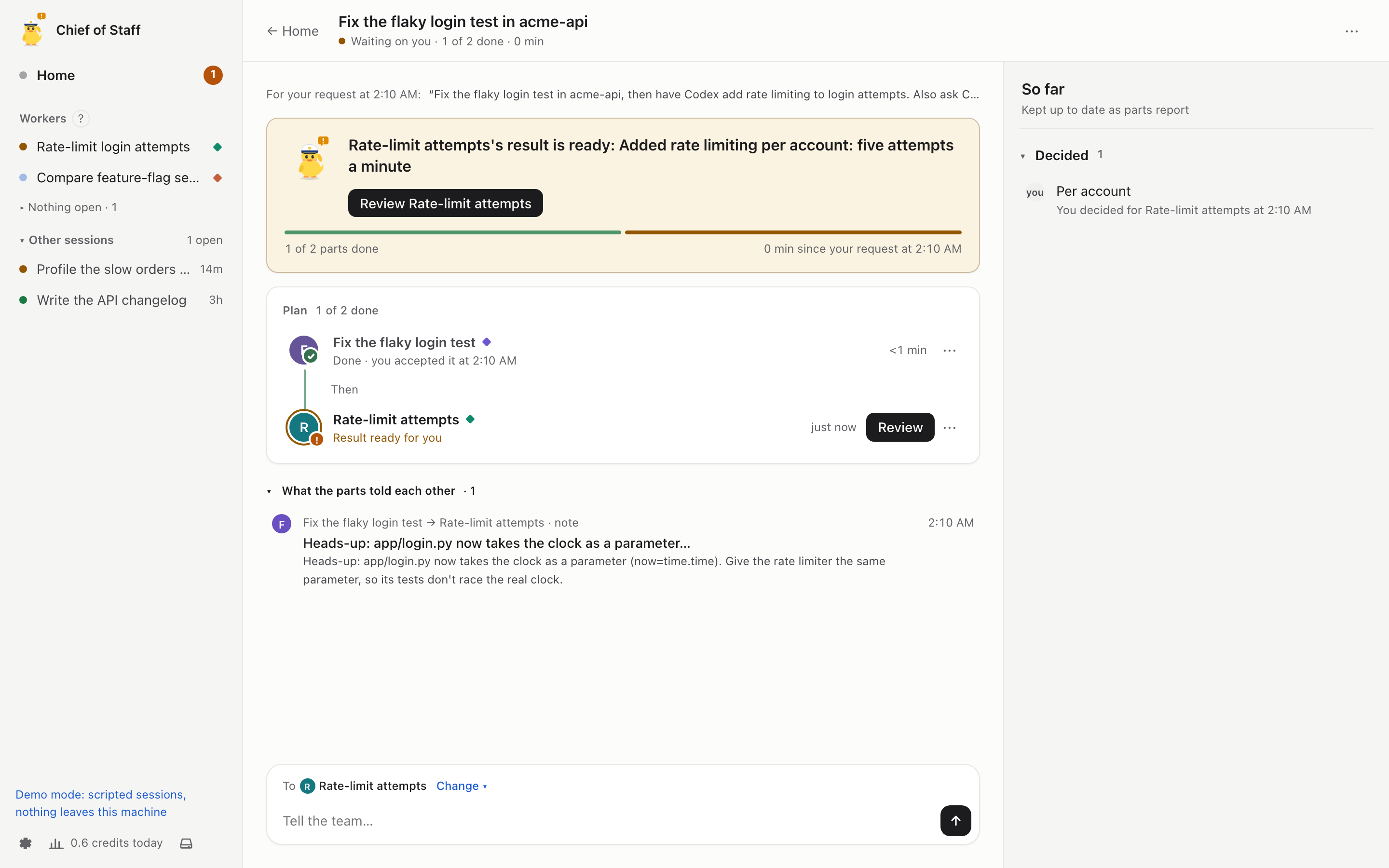 A team's page: the plan, what the parts told each other, what you decided |
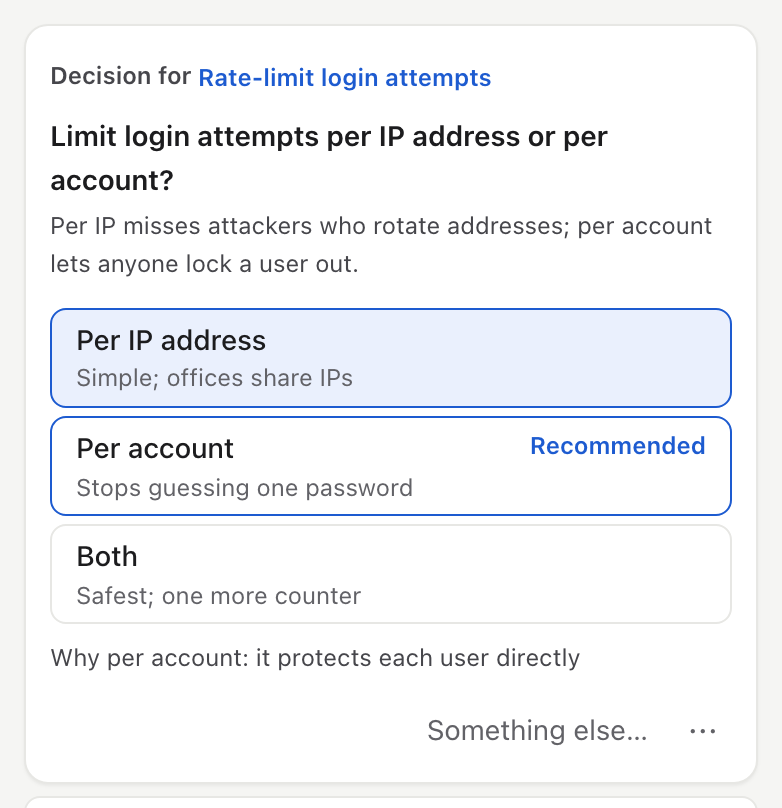 One decision card: options, what each means, a recommendation |
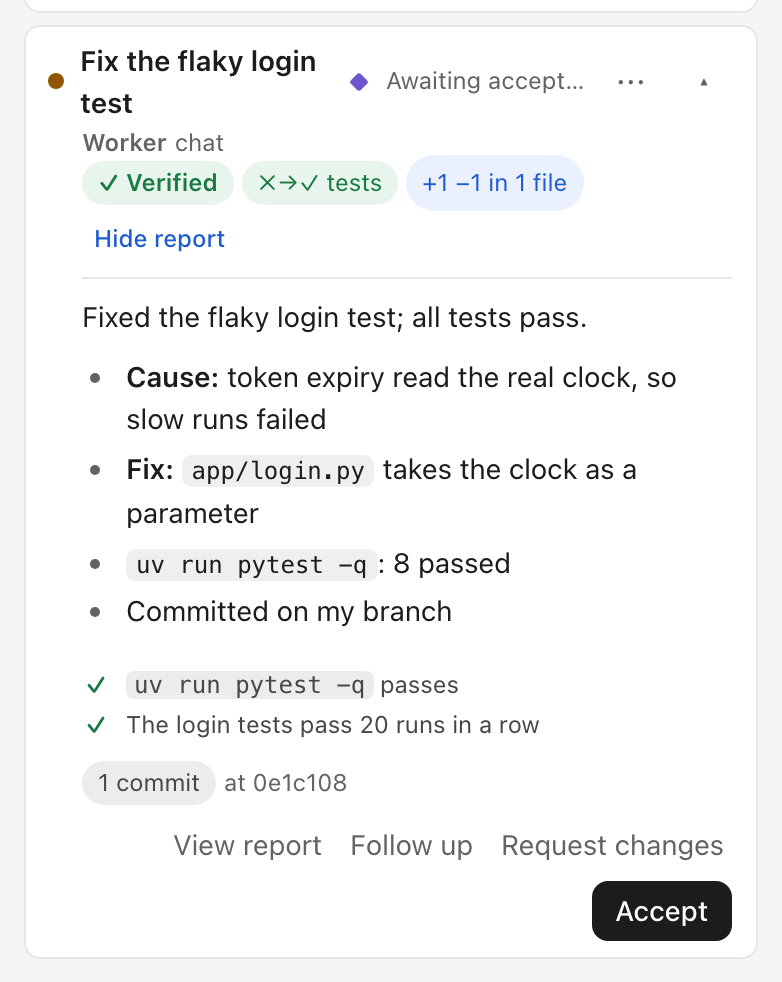 Receipts: verified, the failing test made to pass, the diff, the commit |
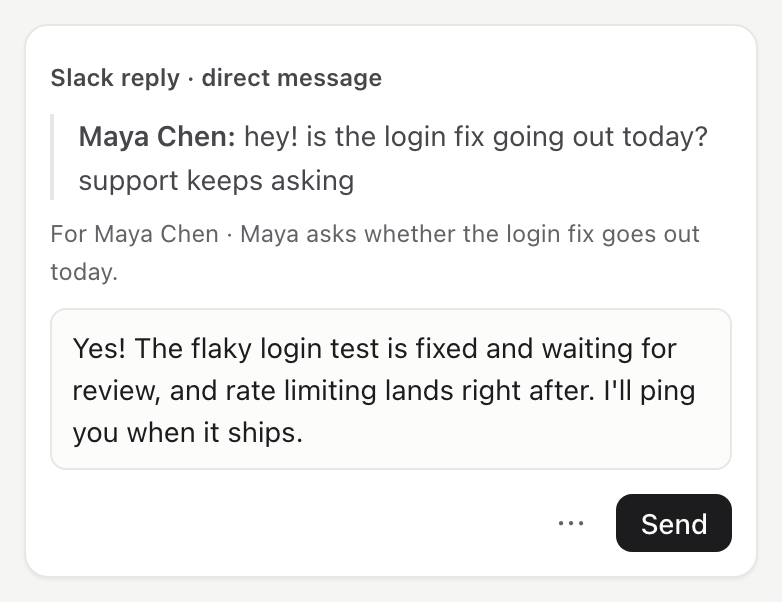 In your voice: a Slack reply drafted, sent on your OK |
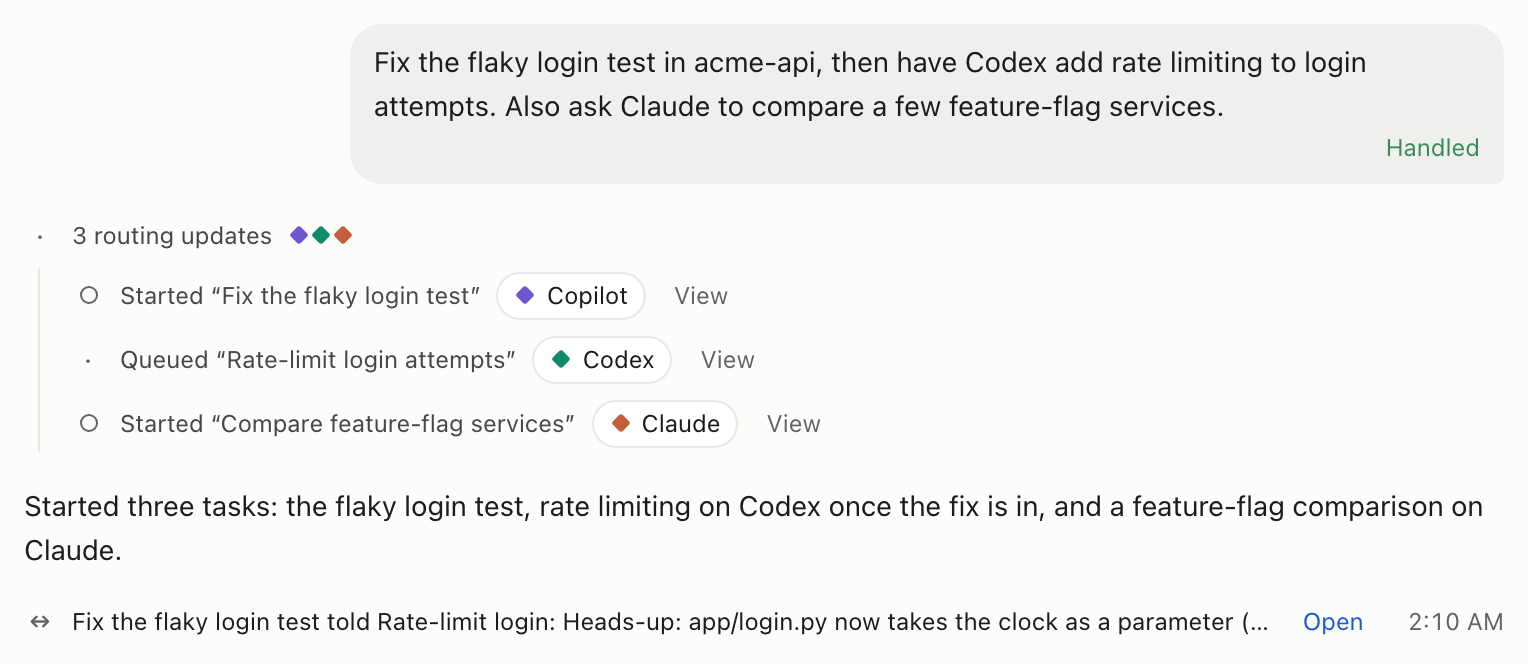 Three agents, one request: and a worker telling another what it changed |
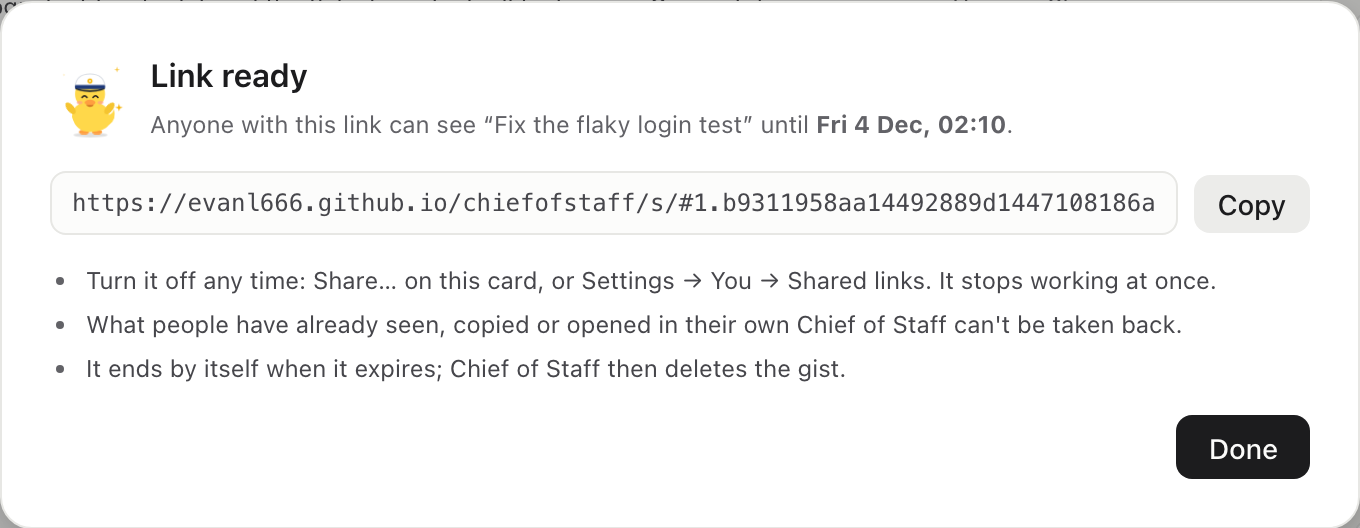 Share in one link: encrypted, and it expires |
Safety and privacy
| On its own | Only with your OK | Never: no worker can, in any mode |
|---|---|---|
| Works in its own folder and git worktree; your checkouts stay untouched | Sends a Slack reply or posts a PR review in your name | Comment on, review, merge or close a PR as you, write to issues, or write anything else through gh |
Runs tests and builds; pushes its own chief/… branches and opens PRs |
Merges a PR (one click on its card) | Push to main or master |
| Reads what you let it: your code, Slack, the tools your agents have | Turns on a check or your profile it learned, or a habit you said fewer than three times | Force-push or delete a branch that isn't its own |
| Asks you instead of guessing | With Ask first on: writes outside its folders, sudo, any force push |
Get your Slack token (no agent ever does) |
Everything runs on your machine; your data stays in your data folder. No account, no telemetry:
your code and prompts go only to the coding agents you use, and it reaches Slack and GitHub with
your own sign-ins. The one call it makes for itself is a once-a-day look at PyPI for a newer
version, which sends nothing about you (and can be turned off). A share link's key lives in the
link itself, never on GitHub. An OS sandbox for workers is one switch in Settings.
SECURITY.md says what the sandbox, Chief of Staff and the model each enforce.
Where it fits
| Great at | What is still on you | |
|---|---|---|
| A terminal coding agent | One task, deep, in your repository | Starting each session, watching it, carrying context, following up |
| A dashboard of parallel agents | Many sessions side by side in worktrees | Watching each one, answering each one, merging |
| An AI editor | Writing code with an agent beside you | Staying in the editor to drive it |
| Chief of Staff | The layer above them: runs your agents as a team and follows the work to done | The decisions |
Install
You need macOS or Linux (Windows is experimental, on Copilot only), Python 3.11+,
uv or pipx, and one coding agent signed
in: the GitHub Copilot CLI, the
Codex CLI or Claude Code.
npm install -g @github/copilot && copilot login   # or: codex login, or: claude auth login
uv tool install chiefofstaff && chiefofstaff       # or: pipx install chiefofstaff
It opens in your browser through a private link printed in the terminal. Tell it where your code
lives (~/workspace, say) and type what you need. Optional: gh auth login for GitHub reviews and
PRs, and a Slack user token in Settings (how). Update with Update and
restart in the sidebar, or uv tool upgrade chiefofstaff.
Learn more
- Guide: quickstart, concepts, daily use, agents, settings, troubleshooting
- Reference: every behavior and setting in detail
- Security · Architecture · Changelog
Does it replace Copilot, Codex or Claude Code? No. It runs them, on your own sign-ins and
plans, and every worker stays a real session of its agent.
What does it cost? Nothing itself. Each agent's work counts against your plan with it: Home
shows the Copilot credits each task used, and Usage every agent's.
Can it post or merge as me? Only when you say so. A reply, a review or a merge happens when
you OK it on its card; no worker can do any of them itself, on any agent. One exception you
choose: reacting 🤖 to a Slack message is your OK for the one reply to that thread.
Do I need all three agents? No. One is enough, any of them. Add more in Settings → Agents &
models, and pick one for a task by typing @codex or @claude.
Is it ready? It is early (0.1) and moving fast: expect rough edges, and please
open an issue when you hit one.
Contributing and license
Issues and ideas are welcome; see CONTRIBUTING.md. MIT licensed. Chief of
Staff is an independent project, not made by or affiliated with GitHub, OpenAI or Anthropic;
product names belong to their owners.
Reviews (0)
Sign in to leave a review.
Leave a reviewNo results found