Audrey
Health Pass
- License — License: MIT
- Description — Repository has a description
- Active repo — Last push 0 days ago
- Community trust — 17 GitHub stars
Code Pass
- Code scan — Scanned 12 files during light audit, no dangerous patterns found
Permissions Pass
- Permissions — No dangerous permissions requested
No AI report is available for this listing yet.
Biological memory architecture for AI agents. Cognitive memory that decays, consolidates, self-validates, and learns from experience.
Audrey


Persistent memory for Claude Code and AI agents. Two commands, every session remembers.
npx audrey install          # 13 MCP memory tools
npx audrey hooks install    # automatic memory in every session
That's it. Claude Code now wakes up knowing what happened yesterday, recalls relevant context per-prompt, and consolidates learnings when the session ends. No cloud, no config files, no infrastructure — one SQLite file.
Audrey also works as a standalone SDK, MCP server, and REST API for any AI agent framework.
On
/dream— Anthropic recently shipped/dreamfor Claude Code memory maintenance. Audrey predates it and goes further: episodic-to-semantic consolidation, contradiction detection, confidence decay, emotional affect, causal reasoning, and source reliability weighting./dreamis a maintenance pass. Audrey is a cognitive memory architecture.
Why Audrey
Most AI memory tools are storage wrappers. They save facts, retrieve facts, and keep everything forever. That leaves real production problems unsolved:
- Old information stays weighted like new information.
- Raw events never become reusable operating knowledge.
- Conflicting facts quietly coexist.
- Model-generated mistakes can get reinforced into false "truth."
Audrey models memory as a working system instead of a filing cabinet.
| Brain Structure | Audrey Component | What It Does |
|---|---|---|
| Hippocampus | Episodic Memory | Fast capture of raw events and observations |
| Neocortex | Semantic Memory | Consolidated principles and patterns |
| Cerebellum | Procedural Memory | Learned workflows and conditional behaviors |
| Sleep Replay | Dream Cycle | Consolidates episodes into principles and applies decay |
| Prefrontal Cortex | Validation Engine | Truth-checking and contradiction detection |
| Amygdala | Affect System | Emotional encoding, arousal-salience coupling, and mood-congruent recall |
What You Get
- Local SQLite-backed memory with
sqlite-vec - MCP server for Claude Code with 13 memory tools
- Claude Code hooks integration — automatic memory in every session (
npx audrey hooks install) - JavaScript SDK for direct application use
- Git-friendly versioning via JSON snapshots (
npx audrey snapshot/restore) - REST API server — any language, any framework (
npx audrey serve) - Health checks via
npx audrey status --json - Benchmark harness with SVG/HTML reports via
npm run bench:memory - Regression gate for benchmark quality via
npm run bench:memory:check - Optional local embeddings and optional hosted LLM providers
- Strongest production fit today in financial services ops and healthcare ops
Install
MCP Server for Claude Code
npx audrey install          # Register 13 MCP memory tools
npx audrey hooks install    # Wire automatic memory into session lifecycle
Audrey auto-detects providers from your environment:
GOOGLE_API_KEYorGEMINI_API_KEY-> Gemini embeddings (3072d)- no embedding key -> local embeddings (384d, MiniLM, offline-capable)
AUDREY_EMBEDDING_PROVIDER=openai-> explicit OpenAI embeddings (1536d)ANTHROPIC_API_KEY-> LLM-powered consolidation, contradiction detection, and reflection
Quick checks:
npx audrey status
npx audrey status --json
npx audrey status --json --fail-on-unhealthy
SDK
npm install audrey
Zero external infrastructure. One SQLite file.
Quick Start
import { Audrey } from 'audrey';

const brain = new Audrey({
  dataDir: './agent-memory',
  agent: 'support-agent',
  embedding: { provider: 'local', dimensions: 384 },
});

await brain.encode({
  content: 'Stripe API returned 429 above 100 req/s',
  source: 'direct-observation',
  tags: ['stripe', 'rate-limit'],
  context: { task: 'debugging', domain: 'payments' },
  affect: { valence: -0.4, arousal: 0.7, label: 'frustration' },
});

const memories = await brain.recall('stripe rate limits', {
  limit: 5,
  context: { task: 'debugging', domain: 'payments' },
});

const dream = await brain.dream();
const briefing = await brain.greeting({ context: 'debugging stripe' });

await brain.waitForIdle();
brain.close();
MCP Tools
Every Claude Code session gets these tools after npx audrey install:
memory_encodememory_recallmemory_consolidatememory_dreammemory_introspectmemory_resolve_truthmemory_exportmemory_importmemory_forgetmemory_decaymemory_statusmemory_reflectmemory_greeting
CLI
# Setup
npx audrey install              # Register MCP server with Claude Code
npx audrey uninstall            # Remove MCP server registration
npx audrey hooks install        # Wire Audrey into Claude Code hooks (automatic memory)
npx audrey hooks uninstall      # Remove Audrey hooks

# Health and monitoring
npx audrey status               # Human-readable health report
npx audrey status --json        # Machine-readable health output
npx audrey status --json --fail-on-unhealthy  # CI gate

# Session lifecycle (used by hooks automatically)
npx audrey greeting             # Load identity, principles, mood
npx audrey greeting "auth"      # With context-aware recall
npx audrey recall "query"       # Semantic memory search (returns hook-compatible JSON)
npx audrey reflect              # Consolidate learnings from stdin conversation + dream

# Maintenance
npx audrey dream                # Full consolidation + decay cycle
npx audrey reembed              # Re-embed all memories after provider/dimension change

# Versioning
npx audrey snapshot             # Export memories to timestamped JSON file
npx audrey snapshot backup.json # Export to specific file
npx audrey restore backup.json  # Restore from snapshot (re-embeds with current provider)
npx audrey restore backup.json --force  # Overwrite existing memories

# REST API server
npx audrey serve                # Start HTTP server on port 3487
npx audrey serve 8080           # Custom port
Hooks Integration
Audrey integrates directly into Claude Code's hook lifecycle for automatic, zero-config memory in every session:
npx audrey hooks install
This configures four hooks in ~/.claude/settings.json:
| Hook Event | Command | What Happens |
|---|---|---|
| SessionStart | npx audrey greeting |
Loads identity, learned principles, current mood, and recent memories |
| UserPromptSubmit | npx audrey recall |
Semantic search on every prompt — injects relevant memories as context |
| Stop | npx audrey reflect |
Extracts lasting learnings from the conversation, then runs a dream cycle |
| PostCompact | npx audrey greeting |
Re-injects critical memories after context window compaction |
With hooks installed, Claude Code sessions automatically wake up with context, recall relevant memories per-prompt, and consolidate learnings when the session ends. No manual tool calls needed.
REST API Server
Turn Audrey into an HTTP service that any language or framework can use:
npx audrey serve           # Start on port 3487
npx audrey serve 8080      # Custom port
AUDREY_API_KEY=secret npx audrey serve  # With Bearer token auth
Endpoints:
| Method | Path | Description |
|---|---|---|
GET |
/health |
Liveness probe |
GET |
/status |
Memory stats (introspect) |
POST |
/encode |
Store a memory ({ content, source, tags?, context?, affect? }) |
POST |
/recall |
Semantic search ({ query, limit?, context? }) |
POST |
/dream |
Full consolidation + decay cycle |
POST |
/consolidate |
Run consolidation only |
POST |
/forget |
Forget by { id } or { query } |
POST |
/snapshot |
Export all memories as JSON |
POST |
/restore |
Wipe and reimport from snapshot |
Example from any language:
# Store a memory
curl -X POST http://localhost:3487/encode \
  -H "Content-Type: application/json" \
  -d '{"content": "The deploy failed due to OOM", "source": "direct-observation"}'

# Search memories
curl -X POST http://localhost:3487/recall \
  -H "Content-Type: application/json" \
  -d '{"query": "deploy failures", "limit": 5}'
Versioning
Audrey stores memories in SQLite with WAL mode, which isn't git-friendly. Instead, use JSON snapshots:
# Save a checkpoint
npx audrey snapshot

# Commit it
git add audrey-snapshot-*.json && git commit -m "memory checkpoint"

# Restore on another machine or after a reset
npx audrey restore audrey-snapshot-2026-03-24_15-30-00.json
Snapshots are human-readable, diffable, and provider-agnostic. Embeddings are re-generated on import, so you can switch providers (e.g., local to Gemini) and restore seamlessly.
Production Fit
Audrey is strongest today in workflows where memory must stay local, reviewable, and durable:
- Financial services operations: payments ops, fraud and dispute workflows, KYC/KYB review, internal policy assistants
- Healthcare operations: care coordination, prior-auth workflows, intake and referral routing, internal staff knowledge assistants
Audrey is a memory layer, not a compliance boundary. For regulated environments, pair it with application-level access control, encryption, retention, audit logging, and data-minimization rules.
Production guide: docs/production-readiness.md
Industry demos:
Core Concepts
Memory Types
- Episodic: raw events and observations
- Semantic: consolidated principles
- Procedural: reusable workflows and actions
- Causal: relationships that explain why something happened
Confidence
Audrey scores memories using source reliability, evidence agreement, recency decay, and retrieval reinforcement. That helps keep direct observations above guesses and keeps stale or weakly supported knowledge from dominating recall.
Dream Cycle
brain.dream() runs the full maintenance path:
- Consolidate related episodes into principles.
- Apply decay so low-value memories lose weight over time.
- Report memory health and current stats.
Contradiction Handling
When evidence conflicts, Audrey tracks the contradiction instead of silently picking a winner. Resolutions can stay open, be marked resolved, or become context-dependent.
Configuration
const brain = new Audrey({
  dataDir: './audrey-data',
  agent: 'my-agent',
  embedding: {
    provider: 'local', // mock | local | gemini | openai
    dimensions: 384,
    device: 'gpu',
  },
  llm: {
    provider: 'anthropic', // mock | anthropic | openai
    apiKey: process.env.ANTHROPIC_API_KEY,
  },
  consolidation: {
    minEpisodes: 3,
  },
  context: {
    enabled: true,
    weight: 0.3,
  },
  affect: {
    enabled: true,
    weight: 0.2,
  },
  decay: {
    dormantThreshold: 0.1,
  },
});
Operations
Recommended production workflow:
# Health checks
npx audrey status
npx audrey status --json --fail-on-unhealthy

# Scheduled maintenance
npx audrey dream

# Repair vector/index drift after provider or dimension changes
npx audrey reembed

# Version control your memories
npx audrey snapshot
npx audrey restore <file> --force

# Run the benchmark harness
npm run bench:memory

# Fail CI if Audrey drops below benchmark guardrails
npm run bench:memory:check
Benchmarking
Audrey now ships with a memory benchmark harness built for two purposes:
- measure Audrey against naive local baselines on LongMemEval-style memory abilities plus privacy and abstention checks
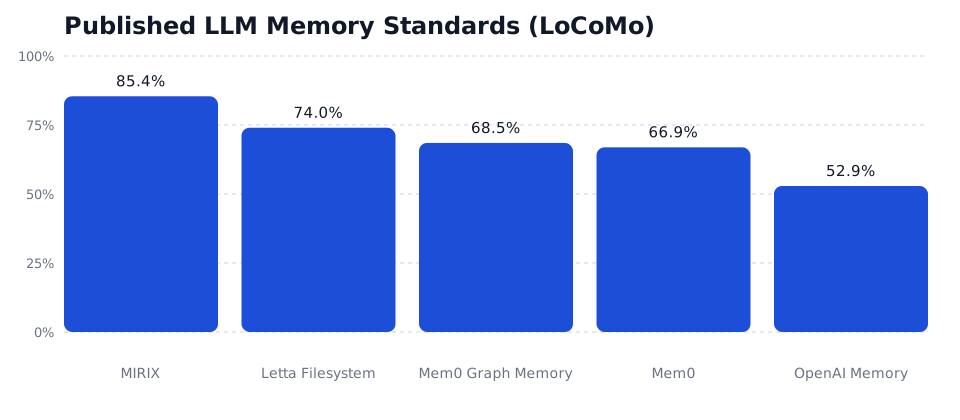
- keep Audrey grounded against published LoCoMo results from leading memory systems
Run it with:
npm run bench:memory
Artifacts land in benchmarks/output/ as JSON, SVG charts, and an HTML report.
For CI and release gates:
npm run bench:memory:check
That command fails if Audrey drops below its minimum local score, local pass rate, or required margin over the strongest naive baseline.
For committed GitHub-friendly charts:
npm run bench:memory:readme-assets
README Snapshot
Local Audrey-vs-baseline results:
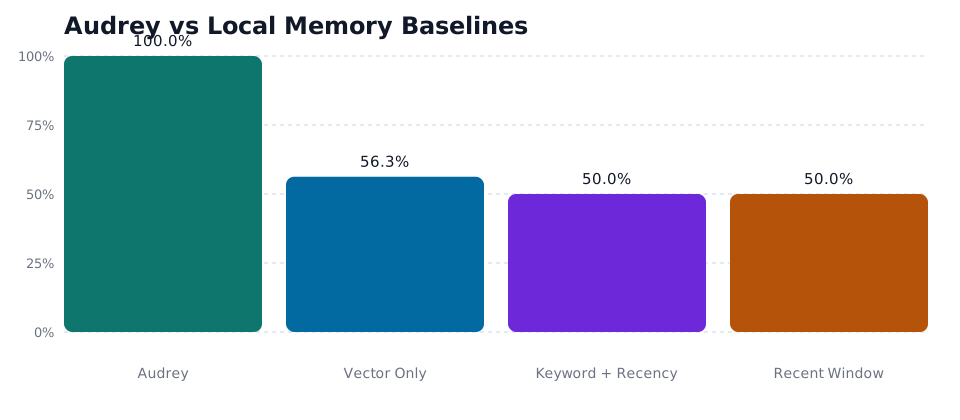
Published comparison anchors from current LLM memory systems:
Audrey 93.8% with local MiniLM embeddings (384d, offline-capable). Per-category breakdown:
| Category | Audrey | Vector Only | Best Baseline |
|---|---|---|---|
| Information Extraction | 100% | 100% | 100% |
| Knowledge Updates | 100% | 0% | 50% |
| Multi-Session Reasoning | 100% | 100% | 100% |
| Temporal Reasoning | 100% | 100% | 100% |
| Abstention | 50% | 50% | 50% |
| Privacy | 100% | 0% | 0% |
Published comparison anchors from the field (different benchmarks and conditions — included for field context, not direct comparison):
| System | Benchmark | Score | What it represents |
|---|---|---|---|
| Audrey | Internal LongMemEval-style | 93.8% | Consolidation, contradiction, abstention, privacy |
| MIRIX | Published LoCoMo | 85.4% | Typed multimodal memory |
| Letta Filesystem | Published LoCoMo | 74.0% | Context-engineering |
| Mem0 Graph Memory | Published LoCoMo | 68.5% | Graph memory |
| Mem0 | Published LoCoMo | 66.9% | Production baseline |
Primary comparison sources:
Benchmark guide: docs/benchmarking.md
Repository
- Contributing guide: CONTRIBUTING.md
- Security policy: SECURITY.md
- CI workflow: .github/workflows/ci.yml
- Benchmarking guide: docs/benchmarking.md
Development
npm ci
npm test
npm run pack:check
npm run bench:memory
npm run bench:memory:check
npm run bench:memory:readme-assets
Current validated baseline:
npm testnpm run pack:checknpm run bench:memorynpm run bench:memory:checknpm run bench:memory:readme-assets
License
MIT. See LICENSE.
Reviews (0)
Sign in to leave a review.
Leave a reviewNo results found