EvoSkills
Health Pass
- License — License: Apache-2.0
- Description — Repository has a description
- Active repo — Last push 1 days ago
- Community trust — 125 GitHub stars
Code Pass
- Code scan — Scanned 12 files during light audit, no dangerous patterns found
Permissions Pass
- Permissions — No dangerous permissions requested
No AI report is available for this listing yet.
🧬 Extend EvoScientist with Installable Skill & Knowledge Packs
🧬 EvoSkills
The official skill repository for EvoScientist. Each skill is an installable knowledge pack that extends EvoScientist with domain-specific expertise.
📦 Installation
[!IMPORTANT]
These skills are purpose-built for EvoScientist — together they amplify each other, unlocking the full potential of both the agent and the skills. Under EvoScientist, skills evolve across research cycles through persistent memory (evo-memory).
In-session commands
Install all skills at once:
/install-skill EvoScientist/EvoSkills@skills
Or install a single skill:
/install-skill EvoScientist/EvoSkills@skills/paper-planning
Ask EvoScientist directly
Simply ask the agent in conversation:
"Install all skills from EvoScientist/EvoSkills@skills."
[!TIP]
Not using EvoScientist? These skills are compatible with any coding agent.
One command via skills.sh to install on Claude Code, OpenCode, Cursor, Codex, Gemini CLI, DeepAgents, and more:npx skills add EvoScientist/EvoSkills
✨ Available Skills
| Skill | Description |
|---|---|
research-ideation |
💡 Research ideation, literature tree & problem finding |
idea-tournament |
🏆 Competitive idea ranking & proposal generation |
paper-planning |
📐 Research paper planning & outline generation |
experiment-pipeline |
🧪 Structured 4-stage experiment execution |
experiment-craft |
🔧 Experiment debugging, logging & iteration |
experiment-iterative-coder |
🔄 Iterative code refinement (plan → code → evaluate → refine) |
paper-writing |
✍️ End-to-end paper writing assistance |
paper-review |
🔍 Automated paper review & feedback |
paper-rebuttal |
💬 Rebuttal writing after peer review |
academic-slides |
🎤 Academic presentation & research talk creation |
evo-memory |
🧠 Persistent research memory & self-evolution |
paper-navigator |
📚 End-to-end academic paper discovery, reading & organization |
nano-banana |
🍌 AI-generated presentation slides & illustrations via Gemini |
Paper Suite + Self-Evolution Suite: Each skill is self-contained — use them individually or combine freely. The self-evolution skills (
idea-tournament,experiment-pipeline,evo-memory) form a learning loop that improves across research cycles.
🔌 MCP Server Marketplace
The mcp/ directory contains a curated collection of MCP servers that extend agents with external tools — web search, academic paper retrieval, documentation lookup, and more. Browse the full list or install directly:
/install-mcp              # interactive browser
EvoSci mcp install arxiv  # install by name
⛳️ Framework Overview
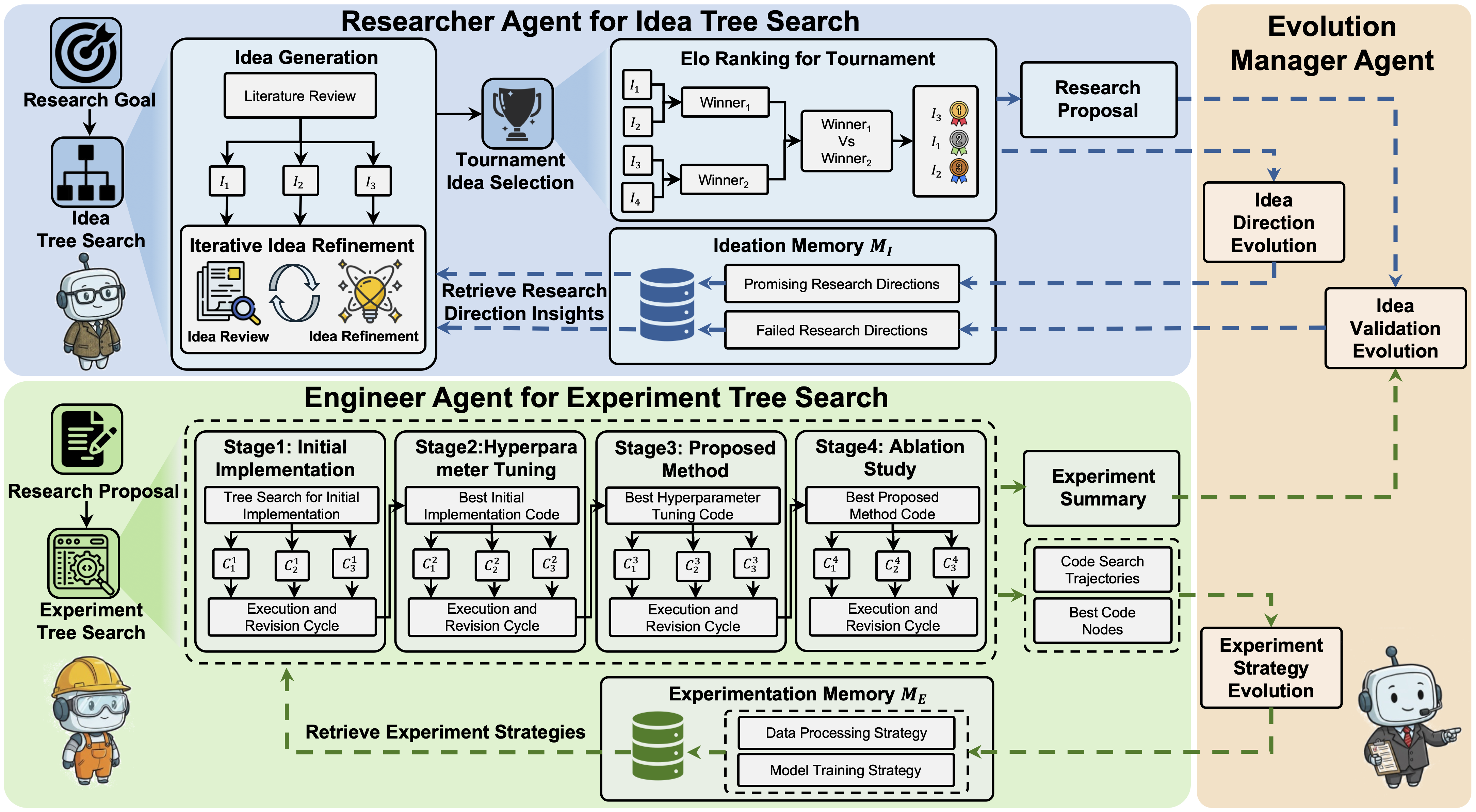
The diagram above shows the full EvoScientist pipeline. The Researcher Agent (top, blue) runs idea tree search and Elo tournament ranking to produce a research proposal. The Engineer Agent (bottom, green) executes the 4-stage experiment pipeline. The Evolution Manager Agent (right) manages three memory evolution mechanisms — IDE, IVE, and ESE — that feed learned knowledge back into Ideation Memory (M_I) and Experimentation Memory (M_E) for future cycles.
🎢 Skill Pipeline
flowchart LR
    A["<b>🔬 Research Phase</b><br/>💡 research-ideation<br/>🏆 idea-tournament"]
    --> B["<b>⚙️ Experiment Phase</b><br/>📐 paper-planning<br/>🧪 experiment-pipeline<br/>🔧 experiment-craft<br/>🔄 experiment-iterative-coder"]
    --> C["<b>📝 Writing Phase</b><br/>✍️ paper-writing<br/>🔍 paper-review<br/>💬 paper-rebuttal<br/>🎤 academic-slides"]

    D[("🧠 evo-memory<br/>(IDE · IVE · ESE)")] <--> A
    D <--> B
    E["📚 paper-navigator<br/>(standalone)"] -.-> A
    E -.-> B
    F["🍌 nano-banana<br/>(standalone)"] -.-> C

    style A fill:#7C3AED,stroke:#5B21B6,stroke-width:2px,color:#fff
    style B fill:#D97706,stroke:#B45309,stroke-width:2px,color:#fff
    style C fill:#16A34A,stroke:#15803D,stroke-width:2px,color:#fff
    style D fill:#475569,stroke:#334155,stroke-width:2px,color:#fff
    style E fill:#0369A1,stroke:#075985,stroke-width:2px,color:#fff
    style F fill:#D97706,stroke:#B45309,stroke-width:2px,color:#fff
💡 research-ideation — Literature Tree & Problem Finding
The starting point of the research pipeline. Guides ideation from literature analysis to solution design:
- Literature Tree — Build a novelty tree and challenge-insight tree to map the research landscape
- Problem Selection — 4-level well-established solution check to identify open problems worth pursuing
- Solution Design — Cross-domain transfer and problem decomposition strategies
- Paper Reading — 3-level structured Q&A methodology for deep comprehension
- Counterintuitive Rules — Problem selection matters more than solution design; pursue new failure cases rather than incremental improvements
🏆 idea-tournament — Competitive Idea Ranking & Proposal Generation
Bridges the gap between having a research direction and having a concrete, validated proposal:
- Tree-Structured Generation — Expand a seed idea into up to N_I=21 candidates by varying technique, domain, and formulation axes
- Elo Tournament — Pairwise comparisons on 4 dimensions (novelty, feasibility, relevance, clarity) with Swiss-system pairing
- Direction Summarization — Synthesize top-3 ideas into promising directions for evo-memory
- Proposal Extension — Extend the winning idea into a full research proposal (5 sections from paper + 1 practical extension)
- Counterintuitive Rules — Quantity before quality; the tournament finds surprises; top-3 not top-1
📐 paper-planning — Research Paper Planning & Outline Generation
Guides pre-writing planning before a single word is drafted. Covers four key activities:
- Story Design — Reverse-engineer the narrative: task → challenge → insight → contribution → advantage
- Experiment Planning — Plan comparisons, ablations, and demo scenarios with structured checklists
- Figure Design — Pipeline figures that highlight novelty; teaser figures that hook reviewers
- Timeline Management — 4-week countdown schedule from outline to submission
Includes counterintuitive tactics: write your rejection letter first, narrow claims before broadening, and plan fallback narratives.
🧪 experiment-pipeline — 4-Stage Experiment Execution
A structured framework for executing research experiments with attempt budgets and gate conditions:
- Stage 1: Initial Implementation — Get baseline code running and reproduce known results (≤20 attempts)
- Stage 2: Hyperparameter Tuning — Optimize configuration for your setup (≤12 attempts)
- Stage 3: Proposed Method — Implement and validate the novel method (≤12 attempts)
- Stage 4: Ablation Study — Prove each component's contribution (≤18 attempts)
- Code Trajectory Logging — Structured attempt logging that feeds into
evo-memory - Counterintuitive Rules — Initial implementation is not wasted time; budget limits prevent rabbit holes; failed attempts are data
Integrates with experiment-craft for failure diagnosis within stages and evo-memory for cross-cycle learning.
🔧 experiment-craft — Experiment Debugging & Iteration
A systematic approach to experiment debugging, logging, and iterative improvement:
- 5-Step Diagnostic Flow — Collect failures → find a working version → bridge the gap → hypothesize → fix
- Counterintuitive Rules — Change one variable at a time; effective experiments beat more experiments
- Experiment Logging — 5-section structured log template for reproducible records
- Handoff to Paper-Writing — Feed validated results and logs into
paper-writingfor drafting
🔄 experiment-iterative-coder — Iterative Code Refinement
Structured plan → code → evaluate → refine cycles for higher code quality:
- Phase Decomposition — Break complex tasks into 1-5 sequential phases
- Iteration Loop — Up to 3 iterations per phase (10 total): plan, code, run lint/tests, score, decide
- Objective Evaluation — ruff lint + pytest with dynamic score weighting and hard caps
- Failure Mode Guidance — Targeted responses for timeout, syntax, import, test, and lint failures
Integrates with experiment-craft for stuck diagnoses and evo-memory for loading prior strategies.
✍️ paper-writing — Section-by-Section Paper Drafting
A proven 11-step workflow for writing academic papers with LaTeX templates:
- Structured Process — From pipeline sketch → story design → Method → Experiments → Related Work → Abstract → Title
- Section Templates — Three Abstract templates, four Introduction openers, Method module structure, Experiments organization
- LaTeX Assets — Annotated paper skeleton (
paper-skeleton.tex) and booktabs table macros (table-style.tex) - Writing Principles — One message per paragraph, topic sentence first, terminology consistency, reverse-outlining
- Counterintuitive Tactics — Underclaim in prose / overdeliver in evidence; lead with mechanism, not just metrics
🔍 paper-review — Self-Review & Quality Assurance
Systematic self-review before submission using adversarial and counterintuitive review strategies:
- 5-Aspect Checklist — Contribution sufficiency, writing clarity, results quality, testing completeness, method design
- Reverse-Outlining — Extract the outline from finished paragraphs to verify logical flow
- Figure & Table Quality Checks — Captions, resolution, booktabs, color-blind friendliness
- Rejection Simulation — Force a reject summary first; attack your own novelty claim
- Handoff to Rebuttal — After review, feed identified weaknesses into
paper-rebuttalfor response preparation
💬 paper-rebuttal — Rebuttal Writing After Peer Review
Dedicated rebuttal skill for responding to reviewer feedback after peer review:
- Score Diagnosis — Color-code every reviewer comment: red (critical), orange (important), gray (minor), green (positive)
- Champion Strategy — Arm your most positive reviewer with evidence for the Area Chair discussion
- Tactical Writing — 18 rules for structure, content, and tone in rebuttal responses
- Counterintuitive Principles — Submit even with extreme scores; concede small points to win the big argument
- Common Concerns — Response strategies for 12 frequently raised reviewer complaints
🎤 academic-slides — Presentation & Research Talk Creation
A structured approach to creating academic presentations and preparing research talks:
- Narrative Arc — Define scope, audience, and key takeaway before touching slides
- Slide Design — 10 design rules, visual hierarchy, one idea per slide, claim-style titles
- Practical Creation —
.pptxfile generation with color palettes, layout code, charts, and figures - Delivery & Q&A — Rehearsal protocol, timing, and backup slide preparation
- Counterintuitive Rules — Slides are not your paper; enthusiasm beats polish; related work builds motivation, not citation counts
🧠 evo-memory — Persistent Research Memory & Self-Evolution
The learning layer that accumulates knowledge across research cycles. Maintains two memory stores and implements three evolution mechanisms:
- Ideation Memory (M_I) — Tracks feasible and unsuccessful research directions across idea tournaments
- Experimentation Memory (M_E) — Stores reusable data processing and model training strategies (paper core), plus architecture and debugging (extensions)
- IDE (Idea Direction Evolution) — Extracts promising directions after idea tournaments
- IVE (Idea Validation Evolution) — Classifies experiment failures as implementation vs fundamental direction failures
- ESE (Experiment Strategy Evolution) — Distills reusable patterns from successful experiment pipelines
Read by idea-tournament and experiment-pipeline at cycle start; updated after each cycle completes.
📚 paper-navigator — Academic Paper Discovery & Reading
End-to-end paper workflow in five stages — from query to organized literature map:
- Disambiguate — Analyze user intent, resolve ambiguous terms (project names, module names) to actual paper titles
- Discover — 7 discovery paths: keyword search, citation traversal, recommendations, author tracking, arXiv monitoring, trending detection, GitHub search
- Evaluate — Quick assessment via TLDR, citations, code availability (HuggingFace + GitHub), and top models by task
- Read — Full-text retrieval via Jina Reader with 3-level reading strategy (Technical, Analytical, Contextual)
- Organize — Build novelty trees, challenge-insight trees, and generate structured literature reports (survey, quick scan, deep dive, baseline hunt)
Includes 12 Python scripts powered by Semantic Scholar, HuggingFace, GitHub, arXiv, and Jina Reader APIs.
🍌 nano-banana — AI-Generated Slides & Illustrations
Generate professional presentation slides and high-quality illustrations using Gemini's image generation API, with an interactive browser-based review loop:
- 7-Phase Workflow — Content planning conversation → slides_plan.json → style selection & batch generation → browser review → feedback editing → PPTX packaging → cleanup
- 3 Visual Styles — Lineal Color (flat icons, educational), Gradient Glass (glassmorphism, premium), Vector Illustration (retro, approachable)
- Interactive Review — Local HTTP server with per-slide feedback; edits are applied without regenerating the entire deck
- Multi-Model Support —
gemini-3-pro-image-preview(best quality),gemini-3.1-flash-image-preview(fast iteration),gemini-2.5-flash-image(rapid prototyping) - Counterintuitive Rules — More planning = better slides; edit don't regenerate; never read generated images yourself (use the review server)
🎯 ᯓ➤ Roadmap
Completed:
- 🧠 Self-Evolution Suite —
idea-tournament,experiment-pipeline,evo-memory - 📚 Literature Survey — Systematic literature search, filtering, and survey generation
- 🔄 Iterative Coder — Iterative code refinement with plan → code → evaluate → refine cycles
- 🎨 Visual Generation — AI-generated slides & illustrations (
nano-banana)
Coming soon:
- 🏅 Math Olympiad — Advanced mathematical reasoning & problem solving
- 🔬 Paper Reproduction — Read a paper, reproduce its core results, and verify claims
- 💡 Grant & Proposal Writing — Research proposal drafting with funding agency conventions
- 🤖 Peer Debate — Multi-agent adversarial discussion to stress-test research ideas
- 📈 Trend Radar — Analyze publication trends, identify emerging topics & research gaps
- 🗣️ Paper QA — Interactive question-answering over paper collections, extracting key findings & cross-referencing claims
Stay tuned — more skills are on the way!
🌍 Project Roles

EvoScientist |

Xi Zhang |

Yougang Lyu |

Dinos Papakostas |
Yuyue Zhao |
Xiaoyi DeepResearch Team and the wider open-source community contribute to this project.
For any enquiries or collaboration opportunities, please contact: [email protected]
🤝 Contributing
We welcome contributions! See the guides for skills and MCP servers, or start with the Contributing Guidelines.
Every contribution brings us one step closer to a future where AI accelerates scientific breakthroughs for all of humanity.
📈 Star History
📝 Citation
If you find our paper and code useful in your research and applications, please cite using this BibTeX:
@article{evoscientist2026,
  title={EvoScientist: Towards Multi-Agent Evolving AI Scientists for End-to-End Scientific Discovery},
  author={Yougang Lyu and Xi Zhang and Xinhao Yi and Yuyue Zhao and Shuyu Guo and Wenxiang Hu and Jan Piotrowski and Jakub Kaliski and Jacopo Urbani and Zaiqiao Meng and Lun Zhou and Xiaohui Yan},
  journal={arXiv preprint arXiv:2603.08127},
  year={2026}
}
📜 License
This project is licensed under the Apache License 2.0 - see the LICENSE file for details.
Reviews (0)
Sign in to leave a review.
Leave a reviewNo results found