Fleck
Health Uyari
- License — License: MPL-2.0
- Description — Repository has a description
- Active repo — Last push 0 days ago
- Low visibility — Only 5 GitHub stars
Code Basarisiz
- rm -rf — Recursive force deletion command in Scripts/build-fleck-app.sh
- rm -rf — Recursive force deletion command in Scripts/check-candidate-release-rejected.sh
Permissions Gecti
- Permissions — No dangerous permissions requested
Bu listing icin henuz AI raporu yok.
Native, local-first macOS notes with on-device dictation and permissioned local agent access. Source developer preview.
Fleck
A native, local-first macOS notes workspace for quick capture, focused editing, on-device dictation, and explicitly granted local agent access.




Download & launch · Features · Build & test · Architecture · Testing · Contributing · Security
Download and launch Fleck
No public app download yet. Fleck is currently a source preview. There is
no published app ZIP or GitHub Release to download and launch. GitHub's
Code → Download ZIP downloads source code, not an installable Mac app.
Check GitHub Releases for
published app builds. Until the first binary release is published there, no
public "newest build" is available. Local development candidates and GitHub
Actions artifacts are not supported public releases.
Installing a future app release
These steps apply only after an app ZIP is published on GitHub Releases.
- Open GitHub Releases and
choose the newest published app release. Read its supported macOS versions,
Mac architecture, known limitations, and upgrade notes. A Pre-release
label means it is a preview, not a stable release. - Under that release's Assets, download the Fleck app ZIP for your Mac
and its checksum file. Do not choose Source code (zip) or
Source code (tar.gz); neither contains a ready-to-run app. Verify the
ZIP against the release's SHA-256 checksum before opening it. - Double-click the ZIP in Finder to extract it, then drag
Fleck <version> Build <number>.appinto Applications, keeping its
versioned name. - Open Applications and double-click that Fleck app. Follow the release's
first-launch instructions. If macOS blocks it, check the release's signing
and notarization notes rather than disabling Gatekeeper or removing
quarantine protection. - Look for Fleck in the macOS menu bar and click its icon to open the
workspace. Fleck is a menu-bar app, so do not rely on a Dock icon to find it.
A prebuilt app does not require Xcode, Swift, or Terminal build commands.
For the current source-only preview, developers can instead
get the source and build and test.
Packaged development apps require the maintainer's private build registry;
those commands are not an end-user installer.
Fleck is under active development. VERSION is the source-version
authority; beta storage formats and contributor-facing interfaces may change.
See the
release policy and binary-distribution checklist for the
remaining release gates.
What is here
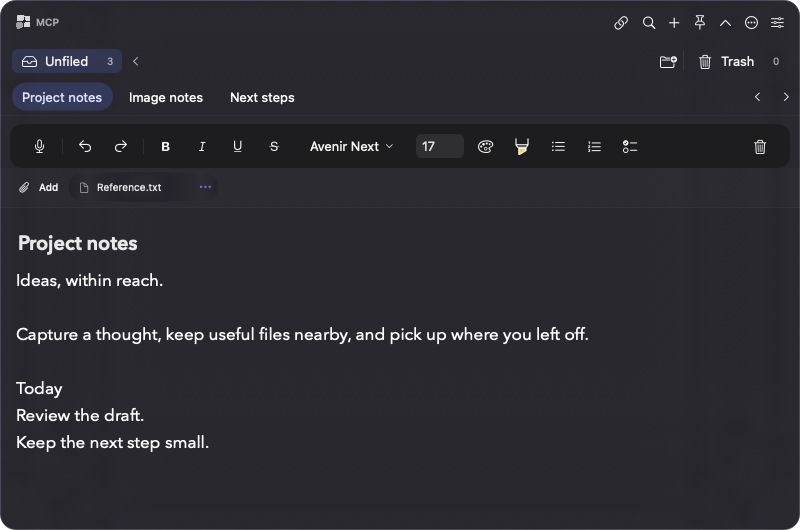
Development build 1.0.13-beta.1 Build 58 with synthetic notes and a synthetic file shortcut.
The ordinary build contains:
| Area | Current implementation |
|---|---|
| Native workspace | Menu-bar workspace and an independently sized pinned window. |
| Notes and organization | Local notes, tabs, folders, search, backlinks, 30-day Trash, recovery, text/Markdown import, and plain-text/Markdown/RTF export. |
| File shortcuts | A native single-file chooser adds local file references; compact rows can open, reveal, relink, or remove them. Shortcuts stay on this Mac and are not included in note exports. |
| Native editor | An AppKit NSTextView editor with native undo, formatting, lists, checklists, and inline display of image files pasted or dropped from Finder. |
| On-device dictation | Apple on-device speech recognition, optional faithful local cleanup, and Inbox-safe Smart Capture routing. |
| Agent Connector | A separately packaged local helper with profile-scoped capabilities, explicit note or folder grants, visible activity, revision checks, and Undo. |
| Local persistence | Readable local storage with atomic replacement and a previous-generation recovery snapshot. |
Inline image import accepts image file URLs, such as files copied or dragged
from Finder; it does not import raw PNG or TIFF bitmap clipboard payloads.
Fleck copies valid images of up to 100 MiB and 100 million pixels into its local
image library, keeps the imported original bytes across editor undo and redo,
and automatically fits the displayed image proportionally to the available
editor width with a 320-point height cap. Notes, RTF state, exports, and agent
text retain absolute local-file Markdown references, so image content is not a
portable or self-contained export.
On macOS 26, Fleck can use Apple's on-device Foundation Models when the system
reports them available. Failure or ambiguity falls back to the original text or
Inbox rather than inventing a destination.
The Enhanced Local dependency graph is different. It is opt-in, debug-only
experimental work behind FLECK_ENHANCED_CANDIDATE=1, with candidate Parakeet
speech and Gemma cleanup/routing paths. It is not part of the ordinary release
graph and is not approved for distribution.
See Implementation status for the short current
roadmap and Architecture for the system boundaries.
Requirements
These are source-development requirements. For a future prebuilt app, use
the macOS and architecture requirements listed on its release page instead.
| Requirement | Version or scope |
|---|---|
| macOS | 14 as the declared minimum deployment target. |
| Xcode | 26 or later, with the full macOS 26 SDK selected. |
| Swift | 6. |
The deployment target is not a completed compatibility matrix. Current local
validation is on Apple silicon; native Intel compatibility and a full macOS 14
native pass have not been verified. Source tests and offscreen component
captures do not establish live-app or VoiceOver behavior.
The standalone Command Line Tools are not enough for this source tree. Check the
active toolchain without building:
xcodebuild -version
xcrun --sdk macosx --show-sdk-version
swift --version
Get the source
Fork the repository on GitHub, then clone your fork:
git clone https://github.com/YOUR-USER/fleck.git
cd fleck
git remote add upstream https://github.com/exterminatorrat/fleck.git
If you only want to inspect or test the canonical source, clone the upstream URL
directly instead.
Build and test
Run the ordinary Swift package tests from the repository root:
unset FLECK_ENHANCED_CANDIDATE
Scripts/run-nonempty-swift-tests.sh '^.+$'
The test runner does not launch the product Fleck.app, but its synthetic
AppKit host may create fixture windows and change focus. Run native fixtures in
a disposable macOS test account or session with synthetic content.
Maintainer handoff packaging requires a clean committed source tree and the
project's private accepted-build registry. It builds the development-signed app
bundle without launching it:
mkdir -p .build
RESULT_DIR="$(mktemp -d "$PWD/.build/development-result.XXXXXX")"
RESULT_FILE="$RESULT_DIR/build-result.json"
Scripts/build-fleck-app.sh --result-file "$RESULT_FILE"
FLECK_APP="$(Scripts/fleck-build-identity.py read-result \
  --repo "$PWD" \
  --result-file "$RESULT_FILE" \
  --flavor development)"
printf 'Built %s\n' "$FLECK_APP"
Interactive native testing is a separate, explicit step:
/usr/bin/open -n "$FLECK_APP"
Every packaging invocation allocates an immutableFleck <version> Build <number> app name. A requested result file appears only
after the app is published and verified, so consumers use that exact path
instead of guessing a newest artifact or replacing an earlier build.
Hosted CI uses the explicit ci-unverified mode for non-handoff packaging;
contributors without the private registry must not bypass the local checks or
describe a CI artifact as accepted.
Opening Fleck creates local Application Support data and may request macOS
permissions. Use a disposable macOS test account and synthetic fixtures, never
personal notes or recordings. The full commands and manual checks are in
Testing.
Repository map
| Path | Responsibility |
|---|---|
Sources/FleckCore/ |
Local models, mutations, persistence, and recovery. |
Sources/FleckAgentProtocol/ |
Typed local IPC protocol and framing. |
Sources/FleckApp/ |
Native macOS UI, editor, dictation, and IPC service. |
Sources/FleckAgentBridge/ |
MCP/CLI helper and Unix-socket client. |
Sources/FleckModelEvaluation/ |
Deterministic local-model evaluation support. |
Sources/FleckCaptureLab/ |
Developer capture tooling. |
Tests/ |
Swift tests and privacy-safe fixtures. |
Scripts/ |
Build, validation, audit, and profiling entry points. |
Packages/ |
Enhanced candidate dependency package. |
Project principles
Fleck keeps the frequent path small and native. Prefer Apple frameworks and the
standard text system over embedded web views or replacement controls; avoid
background services and dependencies without a demonstrated need; keep notes
local by default; and preserve keyboard access, VoiceOver semantics, Reduce
Motion, contrast, and resource efficiency as features evolve.
Contributing
Public issues and pull requests are open for ordinary bugs, feature proposals,
and focused contributions. Start with Contributing,
Testing, and the Code of Conduct.
Keep sensitive reports out of public issues and pull requests. Security
vulnerabilities use the private route in Security; conduct
reports go privately to Harry. The owner
confirmed that a conduct test email and a private security-report notification
were visible to their intended recipients. Those delivery checks do not promise
a response or resolution timeline.
License and name
Fleck-owned source and documentation in the current tree are licensed under the
Mozilla Public License 2.0, subject to the boundaries in
NOTICE, Branding, and
Third-party notices. Earlier revisions remain subject
to the license notices and terms accompanying those revisions. No contributor
license agreement is required. The Fleck name, logo, and other brand assets are
reserved separately; the source license does not grant trademark rights.
Reviewed ordinary Swift code dependencies use MIT and/or Apache-2.0 terms;
documentation and candidate assets may carry additional terms. Exact pins and
attributions are recorded in the package lockfiles andThirdPartyNotices.md.
Yorumlar (0)
Yorum birakmak icin giris yap.
Yorum birakSonuc bulunamadi