Chaty
Health Uyari
- License — License: MIT
- Description — Repository has a description
- Active repo — Last push 0 days ago
- Low visibility — Only 8 GitHub stars
Code Basarisiz
- rm -rf — Recursive force deletion command in scripts/build-mlx-sidecar.sh
- rm -rf — Recursive force deletion command in scripts/bundle-mlx-resources.sh
Permissions Gecti
- Permissions — No dangerous permissions requested
Bu listing icin henuz AI raporu yok.
Private, on-device AI desktop app — GGUF (llama.cpp) & MLX models, a local coding agent, RAG knowledge base, Deep Research, vision and voice. 100% offline, no account, no telemetry. Windows & macOS.
English · 简体中文

Chaty
Private, on-device AI — your models, your data, your machine.
Chaty runs open LLMs 100% offline in a polished desktop app.
No account, no cloud, no telemetry — with a local coding agent, a document
knowledge base, Deep Research, and hands-free voice built right in.








↓ Download · Website · Docs · Chaty model on Hugging Face
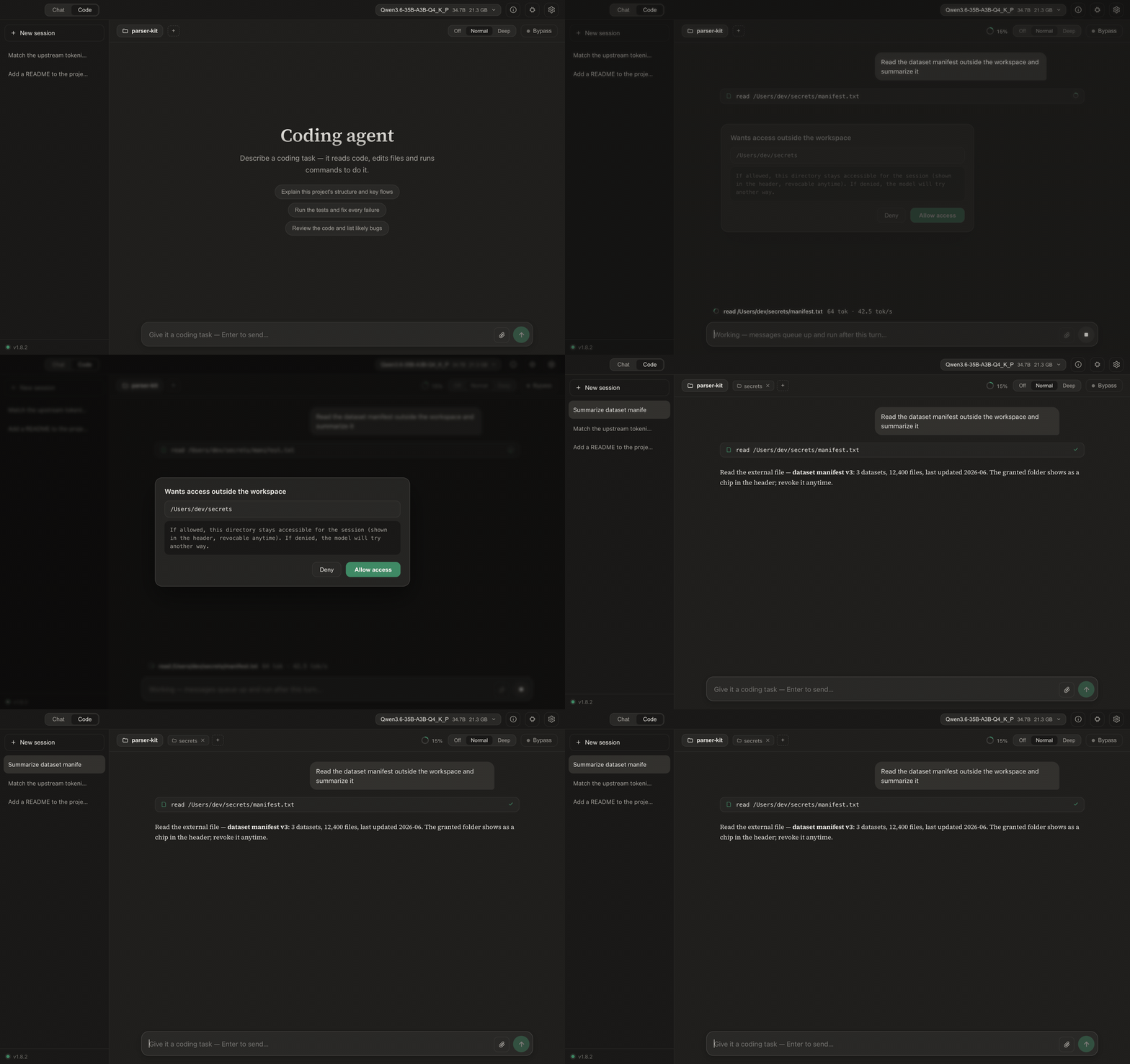
A local coding agent — searches GitHub, reads the source, edits your files, and runs the tests. All on your machine.
Why Chaty
- 🔒 Truly private — every model, document, and conversation stays on your device. No sign-up, no server, nothing phoned home.
- ⚡ Native and fast — a Rust + llama.cpp core with Vulkan / Metal GPU offload that auto-tunes to your hardware and falls back gracefully to CPU.
- 🧰 More than a chat box — a coding agent, a knowledge base (RAG), Deep Research, hands-free voice, and a self-healing Design Canvas — all offline.
- 🧠 Runs almost anything — Llama 3, Gemma 3 / 4, Qwen 3 / 3.5 / 3.6, any GGUF from Hugging Face — and MLX models natively on Apple Silicon — plus Chaty's own fine-tuned model.
- 💻 Friendly to modest hardware — a first-launch “Set up for me” picks a model sized to your RAM and downloads it in one click.
A local coding agent
Flip the Chat · Code switch and Chaty becomes an agent for your codebase. Point it
at a folder, describe the task, and it explores, edits, and verifies the project by
itself — every step shown live, every change behind an approval + diff.
- 🌐 The whole web as a tool — key-less search of GitHub (repos, issues, and code), Reddit, YouTube, Bilibili, and any domain; fetching adapts to the content (articles → Markdown, GitHub pages → raw source, PDFs → text, videos → transcripts).
- 🧭 Drives a real browser — opens pages, reads them as text (dynamic content and all), clicks the right element with real mouse events, fills whole forms and dropdowns in one call, logs in, paginates, and looks with the vision model when it matters — verified end-to-end against real sites. Watch it work in a real Chrome, logins and all.
- 🧠 Tools that do the thinking —
understand_repoorients in one call;search_codereturns relevance-ranked files with their key definitions;read_filecan extract a single symbol plus every call site — and reads PDF / Word / Excel / PowerPoint (scanned PDFs get OCR'd);validate_changefinds and runs just the tests related to what changed. Built so small local models spend steps on decisions, not planning grunt work. - ✏️ Precise edits — exact-string patches with a diff preview and “did-you-mean” hints, a syntax gate that warns when an edit breaks a previously-parsable file, file outlines to navigate big files, and
search_filesto find by name or content. - 🖥️ Real shell — run commands and long background jobs (dev servers, builds), sandboxed to the workspace (Seatbelt on macOS); a
sudocommand asks first, with a secure password prompt. - ⏪ You stay in control — per-action approval, a command allowlist, out-of-workspace access that asks per folder, prompt-injection defense on everything it reads, and one-click checkpoint rewind that restores files and rolls back the conversation.
- Built for local models: an Off / Normal / Deep reasoning switch, a prompt-processing progress ring, a context-usage ring with automatic compaction, whole-file reads sized to your context window, ranked
search_code+ knowledge-basesearch_docs, and loop-breaking for repetitive small models. - Persistent sessions, project memory (AGENTS.md), custom /skills, and slash commands.
- Tune it under Settings → Code: step limit, command timeout, step temperature, an auto-approve-edits toggle, a headless-browser toggle, and a command allowlist.
- File access never leaves the folder you pick; downloads land in the workspace and are covered by checkpoints too.
Chat that renders everything
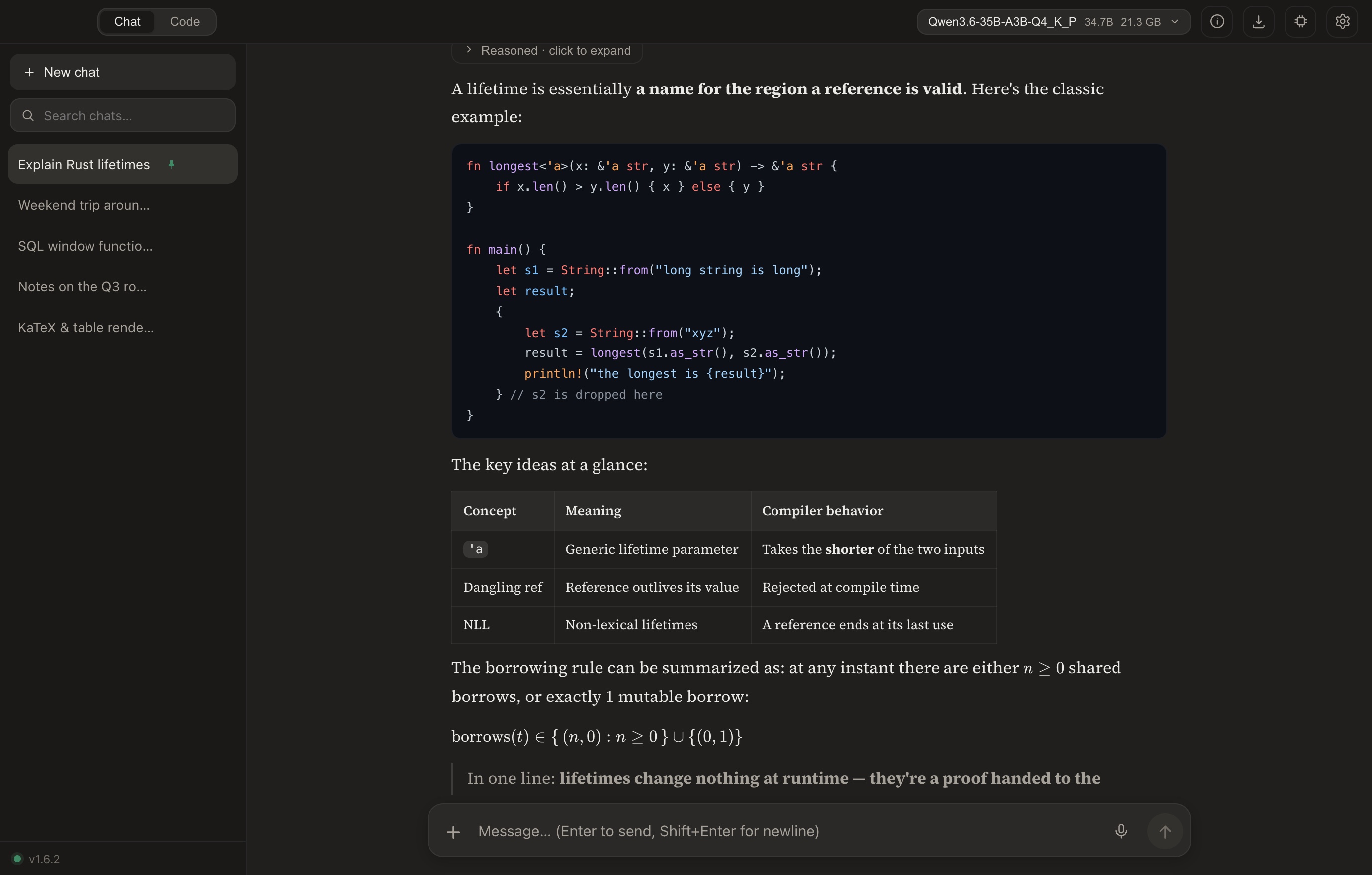 |
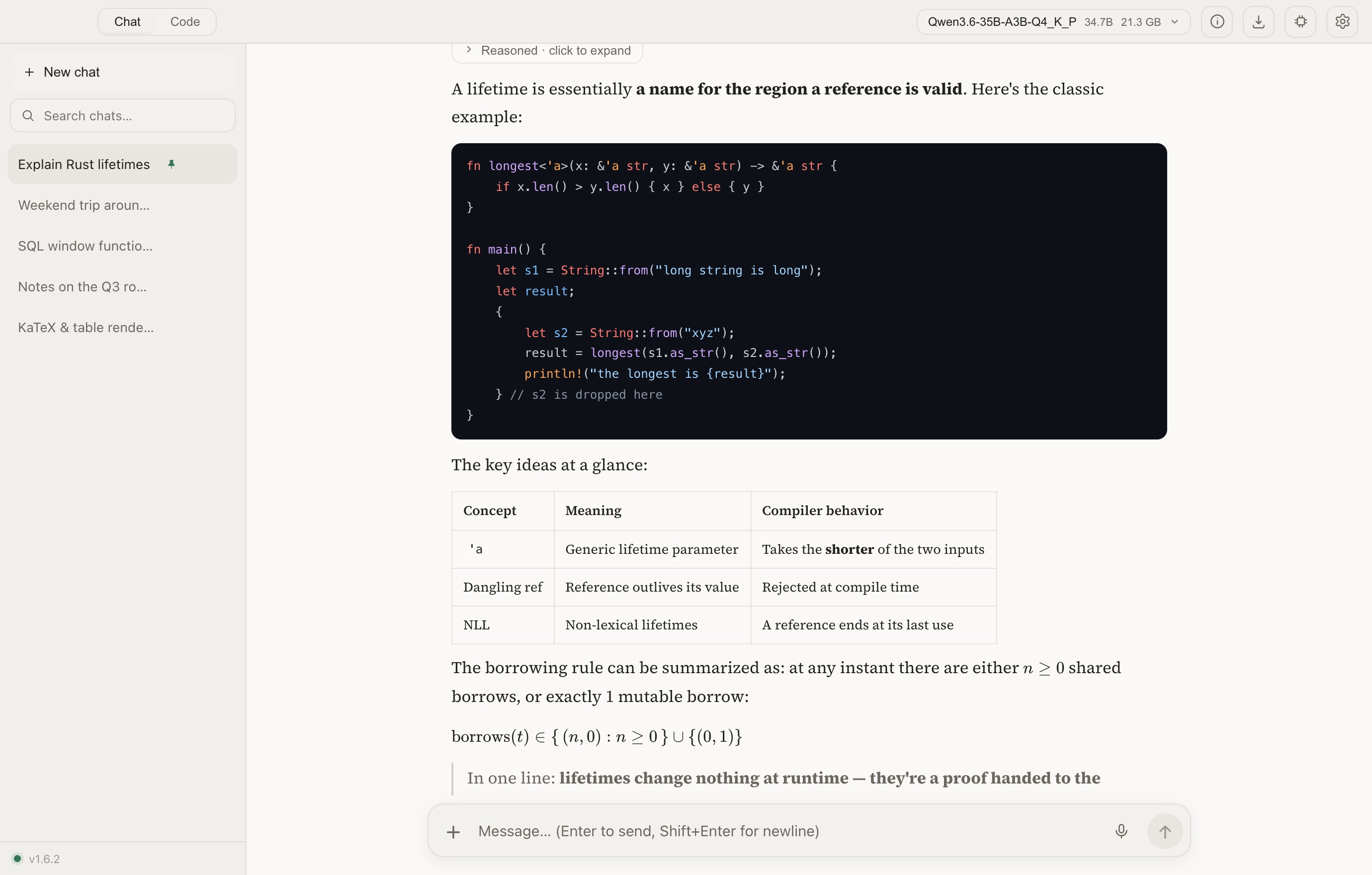 |
- A streaming, foldable
<think>panel that follows the model's reasoning as it generates. - KaTeX math, tables, Mermaid diagrams, per-block code copy, and in-app rendering of single-file HTML — including playable web games.
- A ⌘K command palette, pinnable / renameable conversations, drag-and-drop attachments, export (Markdown / JSON), and full-text search.
- Four palettes (two dark, two light) with system-theme following, native UI zoom, reduced-motion support, and an English / 简体中文 UI.
Chaty can see
Load a vision model (its weights and mmproj encoder live together in one folder, paired automatically) and image understanding turns on everywhere:
- Chat — attach a picture and ask about it; follow-ups stay fast (already-seen images aren't re-encoded).
- Code — the agent reads screenshots and can look at any image with
view_image; the composer takes images and documents just like chat. - Knowledge base — imported images get a written description beside their OCR text, so search finds what's in them; images embedded inside PDFs, Word, Excel and PowerPoint files are extracted and described too.
- Canvas — the model sees the live rendered page when you ask for an edit.
Text-only models keep the OCR path, so nothing regresses — and updating from an older version, a one-time prompt tidies your existing loose .gguf files into the one-folder-per-model layout with a single click.
A model store, and MLX on Apple Silicon
- A built-in model store: search Hugging Face by name or author, filter GGUF / MLX, sort by trending or downloads — then pick a quantization from a dropdown and hit download. Models, not file lists.
- Parameter / architecture / vision badges, the repo's README rendered in-app, and a "fits fully in memory" hint sized to your machine. Vision models fetch their encoder automatically; pasting a repo link still works.
- MLX runs natively: mlx-community folder models load through Apple's MLX stack in an isolated sidecar — same chat, vision, reasoning controls, Code agent and knowledge-base support as GGUF, and ejecting a model always returns its memory. (macOS · Apple Silicon)
A private knowledge base
|
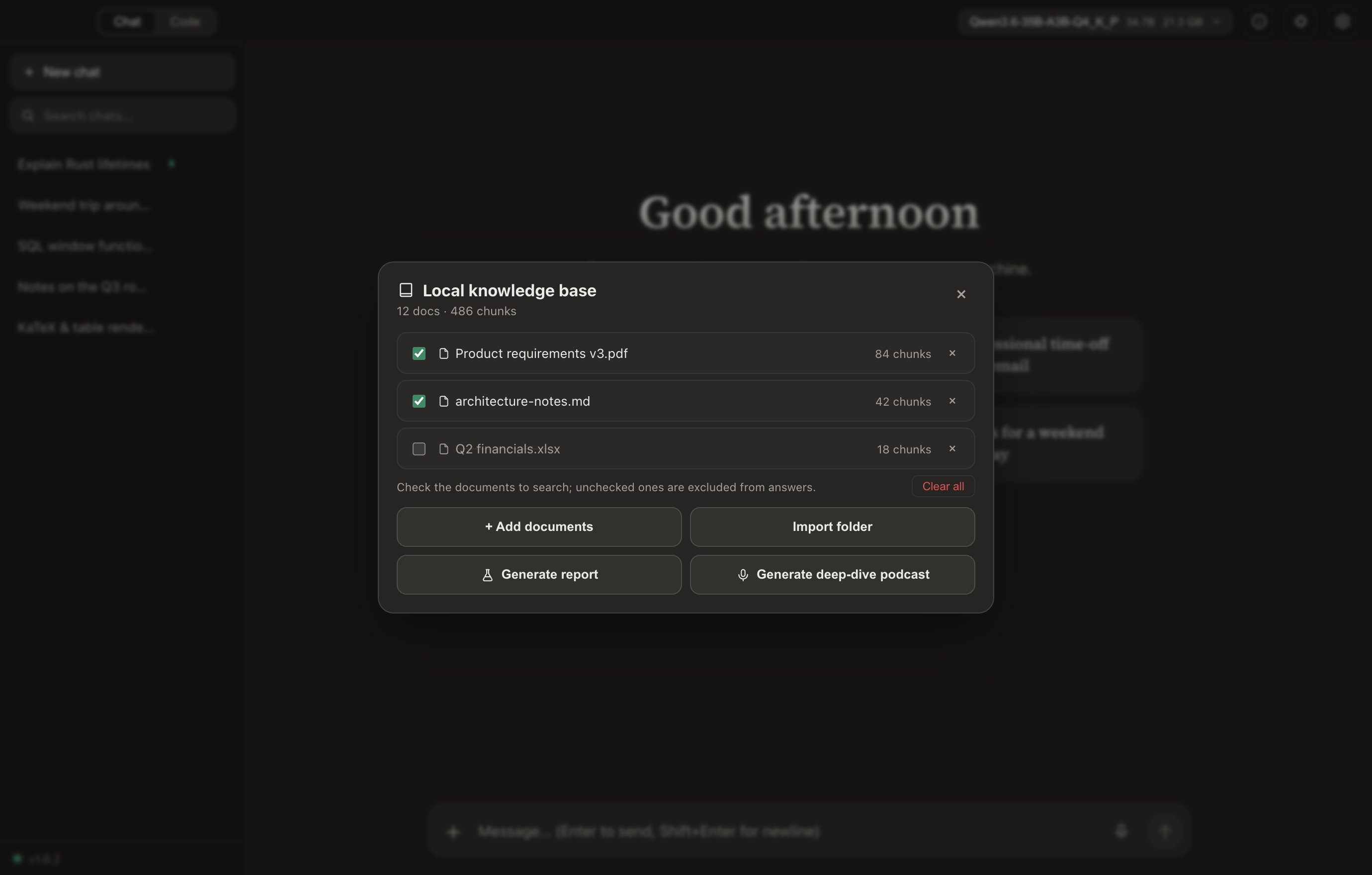 |
Deep Research & the web
- Give a topic and Chaty plans queries, runs multiple rounds of web search interleaved with reasoning, and writes a structured, cited report — exportable to PDF or Markdown.
- Honest by design: the reference list contains only sources it actually cited.
- A free, key-less, multi-provider search chain (Brave → Bing → DuckDuckGo → Wikipedia) so one blocked provider never breaks search.
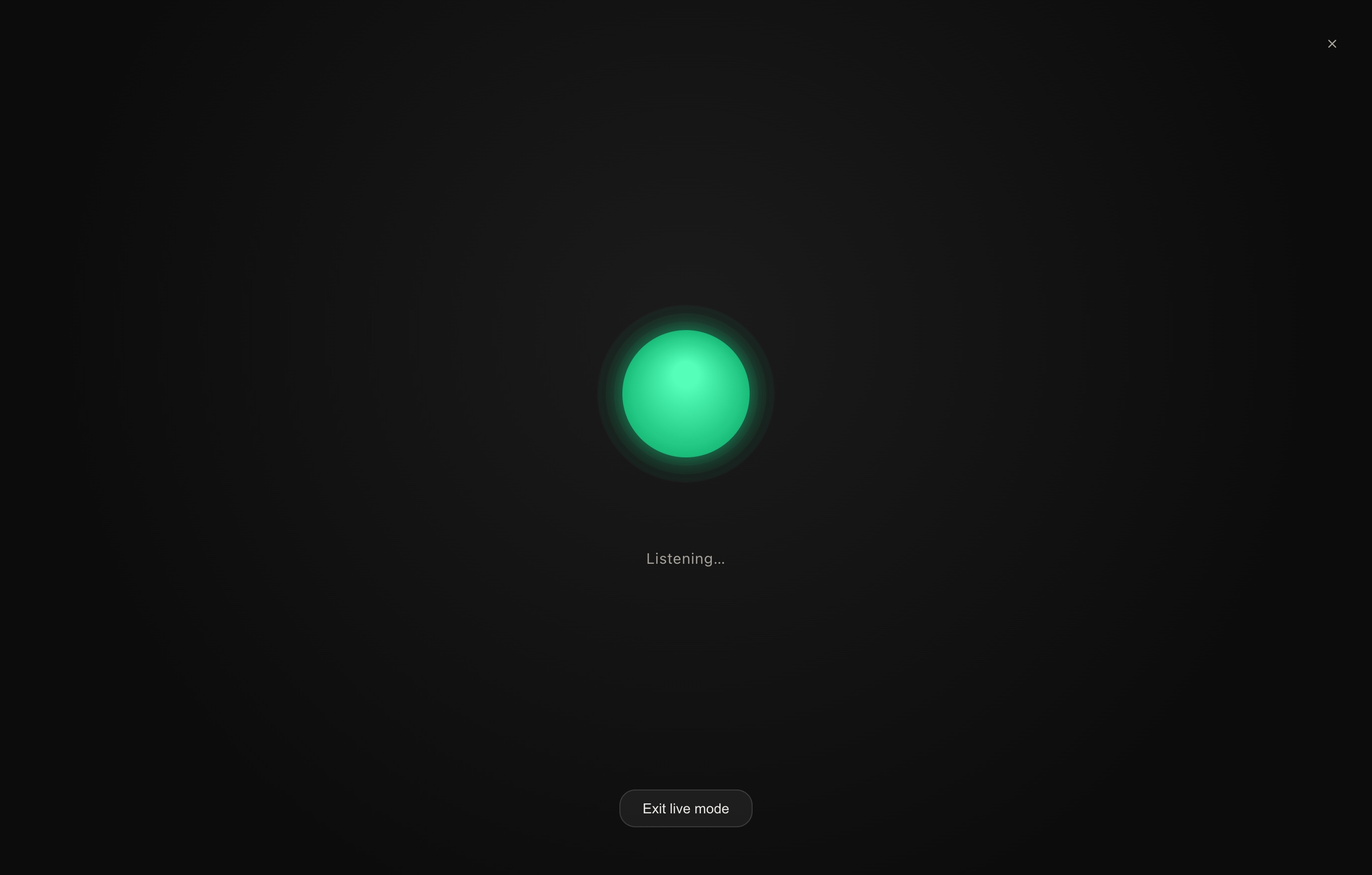
Hands-free voice
 |
|
Everything stays on your machine
|
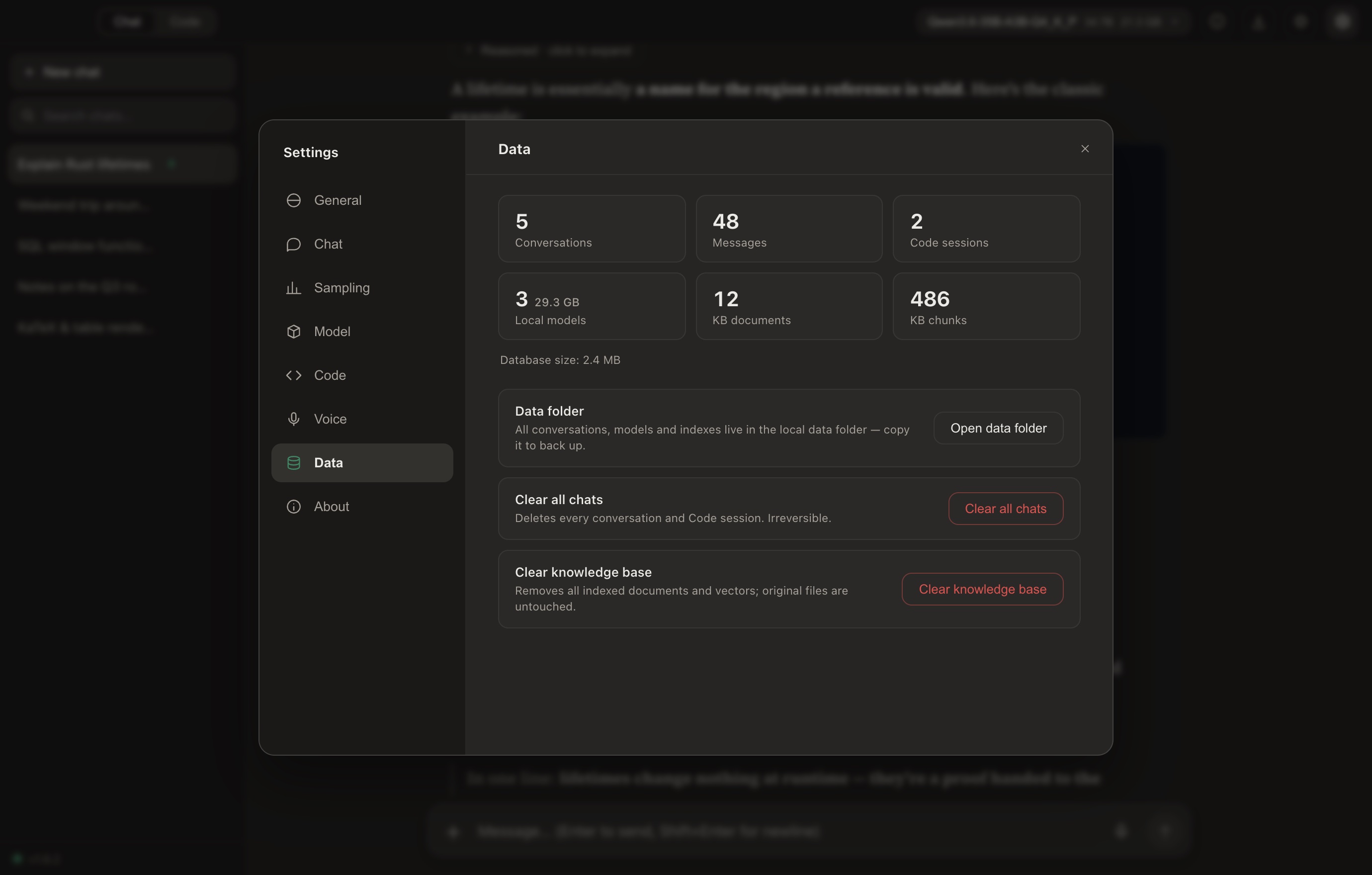 |
Offline-first. The network is used only for optional web search and one-time model downloads.
Design Canvas
- Build a page by chatting — open any single-file HTML Chaty generates into a split studio: live preview on one side, an instruction box on the other. Ask for changes in plain language and Chaty edits the page in place (a fast search/replace patch, not a full re-render).
- Self-healing — the preview watches for runtime errors and offers a one-click Fix; every fix asks first, so there's no runaway loop. With a vision model, Chaty also sees the rendered page (a live screenshot + console) when you ask for a change.
- Version history with revert, plus export to a standalone
.html. Pairs naturally with Chaty's own web-design fine-tune.
Chaty's own model
Beyond third-party models, Chaty ships its own fine-tune — a Qwen3.5-4B distilled from
a much larger teacher and tuned for leaner, on-device single-file web design, with a baked-in
Chaty identity and grounded citations. It's a one-click pick in “Set up for me” and fully
open on Hugging Face.
Install
Grab the latest build from the Releases page:
| Platform | File | Notes |
|---|---|---|
| Windows x64 | Chaty_*_x64-setup.exe |
Per-user installer — no admin required |
| macOS (Apple Silicon) | Chaty_*_aarch64.dmg |
See the first-launch note below |
macOS first launch. Chaty is ad-hoc signed but not notarized (there's no paid Apple
Developer account behind it), so Gatekeeper warns on first open. The app is safe — everything
runs locally. Clear the download quarantine once:
xattr -dr com.apple.quarantine /Applications/Chaty.app
then open Chaty normally. (Or: open it, dismiss the warning, and choose System Settings →
Privacy & Security → Open Anyway.) On macOS the writable models folder lives in app data —
use Open models folder in the model menu.
Build
Full details in BUILD.md.
# Windows
npm install
.\dev.ps1                            # dev
npm run tauri build -- --no-bundle   # release exe → compile the Inno installer
# macOS (Apple Silicon)
npm install
npm run tauri dev      # dev (Metal)
npm run tauri build    # → .app + .dmg
Releases are produced by CI: bump with scripts/bump-version.sh x.y.z, then push a vx.y.z
tag — GitHub Actions builds both installers onto a single release.
Architecture
| Layer | Stack |
|---|---|
| Shell | Tauri 2 — system tray, global shortcut, single-instance |
| Frontend | React 19 · Vite · react-markdown · KaTeX |
| Inference | Rust · llama-cpp-2 (llama.cpp) — Vulkan (Windows) / Metal (macOS) · MLX via an mlx-swift-lm sidecar (Apple Silicon) |
| Voice | sherpa-rs (ONNX Runtime, CPU) — Whisper-base.en + Kokoro-82M |
| Knowledge base | bge-m3 embeddings + BM25 · hybrid RRF / MMR retrieval · SQLite vector store |
| Storage | SQLite — conversations, messages, full-text search |
License
MIT — see LICENSE. Built with llama.cpp, Tauri, and sherpa-onnx.
Yorumlar (0)
Yorum birakmak icin giris yap.
Yorum birakSonuc bulunamadi