tracecrate
Health Gecti
- License — License: MIT
- Description — Repository has a description
- Active repo — Last push 0 days ago
- Community trust — 111 GitHub stars
Code Uyari
- process.env — Environment variable access in playwright.config.ts
- process.env — Environment variable access in scripts/package-release.mjs
Permissions Gecti
- Permissions — No dangerous permissions requested
Bu listing icin henuz AI raporu yok.
Local-first AI agent trace workbench. Inspect Claude Code, Codex and OTLP logs, compare runs, and export privacy-conscious reports. No backend or API keys.
TraceCrate — Your agent ran. Read what happened.
A privacy-first, client-side AI trace workbench. Inspect the sequence, question the patterns, share deliberately.


简体中文 · V0.2 research & design · Format guide · Privacy · Contributing
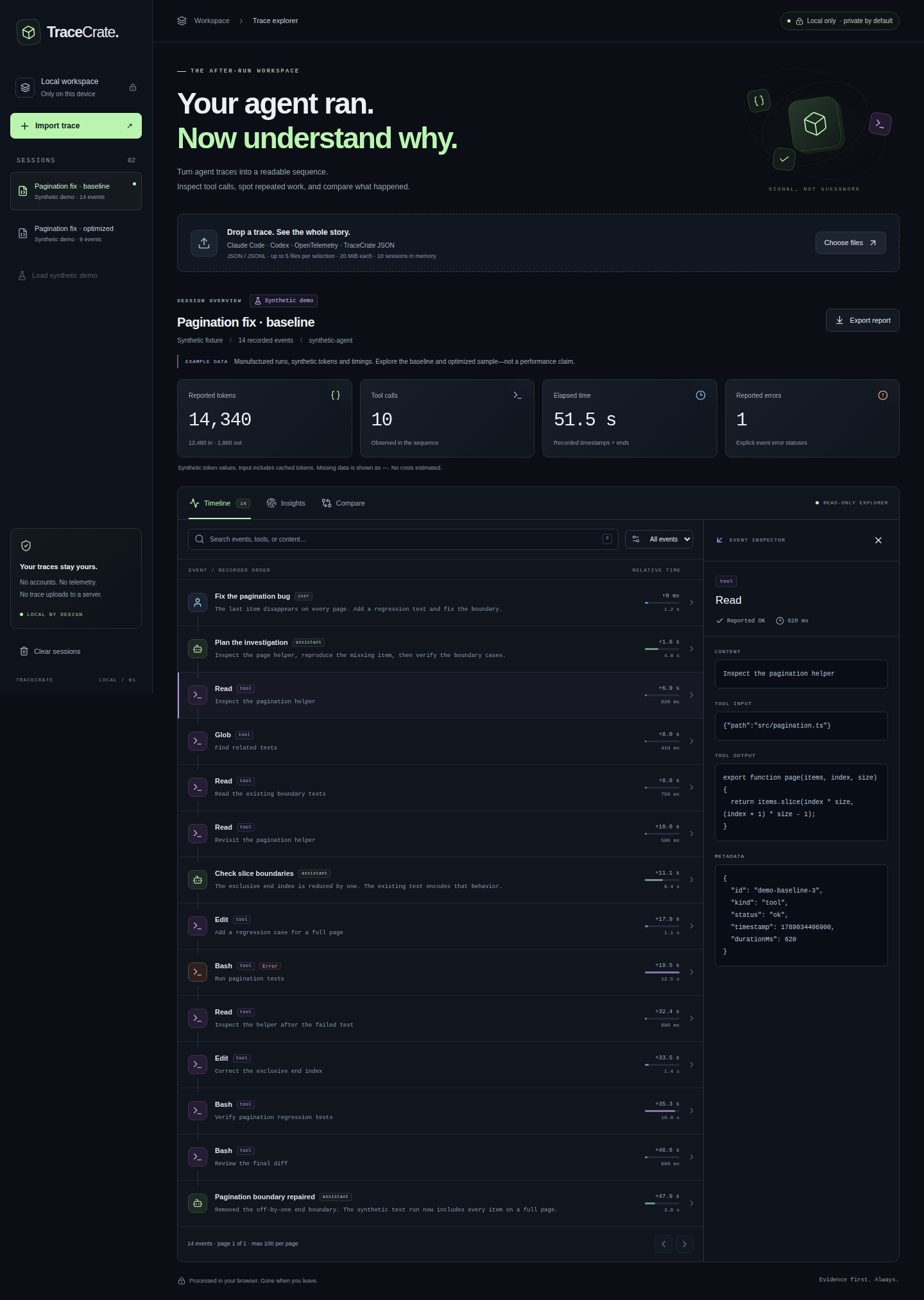
Historical v0.1 live-site screenshot, visually reviewed; 1440 × 2026 full page. All events and values are synthetic demo data, not benchmark results. V0.2 adds controls beyond this image.
TraceCrate turns files you choose into a searchable timeline, recorded metrics, heuristic diagnostics, and side-by-side comparisons. No backend, no telemetry, no accounts, no API keys. It reads traces; it does not run agents or execute recorded commands.
Open the live demo · v0.1.0 release · Contribute · Source on GitHub. Explore synthetic runs without installing anything, or run locally below.
Try the story in 30 seconds
Open the hosted demo and follow the walkthrough below. Local use requires Node.js ≥22.12 (24 recommended) and npm:
git clone https://github.com/FankChen/tracecrate.git
cd tracecrate
npm ci
npm run dev
For local use, open the address printed by Vite. Installation time is separate from the 30-second walkthrough:
- 0–10s: The two synthetic pagination runs load automatically. Open a tool event in Timeline; search or filter by event kind.
- 10–20s: Open Insights, then Compare to inspect recorded differences. “Baseline” and “optimized” are manufactured demo labels, not measured improvements.
- 20–30s: Choose Export report → Structure only → Show redacted preview, then download JSON or a standalone HTML report. Review the full download before sharing.
No Claude/Codex installation or agent commands are necessary. For your own data, use Choose files or drop a supported file. Claude session files are private: explicitly select only files you are authorized to inspect; TraceCrate never scans agent directories. Never contribute actual histories as fixtures.
What you can do
- Focus on the recorded evidence: literal search across text/IDs/models, combined kind/status/minimum-duration filters, stable longest-first or recorded ordering, tool inputs/outputs and metadata; 100 events per page.
- Read evidence, not invented certainty: reported tokens, explicit errors, elapsed time when present; missing values stay unknown. No cost estimates.
- Spot patterns: explicit tool errors, long tool durations, large outputs, and identical name/input repetitions. Heuristics do not establish causes or intent.
- Compare two sessions: recorded metric differences (B − A), tool-call counts and event-by-event kind/name alignment, changed field labels, tools-only/differences-only filters and links to either original event. Repeated names can align ambiguously; descriptive, not a controlled benchmark.
- Share with a deliberate boundary: strict structure-only by default, now with optional timing/token removal; best-effort pattern redaction remains separate. HTML has no scripts or external assets; native JSON can be reimported. Removed values stay unknown, not zero.
- Keep the workflow local: file reading/parsing in Web Workers, sessions in memory, ordinal import progress, independent cancellation and a 30-second per-file deadline. Cancel discards the pending batch but keeps existing sessions; Clear removes them. Reload restores demos; downloaded files remain on disk.
V0.2 walkthrough
- In Timeline, select Reported error or set Min duration (ms), then choose Longest first. Missing duration is excluded when a minimum is set—even zero.
- In Compare, scroll to Event-by-event comparison. Inspect changed fields or choose Tools only; an event button opens the original session and correct timeline page.
- In Export report → Structure only, optionally select Omit timing metadata and/or Omit token usage, preview, then inspect the full download. Switching to patterns clears minimization because free text may contain the same metadata.
See the design decisions and official references, V0.2 release notes and keyboard walkthrough.
Format support — subsets, not universal ingestion
| Format | Supported input | Important boundary |
|---|---|---|
| Claude Code | Normal message JSONL; text, tool calls/results, selected system/result records | Partial streaming deltas ignored; private transcript variants can differ |
| Codex | Rollout JSONL with session_meta, turn_context, response_item, selected event_msg |
Not arbitrary codex exec --json events; reasoning/deltas not imported |
| OTLP JSON | resourceSpans → scopeSpans → spans, nested structured attributes, current/legacy cache-write keys |
No protobuf, collector endpoint, full OTLP, or MCP transcript support |
| TraceCrate native | One validated schemaVersion: 1 JSON report |
Bounded schema; unknown fields stripped; JSON exports are sharing transforms, not raw backups |
See formats, synthetic examples, and public upstream references. Usage.input includes cacheRead and cacheWrite; those are subcounts, not additions. Total reported tokens = input + output.
Limits: 20 MiB UTF-8 per file, 20,000 input records and normalized events, nesting depth 60; up to 5 files per selection and 10 sessions in memory (including demos). Imports have a 30-second per-file deadline; background timer throttling can delay enforcement. Web Workers required; whole-file parsing, not streaming. Sequence alignment permits 2,000 selected events per side, 400 edits and a 200 ms budget, with explicit failure rather than partial output. Analysis, comparison and exports still use the UI thread. Detail/preview rendering is capped at 50,000 characters, not the full download. See architecture.
Privacy is a boundary, not a guarantee
The app has no trace-upload or telemetry path. That does not make every environment or export safe. Browser extensions, a compromised browser/device, and modified hosted code can read data. A static host still receives ordinary request metadata, such as IP address and user agent.
Structure-only removes arbitrary free text, original identifiers/names, inputs, outputs, and model names using a strict allowlist. Token usage and timing remain by default and can now be omitted; event order, counts, remapped relationships and statuses still remain and can be sensitive. Pattern redaction preserves text and can miss secrets. Neither mode guarantees anonymization; inspect every field of the full download. Clearing memory is not secure erasure. Read privacy and export details and security reporting.
Development & publication status
npm run check runs lint, unit tests, browser-test typechecking and the production build. npm run test:e2e invokes Playwright; browser binaries must be installed separately. npm run package:release packages an already-tested build with licenses and SHA-256 checksums. See contribution checks.
V0.2 candidate verified · 2026-09-13: CI 34747596321 passed 225 unit tests and all 64 browser tests, lint, application/browser TypeScript checks and production build at 29bfa6ff462b112030cb1af3035d7a1002704908. Core/adapters line coverage is 97.51% (not UI coverage). Pages/release checks are pending at this documentation revision. The verification record distinguishes candidate evidence from the historical results below.
Verified release · 2026-09-10: v0.1.0 was created at tested commit 52d9ae9b73f815c264a3eb39f5fc3eedc5cb9715. CI run 34462095959 passed lint, TypeScript/build, 107 unit tests and 36 desktop Chromium / Pixel 7 emulation browser tests. Recorded core/adapters line coverage is 96.58% (not UI coverage).
Live verification: Pages run 34462098830 succeeded in build, deployment, and Playwright smoke against the actual public site: subpath assets, cold offline first import using a synthetic Claude fixture after page load, default structure-only HTML download, and no console/page errors. The screenshot above comes from its downloaded evidence artifact. See the verification record. Local browser downloads remain blocked; Firefox/WebKit and screen-reader certification are not claimed. Launch posts and the interaction video are not published.
- CI workflow — Node 24, checks, Chromium E2E.
- Manual Pages workflow — default branch only; enable Pages → GitHub Actions, then dispatch manually. Publication checklist.
- Manual Release workflow — default branch only; reruns checks/audit/browser tests, packages the tested static site and publishes a new version without replacing existing tags.
- Open contribution tasks and roadmap · Organic launch plan and draft copy · Changelog.
Original TraceCrate project; not affiliated with or endorsed by Anthropic, OpenAI, or OpenTelemetry. MIT license, copyright 2026 TraceCrate contributors.
Yorumlar (0)
Yorum birakmak icin giris yap.
Yorum birakSonuc bulunamadi