aletheia
Health Uyari
- License — License: Apache-2.0
- Description — Repository has a description
- Active repo — Last push 0 days ago
- Low visibility — Only 8 GitHub stars
Code Uyari
- fs module — File system access in npm/aletheia/bin/aletheia.js
Permissions Gecti
- Permissions — No dangerous permissions requested
Bu listing icin henuz AI raporu yok.
Memory for coding agents that checks itself against your code. Every memory carries evidence; stale facts never reach the context.
Memory your coding agent can verify.
Every memory carries evidence from your code. Aletheia re-checks it on every recall,
points your agent at the exact lines, and keeps stale facts out of its context.







Quick start · How it works · Results · Reference
The problem
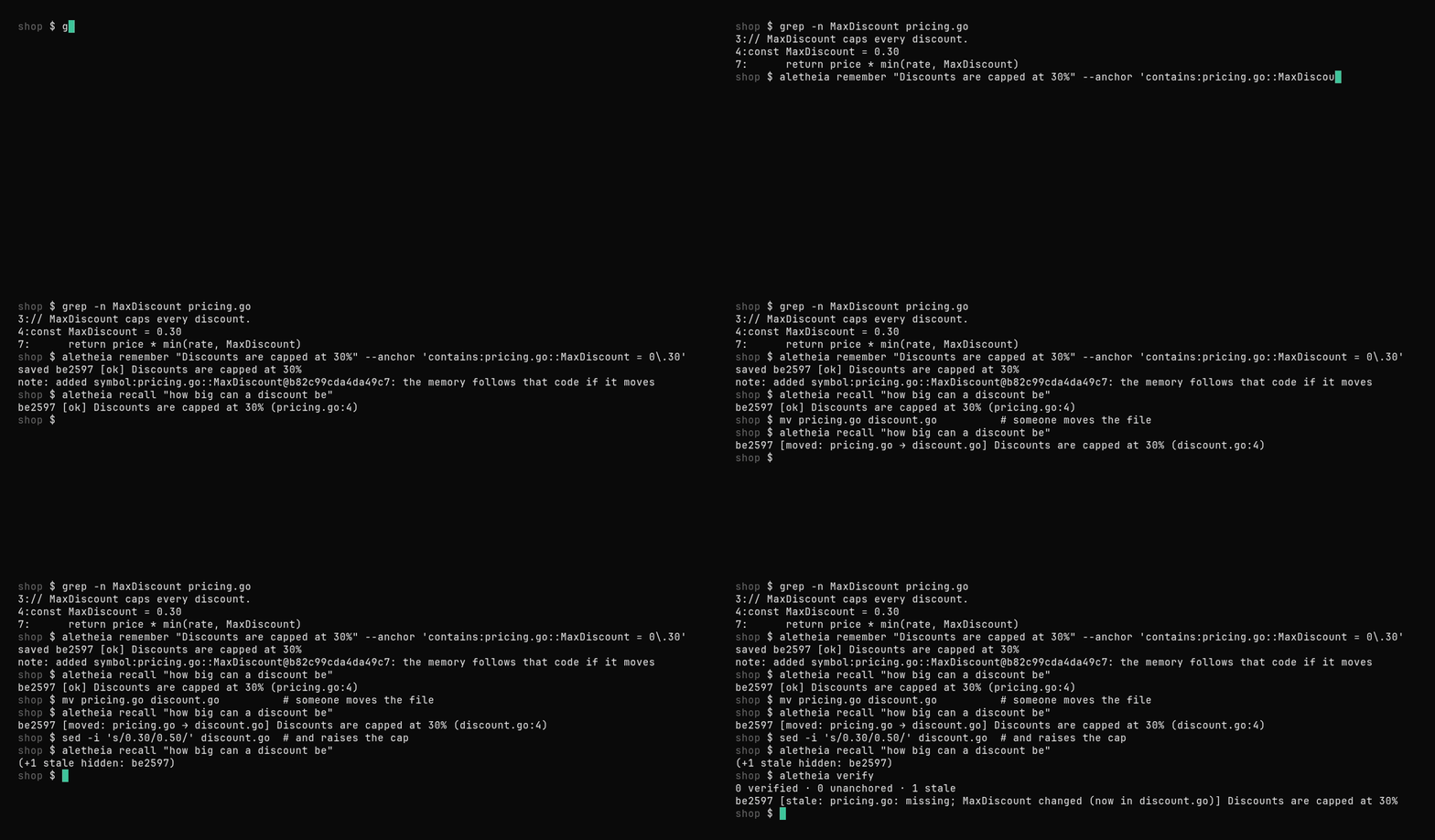
Coding agents forget everything between sessions, so they re-read the same files every time. Memory tools fix the forgetting, but they rank memories by similarity, and an outdated memory looks just as relevant as the fact that replaced it. The agent then builds on something that stopped being true weeks ago. A confidently wrong memory is worse than no memory.
How it works
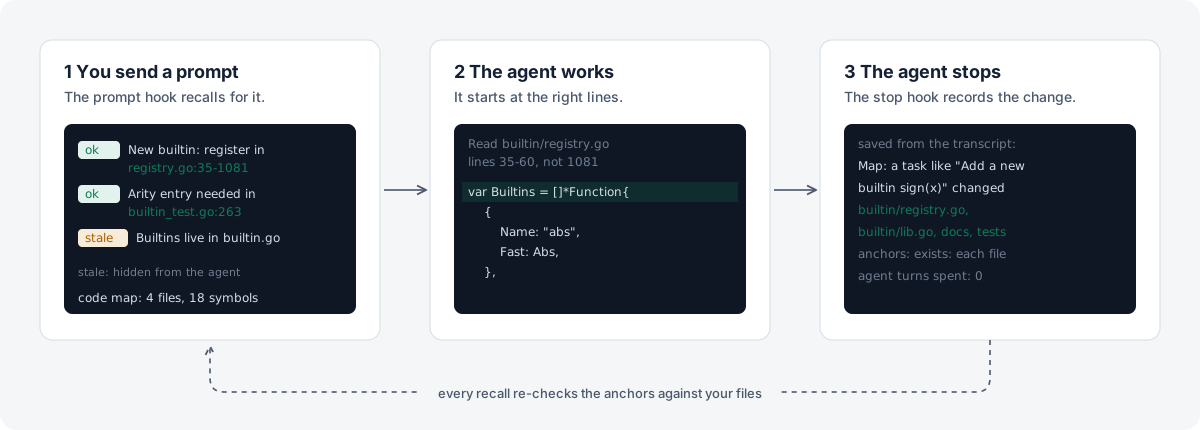
- Memories carry evidence. Each memory is a claim plus anchors: a function that must still exist, a line that must still match, a file that must still be there.
- Evidence is checked on every recall. The checks are mechanical: no model calls, no embeddings, no network. A memory whose evidence broke is hidden from the agent, and a one-line note says so.
- Moved code is followed. When a Go declaration moves unchanged to another file, its memory comes back as
[moved]with the new place instead of going stale. - Recall points at lines. A pointer such as
builtin_test.go:263is computed from the files right now, so the agent opens the right lines instead of searching for them. - Maps write themselves. When the agent stops, Aletheia reads the session transcript and records which files the task changed. The next task of the same kind starts there, and the agent spends no turns writing it down.
- Nothing is deleted. Replaced memories are superseded and long-stale ones archived by
aletheia lethe(Lethe, the river of forgetting).
Quick start
1. Install it in whichever way suits you. Every option gives you the same single binary:
npm install -g @firatmio/aletheia                             # Node 18+, any OS
go install github.com/firatmio/aletheia/cmd/aletheia@latest   # Go 1.24+
scoop bucket add firatmio https://github.com/firatmio/scoop-bucket; scoop install aletheia   # Windows
brew install --cask firatmio/tap/aletheia                     # macOS, Linux
Prebuilt archives for Linux, macOS and Windows are on the releases page.
2. Connect your agent.
Claude Code, with the plugin (recommended). It brings the MCP server and both hooks. /aletheia:setup then initializes the project:
/plugin marketplace add firatmio/aletheia
/plugin install aletheia@aletheia
/aletheia:setup
Claude Code, without the plugin. Set up the project and add the two hooks yourself. Recall then happens on every prompt and costs the agent nothing:
cd your-project
aletheia init --agents --claude-hooks   # .aletheia/, usage notes in CLAUDE.md and AGENTS.md, hooks in .claude/settings.json
aletheia hook --dry-run                 # what an agent would get (add a prompt to try one); changes nothing
Run --claude-hooks yourself. Agents are usually not allowed to change their own hooks, and that is by design. Don't add these hooks if the plugin is installed: it brings the same two. init notices the plugin and says so. To edit the file by hand instead, use this:
{
  "hooks": {
    "UserPromptSubmit": [{ "hooks": [{ "type": "command", "command": "aletheia hook" }] }],
    "Stop": [{ "hooks": [{ "type": "command", "command": "aletheia hook" }] }]
  }
}
Any other agent. Cursor, VS Code, Claude Desktop and Codex connect over MCP; agents without MCP use the CLI. See Other agents below. An MCP client configured with npx needs no install at all: {"command": "npx", "args": ["-y", "@firatmio/aletheia", "serve"]}.
An agent can also do the setup itself from the agent guide. It hands the hook step to you as that single command.
Memories live in .aletheia/memories/*.md as plain Markdown. Commit them and your team, and every agent, shares one memory that verifies itself on each machine.
Upgrading: npm update -g @firatmio/aletheia, scoop update aletheia or brew upgrade --cask aletheia. With Go, run the same go install again. Update the plugin with claude plugin update aletheia@aletheia.
- Which version runs: the hooks use the new binary right away. The MCP server keeps the old one until the agent restarts.
- With
go installon Windows, a running agent keepsaletheia.exeopen through the MCP server, so the install fails with "file in use". Quit the agent first, or move the old binary aside, which Windows allows for a running exe.
This works on every upgrade. It removes old copies that are no longer in use, and the random name never collides with one that is still running:
$bin = "$(go env GOPATH)\bin"
Remove-Item "$bin\aletheia-old*.exe" -ErrorAction SilentlyContinue
Rename-Item "$bin\aletheia.exe" "aletheia-old-$(Get-Random).exe"
go install github.com/firatmio/aletheia/cmd/aletheia@latest
Results
We measured with headless Claude Code (Opus 5.5) on real repositories. Each task ran with and without Aletheia, and the same hidden acceptance tests judged success.
| Repository | Tasks | Cost | Also | Tasks passed |
|---|---|---|---|---|
| gohugoio/hugo, a large site generator (233k lines of Go) | 14 tasks of five kinds, one run each | −15%: −22% on seven tasks of one kind, −7% on a mix | input tokens −27%, turns −21% | 14/14, same as without |
| expr-lang/expr, a mid-size expression language | 7 tasks, two runs | −9% in both runs | code read before the first edit −48% | 14/14, same as without |
| go-chi/chi, a small, tidy router | 7 small tasks, two runs | +5% and −5%: break-even | 14/14, same as without |
Aletheia pays off where finding the right place is expensive, in mid-size and larger codebases, and most when the same kind of change comes back. Expect the mixed figure for everyday work. On a small package that an agent reads in one or two calls there is little to save. The method, the raw numbers and what did not work are in docs/dogfood-4.2.md.
Reference
Anchors| Anchor | Holds while | Example |
|---|---|---|
symbol:PATH::NAME |
the file still declares that function, method (Type.Method), type, var or const |
symbol:store.go::Store.Get |
contains:PATH::REGEX |
the file still matches the regular expression | contains:go.mod::^go 1\.23$ |
exists:PATH |
the path still exists | exists:src/auth |
file:PATH |
the file's content is unchanged (hash sealed when saved) | file:go.mod |
- Use
symbolfor claims about one declaration andcontainsfor one thing in a file. Usefileonly when any change should trigger a re-check. - Recall shows where
symbolandcontainsevidence is right now, e.g.(store.go:15-21). Go declarations get their full range fromgo/parser. In other languages asymbolanchor finds the declaring line by its keyword (function,class,def,fnand the like); it is not sealed, so it cannot follow a move. - Moved code. A Go
symbolanchor is sealed with a fingerprint of the declaration (symbol:store.go::Store.Get@3f9a…). The fingerprint ignores comments and layout.- Edits in place: they never stale the anchor. If the declaration is still in its file, the fingerprint is not even consulted.
- A moved declaration: if the declaration leaves its file, Aletheia searches the project for it. When exactly one declaration with that name has the same fingerprint, the memory comes back as
[moved: old.go → new.go]with the new lines, andverify <id> --resealrecords the new path. - Anything less certain stays stale and hidden: the code changed on the way, several copies match, or the claim names the old file.
containsanchors in Go code: when one matches inside a single declaration,rememberadds a sealedsymbolanchor for that declaration. Thecontainsanchor then moves with it, but only if its pattern still matches inside that declaration at the new place.
- In a
containspattern, a run of spaces matches any run of spaces or tabs, so reformatting does not stale it. - Files named in a claim get an
exists:anchor automatically. - Leave paths to the anchors: say what the code does ("Tokens are issued by IssueToken"), not where it is. A claim that names its symbol's file stays stale when the code moves, and
remembersays so when you save one. rememberwarns when acontainsanchor only matches comments, since a comment can stay while the code changes.- A memory without anchors comes back as
[?], ranked below verified facts, and expires after 90 days unless re-confirmed.
When a memory goes stale, re-check the claim, then:
aletheia verify 3f9a1c --reseal                                   # still true: refresh the evidence
aletheia remember "…new claim…" --anchor … --supersedes 3f9a1c   # changed: replace it
--reseal refuses when a contains, exists or symbol anchor no longer holds, so a false claim cannot be quietly blessed.
aletheia map "<topic>" lists the files most relevant to a topic, each with its key declarations and their current lines:
optimizer/fold.go: fold.Visit 15-311, fold 10-13, toFloat 329-335
builtin/builtin.go: Builtins 35-1081, Index 18
Files are ranked first, as in Aider's repo map, by how well their path and declaration names match the topic. Hidden, dependency and generated files are skipped. For a question about building, testing or shipping, and for the overview without a topic, the map starts with the build files: build and CI: go.mod, Makefile, scripts/, .github/workflows/ci.yml. The hook sends a map with the first prompt of a session, sized to the project: none under 25 source files, then 300 or 600 tokens (--map-budget N overrides it).
Aletheia speaks MCP over stdio with four tools (recall, remember, get, verify) and works as a plain CLI, so any agent that can run a shell command can use it.
{
  "mcpServers": {
    "aletheia": { "command": "aletheia", "args": ["serve", "--dir", "/absolute/path/to/your-project"] }
  }
}
Without a global install, use "command": "npx", "args": ["-y", "@firatmio/aletheia", "serve", "--dir", "…"]. The server finds .aletheia/ from --dir, or from the directory the client starts it in. In a project without one, the tools answer with how to set it up rather than failing, and start working as soon as aletheia init has run.
- VS Code (
.vscode/mcp.json): use"servers"instead of"mcpServers", and${workspaceFolder}as the directory. - Claude Code: use the plugin from the quick start. It adds the hooks too, and they matter more than the tools, because Claude Code loads MCP tool descriptions on demand.
- Agents without MCP (Aider, custom agents):
aletheia init --agentswrites a short block toAGENTS.mdthat teaches the agent to call the CLI. Codex readsAGENTS.mdtoo, so it gets the same notes alongside the MCP tools. Add--jsonto any read command for machine-readable output.
---
id: "3f9a1c"
claim: "Auth tokens are issued by IssueToken, HS256 with a 15 minute expiry"
confidence: 0.8
status: "active"
source: "claude-code"
created: "2026-10-21T09:12:44Z"
updated: "2026-10-21T09:12:44Z"
tags:
  - "auth"
anchors:
  - "symbol:src/auth/jwt.go::IssueToken@7370a7fe3669256c"
  - "contains:src/auth/jwt.go::jwt\\.SigningMethodHS256"
---
Refresh tokens are handled separately, by RefreshToken.
The @7370a7fe3669256c suffix is the sealed fingerprint that lets the memory follow IssueToken if it moves.
Edit memories by hand, review them in pull requests, grep them. They are just files.
CLIaletheia init [dir] [--agents] [--claude-hooks]
aletheia remember <claim> [--anchor SPEC]... [--body TEXT|-] [--tag T]... [--ttl 30d]
[--confidence 0.8] [--supersedes ID]... [--source NAME] [--force]
aletheia remember - [--source NAME] [--force] # several at once: one JSON object per line on stdin
aletheia recall [query] [--budget N] [--limit N] [--full] [--stale] [--tag T] [--session ID] [--json]
aletheia get <id> [--json]
aletheia verify [id] [--reseal] [--ttl 30d] [--json] # exits 1 if anything is stale (CI-friendly)
aletheia map [topic] [--budget 600]
aletheia hook [--budget N] [--map-budget N] [--dry-run [prompt]] # Claude Code hook; every command takes --help
aletheia lethe [--days 30] [--apply] [--json] # archive superseded and long-stale memories
aletheia stats [--json]
aletheia serve [--dir DIR] # MCP server on stdio
aletheia version
Every command takes --help, and --dir DIR (or ALETHEIA_DIR) to point at a project from elsewhere.
remember exits with code 3 when the claim duplicates or closely matches an existing memory, and names it so the agent can --supersedes it instead.
remember - saves several memories in one call. Each stdin line is a JSON object with the MCP tool's keys, and each memory is saved on its own:
aletheia remember - <<'EOF'
{"claim": "Builtins are registered in builtin/registry.go", "anchors": ["symbol:builtin/registry.go::Builtins"]}
{"claim": "go.mod targets Go 1.18", "anchors": ["contains:go.mod::^go 1\\.18$"], "tags": ["toolchain"]}
EOF
It prints one result per line, in order. It exits 0 when all are saved, 3 when the only failures are conflicts, and 1 otherwise. A regex whose \\ became \ on the way through the shell (1\.18) is still accepted. The MCP remember tool takes the same objects as memories.
- Never executes anything. Anchors only read files; there is no "run this command to verify" anchor.
- Stays inside the project. Anchor paths are relative and cannot escape the root, including through symlinks.
- Memories are data, not instructions. The MCP server tells agents so, and the
CLAUDE.md/AGENTS.mdblock repeats it. - No network, no telemetry, no dependencies. A single static binary using only the Go standard library. The one program it starts is
git check-ignore, duringinit, to see whether CLAUDE.md is ignored. - Privacy: Aletheia collects nothing. The hooks read the prompt and the session transcript on your machine, and the map memories keep a shortened copy of the prompt in
.aletheia/. See the privacy policy.
Roadmap
- Evidence-anchored memories, checked on every recall
- Recall hook, live line pointers, code map, task maps from the Stop hook
- Benchmark harness with paired runs on real repositories
- Moved Go code followed by fingerprint (
[moved]) - Prebuilt binaries, npm, Homebrew and Scoop; a Claude Code plugin; listed in the MCP Registry
- Sealed
symbolanchors, and[moved], beyond Go: TypeScript/JavaScript and Python first -
aletheia doctor: find anchors that keep going stale and suggest sturdier ones - Longer benchmarks with more repositories and repeated kinds of change
- Global, cross-project memory for personal preferences
What changed in each release is in CHANGELOG.md.
Contributing
Issues and pull requests are welcome. See CONTRIBUTING.md and the code of conduct. If Aletheia misled your agent, the "An agent was misled" issue form is the most useful report you can send. Report security problems privately, as SECURITY.md describes.
License
Apache-2.0 © Fırat Tuna Arslan
ἀ-λήθεια: truth, literally "un-forgetting"
Yorumlar (0)
Yorum birakmak icin giris yap.
Yorum birakSonuc bulunamadi