first-tree
Health Gecti
- License — License: Apache-2.0
- Description — Repository has a description
- Active repo — Last push 0 days ago
- Community trust — 132 GitHub stars
Code Basarisiz
- process.env — Environment variable access in .github/workflows/publish-npm-package.yml
- fs module — File system access in .github/workflows/publish-npm-package.yml
- rm -rf — Recursive force deletion command in apps/cli/package.json
- spawnSync — Synchronous process spawning in apps/cli/scripts/materialize-bundled-deps.mjs
- process.env — Environment variable access in apps/cli/scripts/materialize-bundled-deps.mjs
- process.env — Environment variable access in apps/cli/scripts/prune-claude-runtime-binary.mjs
- process.env — Environment variable access in apps/cli/scripts/prune-claude-sdk-deps.mjs
Permissions Gecti
- Permissions — No dangerous permissions requested
Bu listing icin henuz AI raporu yok.
First-tree routes work to the right agent, gives it the same context your team has, and loops humans in only when the rules say so. Lives in your GitHub. Open source.

Open App · Get Started · How It Works · Quickstart · Discussions




English | 中文
Try first-tree 🌳 free — the fastest way to give every agent your team's shared context.
First-Tree
Context-grounded agentic work for teams.
First Tree is an open-source workspace where AI agents work from your team's
shared context, not isolated prompts.
At the center is Context Tree: a team-maintained memory of decisions,
ownership, repos, responsibilities, constraints, and prior work. Agents read it
before they work; useful outcomes can flow back into it after the work is done.
The result is a human-agent work loop where every task can start with more team
context, and every useful outcome can make the next task smarter.
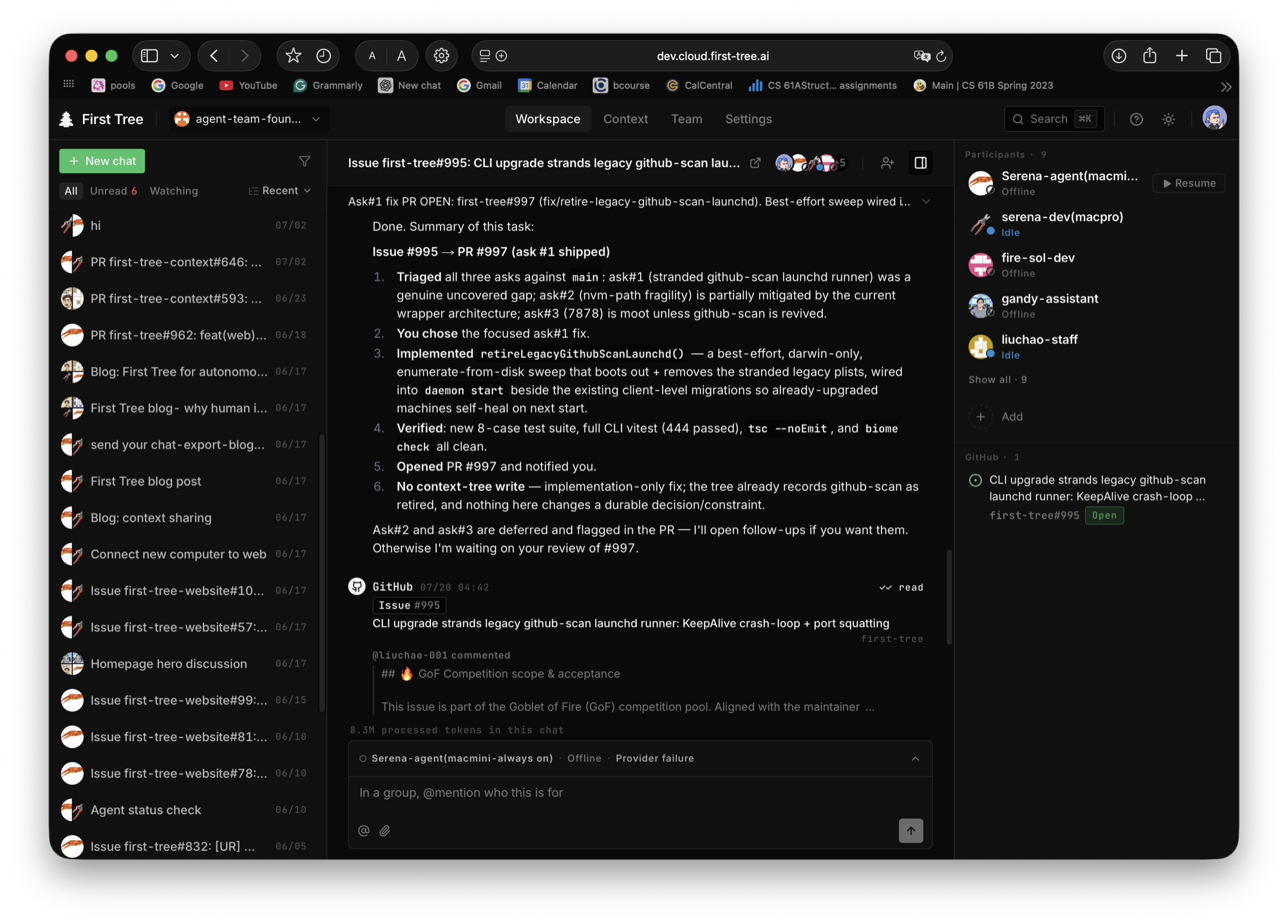
The work loop in practice. An agent reports back on what it shipped for a GitHub issue — while the linked issue, the team's chat history, and every human and agent participant stay in view, so the next task starts from the same shared context.
| Works with |
 Claude Code |
 Codex |
 GitHub |
 MCP |
Why First Tree
There are many AI agent workspaces. First Tree's core difference is the context
loop:
user intent -> read team context -> context-aware agent work
-> human review/control -> durable outcome -> updated team context
This loop solves the part that usually breaks when teams start using agents:
- context stays private in one person's terminal, prompt, or notes
- agents repeat old decisions because they cannot see team memory
- work finishes in a chat, PR, or document but never updates the shared context
- humans get pulled in without enough background to make a good decision
- each new agent task starts cold, even when the team already learned something
First Tree is built around a different assumption:
Agent work should be grounded in team context, visible while it runs, guided
by humans at the right moments, and turned into durable outcomes that can
update team memory.
That makes First Tree useful in two modes:
- Focused copilot work - collaborate deeply with an agent in a persistent
work stream for design, coding, writing, research, or problem solving. - Parallel review work - let agents move multiple tasks forward and involve
you only when a decision, blocker, approval, or review is needed.
In both modes, First Tree gives teams one place to:
- give agents the same Context Tree your team uses
- start and continue agent work in persistent chats
- see active work, blocked states, and human review points
- inspect the process, artifacts, and rationale behind a request
- turn useful outcomes back into updated team context
It is not another agent, and not just another workspace. It is a context loop
for human-agent teams.
How It Works
First Tree connects five pieces around Context Tree:
- Context Tree — a Git-native team memory layer for decisions, ownership,
responsibilities, constraints, and shared context. - Web workspace — the daily surface for chats, agents, team members,
computers, GitHub, and context-backed work. - CLI + daemon — signs a computer in and keeps local agents connected.
- Agent runtime — runs agents on your machine and routes messages through
First Tree. - GitHub integration — connects code work, pull requests, and review back
to the workspace.
Together, these pieces keep agent work connected to team context before,
during, and after execution.
Get Started
Open the app at first-tree.ai
(or your own deployment) and sign in. The guided setup walks you through the
first run: name your team, connect a computer, create your first agent, and
start work.
See the Quickstart for the full walkthrough.
At the "connect a computer" step, setup gives you the channel-aware commands
to install the CLI and link the machine. Hosted production uses:
curl -fsSL https://download.first-tree.ai/releases/prod/install.sh | sh
~/.local/bin/first-tree login <connect-code>
Use the exact commands shown in the web console, especially for staging or a
self-hosted deployment. The macOS/Linux installer bundles Node.js, so new
users do not need to install Node separately. The two lines are intentionally
independent and do not provide shell-level transaction protection: when pasted
together, an install-line failure does not automatically prevent the login line
from running, and POSIX sh does not guarantee that curl | sh preserves acurl failure status. The explicit ~/.local/bin path works immediately, even
before the shell reloads its PATH.
CLI
first-tree
├── login <code>            Sign this computer in
├── logout                  Stop the daemon and clear credentials
├── status                  CLI / daemon / server / auth overview
├── doctor                  Cross-subsystem readiness check
├── upgrade                 Upgrade to the latest published version
├── agent ...               Agent management
├── chat ...                Chats and messaging
├── org ...                 Organization-level operations
├── daemon ...              Background daemon lifecycle
├── config ...              View / modify this machine's client.yaml
└── tree ...                Context Tree onboarding, validation, automation
Run first-tree <namespace> --help for the full list under any namespace.
Repo Layout
apps/cli/— published CLI (first-tree/ft)packages/shared/— Zod schemas, types, config system (@first-tree/shared)packages/server/— Fastify API server (@first-tree/server)packages/client/— Cloud SDK/observability, Runtime, and built-in Providers (@first-tree/client)packages/web/— React web workspace (@first-tree/web)packages/qa/— internal QA workflow assets for agent-run validation (@first-tree/qa)skills/— repo-local skill payloads for First Tree agents
Documentation
- Quickstart — from signup to first agent work
- Onboarding Guide — CLI flow, SDK, troubleshooting
- CLI Reference — every command and environment variable
- Observability — logs and OpenTelemetry traces
- Portable Node Runtime — bundled Node policy for portable releases
- docs/development/ — contributor reference
- docs/troubleshooting/ — environment-specific gotchas
- docs/migration/ — coming from
[email protected]
Development
For the full local setup, including .env, migrations, service URLs,
troubleshooting, and optional GitHub App configuration, see
DEVELOPMENT.md.
pnpm install                                # Install dependencies
docker compose up -d                        # Dev PostgreSQL
pnpm --filter @first-tree/server dev        # Server
pnpm --filter @first-tree/web dev           # Web workspace
pnpm check && pnpm typecheck                # Lint + type check
pnpm test                                   # Tests
pnpm coverage                               # Local unit coverage
pnpm coverage:summary                       # Summarize generated coverage
See AGENTS.md for architecture, conventions, and the per-package
development workflow. See CONTRIBUTING.md for the PR
workflow.
License
Yorumlar (0)
Yorum birakmak icin giris yap.
Yorum birakSonuc bulunamadi