DSSH
Health Uyari
- License — License: NOASSERTION
- Description — Repository has a description
- Active repo — Last push 0 days ago
- Low visibility — Only 5 GitHub stars
Code Basarisiz
- rm -rf — Recursive force deletion command in build-libssh2.sh
- rm -rf — Recursive force deletion command in tools/fetch_fonts.sh
- rm -rf — Recursive force deletion command in tools/install_cia_tools.sh
- rm -rf — Recursive force deletion command in tools/install_whisper_api.sh
- rm -rf — Recursive force deletion command in tools/install_whisper_dual.sh
Permissions Gecti
- Permissions — No dangerous permissions requested
Bu listing icin henuz AI raporu yok.
Nintendo 3DS SSH client with on-screen pinyin IME, RSA auth, citro2d ANSI terminal, and a crab
English · 中文
DSSH

Nintendo 3DS SSH client — pinyin IME · voice input · ANSI terminal
Top screen runs a citro2d ANSI terminal · bottom screen draws its own
soft keyboard · RSA public-key auth over libssh2 + mbedTLS
Press START to dictate Chinese into Claude Code; type pinyin on
the soft keyboard for the rest.
Run tmux + claude-code from a 3DS — code from
the couch without ever opening the laptop.



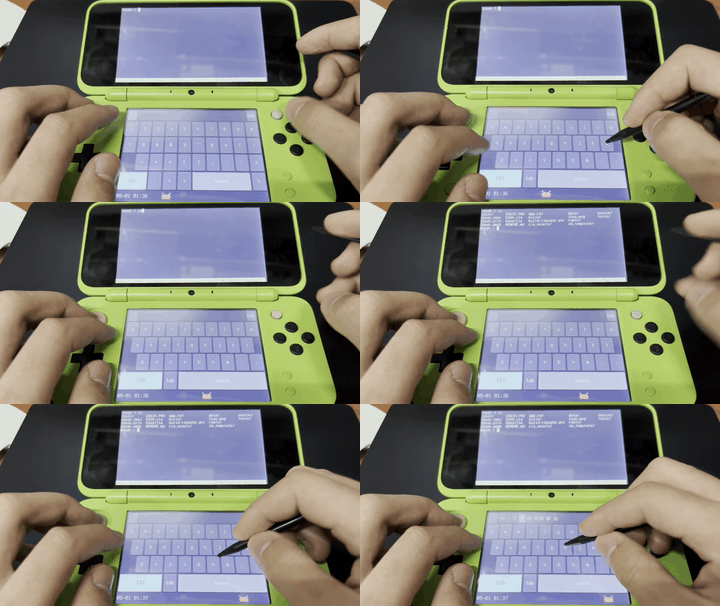
Real New 2DS XL · top screen ANSI terminal · bottom screen soft
keyboard + clock + crab
Full 1m42s demo video (10 MB MP4)
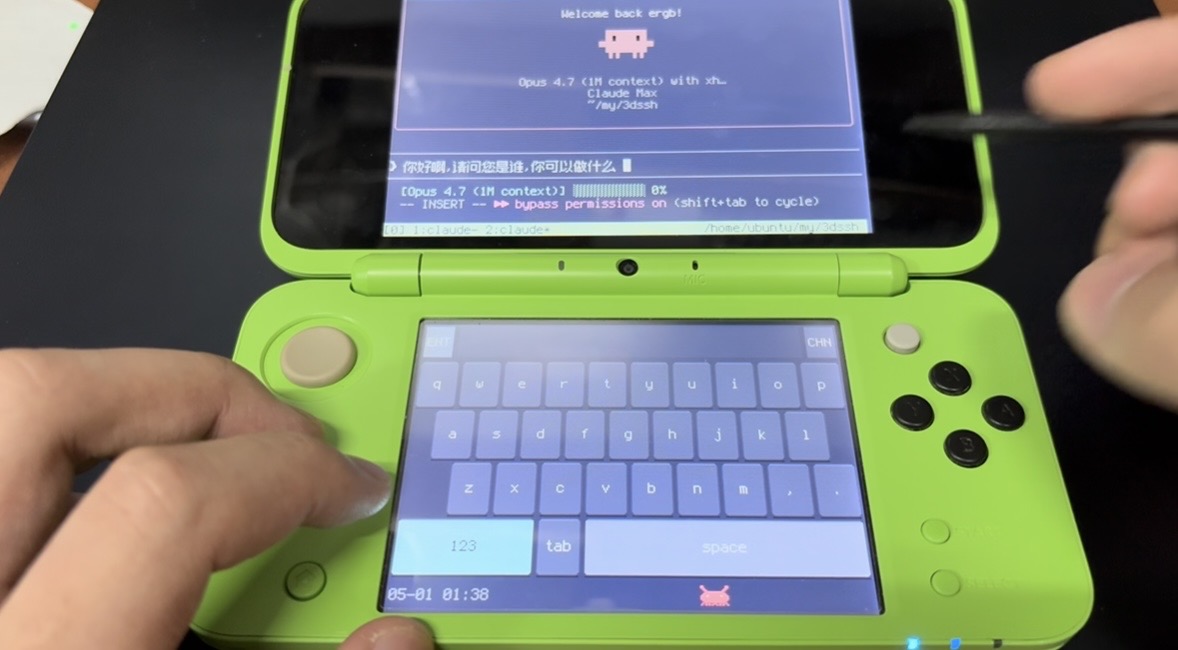
Real New 2DS XL · top: typing「你好啊!请问您是谁,你可以做什么」into
Claude Code · bottom: letter page + CHN mode + Shift held
Features
- Full ANSI / VT100 terminal — tmux status bar, claude-code spinner,
box-drawing borders, 256-color, TrueColor, Braille; everything renders. - Chinese rendering — bundled Zpix 12px pixel font covers 21,000+ CJK
unified ideographs, Terminus 6×12 for ASCII; mixed CJK/ASCII baselines
align cleanly on the same line. - Self-drawn soft keyboard — iOS-style 3px rounded keys with smooth
press-down animation; letters / symbols pages. - Pinyin input method — top 300k entries from rime-ice, plus
abbreviation matching (nh→ 你好), prefix fallback (nihaoz
auto-falls-back tonihao), and a candidate cursor. - Voice input (v1.0) — press START, speak a Chinese sentence,
press START again; ~1-2 s later the transcribed text drops
straight into the SSH terminal. Default backend is OpenRouter
Whisper Large V3 Turbo over the cloud ($0.04per audio-hour); a
self-hosted whisper.cpp track is available if you'd rather not depend
on an external API. - Voice AI ask (NEW in v1.1) — hold L and press START to
ask DeepSeek-Chat a question by voice; the answer pops up in a
bottom-screen modal with markdown-styled rendering (headers in
yellow, code in cyan, bullets, etc.) without disturbing the SSH
session above. Press A in the modal to keep history for follow-
up questions, B to clear and start a new conversation. - RSA-4096 public-key auth — libssh2 + mbedTLS, private key read
from the SD card. - Full physical-key mapping — D-pad arrow keys, hold-style modifiers
(L = Shift, Y = Ctrl, X = Alt), Circle Pad scrollback / mouse-wheel. - Anthropic-red crab mascot — scampers along the bottom row, dodges
when you tap it 🦀. - Hidden debug page — double-tap the ENG/CHN badge to see the live
SSH byte stream, full key-binding cheat sheet, and a mascot toggle.
Table of contents
- Install
- Server-side setup
- Configure config.ini
- Voice input
- Key bindings
- Using the IME
- Debug page
- Build from source
- Project layout
- Credits
- License
Install
DSSH runs on a modded 3DS / 2DS / New 3DS. You need either the
Homebrew Launcher (HBL) or a CIA installer like FBI.
Option A — .cia install (recommended)
- Grab
DSSH.cia(~14 MB) from the latest release. - Copy it anywhere on the SD card (e.g.
/cias/DSSH.cia). - Open FBI → SD → select
DSSH.cia→Install CIA. - The orange DSSH icon shows up on the HOME menu.
Option B — .3dsx direct launch
- Grab
3dssh.3dsxfrom the latest release. - Copy to
/3ds/dssh/dssh.3dsxon the SD card. - Open HBL → pick DSSH.
Option C — 3dslink over Wi-Fi (developer flow)
# On the 3DS: launch HBL, press Y → "Waiting for 3dslink..."
3dslink -a <3DS-LAN-IP> 3dssh.3dsx
Server-side setup (one-time)
The 3DS libssh2 build uses mbedTLS as its crypto backend and
hardcodes-disables ed25519. So you generate a fresh RSA-4096
keypair just for the 3DS — your existing ed25519 key on the PC keeps
working untouched.
⚠️ The
-m PEMflag matters. devkitPro's3ds-mbedtls
package is pinned at 2.28.x, which can only parse the traditional
PEM private-key format (-----BEGIN RSA PRIVATE KEY-----). Recentssh-keygen(Ubuntu 18.04+, macOS) defaults to the new OpenSSH
format (-----BEGIN OPENSSH PRIVATE KEY-----) which mbedtls 2.28
cannot read — DSSH will fail at handshake with "auth failed" if
you skip-m PEM.
# 1. Generate a 3DS-only RSA key on your PC.  -m PEM forces the
#    traditional PEM format so the on-3DS mbedtls can parse it.
ssh-keygen -t rsa -b 4096 -m PEM -f ~/.ssh/id_rsa_3ds -C "3ds-ssh-client"

# 2. Copy the public half into the server's authorized_keys
ssh-copy-id -i ~/.ssh/id_rsa_3ds.pub [email protected]

# 3. Verify the new RSA key works from your PC
ssh -i ~/.ssh/id_rsa_3ds [email protected] 'echo OK'
Already have an OpenSSH-format key? Convert it in place — no
need to re-add it to the server (the public half is unchanged):
ssh-keygen -p -m PEM -f ~/.ssh/id_rsa_3ds
# enter old passphrase (empty if none) and accept any new passphrase.
# The file's first line should now read: -----BEGIN RSA PRIVATE KEY-----
You can sanity-check the format with head -1 ~/.ssh/id_rsa_3ds.
Recommended hardening: prepend the new line in the server's~/.ssh/authorized_keys with from="<your-home-public-IP>" so a lost
SD card can only log in from your home network.
Copy the private key ~/.ssh/id_rsa_3ds onto the SD card at/3ds/3dssh/id_rsa (the path is fixed even when DSSH is installed as a
.cia — config + key always read from sdmc:/3ds/3dssh/).
⚠️ The SD card stores the key in plain text. Anyone holding the SD
can log in to your server. Addfrom="..."IP restriction orcommand="..."lockdown inauthorized_keys.
Configure config.ini
Copy sd_template/3ds/3dssh/config.ini.example to the SD card at/3ds/3dssh/config.ini and edit the values:
host       = your-server.example.com
port       = 22
user       = ubuntu
key_path   = sdmc:/3ds/3dssh/id_rsa
passphrase =
| Field | Meaning |
|---|---|
host |
Server IP or hostname |
port |
Port (default 22) |
user |
SSH login user |
key_path |
Private key path; sdmc:/... is the 3DS standard SD prefix |
passphrase |
Optional key passphrase; leave empty (typing one on the soft keyboard is awkward) |
Final SD layout:
sdmc:/3ds/3dssh/
├── config.ini
└── id_rsa
Voice input
TL;DR: install the API track (one curl + one API key, ~30 KB
on disk, ~1-2 s end-to-end). The self-hosted track exists for
completeness but is not recommended for typical servers — see the
warning at the bottom of this section.
Press START on the 3DS, speak a Chinese sentence, press START
again — the transcribed UTF-8 text drops into the SSH terminal as if
you had typed it. Full sentences flow into Claude Code without ever
opening the soft keyboard.
The 3DS records 16 kHz PCM mono via its built-in microphone, ships up
to 8 seconds of audio over a second libssh2 channel on the same
SSH session (no new ports, no new auth, no firewall changes), and a
small server-side shim transcribes via Whisper.
Status indicator (top-left of the soft keyboard top row):
- 🔴 REC (red, pulsing) — recording in progress
- ⠋⠙⠹⠸ (cyan, spinning) — uploading + transcribing
- ERR (red, 2 s) — request failed; press START again to retry
Recommended install — API track
The voice features need two API keys on the server. Both
together cost a few cents per month for personal use:
| Key | Where to get it | What it powers | Required? |
|---|---|---|---|
| OpenRouter | openrouter.ai/settings/keys | Whisper Large V3 Turbo (speech → text) | Required for voice IME (START) and AI ask (L+START) |
| DeepSeek | platform.deepseek.com/api_keys | DeepSeek-Chat (AI question answering) | Optional — only needed for L+START AI ask; voice IME works without it |
Pricing: OpenRouter Whisper Turbo is $0.04 / audio-hour (~a few
cents per month for an individual); DeepSeek-Chat is roughly$0.0001 per question. Both providers give a small free credit on
sign-up, more than enough to test.
One-command install
SSH into your server, then:
git clone https://github.com/Fishason/DSSH.git ~/dssh-repo
bash ~/dssh-repo/tools/install_whisper_api.sh
The installer will interactively prompt for both keys:
▶ checking prerequisites...
✓ python3 3.10
▶ installing daemon + shim + dssh-whisper CLI ...
▶ writing track config...

Need your OpenRouter API key (https://openrouter.ai/settings/keys).
Used for Whisper transcription.  Looks like:  sk-or-v1-...
Paste your OpenRouter key (or empty to skip): █

✓ api-key saved at /home/you/.config/dssh-whisper/api-key (chmod 0600)

Optional: DeepSeek API key (https://platform.deepseek.com/api_keys).
Used only by the L+START voice AI-ask modal — skip if you only
want plain voice IME.  Looks like:  sk-...
Paste your DeepSeek key (or empty to skip): █

✓ deepseek-key saved at /home/you/.config/dssh-whisper/deepseek-key (chmod 0600)
✓ dssh-whisper-api installed (lightweight, OpenRouter Whisper Turbo).
Non-interactive install (handy for CI / Ansible / clean rebuilds):
OPENROUTER_API_KEY="sk-or-v1-..." \
DEEPSEEK_API_KEY="sk-..." \
bash ~/dssh-repo/tools/install_whisper_api.sh
Verify the install worked
$ dssh-whisper status
active track: api
(API-only install — no local daemon)
api-key:  ✓ /home/you/.config/dssh-whisper/api-key
The 3DS calls ~/.local/bin/dssh-whisper-shim over SSH-exec on every
START press; no further server-side action is needed.
What the installer dropped on disk
~/.config/dssh-whisper/
├── track            # "api" or "local"
├── api-key          # chmod 0600 — OpenRouter
└── deepseek-key     # chmod 0600 — DeepSeek (optional)
~/.local/bin/
├── dssh-whisper          # CLI wrapper (start/stop/status/switch/uninstall)
└── dssh-whisper-shim     # symlink the 3DS reaches over SSH-exec
~/.local/share/dssh-whisper/
└── whisper_shim.py       # the actual Python that talks to both APIs
Footprint: ~30 KB. No daemon, no model, nothing to monitor.
Rotating a key later
Compromised key, expired credit, swapping providers — overwrite the
file:
echo 'sk-or-v1-NEW_KEY' > ~/.config/dssh-whisper/api-key
chmod 0600 ~/.config/dssh-whisper/api-key
# (no service to restart — the shim re-reads the key on every call)
| Field | Value |
|---|---|
| Inference | OpenRouter Whisper Large V3 Turbo (cloud) + DeepSeek-Chat |
| Latency (4 s clip) | ~1-2 s STT, +1-2 s LLM for AI ask |
| Cost | $0.04 / audio-hour STT + ~$0.0001 / AI question |
| Server install size | ~30 KB |
| Server CPU load | negligible |
| Internet | required (HTTPS to openrouter.ai + api.deepseek.com) |
That's enough for 99% of users — install it, press START, done.
dssh-whisper CLI
dssh-whisper status                # active track + daemon status + key presence
dssh-whisper switch                # toggle api ↔ local
dssh-whisper switch [api|local]    # set explicit track
dssh-whisper start                 # start local daemon (dual install only)
dssh-whisper stop | close          # stop local daemon
dssh-whisper restart
dssh-whisper logs [-f]             # tail systemd-user logs (dual install)
dssh-whisper uninstall             # remove all dssh-whisper files
Daemon-related commands degrade gracefully on the API-only install
(they print "no daemon to start", non-fatal).
Quick AI questions (L + START) — v1.1
Stuck in yazi and forgot the keybind for hidden files? Need a
one-liner regex for vim? Hold L and press START — you're
now asking the AI instead of typing into the SSH session. A modal
pops up on the bottom screen with the answer; the SSH terminal on top
is left untouched.
| In modal | Effect |
|---|---|
| A | close, keep the Q&A in history; next L+START continues the conversation |
| B or any touch on the bottom screen | close, clear history; next L+START is fresh |
Conversation history caps at 5 turns; if you keep pressing A past
that, the oldest turn drops off (FIFO).
The model is deepseek-chat (DeepSeek direct API, not via
OpenRouter) — picked for its sub-second latency and very low pricing
(~$0.0001 per question for personal use). Answers are 6-15 sentences
typically; long answers wrap inside the modal and overflow truncates
with a trailing ....
Markdown rendering in the modal
DeepSeek tends to use markdown. The modal renders common forms in
colour rather than showing raw syntax characters:
| Markdown source | Modal rendering |
|---|---|
# Heading / ## Heading / ### Heading |
yellow accent, # markers stripped |
`inline code` |
cyan, backticks stripped |
``` …code block… ``` |
cyan multi-line, fences stripped |
- item / * item |
• item (dim grey bullet + normal text) |
**bold** / *italic* |
normal text — syntax stripped, no emphasis (no bold font at this size) |
[link text](url) |
link text only — URL dropped |
~~strikethrough~~ |
normal text — syntax stripped |
DeepSeek key
You'll need a DeepSeek API key from
platform.deepseek.com/api_keys.
The installer prompts for it alongside the OpenRouter key (skippable
— plain voice IME works without it). Stored at~/.config/dssh-whisper/deepseek-key chmod 0600 — see Rotating a
key later above to change it.
Notes
- 3DS firmware caps recording at ~32 s per press (the 1 MB mic buffer
fills at 16 kHz × 16-bit). Tap START earlier to commit any time. - Use HOME (not START) to exit DSSH — START is dedicated to voice.
~/.config/dssh-whisper/is on.gitignorealready; rotating the
API key is oneecho > api-keyaway.- The 3DS code calls
~/.local/bin/dssh-whisper-shimover a libssh2
exec channel. The shim reads the active track and dispatches —
switching tracks doesn't require restarting the 3DS or the SSH
session.
Advanced — Dual track (self-hosted, ⚠️ not recommended)
⚠️ Heads-up: the self-hosted track loads the
whisper-small
model (~1 GB resident) and runs CPU inference for every recording.
On a 2-vCPU AWS t3.medium with VS Code Remote, claude-code, tmux, and
chrome-devtools-mcp running, transcribing 4 seconds of audio took
~40 seconds — vs. ~1.5 seconds through OpenRouter at the same
moment. The cost difference is so small ($0.04 per audio hour ≈
pennies/month for personal use) that we strongly recommend the cloud
path unless you have a hard reason to keep audio on-prem.If you do go local, plan on:
- 4+ idle vCPU cores at 3+ GHz — anything less and the 3DS UX
spinner becomes painful.- 2+ GB free RAM for the small.zh model + buffers.
- No competing CPU consumers during transcription windows.
- ~600 MB disk for the model + venv.
If you genuinely want the offline path, the same dssh-whisper CLI
manages both tracks side-by-side — install the dual variant and flip
on demand:
git clone https://github.com/Fishason/DSSH.git ~/dssh-repo
bash ~/dssh-repo/tools/install_whisper_dual.sh
The dual install still defaults to track=api; flip to local only when
needed:
dssh-whisper switch local   # next START press → self-hosted whisper.cpp
dssh-whisper switch api     # next START press → OpenRouter (default)
dssh-whisper switch         # no arg = toggle
Key bindings
Physical buttons
| Button | Function | Notes |
|---|---|---|
| A | Enter (EN) / emit pinyin buffer as English (IME) | Accidentally typed English in CN mode? Press A and the buffer flies to SSH as raw ASCII — no need to backspace and switch modes. |
| B | Backspace / consume one pinyin letter | Hold-style auto-repeat (peaks at 60 / sec) |
| X | Alt modifier | Hold-style — held when the next key fires |
| Y | Ctrl modifier | Hold-style — Y + tap c → Ctrl-C |
| L | Shift modifier / + Circle Pad → right pane | See tmux split scrolling below |
| R | Toggle CN/EN input mode | Top-right ENG/CHN reflects the current mode |
| SELECT | Esc | Tap fires immediately |
| START | Voice input toggle | Press once to start recording; press again to stop and transcribe. See Voice input. |
| Space (soft keyboard) | Plain space (EN) / commit highlighted candidate (IME) | Matches sogou / fcitx convention |
| Shift + . | 。 (full-width Chinese period, U+3002) | Works in both EN and CN modes |
| D-pad ↑↓ | Arrow keys / IME page nav | When the IME buffer is active, ↑↓ paginates candidates |
| D-pad ←→ | Arrow keys / IME selection cursor | When active, ←→ moves the candidate cursor within the page |
| Circle Pad ↑↓ | Scrollback / tmux mouse-wheel | Default targets the left/top pane; hold L → right/bottom pane |
Long-press D-pad or B: 250 ms initial delay, ramps up to 12 / sec at
0.5 s, peaks at 60 / sec after 1.5 s.
tmux split scrolling
The 3DS has no real cursor, so tmux's mouse-wheel events get routed by
the (col, row) we send. DSSH defaults to (1, 1) → hits the
left/top pane; holding L sends (60, 12) → hits the right/bottom
pane. In a vertical-split tmux:
| Action | Effect |
|---|---|
| Circle Pad ↑↓ | Scrolls the left pane |
| L held + Circle Pad ↑↓ | Scrolls the right pane |
Soft keyboard
The bottom screen is the soft keyboard — two pages:
- Letters page (default): QWERTY layout with
,.punctuation,
Tab, and a wide Space. - Symbols page (toggle via the bottom-left
123key):1234567890,!@#$%^&*()cleanly aligned on two rows, plus other
common punctuation including?and\.
Any key supports hold-style modifier combos. Example:
hold Y + tap b = Ctrl-B (the tmux prefix).
Status bar (top 30 px)
┌──────────────────────────────────────────────────────┐
│ [SFT]   candidate strip / pinyin buffer / cands [CHN]│
└──────────────────────────────────────────────────────┘
- Left slot [STA]: 3-letter modifier indicator (SFT/CTL/ALT stays lit
while held; ENT/BSP/ESC/R→Cflashes for 200 ms on transient events). - Middle: pinyin buffer + candidates in CN mode; empty in EN mode.
- Right slot [ENG/CHN]: current IME mode. Double-tap to enter
the debug page.
Using the IME
Full pinyin
Tapping letters in CN mode brings up the candidate strip:
ni       → 年 你 牛奶 娘 念   (page 1/52, total 256)
nihao    → 你好 你好吗 你好啊 拟好 你好呀
shijie   → 世界 世界上 世界杯 世界各地 世界里
- A or Space commits the currently highlighted candidate.
- D-pad ←→ moves the highlight within the current page.
- D-pad ↑↓ flips between pages.
- Tap a candidate to commit it directly.
- B consumes one letter from the pinyin buffer.
Abbreviation (initials)
Every multi-syllable word gets an extra entry keyed by its initials —
typing the initials still surfaces it (with weight × 0.3, so the
full-pinyin form still ranks first when typed in full):
nh → 你好  (around the 8th candidate)
wm → 我们  (top candidate)
sj → 世界
zw → 中文
xx → 谢谢
Page or cursor over to your target, then commit with A.
Prefix fallback
Typed an extra letter past a valid prefix? The engine automatically
matches the longest valid prefix and shows the surplus letters in red:
buffer:  niha[oz]    ← niha in green + oz in red
candidates:           still showing what nihao would produce
Press B to chew the red tail back to a clean prefix.
Modifiers always bypass the IME
In CN mode, hold Y + tap c still sends Ctrl-C; hold L + tap a
still sends A. Modifiers take priority over IME routing, so
vim / tmux / claude-code shortcuts keep working.
Bail out: emit pinyin as English
CN mode + non-empty buffer + press A = the buffer flies to SSH as
raw ASCII letters and clears. Example: you accidentally typedcd /etc while in CN mode and the candidate strip is showing strange
Chinese. One press of A delivers cd /etc to the shell — no
backspacing, no mode-toggle, no retyping.
Difference: Space commits the highlighted candidate (Chinese
chars on screen). A sends the typed letters as-is.
Debug page
Double-tap the ENG/CHN badge in the top-right corner (two taps within
500 ms) to enter the debug overlay. Single-tap the badge again to leave.
What it shows:
- Title + exit hint.
- recv hex: the last 32 bytes received from SSH — for diagnosing
ANSI / SCS / mouse-protocol issues at the byte level. - Physical key cheat sheet: a condensed version of the bindings
table above. - MASCOT: ON/OFF toggle button. Default is ON.
Build from source
Prerequisites
- Linux x86_64 (tested on Ubuntu 22.04; other distros need the obvious
package-name adjustments). - devkitPro / devkitARM
release 65+, GCC 14.2.0. - Python 3.10+ with Pillow (for font + dictionary generators).
Steps
# 1. Install devkitPro
wget https://apt.devkitpro.org/install-devkitpro-pacman
bash install-devkitpro-pacman
sudo dkp-pacman -S 3ds-dev 3ds-mbedtls 3ds-libpng 3ds-zlib

# 2. Clone + cd
git clone https://github.com/Fishason/DSSH.git
cd DSSH

# 3. Cross-compile libssh2 (one-time, drops into $DEVKITPRO/portlibs/3ds/lib/)
bash build-libssh2.sh

# 4. Install system fonts (Terminus provides ASCII / box-drawing)
sudo apt install fonts-terminus

# 5. Fetch font sources (Zpix)
bash tools/fetch_fonts.sh

# 6. Generate the font atlas (→ source/font_data.c, ~3 MB)
python3 tools/gen_font.py

# 7. Fetch + build the pinyin dictionary (→ romfs/pinyin_dict.bin, ~13 MB)
bash tools/fetch_pinyin_dict.sh
python3 tools/gen_pinyin_dict.py

# 8. Build the .3dsx
make

# 9. (Optional) build the .cia
bash tools/install_cia_tools.sh   # installs bannertool + makerom into ~/bin
make cia                          # → DSSH.cia
Test the IME engine on the host (no 3DS needed)
make test-ime
Compiles tools/test_ime.c linked against source/ime_pinyin.c and
runs nine smoke-test queries (ni → 你, nihao → 你好, nh → 你好,
etc.).
Project layout
DSSH/
├── 69633.PNG                  # Source icon (162×102)
├── icon.png                   # 48×48 icon for .3dsx / SMDH (derived)
├── app.rsf                    # makerom CIA spec
├── Makefile                   # Top-level build (make / make cia / make test-ime)
├── build-libssh2.sh           # libssh2 + mbedTLS ARM cross-compile
├── source/
│   ├── main.c                 # Main loop, SSH receive, UTF-8 reassembly
│   ├── ssh_client.{c,h}       # libssh2 wrapper
│   ├── config.{c,h}           # SD-card config.ini parser
│   ├── terminal.{c,h}         # ANSI/VT100 parser (forked from skmtrd)
│   ├── renderer.{c,h}         # citro2d rendering (terminal, text, CJK)
│   ├── keyboard.{c,h}         # Physical buttons + IME routing
│   ├── softkb.{c,h}           # Soft keyboard + candidate strip + debug page
│   ├── ime_pinyin.{c,h}       # Pinyin engine
│   ├── mascot.{c,h}           # Crab mascot
│   ├── font_atlas.{c,h}       # Codepoint → glyph index
│   └── font_data.c            # Font bitmaps (gen_font.py output)
├── tools/
│   ├── fetch_fonts.sh         # Download Zpix
│   ├── gen_font.py            # Font atlas generator
│   ├── fetch_pinyin_dict.sh   # Download rime-ice
│   ├── gen_pinyin_dict.py     # Dictionary → binary
│   ├── test_ime.{c,sh}        # Host-side IME smoke test
│   ├── gen_cia_assets.py      # Icon / banner derivation
│   └── install_cia_tools.sh   # bannertool + makerom installer
├── romfs/                     # gitignored — packs pinyin_dict.bin
├── data/                      # gitignored — font + dict sources
└── sd_template/               # SD-card deployment template
    ├── README.md
    └── 3ds/3dssh/config.ini.example
Architecture
SSH server (somewhere on the internet)
     ▲ libssh2 over mbedTLS-RSA-4096
     │
┌────┴──────────────────────────────────────────────────┐
│  main.c poll loop @ 60 fps                            │
│   ├─ ssh_read → softkb_record_recv → utf8 reassemble  │
│   │                ↓                                  │
│   │   terminal_write_n → ANSI parser → cell grid      │
│   ├─ hidScanInput → keyboard_handle_input             │
│   │   └─ IME mode? → ime_input_letter / page / select │
│   ├─ hidTouchRead → softkb_touch                      │
│   │   ├─ candidate strip hit → ime_select             │
│   │   ├─ key hit → keyboard_emit_for / ime_input      │
│   │   └─ badge double-tap → debug_mode toggle         │
│   └─ render: top = renderer_draw_terminal             │
│              bot = softkb_draw + clock + mascot       │
└───────────────────────────────────────────────────────┘
     │
   citro2d (3DS 2D rendering)
     │
   GPU (top 400×240 + bottom 320×240, 24-bit color)
The build went through milestones M0 → M9; see the commit history for
the full progression.
Credits
- skmtrd/3dssh — the original
Japanese-localized 3DS SSH client; DSSH reuses its ANSI/VT100 parser,
UTF-8 reassembly, and citro2d framing. - rime-ice — pinyin dictionary
source (pinned at commit3f57a6f6). - Zpix Pixel Font —
12 px CJK pixel font (OFL 1.1). - Terminus TTF — ASCII
and box-drawing pixel font. - libssh2 + mbedTLS —
SSH / TLS protocol stack. - devkitPro libctru / citro2d / citro3d —
3DS user-mode runtime and rendering. - carstene1ns/3ds-bannertool
- 3DSGuy/Project_CTR makerom —
CIA packaging tools.
- 3DSGuy/Project_CTR makerom —
License
MIT — see LICENSE.
The bundled fonts, dictionary, and upstream SSH/TLS libraries each
have their own licenses (OFL / GPL / BSD / MIT / Apache). Respect
those when redistributing the binary.
Yorumlar (0)
Yorum birakmak icin giris yap.
Yorum birakSonuc bulunamadi