mori
Health Warn
- License — License: AGPL-3.0
- Description — Repository has a description
- Active repo — Last push 0 days ago
- Low visibility — Only 5 GitHub stars
Code Fail
- fs.rmSync — Destructive file system operation in extensions/mori-cline-plugin/dist/mori-plugin.js
- os.homedir — User home directory access in extensions/mori-cline-plugin/dist/mori-plugin.js
- process.env — Environment variable access in extensions/mori-cline-plugin/dist/mori-plugin.js
- fs module — File system access in extensions/mori-cline-plugin/dist/mori-plugin.js
- fs.rmSync — Destructive file system operation in extensions/mori-cline-plugin/src/mori-plugin.ts
- os.homedir — User home directory access in extensions/mori-cline-plugin/src/mori-plugin.ts
- process.env — Environment variable access in extensions/mori-cline-plugin/src/mori-plugin.ts
- rimraf — Recursive directory removal in extensions/mori-shipper/package-lock.json
Permissions Pass
- Permissions — No dangerous permissions requested
No AI report is available for this listing yet.
mori MCP server — A shared memory layer for AI coding agents — one that compounds.

Mori (森) is a shared memory layer for AI coding agents — one that compounds.
Sessions feed a dream pipeline that distils activity into durable knowledge,
so every instance starts informed rather than cold. One Mori, many agents —
every session benefits from what every other session learned.
Works with any OpenAI-compatible provider. No homelab, no Anthropic
account, no LLM Gateway required — though those all work too.
Multi-Instance Coherence
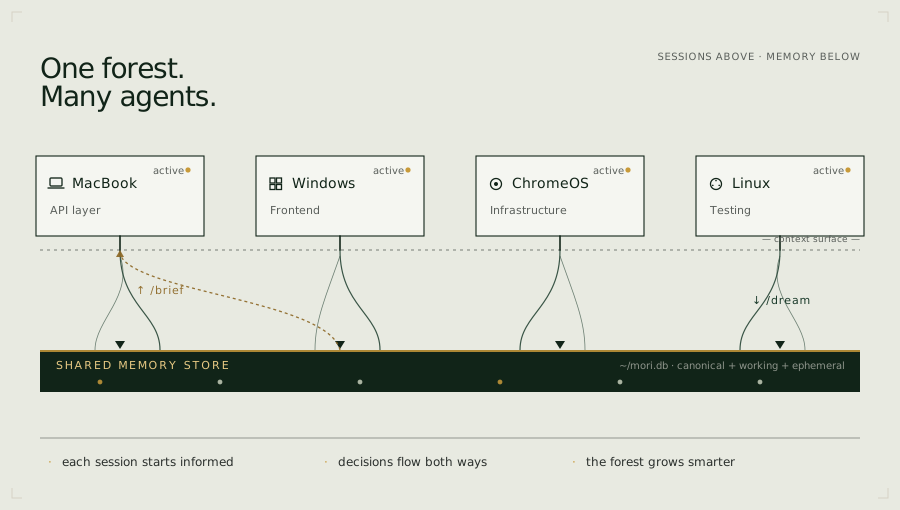
If you run AI coding agents across multiple machines, profiles, or in a team — one focused on the API layer, another on the frontend, a third on infrastructure — you already know the problem: each instance is brilliant in isolation, but none of them know what the others decided.
Instance B doesn't know that Instance A just changed the auth contract. Instance C
doesn't know that Instance B's deployment assumptions shifted. They find out the
hard way, mid-task, when something breaks.
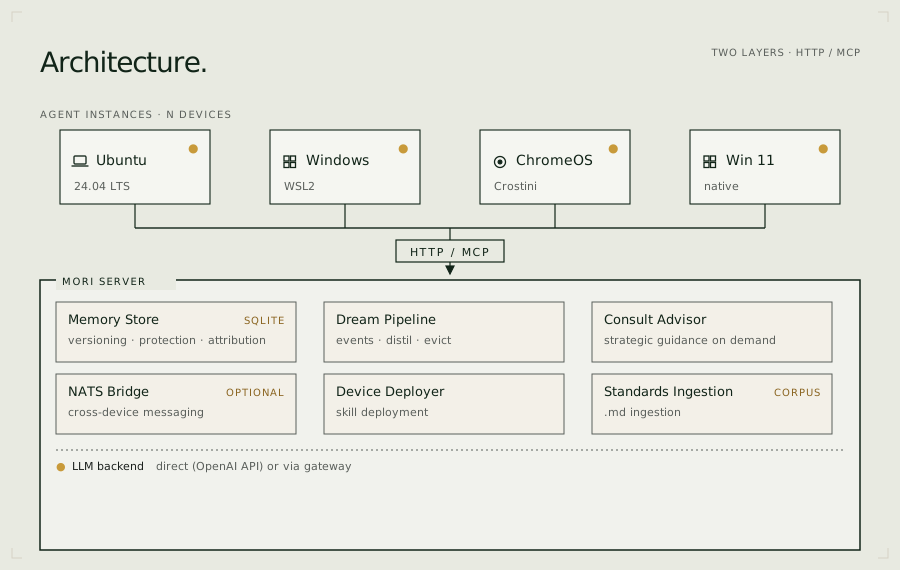
Mori solves this. Every coding agent instance sends its session events to the shared Mori
server. The dream pipeline distils those events from all instances into a
unified memory store. At the start of any session, /brief surfaces what the
other instances have been doing. From turn one, each instance knows what the
others know.
Quickstart
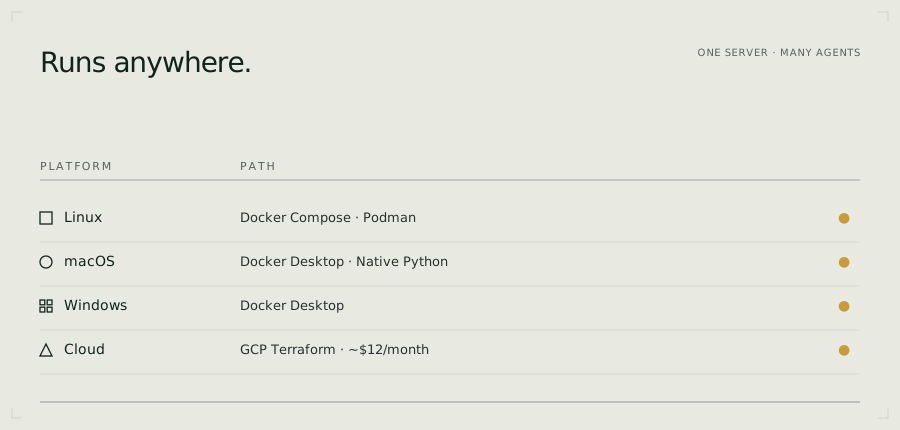
1. Deploy
See docs/deployment/quickstart.md for all
platforms. Docker Compose is the fastest path:
git clone https://github.com/fjwood69/mori.git
cd mori
cp deploy/homelab/.env.example deploy/homelab/.env
# Edit .env with your provider API key
docker compose -f deploy/homelab/docker-compose.yml up -d
2. Verify
curl http://localhost:8968/health
# {"status":"ok","service":"mori-advisor"}
3. Connect your agent
# Claude Code — automated installer:
./scripts/install-mori-claude.sh

# Cursor — automated installer:
./scripts/install-mori-cursor.sh

# Windows:
powershell -File scripts/install-mori-claude.ps1
powershell -File scripts/install-mori-cursor.ps1
Platform guides
| Platform | Installer | Full guide |
|---|---|---|
| Claude Code | ./scripts/install-mori-claude.sh |
docs/getting-started/claude-code.md |
| Cursor | ./scripts/install-mori-cursor.sh |
docs/getting-started/cursor.md |
| Google Antigravity IDE | ./scripts/install-mori-antigravity.sh |
docs/getting-started/antigravity.md |
| Cline | ./scripts/install-mori-cline.sh |
docs/getting-started/cline.md |
Capabilities
| Capability | What it does | Slash command |
|---|---|---|
| Dream pipeline | Auto-distils session events into structured memories | /dream |
| Session grounding | Loads shared context at session start — not per-query RAG | /brief |
| Universal ingestion | Feed PDFs, images, git, transcripts into the memory store | /ingest |
| Strategic review | LLM guidance with focus areas and auto-injected standards | /consult |
| Requirements tracking | Lightweight project checklist surfaced via /brief |
/req |
| Governance | Versioning, trusted dreamers, rollback, attribution | — |
| NATS messaging | Real-time cross-device awareness | /nats |
| Inter-agent messaging | Send tasks, questions, and decisions across the device network | /msg |
| Skill deployment | Push slash commands to all devices in one step | /update |
Full reference: docs/reference/slash-commands.md
How it works
Dream pipeline
Session events are captured via Claude Code lifecycle hooks and distilled into
structured memories by a configurable LLM.
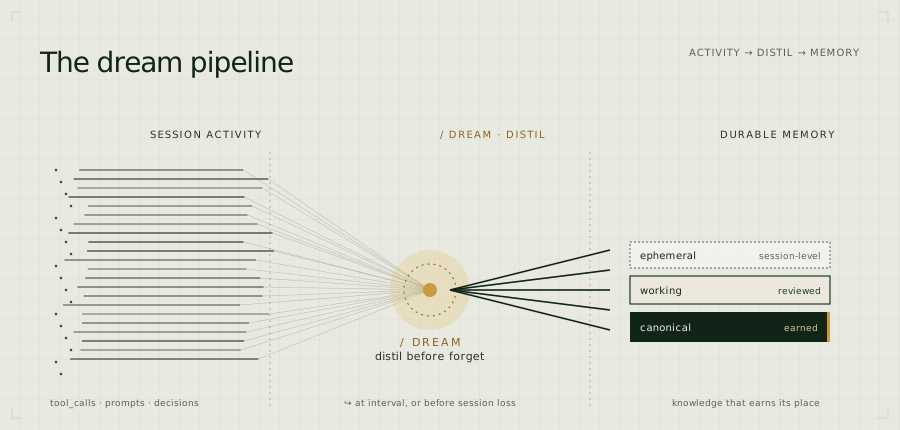
Hook fires  →  POST /api/events/raw  →  SQLite events table
                                             ↓
PreCompact  →  POST /api/precompact  →  dream_run() reads since watermark
                                             ↓
                                      LLM distills events → structured memories
                                             ↓
                                      memories written to store (with attribution)
                                             ↓
                                      watermark advanced
The PreCompact hook triggers an immediate synchronous dream before context
compression — so nothing is lost at the moment it matters most.
What it captures: PostToolUse, PostToolUseFailure, PreCompact,UserPromptSubmit, Stop — tool calls, prompts, errors, stop reasons,
session ID, hostname, working directory, transcript path.
Memory store
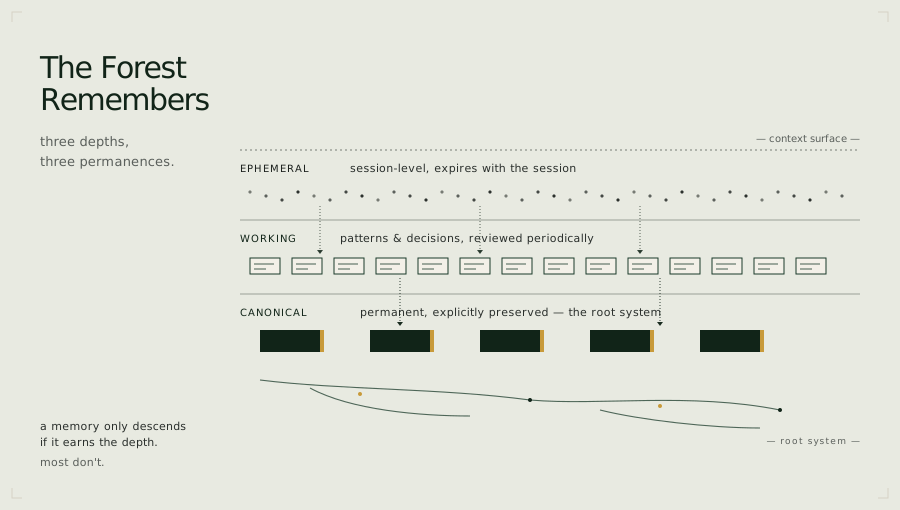
Memories live in SQLite (memories.db) with three tiers:
| Tier | Scope | Lifecycle |
|---|---|---|
| Ephemeral | Session summaries | Auto-expire unless explicitly saved |
| Working | Patterns, decisions, project context | Flagged after 30 days without retrieval |
| Canonical | Explicitly promoted by a trusted dreamer | Indefinite, freshness-checked via /brief |
Versioning, diff, rollback, attribution, and governance built in.
See docs/reference/configuration.md.
Universal ingestion
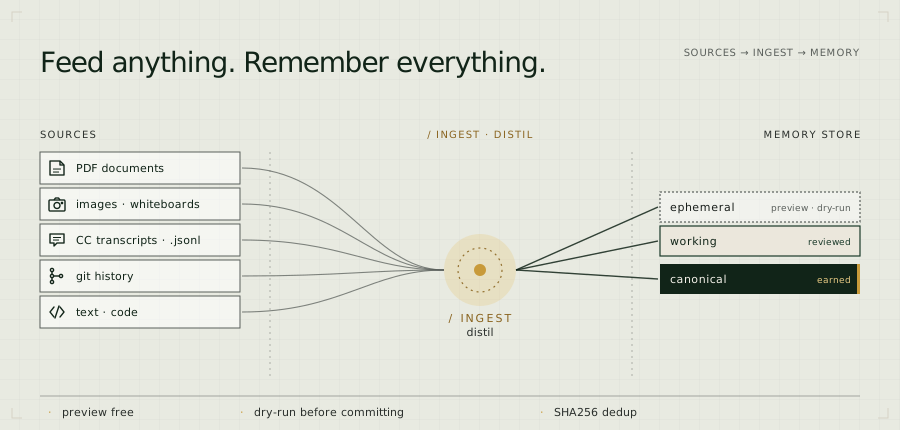
New team members start cold. /ingest bootstraps the memory store from
existing source material — applying the same distillation pipeline that
powers the dream phase.
# Preview (zero cost, no LLM):
/ingest --source ~/my-project --preview

# Dry-run to validate extraction quality:
/ingest --source ~/my-project --dry-run --focus decisions

# Commit:
/ingest --source ~/my-project --focus all --tier working
Supported: PDF, images/whiteboards (Kimi K2.6 vision), CC transcripts
(.jsonl), git history (--since 30d), text and code.
Works with remote servers: /ingest reads files on the client device and
sends content over the wire — no shared filesystem needed. Works whether
mori-advisor is running locally or on GCE.
Cost guard: --max-cost (default $5.00) aborts before spending. Preview
is always free. SHA256 dedup prevents re-ingesting the same content.
Strategic consultation (/consult)
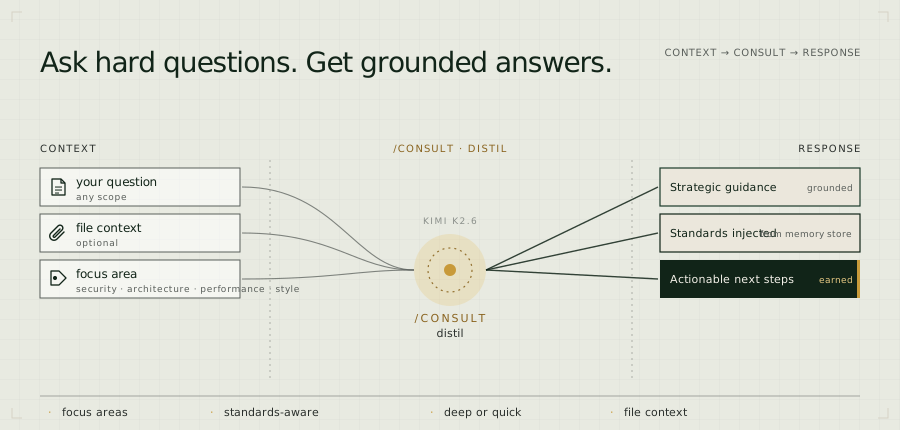
Ask a question mid-session and get strategic guidance grounded in your actual
project context — not generic advice. When a focus area is specified,
relevant team standards are automatically pulled from the memory store and
injected alongside your question. The advisor checks against your own baseline,
not a textbook.
# Architecture review with file context:
/consult "should we move auth to a separate service?" --focus architecture

# Security review against your team's own baseline:
/consult "review this handler" --focus security --file src/auth.py

# Chain tool output directly into the advisor:
/consult "review this" --focus security --file src/auth.py --file snyk-report.json
Focus areas: general, architecture, security, performance, style
Depth levels: quick (fast scan), balanced (default), deep (thorough)
Standards-aware: set MORI_STANDARDS_DIR to a directory of .md files
and Mori imports them as protected memories. /consult --focus security
automatically injects your security baseline — your agents check against your
rules, not generic ones.
Inter-agent messaging (/msg)
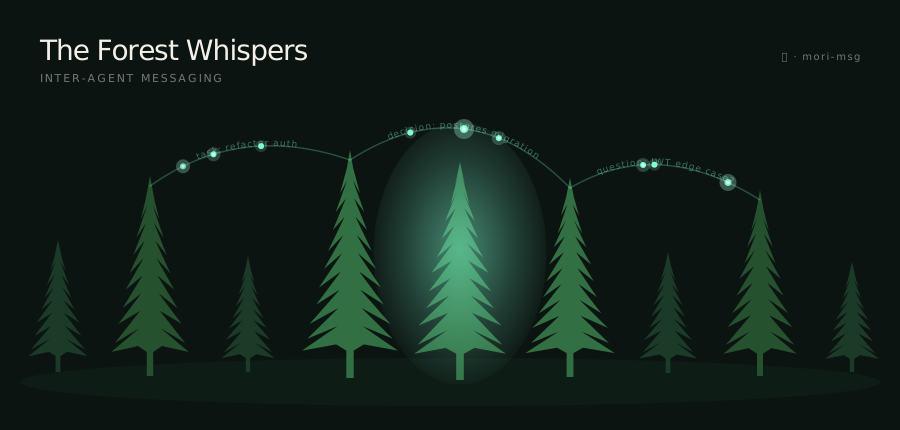
Delegate tasks, ask questions, and share decisions across your Claude Code
instances — without a shared session. Messages are typed, reply-threaded, and
picked up at the next /brief. The mori-msg daemon receives messages
server-side: decision messages are written directly to the memory store
without any human session on the receiving end.
# From UX3405, delegate a task to the NUC:
/msg send nuc15pro task "Refactor auth middleware — extract rate limiting into its own module"

# NUC picks it up at next /brief and acks:
/msg ack a3f9c2b1 "on it"

# Back on UX3405, check the reply:
/msg inbox

# NUC marks it done when finished:
/msg done a3f9c2b1
Message types: task, decision, question, reply, ack, done, broadcast
Requires the mori-msg daemon running alongside mori-advisor (included in
the default pod stack). See docs/reference/msg.md for full reference.
Architecture
Configuration
Configuration reference → docs/reference/configuration.md
Recommended models → docs/reference/models.md
For teams → docs/for-teams.md
Key environment variables:
| Variable | Default | Description |
|---|---|---|
MORI_PROVIDER_MODE |
bifrost |
direct or bifrost |
MORI_API_KEY |
— | Provider key (required in direct mode) |
MORI_BASE_URL |
— | OpenAI-compatible base URL |
MORI_MODEL |
moonshotai/kimi-k2.6 |
Advisor + consult model |
MORI_DREAM_MODEL |
falls back to MORI_MODEL |
Dream + ingest distillation model |
MORI_FAST_MODEL |
deepseek/deepseek-v4-flash |
Contradiction scan + freshness checks |
MORI_TRUSTED_DREAMERS |
— | Comma-separated trusted hostnames |
MORI_DREAM_INTERVAL |
60 |
Dream cron interval (minutes) |
MORI_STANDARDS_DIR |
— | Path to team standards .md files |
MORI_MSG_HEADLESS_ENABLED |
false |
Spawn headless Claude for incoming tasks |
MORI_MSG_HEADLESS_TRUSTED |
— | Comma-separated hostnames allowed to trigger headless CC |
Building
git clone https://github.com/fjwood69/mori.git
cd mori
podman build -t localhost/mori-advisor:latest .
# Or: docker build -t mori-advisor:latest .
License

AGPL-3.0 — see LICENSE. Commercial licences available — see COMMERCIAL.md.

Reviews (0)
Sign in to leave a review.
Leave a reviewNo results found