claude-convo-analyzer
Health Uyari
- License — License: MIT
- Description — Repository has a description
- Active repo — Last push 0 days ago
- Low visibility — Only 5 GitHub stars
Code Uyari
- process.env — Environment variable access in prisma.config.ts
Permissions Gecti
- Permissions — No dangerous permissions requested
Bu listing icin henuz AI raporu yok.
A local-only web app that analyzes your Claude Code conversation logs for per-conversation token usage and cost.
Claude Conversation Analyzer
A local-only web app that reads the Claude Code conversation logs stored on your
machine, parses them deterministically into a SQLite database, and shows you
per-conversation token usage and cost — broken down by project, model, skill,
and sub-agent.
Everything stays on your machine. The app only reads ~/.claude/projects
and writes a local SQLite file (./data/analyzer.db). Nothing is ever sent
anywhere.
About the cost figure: the cost shown is always "what these tokens would
cost through the public API". If you're on a Pro or Max subscription you
don't actually pay per token — so treat the number as the equivalent API
value of your usage, not a bill.
Screenshots
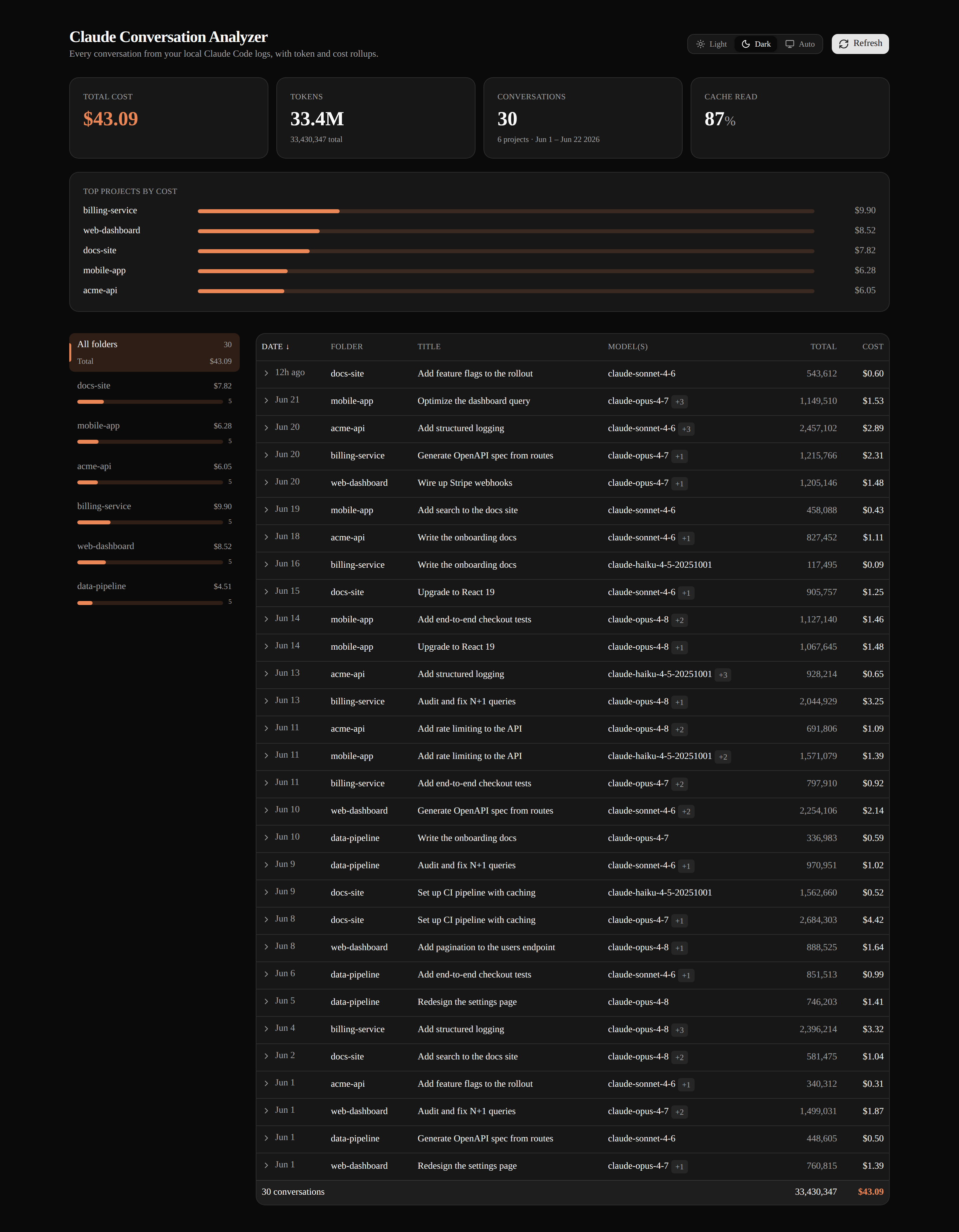
The conversation list — total cost, tokens, and a per-folder breakdown across
every project, sortable by any column:
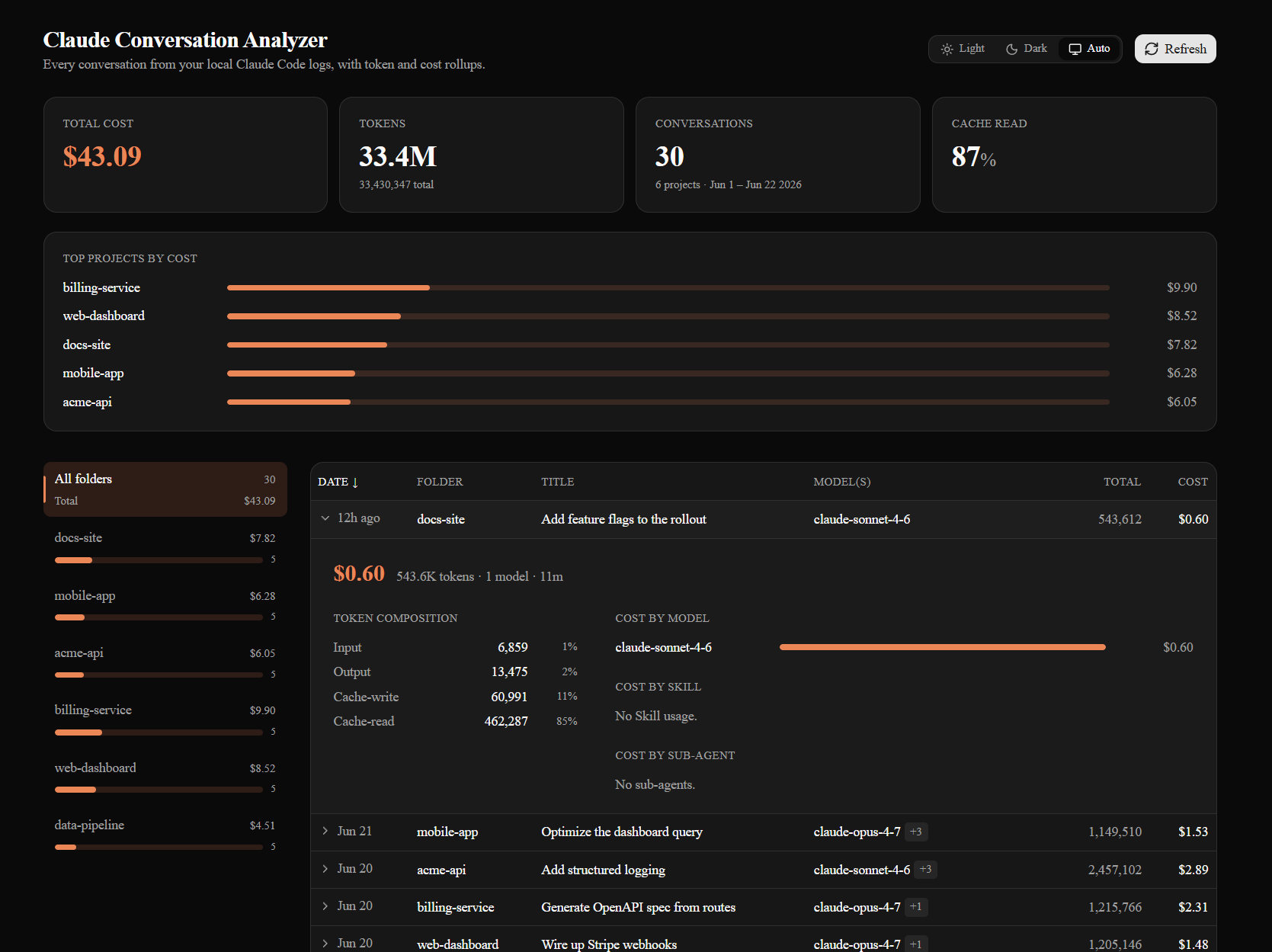
Expand any row for the per-model, per-skill, and per-sub-agent cost breakdown:
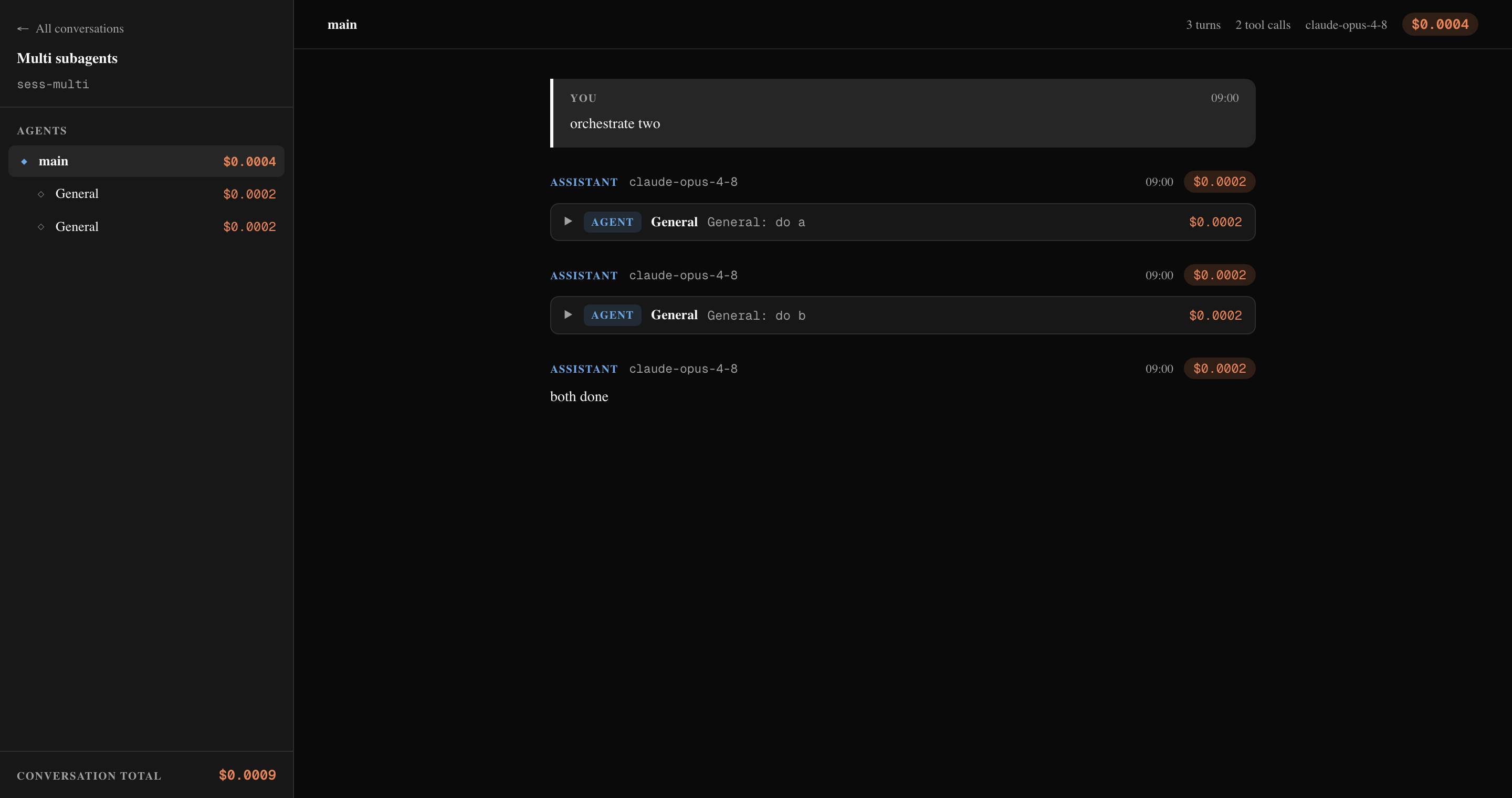
Open any conversation for the Transcript view — an IDE-like two-pane view with
the agent tree (main plus every sub-agent, each with its own cost) on the left
and one agent's turn-by-turn transcript on the right. Click a row's title to
land on the main agent, or a sub-agent in the cost breakdown to jump straight
into its transcript:
Requirements
- Node.js 20 or newer
- pnpm
- Some existing Claude Code usage — the app analyzes the logs Claude Code writes
to~/.claude/projects.
Platform support: Tested on macOS and WSL. It has not been tested on
native Windows and may not work there.
Getting started
git clone https://github.com/flolefebvre/claude-convo-analyzer.git
cd claude-convo-analyzer
pnpm install      # also generates the Prisma client (postinstall)
pnpm build
pnpm start
Then open http://localhost:3000.
On first launch the SQLite database is created and migrated automatically — no
manual database setup. Click Refresh in the UI to ingest your conversation
logs; the parse is incremental, so subsequent refreshes only read what changed.
For live development instead of a production build:
pnpm dev
How it works
The app discovers each project (a directory where you ran Claude Code) under~/.claude/projects, parses every session's .jsonl transcript, and stores a
deterministic, deduplicated token ledger. Cost is computed in application code
from a per-model, per-token-type price list — it's a hypothetical "what these
tokens would list for on the public API today" figure, not your actual billing.
The domain model and the reasoning behind it are documented inCONTEXT.md and the ADRs under docs/adr/.
Roadmap
Today the app answers "where did the tokens and cost go?". The next steps push
it toward "what actually happened in these conversations, and how do I make them
better?"
Usage stats by skill, tool, and sub-agent. Go beyond cost to behaviour:
how often each skill fires, which tools get used the most, how sub-agents are
distributed across a run — so you can see your real usage patterns at a glance,
not just the bill.Deeper conversation analysis — surfacing friction. When running fully
autonomous, different sub-agents often grind on the same underlying problem —
e.g. a missing piece of context like how to invoke a command. The goal is to
detect these recurring friction points automatically and make them visible, so
a single fix (a note inCLAUDE.md, a better tool description) can unblock
every future run instead of each agent rediscovering the wall.
Have an idea or a friction pattern you'd like surfaced? Open an issue.
Development
The validation gate — all four must pass:
pnpm test     # vitest
pnpm lint     # eslint
pnpm fallow   # dead code, cycles, duplication, complexity, core boundary
pnpm build    # next build
See docs/agents/development.md for the testing
approach and fixtures.
Was this made with AI?
Yes.
How to contribute
Found a bug or have an idea? Open an issue.
License
Yorumlar (0)
Yorum birakmak icin giris yap.
Yorum birakSonuc bulunamadi