floom
Health Uyari
- License — License: MIT
- Description — Repository has a description
- Active repo — Last push 0 days ago
- Low visibility — Only 5 GitHub stars
Code Gecti
- Code scan — Scanned 12 files during light audit, no dangerous patterns found
Permissions Gecti
- Permissions — No dangerous permissions requested
Bu listing icin henuz AI raporu yok.
AI wrote it. floom ships it. Paste Python, get a live app with UI, API, and shareable link. Open source.
floom
One @app.action → live form, REST API, share link, and MCP.
Cloud (default for most users): deploy and runs happen on Floom’s servers. Paste in the browser or use MCP against your cloud API. No Docker on your machine for that path. Self-host: run Docker (or your stack) when you want Floom on your infra. Agents always target whatever FLOOM_URL is set to (cloud API origin or http://localhost:3001).


Website · Docs · Examples · llms.txt · OSS hub (target): oss.floom.dev (live when DNS and deploy are wired; until then use Docker in this README)
Demo
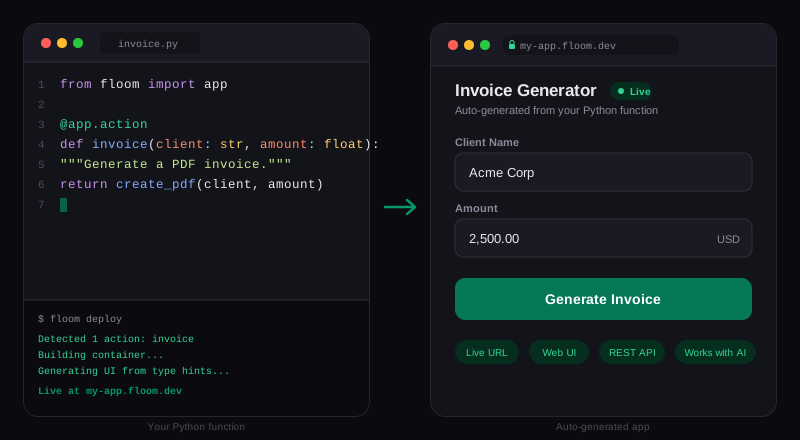
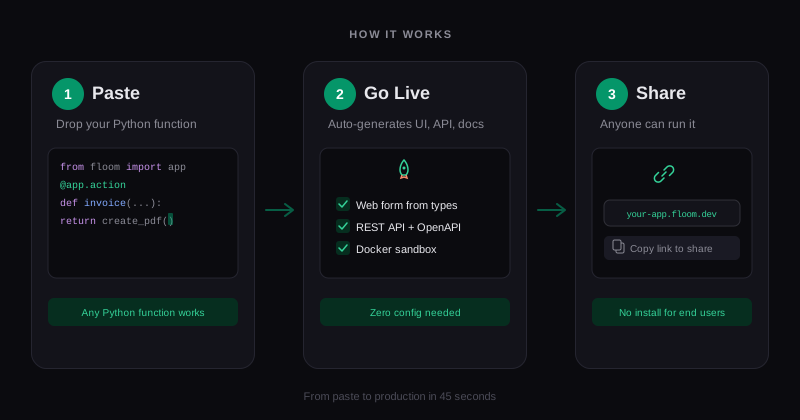
What it does
Deploy vs run (ICP): Deploy means “send your app to a Floom control plane” (hosted cloud or your self-host). Run executes in Floom’s sandbox on that side, not on the user’s laptop. Same low-friction idea as paste-to-publish tools (for example static aired.sh), but floom ships runnable Python, REST, generated forms, and secrets, not only static HTML.
The aha in one beat: you write one Python function with type hints. floom gives one live app: a generated form, a REST surface, a share link, and MCP tools that call the same actions. No duplicate logic between browser and IDE.
Who uses what: Cursor and Claude Code (and similar) integrate via MCP (deploy, run, secrets). Functionality is agent- and API-first: behavior lives in the control plane and is exposed through REST, MCP, and CLI. The web UI is a thin wrapper on that same API: paste a script, use generated forms, run, and share. OpenAPI is generated from your Python; you do not hand-author it for Floom apps.
You write a Python function with type hints:
# main.py
from floom import app

@app.action
def generate_invoice(client: str, amount: float, due_date: str):
    pdf = create_pdf(client, amount)
    return {"url": pdf.url}
# floom.yaml (optional - floom auto-detects from type hints)
name: invoicer
version: 1
endpoints:
  POST /generate_invoice:
    summary: Create an invoice PDF
    inputs:
      type: object
      required: [client, amount, due_date]
      properties:
        client: { type: string, example: "Acme Corp" }
        amount: { type: number, example: 1500 }
        due_date: { type: string, example: "2026-05-01" }
floom gives you:
- A web form with fields auto-generated from your type hints
- A REST API with OpenAPI spec
- A permanent share link anyone can use (no expiry)
- MCP tools for AI agent integration
- Docker sandboxing for isolated execution
No Dockerfile. No frontend code. No deploy config. See BUILDING.md for the full protocol.
Quick Start
Using Floom cloud: create an account on floom.dev, paste or deploy from the UI, or configure MCP with your cloud API base URL as FLOOM_URL and your API key (see Agent guide). You do not need the Docker command below.
Self-host (Docker):
docker run -p 3000:3000 -p 3001:3001 \
  -v /var/run/docker.sock:/var/run/docker.sock \
  -v /tmp/floom-workspaces:/tmp/floom-workspaces \
  -v /tmp/floom-storage:/tmp/floom-storage \
  -v floom-data:/data \
  ghcr.io/floomhq/floom
Open localhost:3000. Paste a Python function. Hit "Go Live."
How type hints become UI
| Python type | Generated UI |
|---|---|
str |
Text input |
int |
Number input |
float |
Number input (decimal) |
bool |
Checkbox |
Literal["a","b"] |
Dropdown select |
dict |
JSON editor |
| Default values | Pre-filled placeholders |
Built-in storage
Your app can remember things across runs. No database setup.
from floom import app, remember

@app.action
def count_visits(name: str) -> dict:
    visits = (remember("visits") or 0) + 1
    remember("visits", visits)
    return {"message": f"Hello {name}! Visit #{visits}"}
Paste raw scripts
Got code from ChatGPT with no functions or type hints? floom can handle it.
import requests
city = "Berlin"
response = requests.get(f"https://wttr.in/{city}?format=j1")
data = response.json()
print(f"Temperature in {city}: {data['current_condition'][0]['temp_C']}°C")
With FLOOM_AI_ENHANCE_INGEST=1 and GEMINI_API_KEY set, floom can use Google Gemini after mechanical extraction to detect city as a form input, identify requests as a dependency, and wrap the script in a callable function. By default ingest is mechanical only. Get a free key.
Examples
| Example | What it does |
|---|---|
| Invoice Generator | Create invoices with automatic tax calculation |
| Text Analyzer | Count words, find common phrases, detect sentiment |
| Unit Converter | Convert temperatures and distances between units |
| Visit Counter | Greet visitors and track counts with remember() |
For AI agents
floom is built for AI-assisted workflows. Every app gets an OpenAPI spec, and the MCP server gives agents direct access.
MCP setup (Claude Code, Cursor, Windsurf)
One command adds floom to your MCP config:
npx @floomhq/cli setup-mcp
Or add manually to your MCP config:
{
  "mcpServers": {
    "floom": {
      "command": "npx",
      "args": ["-y", "@floomhq/mcp-server"],
      "env": { "FLOOM_URL": "http://localhost:3001" }
    }
  }
}
CLI
npm install -g @floomhq/cli
floom deploy app.py --name "My App"
floom run greet name=world
floom doctor    # verify setup
Common patterns
- Deploy with HTTP calls: set
config: { network: true }in deploy, orRUNNER_NETWORK=bridgeon the server - Deploy with secrets: use the
manage_secretstool (persistent), or passsecretsinrun(one-time) - Discover actions:
curl http://localhost:3001/v1/apps/my-app - Call directly:
curl -X POST http://localhost:3001/v1/apps/my-app/greet -H 'Content-Type: application/json' -d '{"name": "world"}'
Resources
- Documentation index (launch, architecture, guides)
- Agent workflow guide
- LLM-readable reference
Self-hosting
Docker (recommended)
The Quick Start command above runs the all-in-one container. Encryption key is auto-generated and persisted in the floom-data volume.
From source
git clone https://github.com/floomhq/floom
cd floom
npm run setup:local    # generates encryption key + .env
npm install
docker-compose up --build
- Web UI:
http://localhost:3000 - API:
http://localhost:3001 - Health:
http://localhost:3001/health
| Variable | Required | Default | Description |
|---|---|---|---|
MASTER_ENCRYPTION_KEY |
No | Auto-generated | 32-byte base64 key for secrets encryption |
COMPUTE_BACKEND |
No | docker |
docker for self-hosted |
PORT |
No | 3001 |
Server port |
API_KEY |
No | Bearer token to protect API | |
RUNNER_IMAGE |
No | floom-runner:latest |
Docker image for code execution |
RUNNER_MEMORY |
No | 512m |
Memory limit per container |
RUNNER_CPUS |
No | 1 |
CPU limit per container |
RUNNER_NETWORK |
No | none |
Network mode (none for isolation) |
FLOOM_AI_ENHANCE_INGEST |
No | (off) | Set to 1 or true to opt in to Gemini post-extract ingest |
GEMINI_API_KEY |
No | Required only if FLOOM_AI_ENHANCE_INGEST is enabled |
See .env.example for the full list.
CLI
npm install -g @floomhq/cli

floom init my-app                          # scaffold main.py + floom.yaml + requirements.txt
floom deploy .                             # deploy current directory
floom validate                             # check floom.yaml + main.py consistency
floom run greet name=world                 # run an action
floom list                                 # list apps
floom logs                                 # view run logs
floom doctor                               # verify setup
floom secrets set API_KEY sk-...           # manage API keys
floom storage list                         # persistent storage
floom share create <endpoint_id>           # create share link
floom setup-mcp                            # MCP config for Claude/Cursor
Architecture
High-level flow:
Python function (type hints)
        |
   OpenAPI schema extraction
        |
   +----+----+
   |         |
 Web form   REST API
   |         |
   Docker sandbox (isolated execution)
        |
     SQLite (state + storage)
Details (single sources of truth, so this README does not duplicate them):
- docs/ARCHITECTURE.md — v0 surface, Docker-only compute,
/v1vs legacy API - docs/CODEBASE_TOUR.md — directory layout, projects/runs/secrets, contributor patterns
Development
npm install
npm run build   # Build all packages
npm test        # Run all tests
Known Limitations
- Single instance only: The control plane uses in-memory state for run progress and deploy tracking. Running multiple control plane instances will cause state to be lost between them. A Redis-backed implementation is planned for multi-instance deployments.
- Artifact serving: Artifacts larger than 1MB are not served inline. S3-backed artifact storage is planned for production use.
Support
- Bugs and questions: GitHub Issues
- Cloud (floom.dev): [email protected]
Contributing
See CONTRIBUTING.md.
License
MIT. See LICENSE.
Yorumlar (0)
Yorum birakmak icin giris yap.
Yorum birakSonuc bulunamadi