LokalBoards
Health Uyari
- License — License: MIT
- Description — Repository has a description
- Active repo — Last push 0 days ago
- Low visibility — Only 7 GitHub stars
Code Uyari
- network request — Outbound network request in app/composables/useOnboarding.ts
- process.env — Environment variable access in app/lib/databaseSetup.ts
Permissions Gecti
- Permissions — No dangerous permissions requested
Bu listing icin henuz AI raporu yok.
LokalBoards is an open-source (MIT License), self-hosted Kanban board system with an integrated REST API and MCP-Server.
LokalBoards




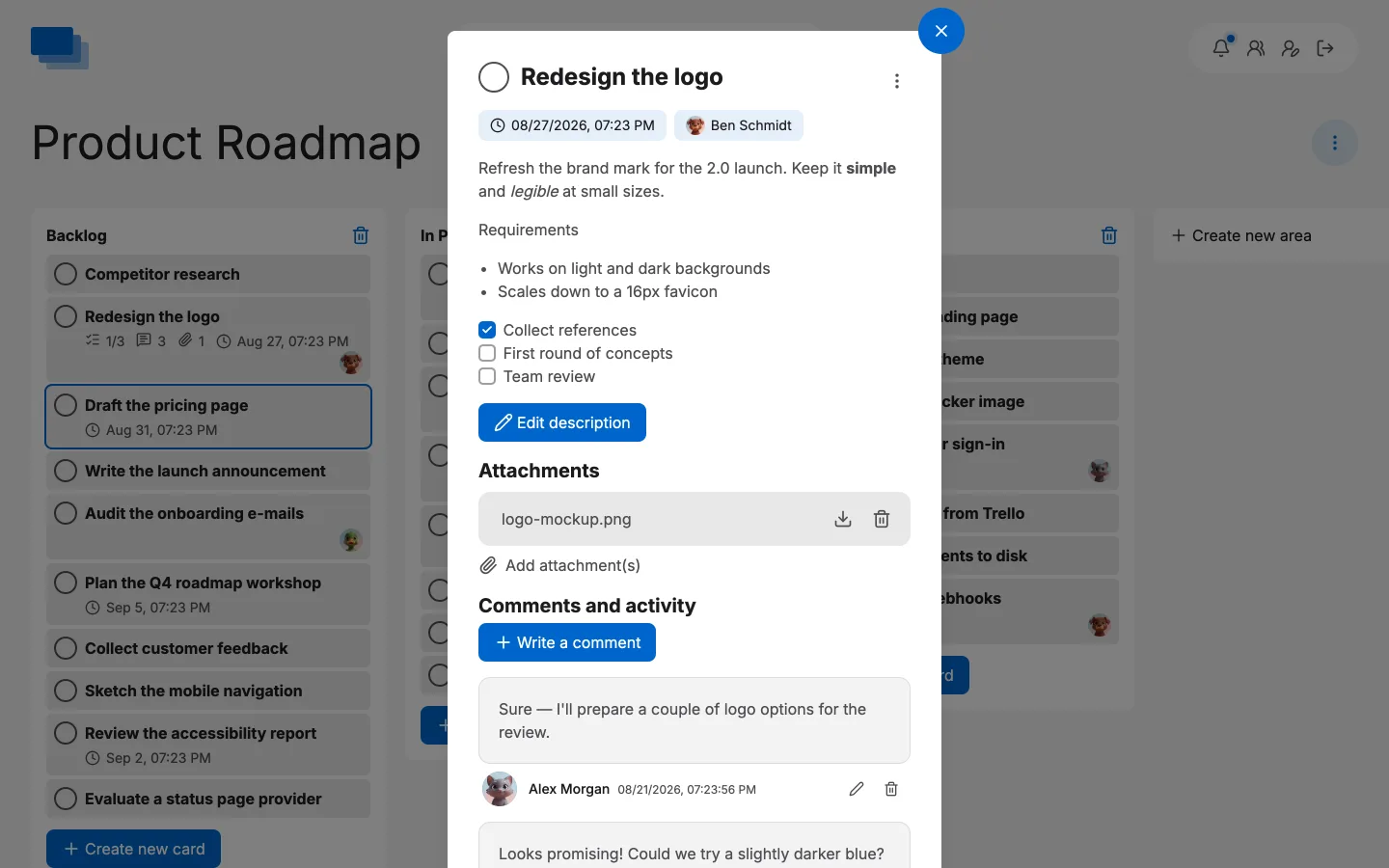
LokalBoards is an open-source (MIT License), self-hosted Kanban board system. It allows users to create boards, invite collaborators, and manage Kanban cards. It also includes admin features for user management. All data is stored in your own database, with no reliance on external services.
We support real-time multiplayer updates. When you edit a card, area, or rename it, the changes are instantly reflected for all users viewing the board. Comments on cards are also updated in real-time across all browsers. This is powered by an internal Socket.IO integration.
LokalBoards is currently available in the following languages: English (EN), German (DE), French (FR), Spanish (ES), Italian (IT), Dutch (NL), Polish (PL), Ukrainian (UK), Portuguese (PT), and Czech (CS).
AI agents (MCP)
LokalBoards isn't only for humans — it ships a built-in Model Context Protocol server (/mcp) so AI agents can read and manage boards on a user's behalf. An agent authenticates with an API key (create one under Settings → API keys, as full-access or read-only) and can search and filter cards, create/update/move/delete them, write comments, assign members and set due dates. Card descriptions and comments are stored as Markdown — the format agents work in natively — and are rendered safely.
Agents and people can share a board safely:
- Give an agent its own account. Admins can mark a user as an AI agent, so its actions are clearly attributed and it shows a bot badge on the board.
- Claiming is atomic. An agent claims a card before working on it, so two agents — or an agent and a person — never do the same task twice.
- See who's around. Live avatars on the board tiles — and in the card modal — show who currently has each card open, human or agent.
- Webhooks wake automations. An MCP agent can't be pushed to, so subscribe a webhook (Settings → Webhooks) and have your automation start a run when a board changes. Subscriptions are per user and per board, so on a shared instance everyone wires up their own without touching anyone else's.
See AGENTS.md for connection details, the agent work loop, the full tool list, and examples.
Single sign-on
Sign people in against the identity provider your organisation already runs —
Entra ID, Google Workspace, Okta, Keycloak, Authentik, Auth0, ADFS,
Shibboleth, or anything else that speaks OpenID Connect or SAML 2.0.
A handful of environment variables, one button on the sign-in page, and no
separate password to look after.
Accounts are created on first sign-in, and anyone already using the instance is
linked to their existing account by e-mail address, so a team adopting SSO keeps
its boards. Optionally restrict it to your own e-mail domains, refuse anyone
without an account here, or read the administrator role from a group claim in
your directory.
It is MIT-licensed like the rest of it — there is no edition to buy. See the
single sign-on guide for
provider-by-provider setup.
Install
To install LokalBoards, follow these steps:
Clone the Repository
git clone https://github.com/florian-strasser/LokalBoards
cd LokalBoards
Install Dependencies
npm install
Configure Environment Variables
Create a .env file (and optionally a .env.local file for local development) with the following settings. Adjust the values to match your database and email configuration.
# App Name
NUXT_APP_NAME=LokalBoards
NUXT_BOARDS_URL=http://localhost:3000
NUXT_LANGUAGE=en
NUXT_PUBLIC_PRIVACY_URL=https://www.yourdomain.com/privacy-policy/

# DB
NUXT_MYSQL_HOST=localhost
NUXT_MYSQL_USER=root
NUXT_MYSQL_PASSWORD=root1234
NUXT_MYSQL_DATABASE=root
# Set NUXT_MYSQL_SSL=true if your database requires a TLS connection
# (common for managed/external MySQL). Optionally set
# NUXT_MYSQL_SSL_REJECT_UNAUTHORIZED=false if its certificate can't be
# verified against a public CA.

# Email Configuration
NUXT_EMAIL_HOST=mail.yourserver.de
NUXT_EMAIL_PORT=465
NUXT_EMAIL_SECURE=true
[email protected]
NUXT_EMAIL_PASS=password1234

# Single sign-on (optional) — any OpenID Connect provider: Entra ID, Google
# Workspace, Okta, Keycloak, Authentik, Auth0. Register
# <NUXT_BOARDS_URL>/api/auth/sso/callback as the redirect URI with your
# provider. See the guide: https://www.lokalboards.com/docs/single-sign-on
NUXT_SSO_ENABLED=false
NUXT_SSO_ISSUER=https://login.example.com/realms/company
NUXT_SSO_CLIENT_ID=lokalboards
NUXT_SSO_CLIENT_SECRET=change-me
NUXT_SSO_LABEL=Single sign-on

# …or SAML 2.0, for providers that speak that instead. Give your provider
# <NUXT_BOARDS_URL>/api/auth/saml/metadata, or the entity id and ACS URL by
# hand. Both protocols can be on at once.
NUXT_SAML_ENABLED=false
NUXT_SAML_ENTRY_POINT=https://idp.example.com/sso
NUXT_SAML_IDP_CERT=MIIDdzCCAl+gAwIBAgIEb...
NUXT_SAML_LABEL=SAML single sign-on
Build the Application
npx nuxt build
Move the builded app from /.output to your favorite hosting solution, that is able to run a nodejs app.
Run the Application
node ./server/index.mjs
Run with Docker
Prebuilt images are published on Docker Hub:
https://hub.docker.com/r/florianstrasser/lokalboards
The image carries a MySQL server of its own, so a single docker run gives you
a working instance with nothing else to install. Point NUXT_MYSQL_HOST at a
database and it uses that one instead, leaving its own MySQL unstarted — which
is the better arrangement for anything long-lived, since a separate database can
be backed up, upgraded and monitored on its own schedule.
Either way the tables are created automatically on first start. Configure the
app through the environment variables described in
Configure Environment Variables.
Pull the image
docker pull florianstrasser/lokalboards:latest
Run the container
Put your settings in a .env file (see the variables above) and start the
container. The app listens on port 3000. Two volumes are worth mounting:
uploaded files live in /app/public/uploads, and — if you are using the
built-in database — its data lives in /var/lib/mysql:
docker run -d \
  --name lokalboards \
  --env-file .env \
  -p 3000:3000 \
  -v lokalboards_uploads:/app/public/uploads \
  -v lokalboards_database:/var/lib/mysql \
  florianstrasser/lokalboards:latest
Leave NUXT_MYSQL_HOST empty (or unset) to use the built-in database. A
password for it is generated on first start and kept next to the data, so there
is nothing to choose; the server only ever listens on the container's loopback
interface.
Then open http://localhost:3000 (or whatever you set as NUXT_BOARDS_URL).
Health check
The app exposes a public GET /api/health endpoint that returns 200 with{ "status": "ok", "database": "ok" } when the app is running and can reach its
database, or 503 if the database is unreachable. The Docker image already
declares a HEALTHCHECK against it, so docker ps / orchestrators show the
container's health automatically — no extra configuration needed.
Run with Docker Compose
Two compose files ship with the repository:
| File | What it does |
|---|---|
docker-compose.yml |
One container with its own database inside it. The quick start. |
docker-compose.external-db.yml |
The app and a MySQL service side by side. Better for anything long-lived. |
cp .env.example .env          # set NUXT_BOARDS_URL and your SMTP details
docker compose up -d
Or, with the database as its own service:
docker compose -f docker-compose.external-db.yml up -d
How configuration is applied
LokalBoards reads its configuration from environment variables at runtime —
there is no need to rebuild the image to change settings. Provide them in any of
these ways:
- Real environment variables —
docker run --env-file .env …, the composeenvironment:block above, or your hosting panel's env-var settings. - A mounted
.envfile at/app/.env(e.g.-v /path/to/.env:/app/.env:ro).
The container entrypoint loads it on start; real environment variables always
take precedence over the file.
Note: the production server does not auto-read a project
.envthe way the
dev server does — that is why the entrypoint loads/app/.envexplicitly. The.envused during development is excluded from the image (.dockerignore), so
no secrets are baked into the build.
Backup and Restore
LokalBoards keeps all its state in two places, so a complete backup is just
these two:
- The MySQL database — boards, cards, comments, users, sessions, API keys,
etc. (Attachment file contents are also stored in the database.) - The uploads directory —
/app/public/uploads, where uploaded images are
written.
Back up
Database (adjust host/user/database to your config):
mysqldump -h "$NUXT_MYSQL_HOST" -u "$NUXT_MYSQL_USER" -p "$NUXT_MYSQL_DATABASE" \
  > lokalboards-backup.sql
For the Docker Compose setup, dump from the db service:
docker compose exec db \
  mysqldump -u lokalboards -p lokalboards > lokalboards-backup.sql
Uploads — copy the mounted directory or the named volume:
# Bind mount / host path:
cp -r /path/to/uploads lokalboards-uploads-backup

# Docker named volume (e.g. `lokalboards_uploads`):
docker run --rm -v lokalboards_uploads:/data -v "$PWD":/backup busybox \
  tar czf /backup/lokalboards-uploads-backup.tar.gz -C /data .
Restore
# Database:
mysql -h "$NUXT_MYSQL_HOST" -u "$NUXT_MYSQL_USER" -p "$NUXT_MYSQL_DATABASE" \
  < lokalboards-backup.sql

# Uploads (named volume):
docker run --rm -v lokalboards_uploads:/data -v "$PWD":/backup busybox \
  sh -c "cd /data && tar xzf /backup/lokalboards-uploads-backup.tar.gz"
Restoring into an empty database is fine — on startup the app creates any
missing tables and applies migrations, then your dump fills in the data. Take
backups while the app is stopped (or use a consistent dump) to avoid capturing a
write mid-flight.
Contribute
LokalBoards is maintained as a solo project without any monetary incentives. Contributions are highly encouraged! If you encounter any issues or have suggestions for improvements, feel free to open a pull request. See CONTRIBUTING.md for how to set up a dev environment, run the tests, and what's expected of a pull request.
Running Locally for Development
To run the application locally for development:
npm run dev
Or, if you have a custom .env.local file:
npx nuxt dev --dotenv .env.local
Building Locally
To build the application locally:
npx nuxt build --dotenv .env.local
Yorumlar (0)
Yorum birakmak icin giris yap.
Yorum birakSonuc bulunamadi