flyntor
Health Uyari
- License — License: MIT
- Description — Repository has a description
- Active repo — Last push 0 days ago
- Low visibility — Only 8 GitHub stars
Code Gecti
- Code scan — Scanned 12 files during light audit, no dangerous patterns found
Permissions Gecti
- Permissions — No dangerous permissions requested
Bu listing icin henuz AI raporu yok.
Open-source CLI that recovers a web app’s shipped source, rebuilds its tree, and exposes what crawlers miss. For authorized security research.

flyntor
Pull a web application's own source out of production and read it like a repository.




Install · Quickstart · How it works · Why · Commands · MCP · Scope
A web application hands its entire client to anyone who asks, then serves it back as a wall
of minified JavaScript. flyntor reads the bundler's own chunk table, fetches the modules the
page never loads, recovers source maps where they were shipped, and writes a source tree you
can open in an editor.
What you get is a directory of the target's real code. Not a crawl, not a URL list. The
files, with the paths they had before the build.
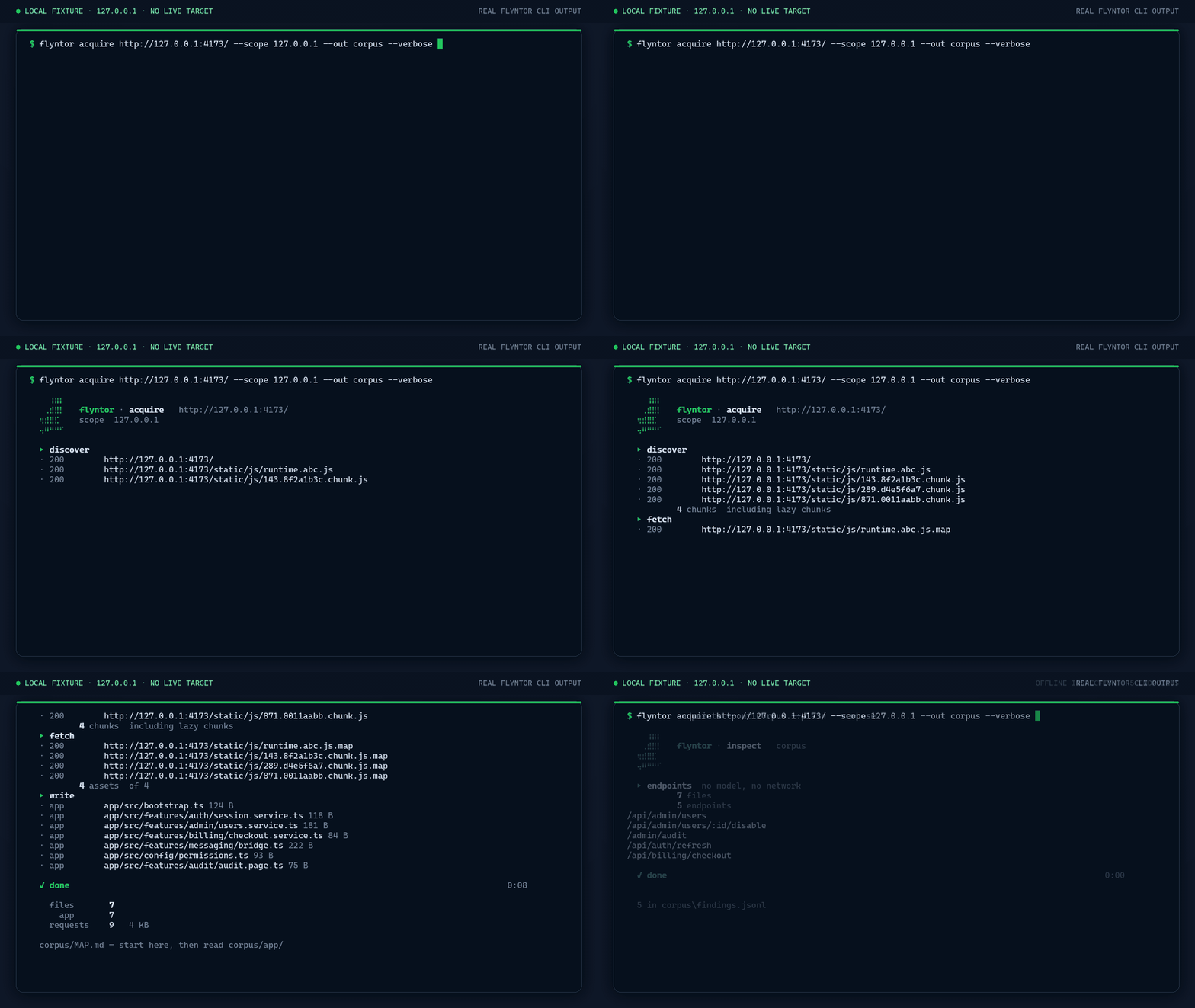
Real CLI output against a controlled localhost fixture · 4 chunks, including lazy chunks → 7 restored source files → 5 offline endpoint findings
Install
npm install -g flyntor
Or from a clone, if you want to read it first or change it:
git clone https://github.com/flyntor/flyntor.git
cd flyntor
npm install
npm link
$ flyntor --version
flyntor acquire, flyntor endpoints and the rest now work from any directory. To install
without touching PATH, skip npm link and run node bin/flyntor.mjs from the checkout.
Node 20.11 or newer. There is no build step: the CLI is TypeScript and runs as TypeScript,
so what you read in src/ is exactly what executes. Point a tool at systems you are
responsible for and you should be able to check that without reconstructing it from a bundle.
session capture opens a real browser through playwright-core. If you have never used
Playwright on this machine, run npx playwright install chromium once. Every other command
works without it.
Quickstart
[!NOTE]
--scopeis mandatory on anything networked. Identify your traffic with--uaand
keep--rateinside the program's limit.
# 1. Take the application apart. Scope is required; nothing leaves without it.
flyntor acquire https://app.example.com/ \
  --scope "*.example.com" \
  --ua "YourHandle-Bugbounty" \
  --rate 1

# 2. Read it. Free, offline, instant.
flyntor endpoints
flyntor secrets
flyntor listeners

# 3. Or read it yourself.
$EDITOR corpus/app/
acquire writes:
corpus/
  MAP.md            where every file came from, with its origin URL
  findings.jsonl    one record per observation, appended by every lens
  app/              the target's own code, source tree reconstructed
  app/index.html    the document itself, filed by the route it was served for
  vendor/           frameworks and libraries
  data/             locale tables, one kept per key space
How it works
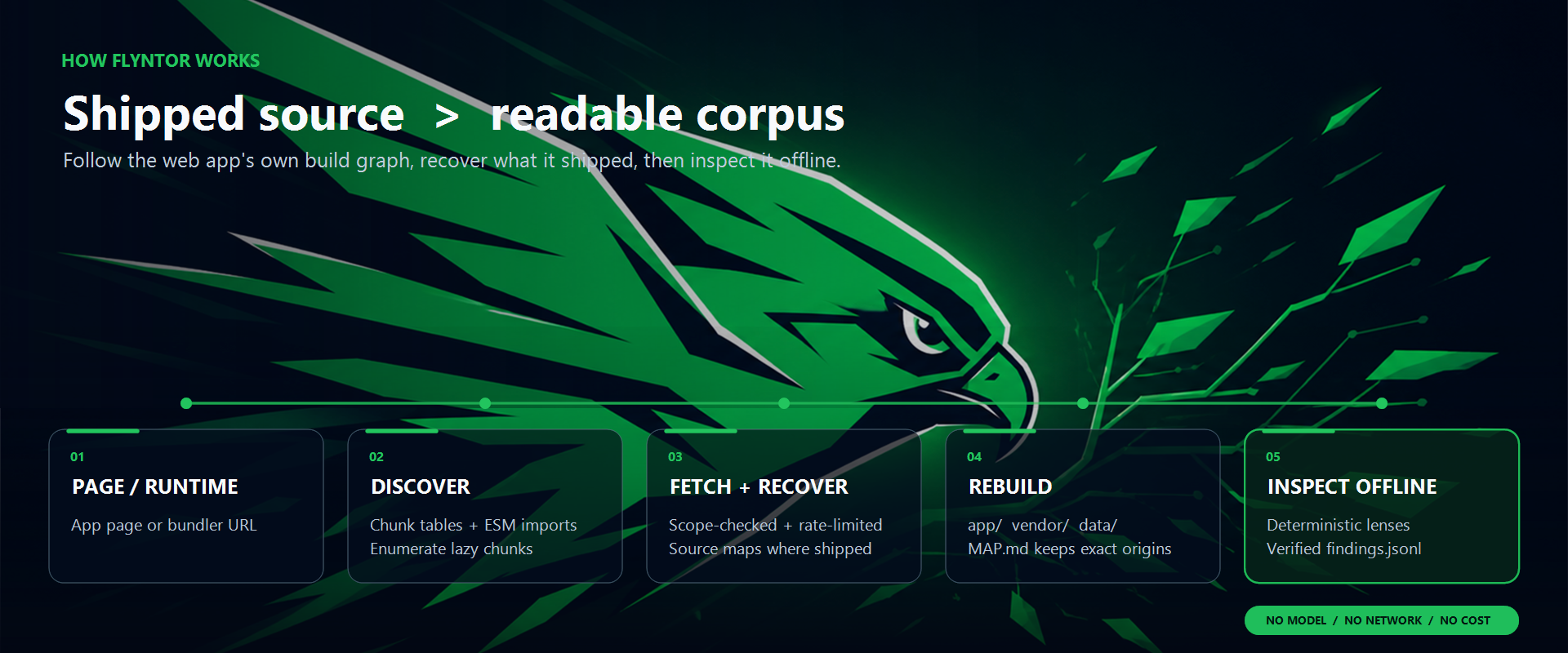
| phase | what flyntor does |
|---|---|
| Discover | reads the bundler runtime and enumerates entry points, lazy chunks and source maps |
| Fetch | requests only in-scope assets, at the configured rate, with an attributable User-Agent; keeps the document, robots.txt and sitemap.xml |
| Rebuild | restores shipped source content, separates app from vendor code and reconstructs paths |
| Inspect | runs local lenses over bundles, the document, API specs and crawler files, and writes evidence-backed records to findings.jsonl |
What leaves your machine
| command | network | sends | writes |
|---|---|---|---|
acquire, probe, dns, subdomains, session capture |
explicit | scoped requests or public CT lookups | corpus or local session data |
endpoints, secrets, listeners, other lenses, graph, diff |
none | nothing | local findings or graph files |
read, agent |
explicit provider API | selected corpus content | verified local findings |
flyntor mcp is offline by default. Its network tools do not exist unless the server is
started with --allow-network.
What a crawler misses
The code the application does not load. A page fetches only what its current route
needs. The admin panel, the billing flow, and the module behind a role you do not hold sit
on the origin as static files that nobody requests. flyntor reads the bundler runtime's
chunk table and enumerates them.
The naming scheme is read from the runtime rather than assumed, because builds disagree:
| runtime expression | chunk naming |
|---|---|
a => a + ".js?ver=" + {…}[a] |
hash in a query parameter |
e => "static/js/" + e + "." + {…}[e] + ".chunk.js" |
hash in the filename |
e => e + ".js" |
no hash at all |
Source maps, where the build shipped them. On one billing portal, 62 fetched assets
became 620 files with real .vue components at real paths, in two minutes. A minified
chunk is evidence. The component it was built from is source.
An app whose session has lapsed. An authenticated console redirects its document to a
login page the moment the session expires. The chunks that document names are static assets
needing no session at all. Point flyntor at the runtime script and it still gets the
application.
Paths, rebuilt. apps_manager_src_app_modules_security_security_module_ts.js becomesapp/apps/manager/src/app/modules/security/security.module.ts.js. Reconstruction is best
effort, since _ stands for both / and ., so MAP.md keeps the origin URL. That is
the fact; the tree is the convenience.
The document itself. The entry page is the one file that did not come out of a build,
and it is kept. Inline <script> bodies feed every lens as if they were a file of their
own, with line numbers that point at the real document. On top of that the lenses read
what only markup states: each <form action> with its field names and which are hidden,
the hosts the page loads scripts and styles from, a <meta> CSP, and HTML comments, where
a staging host or a commented-out route tends to survive a deploy.
What the site tells crawlers. robots.txt and sitemap.xml are fetched through the
same gate and kept when they are real, not the app's shell answering for a missing file.
Every Disallow becomes an endpoint row, since a path the site asks crawlers to leave
alone is a strong hint about where the surface is; every sitemap <loc> becomes one too.
API descriptions the build shipped. An OpenAPI 3 or Swagger 2 document found in a
corpus is parsed rather than pattern-matched: every path with its method, parameters, and
whether the operation requires auth. An operation that overrides a document-levelsecurity block with an empty one is reported as stating no auth requirement, which is
the row worth reading first.
A refusal to make a mess. Requests are scope-checked, spaced, and carry the attribution
a program requires. A 200 that is really the app's shell standing in for a missing asset
is rejected rather than filed as source. Seven translation tables holding one key space
between them are collapsed to one.
Commands
Get the source
acquire <url> |
fetch a page or runtime, follow its chunk table, write the corpus |
session capture --url <login> |
open a browser, log in yourself, keep the session |
session status |
what is stored, and whether it has expired |
Read it. No model, no network, no cost
Each appends to corpus/findings.jsonl. Run these before you spend anything.
hosts |
every host the application talks to, loads from, or links to |
endpoints |
routes it calls, with the verb where the code states one; form actions; paths a spec declares |
graphql |
operations and the fields they select |
sinks |
untrusted input reaching somewhere dangerous |
secrets |
credential-shaped literals |
listeners |
postMessage handlers, and whether each checks origin |
constants |
roles, permissions and flags the build baked in |
graph |
module imports and lazy-loaded routes, to corpus/graph.json |
diff <before> <after> |
what changed between two acquisitions |
diff is worth a habit. Code shipped since your last acquisition is the code least likely
to have been looked at by anyone, and a route that vanished from the frontend has very often
not vanished from the server.
Read it with a model
These are the only commands that cost money.
read |
every claim checked against the file's bytes; unverifiable ones discarded |
agent ["question"] |
ask about the corpus, with tools that verify quotes |
config |
model profiles, stored outside the corpus so no key travels with it |
read --dry-run costs nothing and asks for nothing. Run it first. read --from corpus/findings.jsonl reads only the files the free lenses flagged, which on a real corpus
was a 19x difference in spend.
Reach the target
probe <url> |
one request through the gate, for confirming a single hypothesis |
dns |
resolve the hosts the corpus names; private addresses, dangling CNAMEs |
subdomains <apex> |
certificate-transparency lookup, filtered to scope |
subdomains sends nothing to the target. CT logs are a public record, so it cannot breach a
rate limit or appear in anyone's access log.
--scope <a,b>     hosts the program permits. Required on anything networked.
                  "*.example.com" covers subdomains and the apex.
--ua <suffix>     appended to the User-Agent. Programs require attribution; supply it.
--rate <n>        requests per second, default 1
--limit <n>       ceiling on files fetched, default 300
--cookies <file>  a cookies.txt export
--session         use a session captured with "session capture"
--out <dir>       corpus directory, default ./corpus
--plain           lens output as one value per line on stdout, deduplicated
--json            lens output as one JSON record per line on stdout
--vendor          include vendor/ in a lens run, normally skipped
--verbose         every file, every request, and the model's reasoning
--version         print the installed version and exit

acquire     --limit, --rate, --cookies, --session, --ua
graph       --external          include third-party modules
read        --lens authz|secrets|sinks|flows   (omit for a full pass)
            --from <jsonl>      read only the files that file names
            --resume            skip files already read, matched on content
            --dry-run           what it would cost, without spending it
dns         --hosts <a,b>       names to resolve, instead of the corpus's
            --tls               also check whether a strict client can build the chain
mcp         --allow-network     offer the two tools that send traffic
probe       --ua <suffix>
session     capture --url <login url> [--as <name>] | status

model options (read / agent / config only)
--provider <p>    deepseek | openai | openrouter | together | local
--effort <e>      low | medium | high | xhigh, where the provider supports it
--max-cost <n>    ceiling on spend, in USD. Real, not advisory.
--key, --base-url, --model      override the saved values for one run
--max-files <n>   default 5000        --concurrency <n>   default 8
--max-tokens <n>  --timeout <s>       --yes   approve requests without asking
                  FLYNTOR_API_KEY, FLYNTOR_BASE_URL, FLYNTOR_MODEL, FLYNTOR_EFFORT
flyntor help prints the same thing with prose.
Pipe it into everything else
Any lens takes --plain for one value per line, deduplicated, or --json for the whole
record. Both put findings on stdout and move the renderer to stderr, so what a pipe receives
is a list and nothing else.
flyntor endpoints --plain | httpx -mc 200,401,403
flyntor hosts --plain | anew hosts.txt
flyntor secrets --json | jq -r 'select(.state == "VERIFIED") | .value'
flyntor dns --scope "*.example.com" --plain | anew dns-findings.txt
flyntor subdomains example.com --scope "*.example.com" --json | jq -r .host
dns and subdomains take the same flags, so a whole sweep pipes end to end.
{
  "kind": "ENDPOINT",
  "value": "/api/v2/workspaces/:id/members",
  "detail": "called from shipped code",
  "derived": false,
  "file": "app/src/features/workspace/members.service.ts",
  "line": 356,
  "snippet": "… const membersUrl = \"/api/v2/workspaces/:id/members\", …",
  "state": "VERIFIED",
  "reader": "inspect:endpoints"
}
state is the honest part. VERIFIED means the quoted snippet was found in that file at
that line. RELOCATED means it was found, at a different line. CONTRADICTED rows are
discarded before they reach you. A claim nobody can point at is not a finding.
Drive it from an agent
mcp |
serve the corpus tools over MCP on stdio |
flyntor mcp puts the corpus behind an MCP server, so an agent you already run can drive it.
claude mcp add flyntor -- node /path/to/flyntor/bin/flyntor.mjs mcp \
  --scope "*.example.com" --out /path/to/corpus
Eleven tools, none of which sends traffic: graph_query, endpoint_callers, params_for,curl_for, list_files, open_file, search, findings_query, corpus_diff,verify_snippet, inspect.
--allow-network adds probe and resolve_hosts. Without it they are not listed at all,
so a model driving flyntor cannot reach a host whether or not that host is in scope. The
gate lives in the server rather than in the prompt: the model proposes, checkScope
disposes, and a refusal comes back as a tool result instead of as a request.
There is a skill for agents at skill/flyntor.md covering the sweep
order and what each lens is worth reading for.
Scope is not optional
[!IMPORTANT]
This is a tool for security research you are permitted to perform: a bug bounty program, a
penetration test with a signed scope, or your own systems.
--scope is required on every command that touches the network. Without it nothing leaves
the machine, which is the whole point. A host found inside a bundle is not in scope by virtue
of having been found.
What that buys, concretely. On one engagement the free hosts lens named 14 hosts and dns
refused 8 of them as out of scope, among them a third-party mapping API the program's rules
put off limits. Up to that point the rule had been enforced by remembering it. Single
deliberate requests, enforced scope, mandatory attribution, and no scanning behaviour
anywhere in the tool.
What it has actually found
A tool's track record is more useful than its feature list.
- Internal RFC1918 addressing in public DNS across ten in-scope hosts, and an
incomplete TLS chain on an apex that browsers paper over and Node does not. Both
reported. Neither is visible from any corpus. - Two hosts referenced from production JS with no DNS record, one leaking a
non-production naming convention, that a manual sweep of the same target had missed. - A bot-detection result worth knowing. A perfect bare Chrome User-Agent got
403
where the same UA with an identifying suffix got200, repeatably. A flawless browser
claim arriving on a non-browser TLS stack is a contradiction, and it is the cheapest
heuristic there is. flyntor's User-Agent is browser-shaped but never anonymous.
The lenses earn their keep by removing work as much as by finding it: 67 sinks dismissed in
seconds because every row carries what feeds it, and 25 of 25 hosts correctly labelled as
comment mentions rather than as traffic.
Development
npm test          # 608 tests, 35 files
npm run typecheck # tsc --noEmit, strict
npm run recall    # regression harness: 18 fixtures over real corpora
recall is the one that matters. It runs the extractors against saved corpora from real
targets and fails if a route that used to be found stops being found, or if a route the code
never states starts appearing. An invented URL is the worst thing this tool can produce, and
it is the thing an ordinary test suite is least likely to catch.
Licence
MIT.
Yorumlar (0)
Yorum birakmak icin giris yap.
Yorum birakSonuc bulunamadi