forge
Health Gecti
- License — License: MIT
- Description — Repository has a description
- Active repo — Last push 0 days ago
- Community trust — 27 GitHub stars
Code Gecti
- Code scan — Scanned 12 files during light audit, no dangerous patterns found
Permissions Gecti
- Permissions — No dangerous permissions requested
Bu listing icin henuz AI raporu yok.
AI coding agent workflow engine for structured task lifecycles.
Make multiple coding agents collaborate on one repo — without stepping on each other.





Forge gives every task its own isolated git worktree, then runs your CI gate and
review step before changes touch main. Drive Claude Code, Codex, Gemini, opencode,
and your own shell agents through one local-first task lifecycle — REST API, MCP
endpoint, CLI, and web UI in a single binary. Self-hosted, MIT, no cloud.
Quickstart · Why Forge · Docs · Changelog · Contributing
Why Forge
Running two coding agents against the same repo is how you lose diffs. Forge fixes
that: every task runs in its own git worktree, hits your CI gate, and waits for
review before it merges. Agents collaborate; they don't collide.
- One isolated git worktree per task — Claude Code, Codex, and Gemini can each work in parallel without overwriting each other or polluting your main checkout.
- Review gate with your CI — define
ci_stepsper task; the review runner blocks merge until they pass. Human approval is an explicit transition, not an afterthought. - Structured task lifecycle —
todo → in_progress → review → merging → done, with an audit log and explicit cancellation paths so handoffs between agents (and humans) are legible. - BYO agent — first-class adapters for Claude Code, Codex, Gemini, opencode, and a generic shell executor. Add your own with a small adapter.
- One binary, every surface — REST API, MCP JSON-RPC,
forge-ctlCLI, and a React web UI ship together. Drive Forge from a script, an editor, or a browser. - Local-first by default — single binary, SQLite, loopback-only server with a persisted local port. No telemetry, no SaaS, your data stays on disk.
Who it's for
- Developers already running more than one coding agent (Claude Code + Codex, Codex + Gemini, …) who keep losing diffs to branch collisions or shared-tree edits.
- Small engineering teams piloting agent workflows who need worktree isolation, audit trails, and a review gate before code lands on
main. - Builders who want a local, hackable control plane for AI coding work — not another hosted dashboard.
If you only want a chat UI bolted onto your editor, Forge is not for you. Try Continue or Cline instead.
5-minute quickstart
# Run instantly through npm (macOS / Linux)
npx @forgeailab/forge --demo

# Install via Homebrew (macOS / Linux)
brew install forgeailab/tap/forge

# Or grab the latest release directly
curl -fsSL https://raw.githubusercontent.com/ForgeAILab/forge/main/install.sh | bash

# Start the server with seeded demo data if you installed it locally
forge --demo
Open the management_url printed in the server logs. That's it — you should
see a demo project with a labelled task and a fake daemon report. From here:
- Drive a real task end-to-end → docs/getting-started.md
- Wire up Claude Code / Codex / Gemini → docs/getting-started.md#agents
- Hit the API directly → docs/api.md
Prefer to build from source? cargo run -p forge-cli -- --demo.
Core concepts
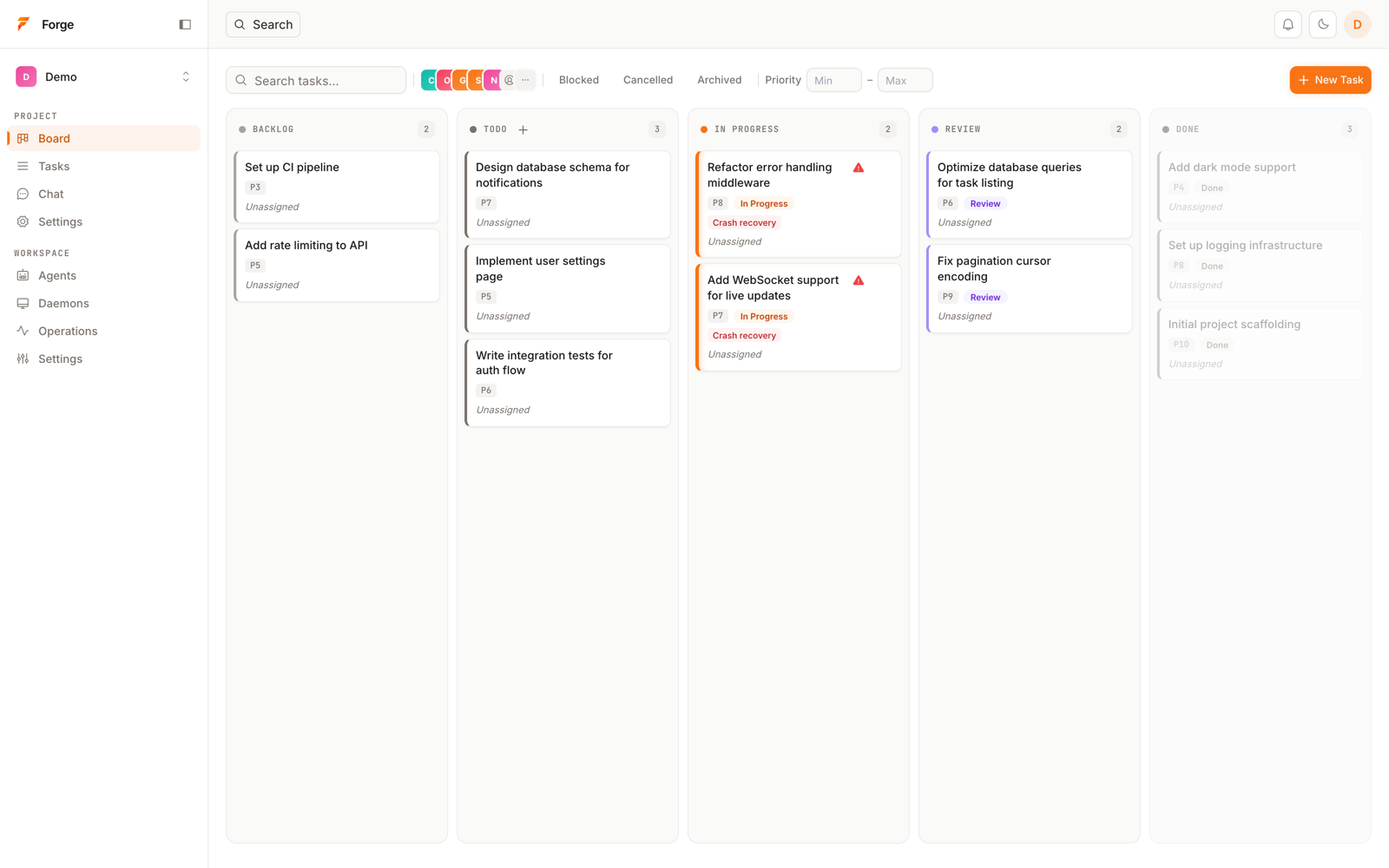
| Concept | What it is |
|---|---|
| Project | A workspace grouping repos, tasks, agents, and a workflow definition. |
| Repo | A pointer to a local git checkout that tasks operate on. |
| Task | A unit of agent work with a state, optional CI steps, and an audit log. |
| Agent | A registered AI executor (Claude Code, Codex, shell, …) bound to a daemon. |
| Daemon | The local process that reports installed CLIs and runs executions. |
| Worktree | An isolated git checkout created per task, cleaned up on done/cancelled. |
| Review gate | The CI steps + optional human approval that block review → merging. |
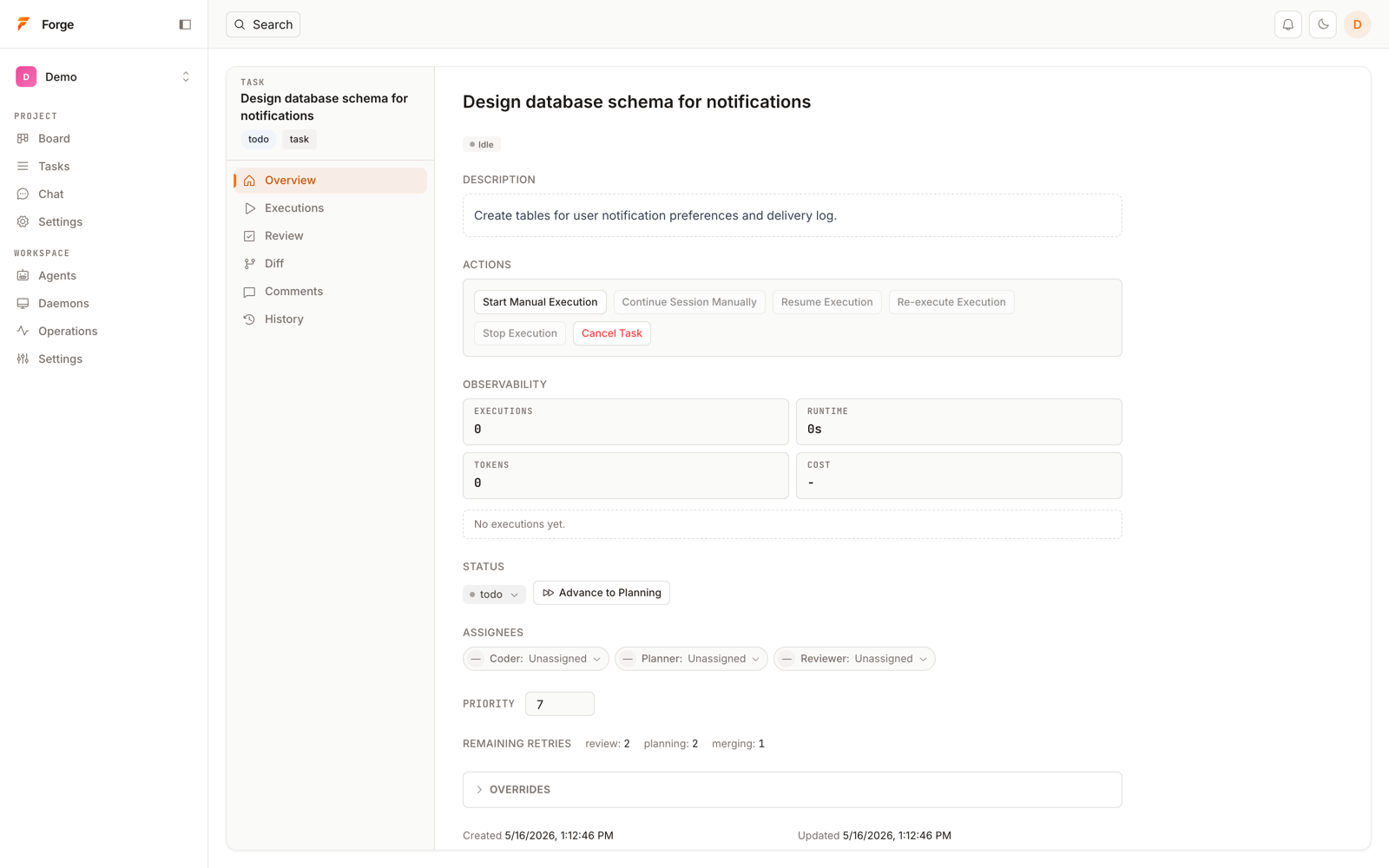 |
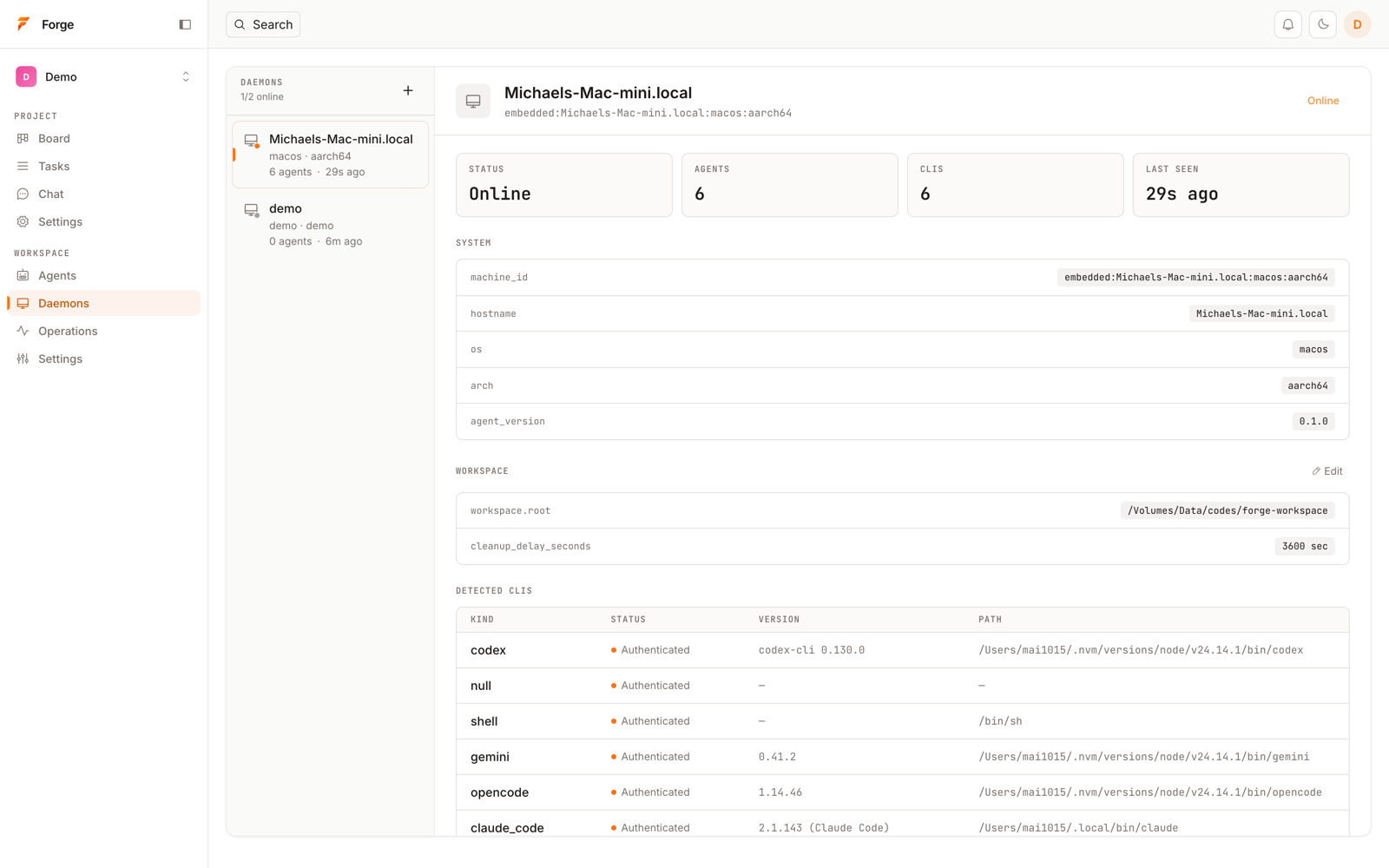 |
| Task detail — lifecycle, role assignments, CI/review gate, audit log | Daemon — auto-detects installed CLIs on the host (Claude Code, Codex, Gemini, opencode, shell) |
Deeper dive → docs/architecture.md.
Documentation
| Doc | What's in it |
|---|---|
| Getting started | Install, first project, agents, end-to-end task walkthrough. |
| Architecture | Crate graph, task state machine, database, event bus. |
| API reference | REST endpoints, query params, pagination, MCP tools, SSE. |
| forge-ctl CLI | Subcommands, daemon link, scripted runs. |
| Execution logs | JSONL log schema and chat-history reconstruction. |
| Changelog | Per-release changes and breaking notes. |
Status
Forge is in public beta (0.1.x). The local-first single-user product is usable
end-to-end, but APIs, schemas, and CLI flags can change without deprecation cycles.
Track breaking changes in CHANGELOG.md. A stable 1.0 will land
once the workflow engine, multi-user story, and release artifacts (signing, SBOMs,
Homebrew, Windows builds) are finalized.
Contributing
Issues, PRs, and design discussion are welcome. Start with CONTRIBUTING.md
and check good first issue and help wanted labels. By participating you agree to
the Code of Conduct.
Security
Please report vulnerabilities privately per .github/SECURITY.md.
License
MIT © Forge contributors.
Yorumlar (0)
Yorum birakmak icin giris yap.
Yorum birakSonuc bulunamadi