mindbase-llm-wiki
Health Gecti
- License — License: MIT
- Description — Repository has a description
- Active repo — Last push 0 days ago
- Community trust — 86 GitHub stars
Code Uyari
- process.env — Environment variable access in apps/app/bin/mindbase-app.js
- network request — Outbound network request in apps/app/bin/mindbase-app.js
- network request — Outbound network request in apps/app/smoke.mjs
- network request — Outbound network request in apps/browser-ext/entrypoints/background.ts
- network request — Outbound network request in apps/browser-ext/entrypoints/popup/main.ts
- network request — Outbound network request in apps/browser-ext/lib/api.ts
Permissions Gecti
- Permissions — No dangerous permissions requested
Bu listing icin henuz AI raporu yok.
Karpathy's LLM Wiki idea as a product — an AI that builds and maintains a markdown wiki from your notes and sources. MCP server + web UI, runs on free local models (Ollama), no API key needed. MIT.
MindBase — Karpathy's LLM Wiki, as a product





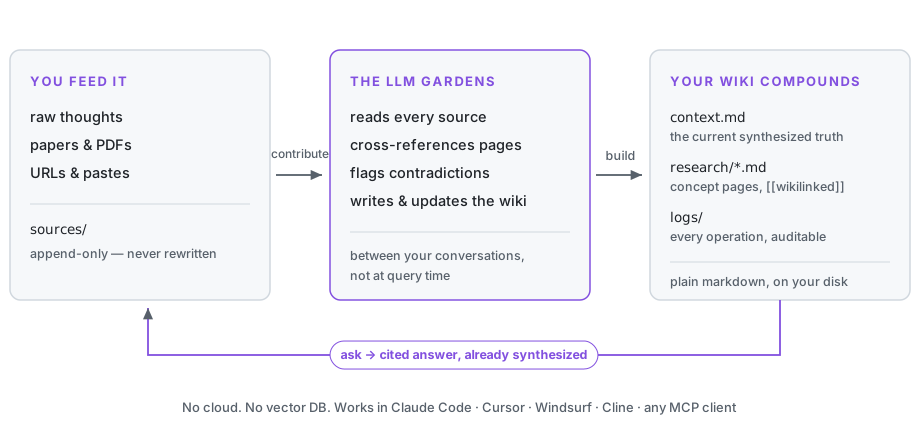
An open-source implementation of Andrej Karpathy's LLM Wiki idea: an AI that builds and maintains a wiki from your sources. Not RAG-in-a-vector-DB. A real markdown wiki on your disk, that an LLM gardens for you between conversations.
MindBase implements Andrej Karpathy's LLM-Wiki pattern as a product. You feed it sources (papers, articles, thoughts). The LLM reads, cross-references, flags contradictions, and writes structured wiki pages. Later, when you ask a question, the wiki already has the synthesized answer — no vector search re-derivation at query time.
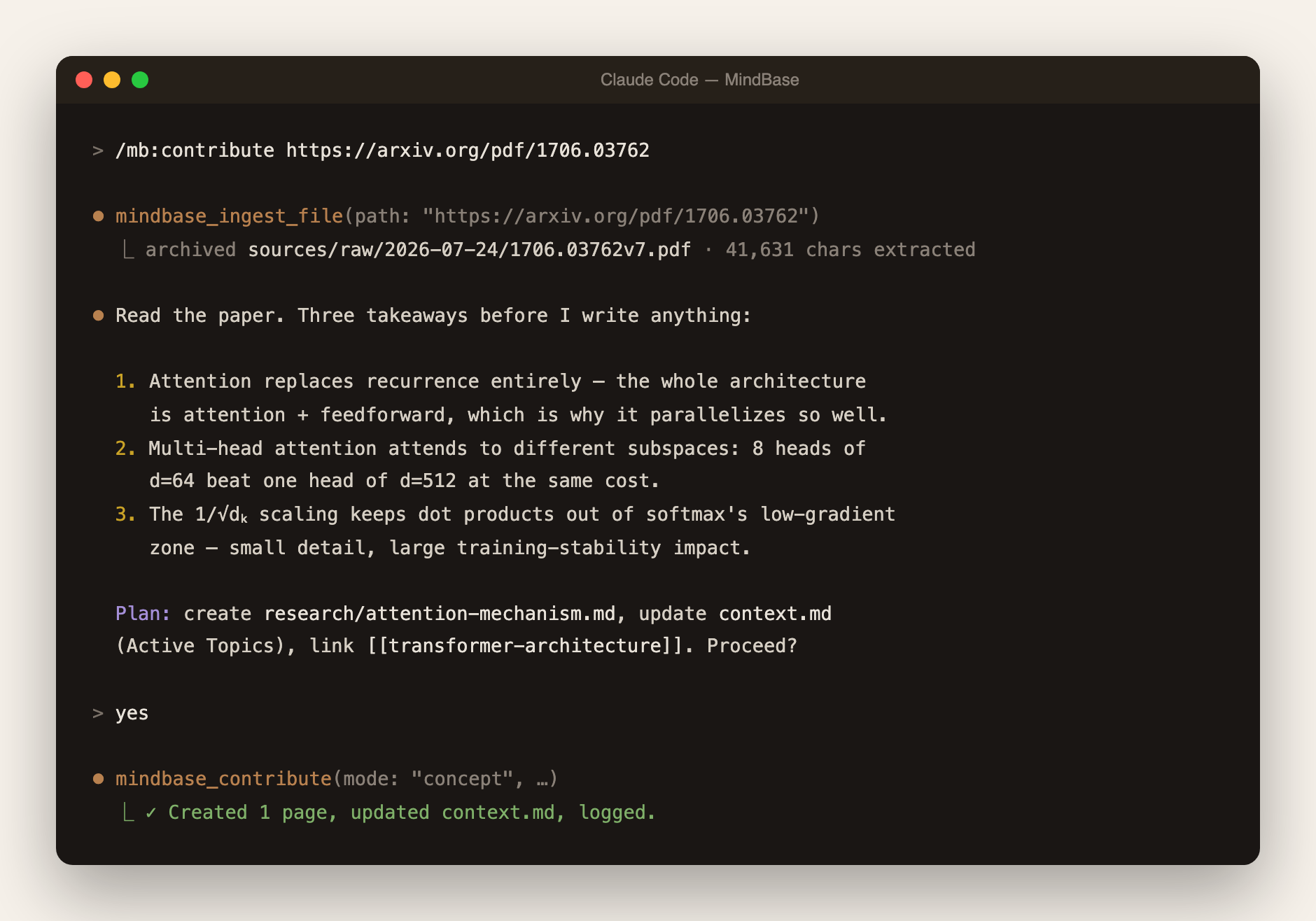
Your editor is the primary interface. Throw an arXiv link at it and the ingest flow runs right where you work — the model archives the original, walks you through the takeaways, and waits for your go-ahead before touching the wiki:
(Prefer a GUI? Since 0.3 the web UI runs the same operations standalone — write notes, approve AI updates, run health checks — no editor or API key required.)
Status: Early access, actively developed. The v2 data model and the full core loop (ingest → build → ask → lint) are stable and what you install today. A few legacy corners of the optional web UI are still being polished.
Table of contents
- Why MindBase
- What's new
- How it works (30 seconds)
- What makes it different
- Prerequisites
- Install — choose your AI editor
- First project (2 minutes)
- Core workflows
- Working with multiple projects
- Web UI (optional companion)
- Feature matrix by editor
- Where your data lives
- Architecture at a glance
- Troubleshooting
- Roadmap
- Beta feedback
- License
Why MindBase
You read a lot. Papers, articles, tweets, docs. You want to remember them, connect them, form opinions from them. Today you have two bad options:
- Notion / Obsidian / Roam: Passive containers. You do all the organizing. AI features are bolted-on generation, not maintenance.
- NotebookLM / Perplexity Pages / ChatGPT search: RAG-based. Nothing accumulates. Every question re-derives the answer from raw sources.
MindBase is the third option: the LLM actively maintains a persistent, structured wiki as you feed it sources. Knowledge compounds. Your context.md gets sharper every time you contribute. The AI remembers you across sessions because your beliefs are written down in markdown files — not stored in a chat history that gets summarized away.
Think of it as a personal Wikipedia that an AI intern writes for you, kept up to date, cross-referenced, and honest about what it doesn't know.
What's new
0.4.0 — Write full notes in the UI (2026-08-07)Cmd+N opens a real WYSIWYG editor (headings, links, [[wikilinks]],
outline, backlinks). Notes live in your layer — the AI reads them but
never rewrites them. A wiki-status chip on every note shows whether
the wiki has absorbed it yet: ✨ Add to wiki → ✓ In wiki · 2 pages.
0.3.0 — The Web UI runs the core operations (2026-08-06)/contribute, /build, /lint, /research now work in the browser,
orchestrated server-side with whatever LLM you configure. Contribute
shows takeaways + a checkbox plan and only writes what you approve. The
Health view surfaces contradictions, orphans, and gaps as cards. Also
fixed: chat retrieval now actually indexes your wiki (it was silently
empty on new-layout projects).
0.2.0 — Free local models, no API key (2026-08-06)
The setup wizard detects your hardware, recommends the best Ollama model
that fits your RAM, installs it with a progress bar, and verifies it with
a real generation. MindBase now works end-to-end with zero subscriptions
and zero data leaving your machine.
0.1.x — First public release (2026-07)
MCP server on npm (mindbase-mcp), Claude Code plugin with slash
commands + sub-agents, works in Cursor/Windsurf/Cline/Continue, local
PDF/URL ingestion, hybrid search, knowledge graph, web viewer.
Full details in CHANGELOG.md.
How it works (30 seconds)
Three physical layers on disk (Karpathy's model):
Layer 1 — sources/          You add these. Append-only. LLM reads, never rewrites.
   ├─ contributors/          Your thoughts, dated per-user (like a lab notebook)
   ├─ research/              Wiki pages the LLM writes (concepts, entities, syntheses)
   └─ raw/                   PDFs, URL captures, pastes — original binaries

Layer 2 — README.md          The rules of your wiki. You edit. LLM reads at every op.
          context.md         The synthesized current truth. LLM writes. You read.
          index.yaml         Auto-generated file catalog. LLM maintains.

Layer 3 — logs/              Chronological log of every operation. LLM appends.
          artifacts/         Generated outputs: daily briefs, exports, lint reports.
Three operations the AI can run:
| Operation | What happens |
|---|---|
| Contribute | You feed a thought / PDF / URL. LLM reads, discusses key takeaways with you, updates 5-15 relevant wiki pages, appends log. |
| Ask | You ask a question. LLM reads your context.md first (already-synthesized truth), then drills into cited source pages. Cited answers with [[wikilink]] provenance. |
| Lint | LLM audits the whole wiki for contradictions, stale claims, orphan pages, missing cross-references, gaps that need investigation. |
They form a loop — good answers and lint findings flow back in as new contributions, so the wiki compounds:
flowchart LR
    C["contribute<br/><small>thought · PDF · URL</small>"] --> S[("sources/<br/><small>append-only</small>")]
    S --> B["build<br/><small>LLM synthesizes</small>"]
    B --> W[("context.md<br/>research/*.md")]
    W --> Q["ask<br/><small>cited answers</small>"]
    W --> L["lint<br/><small>contradictions · orphans · gaps</small>"]
    Q -. "good answers filed back" .-> C
    L -. "follow-up notes" .-> C
That's the entire product. Everything else is UX.
What makes it different
vs. Notion: You own the data (markdown files, not a proprietary DB). The AI is a maintainer, not a bolt-on generator. context.md evolves; Notion pages don't.
vs. Obsidian: You get the same local-first markdown vault, but with an AI that actively writes the wiki — you don't have to hand-craft every note. Comes with [[wikilinks]] cross-referencing done for you.
vs. NotebookLM / Perplexity: Knowledge compounds. Ask "what's my view on RAG?" and the answer already exists in context.md. NotebookLM re-derives it from raw sources every time — nothing accumulates.
vs. any RAG tool: RAG is stateless retrieval. MindBase is stateful synthesis. The wiki gets richer with every ingest. Answers get faster and more consistent over time.
Prerequisites
- Node.js 20+ (that's it for Cursor / Windsurf / Cline / Continue — the MCP server installs itself via
npx) - One of: Claude Code, Cursor, Windsurf, Cline, Continue.dev, or another MCP-compatible AI editor
- pnpm 10+ only if you install the Claude Code plugin or the web UI from source
- (Optional) A modern browser, if you want the web UI
MindBase runs entirely on your machine. No cloud upload, no signup, no telemetry.
Install — choose your AI editor
MindBase ships as an MCP (Model Context Protocol) server — published on npm as mindbase-mcp. Every MCP-compatible AI editor can use its tools with a one-line config; no clone, no build. Claude Code gets an extra layer of polish (slash commands, sub-agents) via the plugin.
Claude Code (flagship experience)
Get the full Karpathy 8-step ingest with sub-agents, slash commands, auto-context, and per-agent tool boundaries.
Install the plugin — two commands inside Claude Code, no clone, no build:
/plugin marketplace add frankchu91/mindbase
/plugin install mb@mindbase
Restart Claude Code when prompted. (The plugin launches its MCP server via npx -y mindbase-mcp, so npm delivers the server automatically.)
git clone https://github.com/frankchu91/mindbase.git
cd mindbase && pnpm install
claude --plugin-dir apps/plugin
Verify: Open Claude Code, type /. You should see /mb:contribute, /mb:ask, /mb:build, /mb:status, and 8 others. Run /mcp — you should see mb connected with 49 tools.
What you get:
- 12 slash commands (
/mb:*) - 5 sub-agents with security boundaries (
contributor,builder,curator,researcher,migrator) — each has a strict tool allowlist - SessionStart hook — every new Claude Code session auto-injects your project's README + context + recent log entries
- The full Karpathy 8-step ingest: read → discuss takeaways → propose plan → wait for approval → execute
Skip to First project.
Cursor
Add to ~/.cursor/mcp.json (create the file if missing):
{
  "mcpServers": {
    "mindbase": {
      "command": "npx",
      "args": ["-y", "mindbase-mcp"]
    }
  }
}
Restart Cursor. Open Cursor Chat → the tool picker should list mindbase_contribute, mindbase_ask_wiki, and 47 others.
Optional but recommended: teach Cursor's LLM about MindBase conventions by adding to ~/.cursor/rules.md (or per-project .cursorrules):
# MindBase conventions

When the user mentions "mindbase", "mb", "my wiki", "记一下", or "记忆",
the following MCP tools are available: mindbase_contribute, mindbase_ask_wiki,
mindbase_status, mindbase_load_project, and more.

Rules:
1. When user says "add to mindbase X" or "记一下 X", ALWAYS call mindbase_contribute
   with text=X. Never just acknowledge without calling the tool.
2. When user says "ask mindbase X" or "问问我的 wiki", call mindbase_ask_wiki
   with query=X.
3. When ingesting a PDF/URL, follow the 8-step Karpathy loop:
   read → discuss 3 key takeaways with user → propose plan → wait for approval
   → then call mindbase_contribute with the summary.
4. Default project comes from config.json currentProjectId. If the user says
   "for project X" or "在 X 项目里", pass projectId=X to the tool call.
Skip to First project.
Windsurf
Windsurf uses the same MCP config format. Open Cascade settings → MCP → add:
{
  "mcpServers": {
    "mindbase": {
      "command": "npx",
      "args": ["-y", "mindbase-mcp"]
    }
  }
}
Restart Windsurf. Same rules-file approach as Cursor works — put a MindBase conventions block in your Cascade rules.
Skip to First project.
Cline (VSCode)
Open VSCode → Cline extension settings → MCP Servers. Add:
{
  "mcpServers": {
    "mindbase": {
      "command": "npx",
      "args": ["-y", "mindbase-mcp"]
    }
  }
}
Cline auto-detects. Every tool call gets a confirmation dialog by default (transparency win). Skip to First project.
Continue.dev
Open ~/.continue/config.json. Add under experimental.modelContextProtocolServers:
{
  "experimental": {
    "modelContextProtocolServers": [
      {
        "transport": {
          "type": "stdio",
          "command": "npx",
          "args": ["-y", "mindbase-mcp"]
        }
      }
    ]
  }
}
Restart VSCode. In Continue chat, MCP tools appear under @. Skip to First project.
Any other MCP-compatible client
If your editor supports MCP (Zed, Aider, Goose, ChatGPT Desktop's future MCP support, custom Claude Agent SDK apps), the pattern is identical: point it at
npx -y mindbase-mcp
as a stdio server. See your client's MCP docs for the exact config location.
First project (2 minutes)
Once your editor has the MCP server connected, create your first project.
Claude Code
/mb:init my-research --mission "Study transformer attention mechanisms"
Claude will scaffold ~/mindbase-data/projects/my-research/ with README.md, context.md, index.yaml, and empty sources/, logs/, artifacts/ directories, and set it as your current project.
Cursor / Windsurf / Cline / Continue
Type in chat:
Create a new mindbase project called my-research about transformer
attention mechanisms.
The LLM will call mindbase_init_project({ name: "my-research", mission: "..." }) and confirm.
Verify
/mb:status # in Claude Code
Or ask any other IDE:
what's the status of my mindbase?
You should see:
MindBase — Project: my-research
Location: ~/mindbase-data/projects/my-research

README     28 lines
context.md 8 lines  (last built: never)
index.yaml 5 lines

Contributors: 0 users, 0 entries
Sources:      0 research, 0 raw
Logs:         1 day
Artifacts:    0 outputs
You're ready.
Core workflows
The four things you'll do every day.
1. Contribute a thought
Add a short observation, a decision, or a hot take. Goes straight into today's contributor file, no ceremony.
Claude Code:
/mb:contribute "Attention is basically a soft dictionary lookup — each query
retrieves a weighted average of values based on similarity to keys."
Any other IDE:
Add to my mindbase: Attention is basically a soft dictionary lookup — each
query retrieves a weighted average of values based on similarity to keys.
Result: appends to ~/mindbase-data/projects/my-research/sources/contributors/<you>/2026-07-11.md and logs the operation.
2. Ingest a substantive source (paper, article, PDF)
For a real source, MindBase walks through Karpathy's 8-step ingest.
Claude Code (flagship — with sub-agent):
/mb:contribute /Downloads/attention-is-all-you-need.pdf
The contributor sub-agent will:
- Read the PDF fully
- Come back to you with 3 key takeaways
- Propose which wiki pages to create/update
- Wait for your approval
- Execute — creating
sources/research/attention-mechanism.md, updatingcontext.md, appending log - Confirm:
✓ Created 4, updated 3, logged.
Any other IDE (lite mode — no sub-agent):
Read this paper [/Downloads/paper.pdf] and ingest it into my mindbase.
Walk me through the 3 key takeaways before committing anything.
You get most of the value but the sub-agent's structured approval flow is a Claude Code exclusive. The LLM in Cursor/Windsurf/Cline will typically call mindbase_contribute directly — you can steer the ritual manually via your prompt.
3. Ask your wiki
Query with cited answers.
Claude Code:
/mb:ask "how did I resolve the attention scaling factor question?"
Any other IDE:
Search my mindbase — how did I resolve the attention scaling factor question?
The LLM calls mindbase_ask_wiki (graph-aware retrieval: top hits + wikilink neighbors) then synthesizes a cited answer:
You resolved this on 2026-06-15 [context.md:42-51]. The 1/√d_k scaling
prevents dot products from growing too large in high dimensions, which
would push softmax into low-gradient regions [attention-mechanism.md:23-28].

Sources:
- [[context.md]]
- [[attention-mechanism.md]]
- [[sources/research/scaled-attention.md]]
4. Build (regenerate context.md)
After a few contributions, regenerate the curated context.md so it reflects your current thinking.
Claude Code (flagship — with sub-agent):
/mb:build
The builder sub-agent:
- Validates project structure
- Gathers all unbuilt sources since last build
- Synthesizes them into a fresh
context.md - Writes atomically (snapshots the old one first so you can rollback)
- Rebuilds the index
Any other IDE:
Rebuild my mindbase context.md — synthesize all unbuilt sources.
The LLM will orchestrate the equivalent MCP tool calls. Slightly less structured than the sub-agent flow but functionally equivalent.
5. Health check (lint)
Ask MindBase to audit itself.
Claude Code:
/mb:lint
Any other IDE:
Run a health check on my mindbase — find contradictions, orphans, gaps.
Output looks like:
Found:
- 1 contradiction: attention-mechanism.md:15 says "scaling by √d" but
  context.md:32 says "scaling by 1/√d". Same claim, different notation.
- 2 orphan pages: [[legacy-transformer-note]] and [[old-benchmark]]
  have no inbound wikilinks.
- 1 gap: "positional encoding" is mentioned 4 times across the wiki
  but has no dedicated page.
- 3 suggested cross-links: [[scaled-attention]] ↔ [[transformer-architecture]]
  (co-mentioned in 3 sources).

Want to file follow-up notes for any of these?
Working with multiple projects
You can have as many projects as you want (ai-research, insurance, dissertation). One is the "current" project — everything defaults to it. To switch, or to route a single operation to a specific project without switching, use flags.
Switch current project
Claude Code:
/mb:load ai-research
Any other IDE:
Switch my mindbase to the ai-research project.
Writes {"currentProjectId": "ai-research"} to ~/mindbase-data/config.json. Persists across sessions.
One-off routing (-p flag) — Claude Code
Every command that takes a project supports -p <project-id> (or --project <project-id>):
/mb:contribute -p ai-agents "GPT-5 rumored 2026-Q4"
/mb:build -p insurance
/mb:ask -p ai-agents "my stance on agent marketplaces"
/mb:lint -p dissertation
/mb:daily-brief -p ai-agents --date 2026-07-05
The -p flag does not change your current project. It only routes this one operation.
One-off routing — other IDEs
Just mention the project in natural language:
Add "GPT-5 rumored 2026-Q4" to my mindbase's ai-agents project.
The LLM passes projectId: "ai-agents" to the MCP tool call. Current project unchanged.
Web UI (optional companion)
MindBase includes a browser-based app at http://localhost:4321. It's not required — the plugin/MCP path is the primary interface — but since 0.3/0.4 it stands on its own: write notes, run the AI operations, browse what the LLM has written.
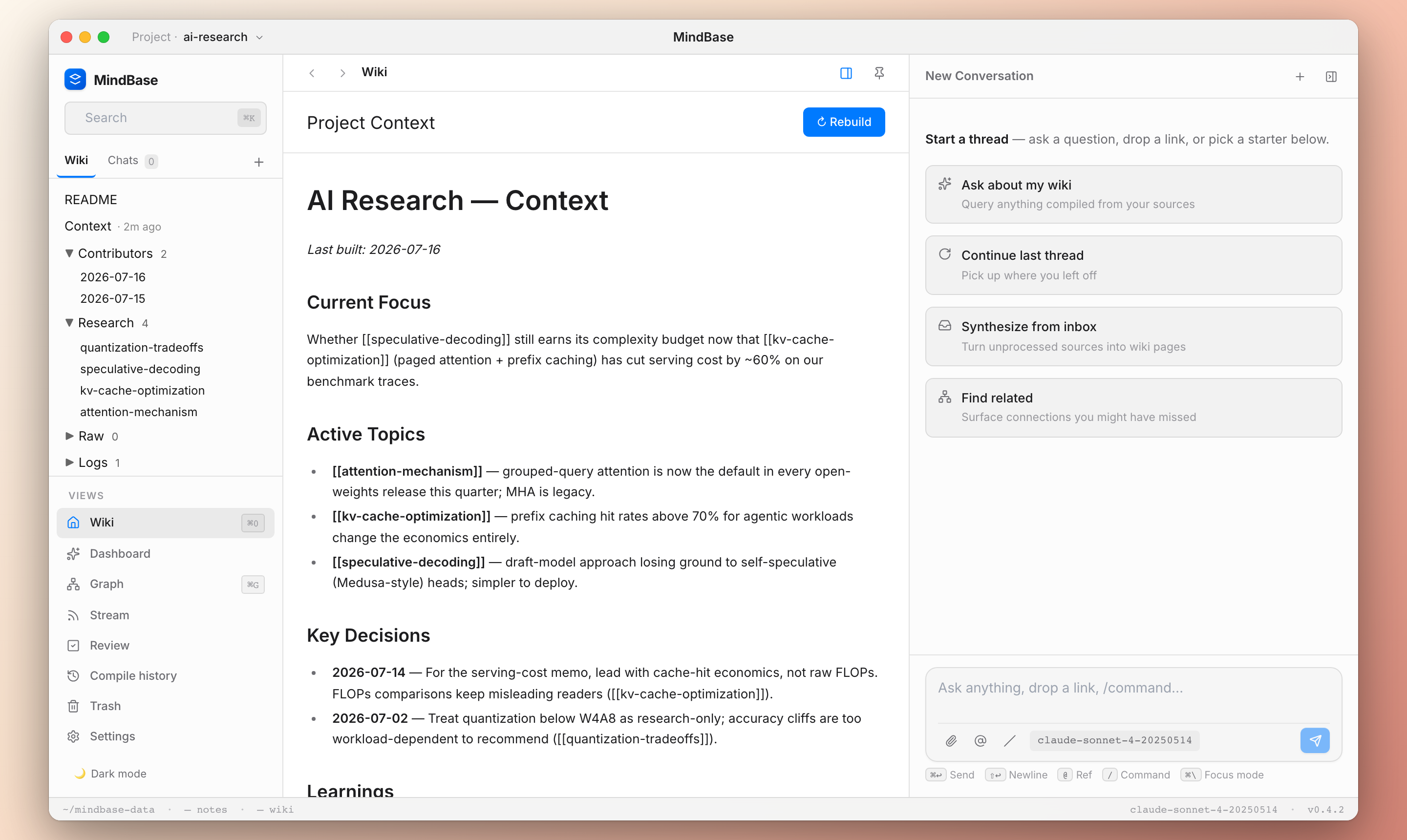
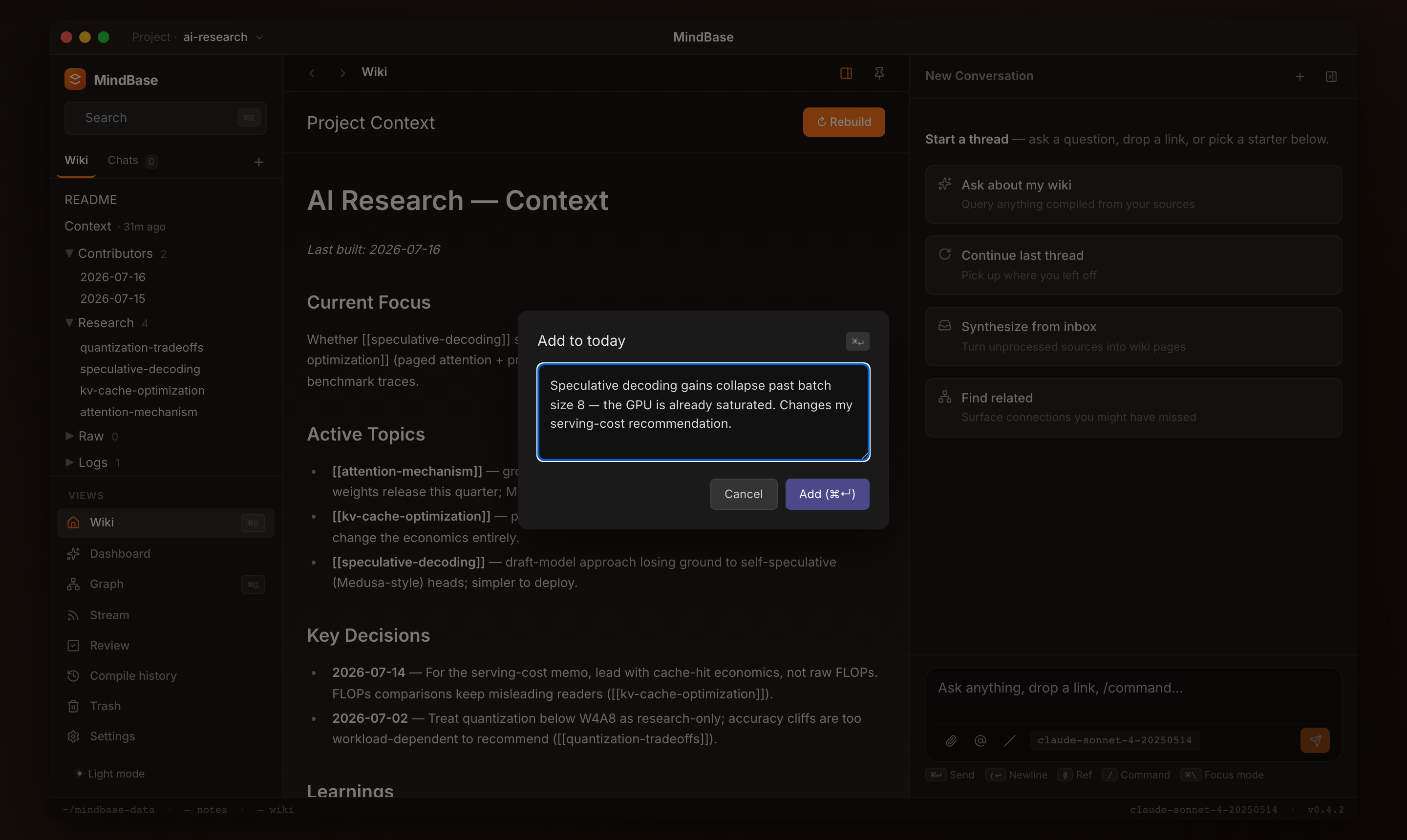
Cmd+I from anywhere — a thought goes straight into today's contributor file. Dark mode included.
Start it
pnpm --filter @mindbase/server dev
# then open http://localhost:4321
You'll see:
- LeftRail tree: Contributors, Research, Logs, Artifacts, README, Context, Raw — organized as a file tree
Cmd+NNew note: a full WYSIWYG editor (headings, GFM, links,[[wikilink]]autocomplete) writing into your contributor layer; each note carries a wiki-status chip (✨ Add to wiki → ✓ In wiki)Cmd+IAddEntry: quick capture that appends to today's contributor file (works in any browser tab)- Article view: click any file to read it; edit inline
- Search (
Cmd+K): keyword search across your wiki - Project switcher: dropdown at the top
Since 0.3.0 the Web UI also runs the core operations itself, with whatever
LLM you configure in Settings (a cloud key or the free local model —
see below):
/contributein the chat composer — the AI reads your thought,
shows takeaways + a checkbox plan of wiki updates, and only writes what
you approve/build(or the Rebuild button on the wiki home) — regeneratescontext.mdfrom unbuilt sources, with an automatic snapshot first- ✨ Process on any note — sends that note through the same
contribute approval flow
/mb:lint and /mb:research still live in your AI editor (UI versions
are on the roadmap).
No API key? Use the free local model
The setup wizard can run MindBase entirely on a free local model via
Ollama — no subscription, no API key, no data
leaving your machine. It detects your hardware (RAM/CPU), recommends the
best model that fits (e.g. llama3.2:3b on 8GB, qwen3:14b on 32GB+),
installs Ollama if needed, pulls the model with a progress bar, and
verifies it with a real generation before finishing. Cloud models still
give deeper synthesis; the local path is a real, working default.
Muse Glimmer support (Meta's open-weight 30B)
MindBase supports Muse Glimmer
as a first-class local model. On Apple Silicon Macs with 32GB+ RAM the
setup wizard offers it as the best-tier pick, and the composer's model
badge switches between it and qwen3 in two clicks.
Inference engine: Ollama ≥ 0.32.7. That's the engine MindBase
integrates, and the version floor is real — older Ollama rejects the pull
with a 412. Glimmer currently runs through Ollama's MLX engine, which
means Apple Silicon only for now (NVIDIA/AMD support is upstream work
in progress — non-Mac machines won't be offered the model until then).
How to use it well (measured on an M2 Pro, 32GB):
| Task | Use | Why |
|---|---|---|
Chat, /contribute, interactive work |
qwen3:14b |
~30s responses. Glimmer takes minutes: ~60 tok/s prompt eval on MLX + an always-on reasoning phase. |
/lint, big /build, /research |
muse-glimmer:30b-mlx |
Slower but noticeably more grounded — its health-check findings quote the exact conflicting sentences instead of gesturing at them. |
Two Glimmer-specific behaviors MindBase handles for you:
- Thinking can't be disabled. Ollama's
think: falsesilently
discards Glimmer's reasoning tokens instead of skipping them — the
stream goes quiet for the whole think phase. MindBase leaves thinking
on for Glimmer and streams it live in the chat UI (🧠 …) so it never
looks frozen. - It follows instructions to the letter. Great for structured wiki
operations (its JSON never broke a schema in our testing); it needs
explicit rules for conversational edge cases, which MindBase's prompts
provide.
Feature matrix by editor
| Feature | Claude Code | Cursor / Windsurf / Cline / Continue | Web UI |
|---|---|---|---|
Slash commands (/mb:*) |
✅ | ❌ (use natural language) | ❌ |
| MCP tools directly | ✅ | ✅ | ❌ |
| Karpathy 8-step ingest with sub-agents | ✅ | ⚠️ Manual (LLM won't auto-follow the ritual) | ❌ |
| Auto-context via SessionStart hook | ✅ | ✅ (Cursor supports MCP hooks) | N/A |
| Contribute short thought | ✅ | ✅ | ✅ (Cmd+I) |
| Ingest PDF / URL / paste | ✅ | ✅ | ❌ |
| Ask wiki with cited answers | ✅ | ✅ | ❌ (planned) |
Build (regenerate context.md) |
✅ | ✅ | ⚠️ (button dispatches, but LLM runs elsewhere) |
| Health check / lint | ✅ | ✅ | ❌ (planned) |
| Deep research (web + wiki) | ✅ | ✅ | ❌ |
| Wiki tree browsing | ❌ | ❌ | ✅ |
| Rich file editor | ❌ | ❌ | ✅ |
| Cross-project search | ✅ | ✅ | ⚠️ (partial) |
-p project-id routing flag |
✅ | ⚠️ (via natural language) | N/A |
Legend: ✅ works · ⚠️ partial / experimental · ❌ not yet
Where your data lives
Everything is under ~/mindbase-data/ (override with MINDBASE_DATA_DIR env var).
~/mindbase-data/
├── config.json                       # { currentProjectId, ... }
└── projects/
    └── my-research/
        ├── README.md                 # Ops manual — you edit, LLM reads
        ├── context.md                # Synthesized truth — LLM writes, you read
        ├── index.yaml                # Auto-generated catalog
        ├── sources/
        │   ├── contributors/         # Your dated entries (append-only)
        │   │   └── <you>/
        │   │       └── 2026-07-11.md
        │   ├── research/             # LLM-authored wiki pages
        │   │   └── attention-mechanism.md
        │   └── raw/                  # PDFs, HTML captures, binary sources
        │       └── 2026-07-11/
        │           └── paper.pdf
        ├── logs/                     # Chronological operation log
        │   └── 2026-07-11.md
        ├── artifacts/                # Generated outputs
        │   ├── briefs/               # Daily briefs
        │   ├── exports/              # Bundle exports
        │   └── attachments/          # Images pasted into notes
        └── state/                    # LLM working state
            └── builder/snapshots/    # context.md snapshots for rollback
- Everything is markdown. Open in vim, VSCode, Obsidian — all work.
- No proprietary database. No SQLite of secret sauce. What you see on disk is what MindBase knows.
- Git-friendly.
cd ~/mindbase-data && git init— every change auditable and rollbackable. - Delete freely.
rm -rf ~/mindbase-data/projects/foo— nothing else needs cleanup.
Backups: if you use iCloud / Time Machine / Dropbox, they'll pick this up automatically since it's just files.
Architecture at a glance
       ┌────────────────────────────────────────────┐
       │  Your AI editor (any MCP-compatible):      │
       │  Claude Code · Cursor · Windsurf · Cline · │
       │  Continue.dev · Zed · Aider · ...          │
       └───────────────────┬────────────────────────┘
                           │  MCP (stdio JSON-RPC)
                           ▼
       ┌────────────────────────────────────────────┐
       │       MindBase MCP server (Node.js)        │
       │       — 49 tools: contribute, ask_wiki,    │
       │         build, lint, research, ...         │
       │       — reads/writes ~/mindbase-data/      │
       └───────────────────┬────────────────────────┘
                           │  file I/O
                           ▼
       ┌────────────────────────────────────────────┐
       │        ~/mindbase-data/projects/…          │
       │        Your markdown wiki on disk          │
       └───────────────────┬────────────────────────┘
                           │  read-only http
                           ▼  (optional)
       ┌────────────────────────────────────────────┐
       │  Web UI at localhost:4321 (React + Vite)   │
       │  Tree browser, editor, Cmd+I add-entry     │
       └────────────────────────────────────────────┘
packages/core— TypeScript strict library; storage adapters, LLM adapters, wiki index, graph, compile pipelineapps/mcp— MCP server (JSON-RPC over stdio); tools + prompts; framework-agnosticapps/server— Express server; serves the Web UI +/api/tree/*REST endpointsapps/web— React 19 + Zustand + Tailwind frontendapps/plugin— Claude Code plugin bundle (slash commands + sub-agents + hooks + bundled MCP server)
Troubleshooting
"MCP server not connected"
Cause: malformed config JSON, or the server binary can't start.
Fix:
- Run it manually:
npx -y mindbase-mcp < /dev/null— should print[mindbase-mcp] connected · dataDir=…on stderr and exit 0. - If that works, the issue is in your editor's config (typo, wrong file, trailing comma).
- Claude Code plugin users: verify the bundle exists —
ls /path/to/mindbase/apps/plugin/mcp-server/dist/cli.js— and rebuild withpnpm --filter @mindbase/plugin buildif missing. - Restart your editor after fixing config.
"No current project"
Cause: You haven't run /mb:init yet, or config.json is missing currentProjectId.
Fix:
/mb:init my-first-project
Or manually: echo '{"currentProjectId": "my-project"}' > ~/mindbase-data/config.json
"V1_LAYOUT_UNSUPPORTED"
Cause: you have a legacy v1 project directory (from before the 2026-06 refactor).
Fix (Claude Code only):
/mb:migrate --project <legacy-project-name>
Or delete it and start fresh: rm -rf ~/mindbase-data/projects/<legacy-project-name> then /mb:init.
Tools don't show in autocomplete
Cause: MCP handshake didn't complete.
Fix: Restart your editor. Check that no other MCP server is failing (a crash in one can block others in some clients).
The LLM in Cursor/Windsurf ignores my "add to mindbase" request
Cause: the LLM didn't recognize the intent as a tool call opportunity.
Fix: Add the .cursorrules block from the Cursor section. Being explicit ("call mindbase_contribute with text=...") works too.
"/api/counts 404" in Web UI
Cause: a pre-existing server-side route gap. Non-blocking — some tab count badges show 0 until fixed.
Fix: known issue, coming in the next patch release. Track it on the issues page.
More issues
Open a GitHub issue: github.com/frankchu91/mindbase/issues
Roadmap
Now (2026-Q3 beta):
- Multi-editor MCP support ✅
- Karpathy 8-step ingest via sub-agents (Claude Code) ✅
- Cross-project routing (
-pflag) ✅ - Web UI tree browser + Cmd+I add-entry ✅
- Wiki v2 layout ✅
Next (Q4):
- Web UI
Askpanel (skip Claude Code roundtrip for queries) - Web UI
Lintcards (visual health check inbox) - Audio input via Whisper (
/mb:contribute --audio recording.m4a) - Browser extension for one-click "save this page to MindBase"
- Anthropic marketplace listing (
/plugin install mindbase@mindbase-official) mindbase_commandunified meta-tool (slash-like UX in Cursor/Windsurf)
Later:
- Team brain (multi-contributor projects with human-in-the-loop review)
- Audio Overview (NotebookLM-style podcast digests)
- Marp slide-deck answers
- Tauri desktop app (one-click install for non-technical users)
- Mobile quick-capture apps
Beta feedback
I'm running MindBase as a private beta through 2026-Q4. If you're using it:
- Bug reports / feature requests: github.com/frankchu91/mindbase/issues
- Direct feedback / 30-min interview: [email protected]
I read every issue and reply within 24 hours during beta. If you tried MindBase and gave up — please tell me why. The blockers you hit are gold.
What kind of feedback is most useful?
- What happened the first minute after install?
- Which command / workflow do you use every day, if any?
- Which command / workflow did you try once and never again?
- What did you expect to work that didn't?
- What broke your trust in the LLM's synthesis?
- Would you pay for this? What's the shape of the pricing that would feel fair?
License
MIT — do what you want, no warranty. If you build something interesting on top, I'd love to hear about it.
Built with the belief that AI's most valuable gift is not "generation on demand" but "gardening of a persistent artifact you own."
Yorumlar (0)
Yorum birakmak icin giris yap.
Yorum birakSonuc bulunamadi