lad
Health Gecti
- License — License: NOASSERTION
- Description — Repository has a description
- Active repo — Last push 0 days ago
- Community trust — 77 GitHub stars
Code Uyari
- network request — Outbound network request in demo/tests/test_user_agent.py
- network request — Outbound network request in reference/client/lad_client.py
Permissions Gecti
- Permissions — No dangerous permissions requested
Bu listing icin henuz AI raporu yok.
An open protocol for discovering A2A-capable AI agents on local networks — the discovery & trust bootstrap layer beneath A2A (mDNS/DNS-SD, well-known endpoints, signed AgentCards).

Local Agent Discovery for A2A (LAD-A2A)



An open protocol for discovering A2A-capable agents on local networks.
LAD-A2A addresses a critical gap in the AI agent ecosystem: when a device joins a network—hotel Wi-Fi, office LAN, cruise ship, hospital campus—how does the user's AI assistant discover and connect to local agents? While A2A defines agent-to-agent communication and MCP defines agent-to-tool integration, LAD-A2A defines agent discovery.
With LAD-A2A, agents can:
- Automatically discover local A2A agents when joining a network
- Verify identity through signed AgentCards and DIDs
- Obtain user consent before establishing connections
- Negotiate capabilities via standard A2A mechanisms
See It In Action
https://github.com/user-attachments/assets/a6a06e95-729b-465a-857c-6a87da52b302
Real mDNS discovery → LAD-A2A protocol → A2A JSON-RPC communication
Why LAD-A2A?
AI agents are increasingly capable, but they remain isolated from their physical environment. A guest's AI assistant has no way to discover the hotel's concierge agent. An employee's assistant can't find the building's room booking agent. A patient's assistant doesn't know the hospital offers a wayfinding agent.
LAD-A2A solves this by providing:
- Zero-Configuration Discovery: Agents find each other automatically via mDNS/DNS-SD (
_lad-a2a._tcp) and well-known endpoints. - An honest trust model: Local networks are hostile by default. LAD-A2A carefully separates channel authentication (TLS proves you reached the host in the URL) from identity verification (domain/JWS/DID anchored to the org). TLS to an attacker-chosen host proves nothing about identity — see the Trust Model.
- Explicit user consent: Human approval before first contact, keyed to a verified identity — never auto-approved.
- Ecosystem Alignment: LAD-A2A only handles discovery—once an agent is verified and approved, standard A2A communication takes over.
How It Fits
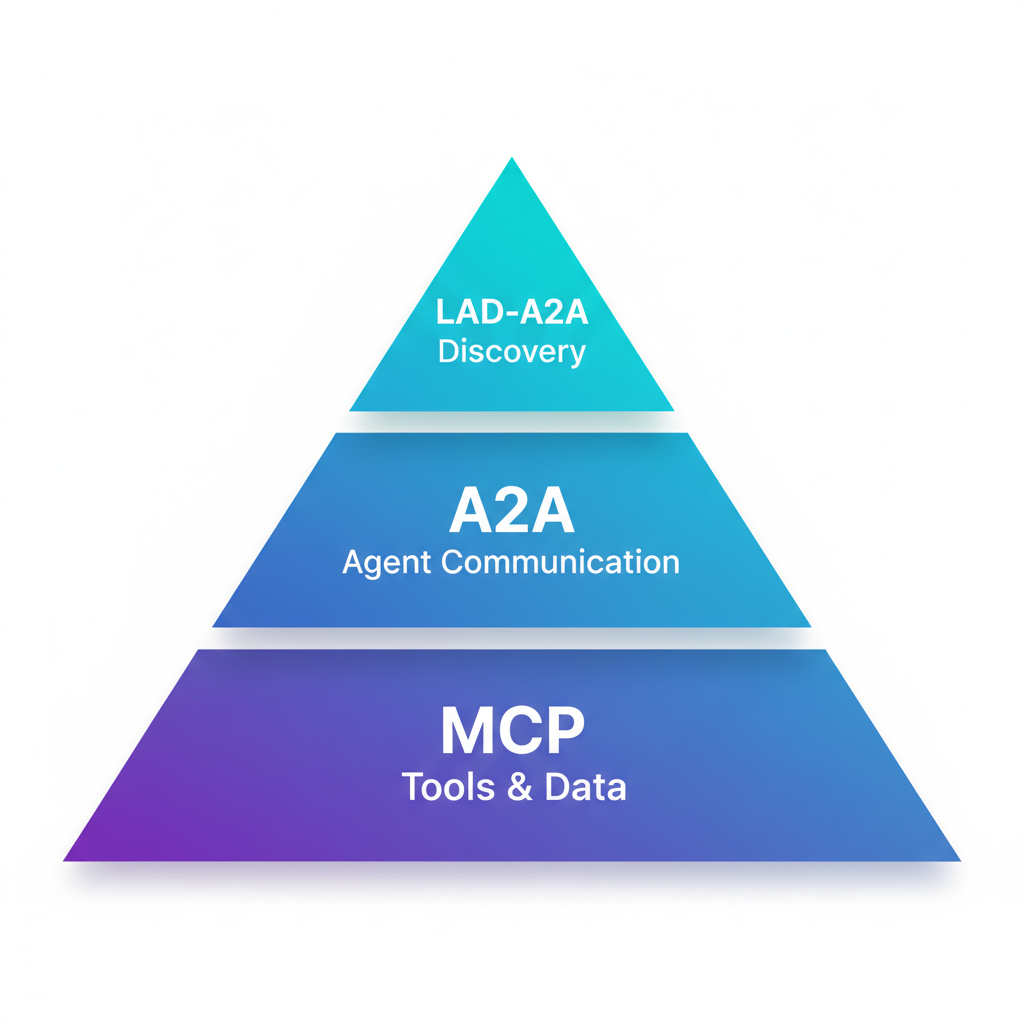
| Protocol | Role | Specification |
|---|---|---|
| LAD-A2A | Discovery & Trust Bootstrap | lad-a2a.org |
| A2A | Agent-to-Agent Communication | a2a-protocol.org |
| MCP | Agent-to-Tools/Data | modelcontextprotocol.io |
LAD-A2A is the first handshake. It answers "who's here?" so that A2A can answer "what can you do?" and MCP can answer "how do I do it?"
Discovery Mechanisms
LAD-A2A supports multiple discovery paths with automatic fallback:
| Mechanism | Environment | Description |
|---|---|---|
| mDNS/DNS-SD | LAN, Consumer Wi-Fi | Zero-config discovery via the LAD-owned _lad-a2a._tcp service type |
| Well-Known Endpoint | Captive Portals, Web | /.well-known/lad/agents on the network domain |
| DHCP Option | Enterprise Networks | Custom option containing discovery URL |
| QR/NFC | Physical Fallback | Direct link to AgentCard for restricted networks |
Getting Started
Interactive Demo (Recommended)
Experience LAD-A2A with a fully working demo featuring two AI agents:
cd demo
cp .env.example .env
# Add your OpenAI API key to .env
./run_demo.sh
Open http://localhost:8000 to see:
- Real mDNS discovery (
_a2a._tcp.local) - LAD-A2A protocol in action
- A2A JSON-RPC 2.0 communication
- LLM-based query routing
See demo/README.md for full documentation.
Run Locally
cd reference
pip install -e .

# Start a discovery server (development only)
python -m server.lad_server --name "My Agent" --port 8080

# Discover agents (in another terminal). --no-verify-tls opts into plaintext for
# local dev; without it the client refuses non-https URLs as a discovery failure.
python -m client.lad_client --url http://localhost:8080 --no-verify-tls
Note: The example above uses HTTP for local development. In production, TLS is required per the security spec: all endpoints MUST use TLS 1.2+, and a non-https URL is a discovery failure, not merely an unverified agent.
Example: Hotel Concierge
1. Guest device joins "ExampleHotel-Guest" Wi-Fi
2. Client queries mDNS for _lad-a2a._tcp.local AND the well-known endpoint,
   then aggregates + dedups by identity key
3. Discovery response includes an AgentCard URL (https) and a DID identity key
4. Client fetches the card over verified TLS and verifies IDENTITY
   (JWS/DID anchored to the org domain); a failed method is fatal
5. Client prompts the user, showing channel and identity separately:
   "Domain-authenticated: concierge.examplehotel.com — Connect?"
6. User approves → Standard A2A session begins (this is first contact)
7. User asks: "What time is breakfast?" → Agent responds via A2A
Security Model
Local networks are hostile by default — a valid TLS certificate for an attacker-owned look-alike domain is part of the threat model, not a defense against it. LAD-A2A mandates:
| Requirement | Description |
|---|---|
| Channel ≠ identity | Verified TLS authenticates the channel; it never, on its own, marks an agent "verified" |
| Anchored identity | Domain / JWS / DID, each bound to the org domain; a failed stronger method is fatal (no weaker fallback) |
| Fresh signed cards | JWS AgentCards carry a short exp; expired/replayed cards are rejected |
| Explicit consent | Human approval before first contact, keyed to the verified identity — never auto-approved |
| Limits & privacy | Bounded discovery responses; no wildcard CORS; data minimization before consent |
See the Trust Model for why the channel/identity split is the crux.
Documentation
📚 Full documentation at lad-a2a.org
| Resource | Description |
|---|---|
| 📖 Specification | Full protocol specification with JSON schemas |
| 🔧 Reference Implementation | Python server and client libraries |
| 🎮 Interactive Demo | Full working demo with mDNS + A2A |
| 📚 Examples | Integration scenarios and use cases |
Use Cases
| Environment | Example Interaction |
|---|---|
| Hotels | "What's the spa schedule?" / "Request late checkout" |
| Cruise Ships | "Where's tonight's show?" / "Book shore excursion" |
| Offices | "Book conference room 4B" / "Find available desks" |
| Hospitals | "Navigate to radiology" / "Check appointment status" |
| Stadiums | "Find my seat" / "Order food to section 112" |
| Smart Cities | "Next bus to downtown?" / "Find parking near me" |
Contributing
We welcome contributions to enhance the LAD-A2A protocol.
- Questions & Discussions: GitHub Discussions
- Issues & Feedback: GitHub Issues
- Contribution Guide: CONTRIBUTING.md
License
This project is licensed under the Apache License 2.0.
Yorumlar (0)
Yorum birakmak icin giris yap.
Yorum birakSonuc bulunamadi