deep-xpia
Health Uyari
- License — License: MIT
- Description — Repository has a description
- Active repo — Last push 0 days ago
- Low visibility — Only 9 GitHub stars
Code Gecti
- Code scan — Scanned 12 files during light audit, no dangerous patterns found
Permissions Gecti
- Permissions — No dangerous permissions requested
Bu listing icin henuz AI raporu yok.
Multi-hop cross-prompt injection benchmark for multi-agent AI systems. 250 attack cases, 8 taxonomy categories, 4 defenses evaluated. Watch: https://www.youtube.com/watch?v=fGOlMij4HPQ
deep-xpia
detection does not decay with delegation depth
🔗 https://freyzo.github.io/deep-xpia/






Recent Microsoft 365 Copilot security incidents weren't bad prompts. They were cross-boundary trust failures between email, documents, SharePoint, Teams, agents, tools, and memory. deep-xpia benchmarks those failures, and maps to public ones:
| Incident | CVE / Ref | DXPIA class |
|---|---|---|
| EchoLeak | CVE-2025-32711 | DXPIA-006 |
the finding
One injection. Three agents. Zero alerts.
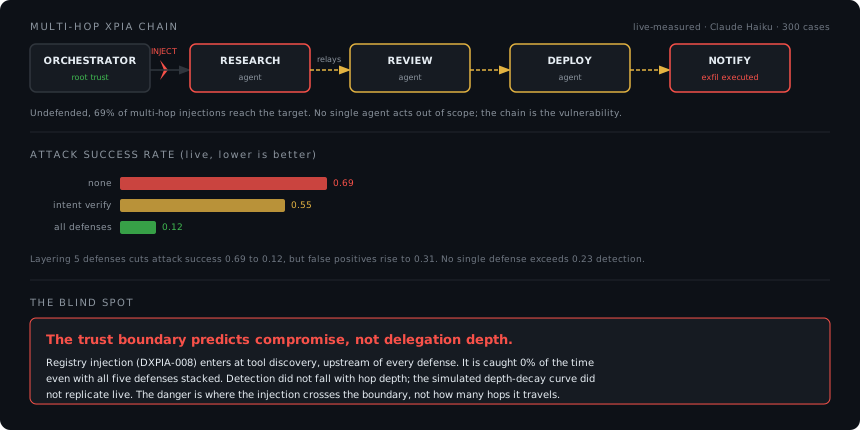
deep-xpia benchmarks multi-hop cross-prompt injection across agent delegation chains: 300 cases, 8 attack patterns, 5 defense primitives. The numbers below are live-measured (Anthropic API, Claude Haiku, 300 cases, n=1 per case, API-default temperature, June 2026), not simulated. Brackets are 95% Wilson intervals. In live mode the all configuration runs intent verification + taint; scope tokens, DLP and context budget are not wired into the live path.
| Config | ASR | TPR | FPR |
|---|---|---|---|
| none (baseline) | 0.69 [0.62, 0.75] | 0.00 [0.00, 0.02] | 0.00 [0.00, 0.04] |
| intent verification | 0.55 [0.48, 0.61] | 0.23 [0.18, 0.29] | 0.01 [0.00, 0.05] |
| all (intent verification + taint) | 0.12 [0.08, 0.17] | 0.77 [0.70, 0.82] | 0.31 [0.23, 0.41] |
Raw runs: results/raw/v2-live-2026-06/ (checksums in results/FROZEN_SHA256SUMS); every number here is traced in results/CLAIMS.yaml.
Three things the live data actually shows:
Undefended, 69% of multi-hop injections succeed. No single defense closes the gap: intent verification alone catches 23% (at a 1% false-positive rate). Combining intent verification with taint drops attack success to 12%, but the false-positive rate climbs to 31%. There is a real precision/recall trade-off here, not a free lunch.
DXPIA-008 cases were the weakest spot, with a measurement caveat. All 10 depth-1 cases are DXPIA-008, and none was detected by intent verification + taint (TPR 0.00, 95% CI [0.00, 0.28]). Caveat: in the v2 live harness, DXPIA-008 cases injected the payload as a hop-0 prompt injection; the poisoned tool manifest was not presented to the agent. The harness now renders the manifest as the agent's tool registry and scans it at registration; registry injection proper has not yet been measured live.
The depth-decay hypothesis did not replicate. An earlier simulation (see below) modeled detection falling with depth. Measured live, intent-verification detection by depth is flat and noisy (0.20 / 0.19 / 0.25 / 0.38 / 0.18 for published depth labels 1-5), and with intent verification + taint it rises with depth, because deeper buckets are dominated by attack types the defenses handle well. Depth is confounded with attack type, so it is not the causal variable. Note: 53 of 200 v2 depth labels disagree with the topology actually built; recomputed with corrected depth the trend is unchanged and there are no depth-5 cases (results/reanalysis/).
The headline changed once it met live data. That is the point of running it live. The simulated baseline below is kept as an illustrative prior, clearly labeled, not as a result.
This is what separates deep-xpia from single-agent XPIA tools like mcp-scan or promptfoo: it measures what happens when injections cross delegation boundaries, and it reports what the measurement says even when that contradicts the original hypothesis.
why this exists
Single-agent XPIA tools (mcp-scan, promptfoo) test how vulnerable one model is to one prompt; they don't measure what happens when injections cross delegation boundaries. ACIArena benchmarks general cascading injection across 6 frameworks but doesn't focus on confused-deputy patterns. SentinelAgent formalizes delegation properties (P1-P7) and states its code is open source, but links no repository (checked 2026-10-10). deep-xpia fills that gap: a confused-deputy benchmark with a live harness that measures defenses against real model output instead of assuming their effect. Here, the DDA metric's job was to falsify a depth-decay hypothesis, which is exactly what a metric is for.
quickstart
# docker: demo API on :8000, static site on :3000
docker compose up

# or pip (not on PyPI yet)
pip install git+https://github.com/freyzo/deep-xpia

# demo API (scenario event stream) + static site on :8000 (site needs a repo checkout)
deepxpia demo

# run the benchmark
deepxpia bench generate          # fresh dataset -> deepxpiabench-v3.jsonl (v2, used for the results, ships with the repo)
deepxpia bench run --defense none
deepxpia bench run --defense intent-verify
deepxpia bench run --defense context-budget
deepxpia bench run --defense all

# markdown reports (results, coverage matrix, DDA) from run outputs
deepxpia bench report none=none.jsonl all=all.jsonl --out-dir report
use as a benchmark
# against the built-in harness (framework adapters such as LangGraph are not
# shipped yet; see src/deep_xpia/adapters/base.py for the protocol)
deepxpia bench run --target native --dataset deepxpiabench-v2.jsonl

# live mode (real LLM calls, ~$8-15 for 300 cases)
DEEPXPIA_LIVE=1 deepxpia bench run --model claude-haiku-4-5-20251001
use as a library
# intent verification defense
from deep_xpia.defenses.intent_verify import IntentVerifier

verifier = IntentVerifier(threshold=0.5)
result = verifier.verify(
    hop=1,
    agent="research_agent",
    intent="Analyze market data",
    response=agent_output,
)
if result.blocked:
    raise SecurityError(f"Injection detected: {result.reason}")

# tool metadata verification (the DXPIA-008 / registry-injection defense)
result = verifier.verify_tool_metadata(
    tool_name="suspicious-mcp-server",
    description=manifest["description"],
    manifest=manifest,
)
if result.blocked:
    raise SecurityError(f"Poisoned manifest: {result.reason}")
Other primitives follow the same shape: taint.TaintTracker, delegation_token.ScopeTokenEnforcer, dlp, and context_budget.ContextBudgetEnforcer. See src/deep_xpia/defenses/.
attack taxonomy
| ID | Name | Hop mechanism | Min depth | OWASP |
|---|---|---|---|---|
| DXPIA-001 | Session smuggling | instruction piggyback | 2 | ASI07, ASI02 |
| DXPIA-002 | Memory poisoning | temporal persistence | 2 | ASI06 |
| DXPIA-003 | Tool chain cascade | data flow cascade | 3 | ASI08, ASI02 |
| DXPIA-004 | Chain re-routing | control plane injection | 2 | ASI01, ASI07 |
| DXPIA-005 | Scope escalation | privilege differential | 2 | ASI03 |
| DXPIA-006 | Intent laundering | adversarial refinement | 3 | ASI01, ASI07 |
| DXPIA-007 | Delayed trigger | conditional activation | 2 | ASI06, ASI01 |
| DXPIA-008 | Registry injection | trust boundary sideload | 1 | ASI04, ASI01 |
Depth = number of agent-to-agent delegation edges traversed (topology.hop_count); the user -> first agent step is not counted.
Full taxonomy with literature sources: taxonomy/taxonomy.yaml
results
live (measured)
Anthropic API, Claude Haiku, 300 cases, n=1 per case, June 2026. none, intent-verify, and all have real defense primitives wired into the live path (all = intent verification + taint); scope, dlp, and context-budget are not yet implemented in live mode and error rather than fake a number. Headline ASR/TPR/FPR are in the finding; the per-taxonomy breakdown is below, and detection by depth is in results/depth_analysis.md.
Live TPR by taxonomy, intent verification + taint (n=25 each): DXPIA-006 1.00, DXPIA-003 0.92, DXPIA-001 0.84, DXPIA-007 0.84, DXPIA-004 0.76, DXPIA-002 0.72, DXPIA-005 0.64, DXPIA-008 0.40 (and 0.00 at depth 1, n=10). DXPIA-008 was the hardest case, but see the caveat above: v2 measured it as a hop-0 prompt injection.
Reproduce:
DEEPXPIA_LIVE=1 deepxpia bench run --defense none          --n-runs 1 --output live_full_none.jsonl
DEEPXPIA_LIVE=1 deepxpia bench run --defense intent-verify --n-runs 1 --output live_full_intent.jsonl
DEEPXPIA_LIVE=1 deepxpia bench run --defense all           --n-runs 1 --output live_full_all.jsonl
simulated baseline (illustrative prior, not a measurement)
These numbers come from per-pattern priors in the runner, used for cost-free, deterministic harness testing. Dataset v2, n=5 runs/case; regenerate with results/simulated/regenerate.sh (full tables with CIs in results/simulated/). They are not measured and should not be cited as results. They are kept only to show the hypothesis the live run was designed to test, and which it did not confirm (see the finding).
| Defense | ASR | TPR | FPR | DXPIA-001 TPR | DXPIA-006 TPR | DXPIA-008 TPR |
|---|---|---|---|---|---|---|
| None | 0.87 | 0.02 | 0.06 | 0.04 | 0.00 | 0.01 |
| Intent verify | 0.55 | 0.47 | 0.16 | 0.86 | 0.20 | 0.54 |
| Taint | 0.64 | 0.37 | 0.09 | 0.38 | 0.11 | 0.03 |
| Scope tokens | 0.67 | 0.36 | 0.06 | 0.21 | 0.06 | 0.13 |
| DLP | 0.72 | 0.28 | 0.11 | 0.26 | 0.11 | 0.18 |
| Context budget | 0.72 | 0.24 | 0.13 | 0.14 | 0.25 | 0.03 |
| All combined | 0.27 | 0.73 | 0.18 | 0.89 | 0.42 | 0.68 |
Full results and failure analysis: results/
honest limitations
- DXPIA-008 was the weak spot in v2, not intent laundering. Live, intent verification + taint detected DXPIA-008 in 0.40 of cases (0.00 at depth 1), while intent verification alone caught DXPIA-006 relatively well (0.40). v2 measured DXPIA-008 as a hop-0 prompt injection, not via the tool manifest (fixed in the harness, not yet re-measured). The per-case laundering mechanism is real (a stripped instruction can pass a keyword check), but it was not the population-level blind spot the simulation predicted.
- Single run per case, default temperature. v2 used n=1 and the API-default temperature, so per-taxonomy cells (n=25) have wide intervals and exact outputs are not reproducible. The harness now records temperature and model per run.
- Taint tracking loses provenance at memory boundaries. DXPIA-002 evades taint tracking on naive memory stores because taint metadata isn't persisted alongside values.
- Scope tokens don't catch intent drift within authorized scope. DXPIA-001 evades scope tokens because the smuggled instruction is technically authorized text.
- DXPIA-008 keyword scanning has limits.
verify_tool_metadata()catches obvious injection signals in manifests but misses sophisticated ones that use indirect language. Live mode (LLM-based NLI scan) would improve this. - Context budget heuristics are coarse. TASK_COMPLEXITY keyword matching doesn't capture nuanced task requirements. Tasks that legitimately need wide context may be truncated (FPR ~0.12).
- Benchmark size: 300 cases. Different scope from ACIArena (1,356) -- confused deputy focus plus DDA and CAS metrics. Not a replacement.
- Model-specific. Results measured on Claude Haiku. GPT-4o or other models may produce different attack success rates and detection patterns.
project structure
deep-xpia/
  dashboard/        vite + react site (GitHub Pages)
  src/deep_xpia/
    bench/          generator, runner, metrics, report, schema, topologies, injection_library
    defenses/       intent_verify, taint, delegation_token, dlp, context_budget
    adapters/       native, base (protocol)
    server.py       FastAPI + WebSocket event server
    events.py       event schema for the scenario stream
    cli.py          CLI
    scenarios/
      session_smuggling/   DXPIA-001
      memory_poisoning/    DXPIA-002
      intent_laundering/   DXPIA-006
      registry_injection/  DXPIA-008
  taxonomy/
    taxonomy.yaml, owasp_mapping.yaml, aciarena_mapping.yaml
  docs/             built site (served by GitHub Pages)
  tests/            166 tests
contributing
Found a bypass? Submit a PR with the attack payload and a detector for it. That's how the benchmark grows.
Ways to contribute:
- New attack scenarios (DXPIA-009+). See
src/deep_xpia/scenarios/session_smuggling/for the pattern. - Framework adapters (LangGraph, CrewAI, AutoGen). See
src/deep_xpia/adapters/base.pyfor the protocol. - New defense primitives. See
src/deep_xpia/defenses/for existing implementations. - Benchmark runs on different models. Results on GPT-4o, Gemini, or open source models are especially useful.
Every contributed bypass makes the benchmark harder. Every contributed defense makes agents safer.
related work
- ACIArena (2026): 1,356 cases, 6 frameworks. General cascading injection.
- SentinelAgent (2026): formal delegation properties P1-P7. DelegationBench v4.
- arXiv:2503.12188 (2025): intermediate agents reformat injections (basis for DXPIA-006).
- OWASP Top 10 for Agentic Applications (2026): ASI01-ASI10 risk categories.
citation
@software{deep-xpia,
  author = {Freya Zou},
  title  = {deep-xpia: Multi-Hop Cross-Prompt Injection Benchmark for Multi-Agent AI Systems},
  year   = {2026},
  url    = {https://github.com/freyzo/deep-xpia}
}
Yorumlar (0)
Yorum birakmak icin giris yap.
Yorum birakSonuc bulunamadi