TIRPAN
Health Warn
- License — License: NOASSERTION
- Description — Repository has a description
- Active repo — Last push 0 days ago
- Low visibility — Only 6 GitHub stars
Code Pass
- Code scan — Scanned 12 files during light audit, no dangerous patterns found
Permissions Pass
- Permissions — No dangerous permissions requested
This tool is an autonomous, AI-driven agent designed to act as a senior penetration tester. Given a target scope, it automatically scans networks, identifies vulnerabilities, executes exploits, and generates structured security reports.
Security Assessment
The agent inherently executes arbitrary shell commands, makes extensive network requests, and interacts with system services (such as running Nmap and Metasploit). The codebase scan found no dangerous hidden patterns or hardcoded secrets, and it requests no unnecessary local permissions. However, because the core function of this software is to autonomously hack networks, the overall operational risk is High. It possesses a built-in kill switch and emphasizes legal use, but users are entirely responsible for ensuring it runs only in properly authorized environments.
Quality Assessment
The project is under active development with very recent repository updates. It claims a solid test suite with high coverage and provides a demo video. However, community trust is extremely low, evidenced by only 6 GitHub stars, meaning the tool has not been widely vetted by the broader security community. Additionally, the repository lacks a standard open-source license, using a custom Non-Commercial assertion instead, which restricts commercial use and creates potential legal ambiguity for enterprise adoption.
Verdict
Use with caution: The code itself appears clean, but given its immense capability for autonomous network exploitation and its low public community vetting, it should only be deployed by experienced professionals in strictly controlled and legally authorized lab environments.
Autonomous Ethical Guardrailed Intelligence System — AI-powered penetration testing bot

TIRPAN
Targeted Intrusion Recon, Penetration & Autonomy Node
An AI agent that reasons like a senior penetration tester and executes like one.







Read in another language: Türkçe
Give TIRPAN a target and a scope. It handles the rest.
The agent scans the network, enumerates services, searches for known exploits, selects and executes the best attack path, performs post-exploitation reconnaissance, and produces a structured vulnerability report with CVSS scores — all autonomously, all in real time, all with a built-in kill switch.
For authorized security testing only. Lab environments, CTF competitions, and engagements with explicit written permission. Read the legal requirements.
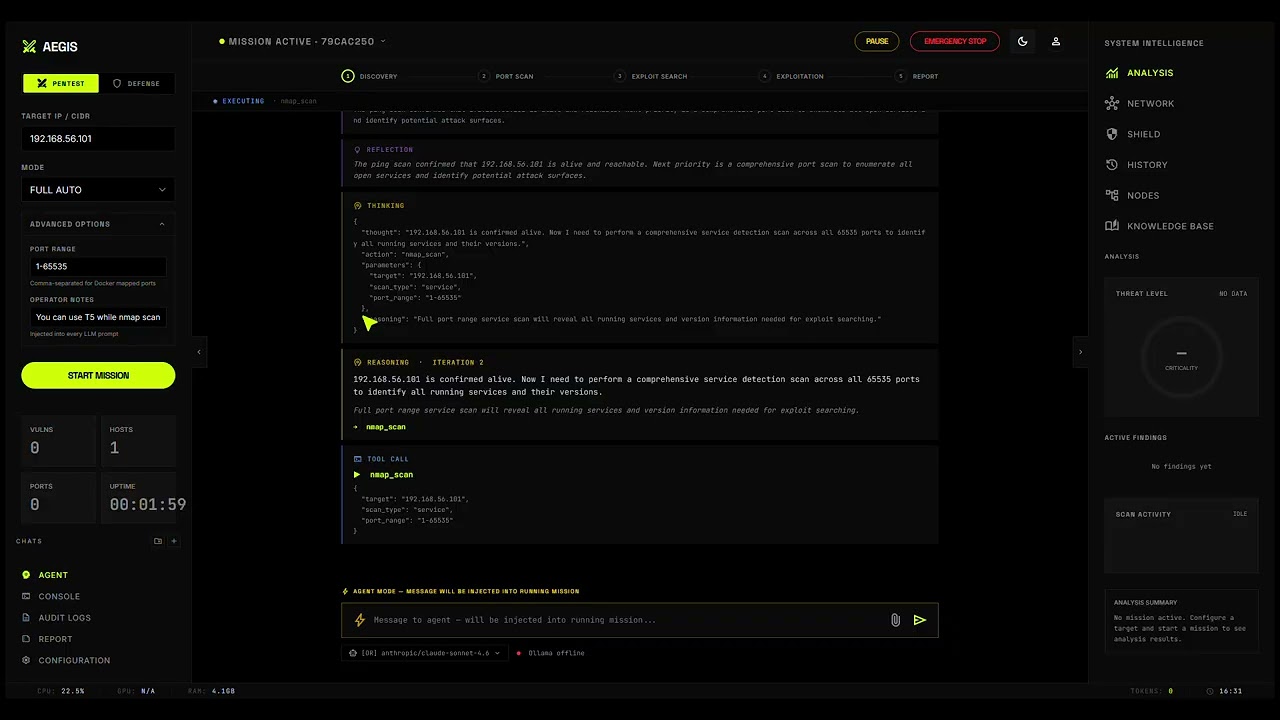
Demo
How It Works
TIRPAN runs a ReAct loop — Reason, Act, Observe, Reflect — continuously until the engagement is complete or all objectives are satisfied.
Operator:  "Scan 192.168.1.0/24, exploit what you find, collect post-exploitation data."

TIRPAN:     [Thought]   No hosts discovered yet. Starting ping sweep.
           [Act]       nmap_scan — ping sweep on 192.168.1.0/24
           [Observe]   4 live hosts: .5, .10, .23, .42
           [Thought]   Running full service detection on all hosts in parallel.
           [Act]       nmap_scan — service scan x4
           [Observe]   Host .5: SMB/445 (Windows Server 2008 R2), SSH/22, HTTP/80
           [Thought]   SMB on an old Windows host. Checking for EternalBlue.
           [Act]       searchsploit_search — "ms17-010"
           [Observe]   exploit/windows/smb/ms17_010_eternalblue — CVSS 9.8
           [Thought]   Critical severity, high confidence. Running exploit with post-commands.
           [Act]       metasploit_run — ms17_010_eternalblue + post_commands
           [Observe]   Shell opened. Session 1. whoami: NT AUTHORITY\SYSTEM
           [Thought]   Root shell on .5. Recording recon. Moving to next host.
           ...
           [Act]       generate_report
           [Done]      3 critical findings. HTML and PDF reports saved.
Every step is visible in the web UI in real time. Every action is logged for audit purposes.
Current Capabilities (V1)
| Capability | Detail |
|---|---|
| Network discovery | Ping sweep across any CIDR range |
| Service enumeration | Full port scan with version and OS detection, NSE scripting |
| Exploit search | SearchSploit / ExploitDB queries per discovered service and version |
| Exploitation | Metasploit RPC and msfconsole fallback; auto payload selection; parallel exploit batches |
| Post-exploitation | Inline post-commands, persistent SSH sessions, bind and reverse shells, script upload and execution |
| Reporting | HTML and PDF reports with CVSS v3.1 scoring per finding |
| Real-time UI | WebSocket-based streaming of every agent thought, action, and result |
| Knowledge base | Cross-session memory of which exploits succeeded against which service versions |
| Audit logging | Append-only log of every action with timestamp, target, and outcome |
| Kill switch | Immediate halt of all operations with one click or signal |
Tools registered at runtime: nmap_scan, searchsploit_search, metasploit_run, ssh_exec, shell_exec
Architecture
+----------------------------------------------------------+
|                         TIRPAN                            |
|                                                          |
|  +----------+     +----------------------------------+   |
|  |  Web UI  |<--->|  FastAPI  —  REST + WebSocket    |   |
|  +----------+     +----------------+-----------------+   |
|                                    |                     |
|                       +------------v-----------+         |
|                       |    ReAct Agent Core    |         |
|                       |                        |         |
|                       |  Reason  ->  Act    -> |         |
|                       |  Observe ->  Reflect   |         |
|                       |                        |         |
|                       |   +----------------+   |         |
|                       |   |  Safety Guard  |   |         |
|                       |   | (every action) |   |         |
|                       |   +----------------+   |         |
|                       +------------+-----------+         |
|                                    |                     |
|                       +------------v-----------+         |
|                       |     Tool Registry      |         |
|                       |                        |         |
|                       |  nmap_scan             |         |
|                       |  searchsploit_search   |         |
|                       |  metasploit_run        |         |
|                       |  ssh_exec              |         |
|                       |  shell_exec            |         |
|                       |  [+ plugins]     V2+   |         |
|                       +------------------------+         |
|                                                          |
|  +---------------------+  +--------------------------+   |
|  |      LLM Layer      |  |     SQLite Database      |   |
|  |  OpenRouter + Ollama|  |  Sessions / Findings /   |   |
|  |  (cloud or local)   |  |  Knowledge Base / Audit  |   |
|  +---------------------+  +--------------------------+   |
+----------------------------------------------------------+
Design principle: small core, large plugin surface.
The ReAct loop, safety layer, and LLM client are stable. Every attack capability is a plugin.
Quick Start
Prerequisites: Python 3.11+, Nmap 7.94+, Metasploit Framework 6.x, SearchSploit
# Clone
git clone https://github.com/fthsrbst/tirpan.git
cd tirpan

# Install dependencies
python3 -m venv .venv
source .venv/bin/activate
pip install -r requirements.txt

# Configure
cp .env.example .env
# Set OPENROUTER_API_KEY for cloud LLM, or configure OLLAMA_MODEL for local inference

# Start Metasploit RPC (required for exploitation; skip for scan-only mode)
msfrpcd -P your_password -S

# Launch web UI
python3 main.py
# Open http://localhost:8000

# Or run headless from the terminal
python3 main.py run --target 192.168.1.0/24 --mode full_auto --scope 192.168.1.0/24
Quick lab setup with Docker:
# Start a vulnerable target (Metasploitable 2)
docker run -d --name target tleemcjr/metasploitable2

# Point TIRPAN at it
python3 main.py run --target $(docker inspect -f '{{range .NetworkSettings.Networks}}{{.IPAddress}}{{end}}' target)
CLI Reference
TIRPAN operates in two modes: web UI (default) and terminal (headless).
Web UI
python3 main.py [--host HOST] [--port PORT] [--no-reload] [--log-level LEVEL]
| Flag | Default | Description |
|---|---|---|
--host |
127.0.0.1 |
Bind address |
--port |
8000 |
Listen port |
--no-reload |
off | Disable hot-reload |
--log-level |
info |
debug / info / warning / error |
Terminal Mode
python3 main.py run --target TARGET [options]
| Flag | Default | Description |
|---|---|---|
--target / -t |
required | IP, CIDR, hostname, or URL |
--mode / -m |
scan_only |
full_auto / ask_before_exploit / scan_only |
--scope |
0.0.0.0/0 |
Hard CIDR boundary — agent cannot leave this range |
--exclude-ips |
— | Comma-separated IPs to skip entirely |
--exclude-ports |
— | Comma-separated ports to skip |
--time-limit |
0 (none) |
Auto-stop after N seconds |
--rate-limit |
10 |
Maximum requests per second |
--max-iterations |
50 |
Maximum agent decision cycles |
--no-dos-block |
off | Permit DoS-category exploits (dangerous) |
--no-destructive-block |
off | Permit destructive exploits (dangerous) |
--output / -o |
reports/ |
Report output directory |
Examples:
# Reconnaissance only — no exploitation
python3 main.py run --target 10.0.0.0/24

# Full engagement with scope enforcement and time limit
python3 main.py run --target 10.0.0.1 --mode full_auto --scope 10.0.0.0/24 --time-limit 3600

# Scan with exclusions
python3 main.py run --target 192.168.1.0/24 --exclude-ips 192.168.1.1,192.168.1.254 --exclude-ports 22,3389
Safety Guardrails
TIRPAN enforces ten configurable safety constraints on every action. These cannot be bypassed by the LLM — they are evaluated in a separate layer before any tool executes.
| Guardrail | Default | Description |
|---|---|---|
target_scope |
required | CIDR boundary — agent cannot target IPs outside this range |
allow_exploits |
true |
Set false for reconnaissance-only mode |
no_dos |
true |
Blocks all denial-of-service exploit categories |
no_destructive |
true |
Blocks exploits that modify or delete data |
max_exploit_severity |
critical |
CVSS ceiling — will not attempt exploits above this level |
max_duration_seconds |
7200 |
Automatic stop after N seconds |
max_requests_per_second |
50 |
Rate limit to prevent network disruption |
excluded_ips |
[] |
IPs that are always skipped |
excluded_ports |
[] |
Ports that are always skipped |
port_scope |
1-65535 |
Constrain scanning to a specific port range |
Mission Configuration
For structured engagements, TIRPAN accepts a MissionBrief configuration that controls scope, permissions, credentials, and objectives.
{
  "target": "10.0.0.50",
  "mode": "full_auto",
  "target_type": "webapp",
  "speed_profile": "stealth",
  "objectives": ["find flag.txt", "dump /etc/shadow", "achieve root"],
  "known_tech": ["apache/2.4", "php/8.1"],
  "scope_notes": "Production system. Ports 80 and 443 only.",
  "allow_exploitation": true,
  "allow_post_exploitation": true,
  "allow_lateral_movement": false,
  "excluded_targets": ["10.0.0.1", "10.0.0.254"]
}
Speed profiles:
| Profile | Nmap timing | Behavior |
|---|---|---|
stealth |
-T1 --scan-delay 5s |
Slow, IDS-evasive, minimal log footprint |
normal |
-T3 |
Balanced, default for most engagements |
aggressive |
-T5 --min-rate 5000 |
Maximum speed, lab and CTF targets only |
Credential types supported: SSH (password or key), SMB/NTLM, SNMP, database (MySQL, PostgreSQL, MSSQL, MongoDB), HTTP (basic, digest, form, bearer token).
Roadmap
TIRPAN is built in three phases. V1 is the network-level foundation — everything after it arrives as a plugin.
V1 — Network Pentesting (complete)
- ReAct agent loop (Reason, Act, Observe, Reflect)
- Nmap / SearchSploit / Metasploit integration
- Post-exploitation via SSH, bind shell, reverse shell, script execution
- 10 safety guardrails and kill switch
- Web UI with real-time streaming
- SQLite knowledge base and full audit log
- HTML and PDF reports with CVSS v3.1 scoring
- MissionBrief structured configuration
- Speed profiles: stealth / normal / aggressive
- Plugin architecture (infrastructure ready)
V2 — Full Attack Lifecycle (planned)
Passive Reconnaissance
- OSINT: theHarvester, subfinder, amass, crt.sh certificate transparency, Shodan, WHOIS
- GitHub and source code secret scanning
- DNS zone transfer and subdomain enumeration
Service Enumeration
- SMB: enum4linux-ng, CrackMapExec (shares, users, password policy)
- LDAP / Active Directory: ldapsearch, ldapdomaindump
- SNMP, SMTP, Redis, MongoDB unauthenticated access
- DNS brute-force and zone transfers
Web Application Testing
- Technology fingerprinting: WhatWeb, WAF detection
- Directory and file discovery: Feroxbuster, ffuf, Gobuster
- Vulnerability scanning: Nuclei (9000+ templates), Nikto
- SQL injection: sqlmap (detection and exploitation)
- Cross-site scripting: Dalfox, XSStrike
- Command injection: Commix
- Server-side template injection: tplmap
- SSRF, XXE, LFI/RFI, file upload bypass, open redirect
- JWT attacks, GraphQL enumeration, OAuth misconfiguration
- HTTP request smuggling and deserialization vulnerabilities
Active Directory Attacks
- BloodHound-python collection
- Kerberoasting and AS-REP roasting via Impacket
- Pass-the-hash: CrackMapExec, evil-winrm
- DCSync: impacket-secretsdump
Credential Attacks
- Online brute-force: Hydra, Medusa
- Credential spraying with lockout guard
- Offline hash cracking: Hashcat, John the Ripper
Post-Exploitation
- Automated linpeas / winpeas upload and execution
- Custom code generation, upload, and execution on target (LLM-written payloads)
- Privilege escalation path analysis
Lateral Movement
- TCP tunneling: Chisel, Socat
- Impacket psexec / wmiexec
- Internal subnet discovery and pivot scanning
CTF and Bug Bounty Modes
- Automatic flag detection and capture (HTB, THM, CTFd)
- Bug bounty scope enforcement and out-of-scope blocking
- CVSS-filtered reporting for HackerOne / Bugcrowd submission templates
Infrastructure
- Tool health check system with install hints
- Plugin types: Python class, CLI wrapper, REST API wrapper (no code required for CLI and API plugins)
- Structured
Findingmodel with evidence, reproduction steps, and remediation - SARIF output for CI/CD and IDE integration
- Vector search knowledge base (RAG) using local embeddings
V3 — XBOW Level (planned)
- Coordinator and Solver multi-agent architecture
- Docker-isolated tool execution per solver
- White-box source code analysis via Semgrep and LLM
- Zero-day reasoning over unusual service behavior
- LLM-generated custom exploit scripts
- Internal Reviewer agent for false positive reduction
- CI/CD pipeline integration (GitHub Actions, GitLab)
- Cloud environment support (AWS, Azure, GCP asset discovery)
Writing a Plugin
Any new attack capability is a plugin. Three files are required; core code is never touched.
Python class plugin (complex logic):
# plugins/my_tool/tool.py
from tools.base_tool import BaseTool, ToolMetadata

class MyTool(BaseTool):
    @property
    def metadata(self) -> ToolMetadata:
        return ToolMetadata(
            name="my_tool",
            description="Scans for X vulnerability.",
            parameters={
                "type": "object",
                "properties": {
                    "target": {"type": "string", "description": "IP or hostname"}
                },
                "required": ["target"]
            },
            category="recon",
            version="1.0.0"
        )

    async def execute(self, params: dict) -> dict:
        target = params["target"]
        # implementation
        return {"success": True, "output": results, "error": None}
CLI wrapper plugin (V2 — no Python required):
{
  "name": "nuclei_scan",
  "type": "cli_wrapper",
  "binary": "nuclei",
  "install_hint": "go install github.com/projectdiscovery/nuclei/v3/cmd/nuclei@latest",
  "args_template": ["-u", "{target}", "-t", "{templates}", "-o", "{output_file}", "-json", "-silent"],
  "output_format": "jsonlines",
  "parameters": {
    "type": "object",
    "properties": {
      "target": {"type": "string"},
      "templates": {"type": "string", "default": "cves/"}
    },
    "required": ["target"]
  }
}
The agent discovers, loads, and uses plugins automatically — including exposing them to the LLM as available actions.
Comparison with XBOW
XBOW is the current commercial benchmark for autonomous AI pentesting. TIRPAN is the open-source equivalent.
| Capability | XBOW | TIRPAN V1 | TIRPAN V2+ |
|---|---|---|---|
| Network scanning and exploitation | Yes | Yes | Yes |
| AI-driven ReAct loop | Yes | Yes | Yes |
| Safety guardrails | Yes | Yes | Yes |
| Cross-session knowledge base | Yes | Yes | Yes |
| Full audit logging | Yes | Yes | Yes |
| Web application testing | Yes | No | Yes |
| Active Directory attacks | Yes | No | Yes |
| OSINT and passive reconnaissance | Yes | No | Yes |
| Self-correction on failure | Yes | No | Yes |
| Docker-isolated tool execution | Yes | No | V3 |
| Multi-agent coordinator architecture | Yes | No | V3 |
| Open source | No | Yes | Yes |
| Free to use | No | Yes | Yes |
| Extensible plugin ecosystem | No | Yes | Yes |
| Local LLM support | No | Yes | Yes |
Full comparison: docs/01_XBOW_COMPARISON.md
Tech Stack
| Component | Technology |
|---|---|
| Language | Python 3.11+ |
| Web framework | FastAPI 0.110+ with WebSocket streaming |
| LLM (cloud) | OpenRouter — Claude, GPT-4, Gemini, and others |
| LLM (local) | Ollama — Llama 3, Qwen, Mistral, and others |
| Offensive tools | Nmap 7.94+, SearchSploit, Metasploit 6.x (pymetasploit3) |
| Database | SQLite via aiosqlite |
| Reporting | Jinja2 + WeasyPrint (HTML and PDF) |
| Frontend | Vanilla HTML/CSS/JS with TailwindCSS |
| Testing | pytest + pytest-asyncio + pytest-cov — 329 tests, 79% coverage |
| Linting | ruff + black |
| CLI | argparse + Rich |
| Plugin loading | importlib (stdlib) |
Safe Testing Environments
Never test on systems you do not own or have explicit written authorization to test. Use these instead:
| Environment | Description | Setup |
|---|---|---|
| Metasploitable 2 | Intentionally vulnerable Linux VM | docker run -d tleemcjr/metasploitable2 |
| DVWA | Vulnerable web application | docker run -d vulnerables/web-dvwa |
| HackTheBox | CTF and lab platform | hackthebox.com |
| VulnHub | Downloadable vulnerable VMs | vulnhub.com |
| TryHackMe | Guided learning labs | tryhackme.com |
Documentation
| Document | Description |
|---|---|
| Architecture | Full system design with diagrams |
| Prerequisites | Installation and dependency setup |
| Roadmap | V1 through V3 feature plan |
| Safety and Legal | All 10 guardrails and legal requirements |
| XBOW Comparison | Feature gap analysis |
| Plugin System | Plugin authoring guide |
| V2 Feature Specification | Detailed V2 technical design |
Contributing
TIRPAN grows through its plugin ecosystem. Contributions are welcome:
- New plugins — Add a new attack type following the plugin guide
- Core improvements — Agent loop, safety layer, LLM client
- Bug reports — Open an issue on GitHub
- Documentation — Improve setup guides and examples
See CONTRIBUTING.md for guidelines.
Legal Disclaimer
This software is provided strictly for use in authorized security testing environments — penetration testing engagements with explicit written permission, controlled lab environments, CTF competitions, and academic research.
By using this software, you agree that:
- You will only test systems you own or have explicit written authorization to test.
- You are solely responsible for compliance with all applicable local, national, and international law.
- Unauthorized use against systems you do not own or lack explicit permission to test may constitute a criminal offense under the CFAA, Computer Misuse Act, and equivalent legislation in other jurisdictions.
The authors accept no liability for any damage, data loss, legal consequences, or other harm resulting from the use or misuse of this software.
License
TIRPAN Non-Commercial License — Free for personal, educational, and research use. Commercial use requires explicit written permission from the authors.
Reviews (0)
Sign in to leave a review.
Leave a reviewNo results found