cerber
Health Uyari
- License — License: MIT
- Description — Repository has a description
- Active repo — Last push 0 days ago
- Low visibility — Only 9 GitHub stars
Code Gecti
- Code scan — Scanned 12 files during light audit, no dangerous patterns found
Permissions Gecti
- Permissions — No dangerous permissions requested
Bu listing icin henuz AI raporu yok.
AI code-review cockpit: Claude reviews PRs into local artifacts; nothing reaches GitHub until you say so
cerber 🐕


AI code-review cockpit. Claude reviews your pull requests into local
artifacts — a summary, a chaptered walkthrough of the changes, draft inline
comments, and a verdict with a confidence score. You read it in a local web
cockpit, keep or rewrite or drop each comment, then press Send when you agree
with it.
Nothing reaches GitHub until you explicitly say so. Cerber's only GitHub
write is the Send button (plus opt-in daemon auto-send you turn on yourself) —
reviewing is 100% local and read-only. Reviews go out under your own account,
as your review, because you decided each line of it should.
That gate is the whole point, and the reason this is not another review bot:
Reviewing pull requests with an AI model creates a specific danger: a system
that can both draft opinions and hold GitHub credentials will eventually post
one without a human deciding it should.
Named after Cerberus, the gatekeeper: cerber guards what gets merged.
The whole loop in seventeen seconds — five PRs already drafted when you sit
down, the one that isn't an approval, straight to its blocker, arguing with the
reviewer until it rewrites its own finding, dropping the comment you disagree
with, and sending what's left as your review:
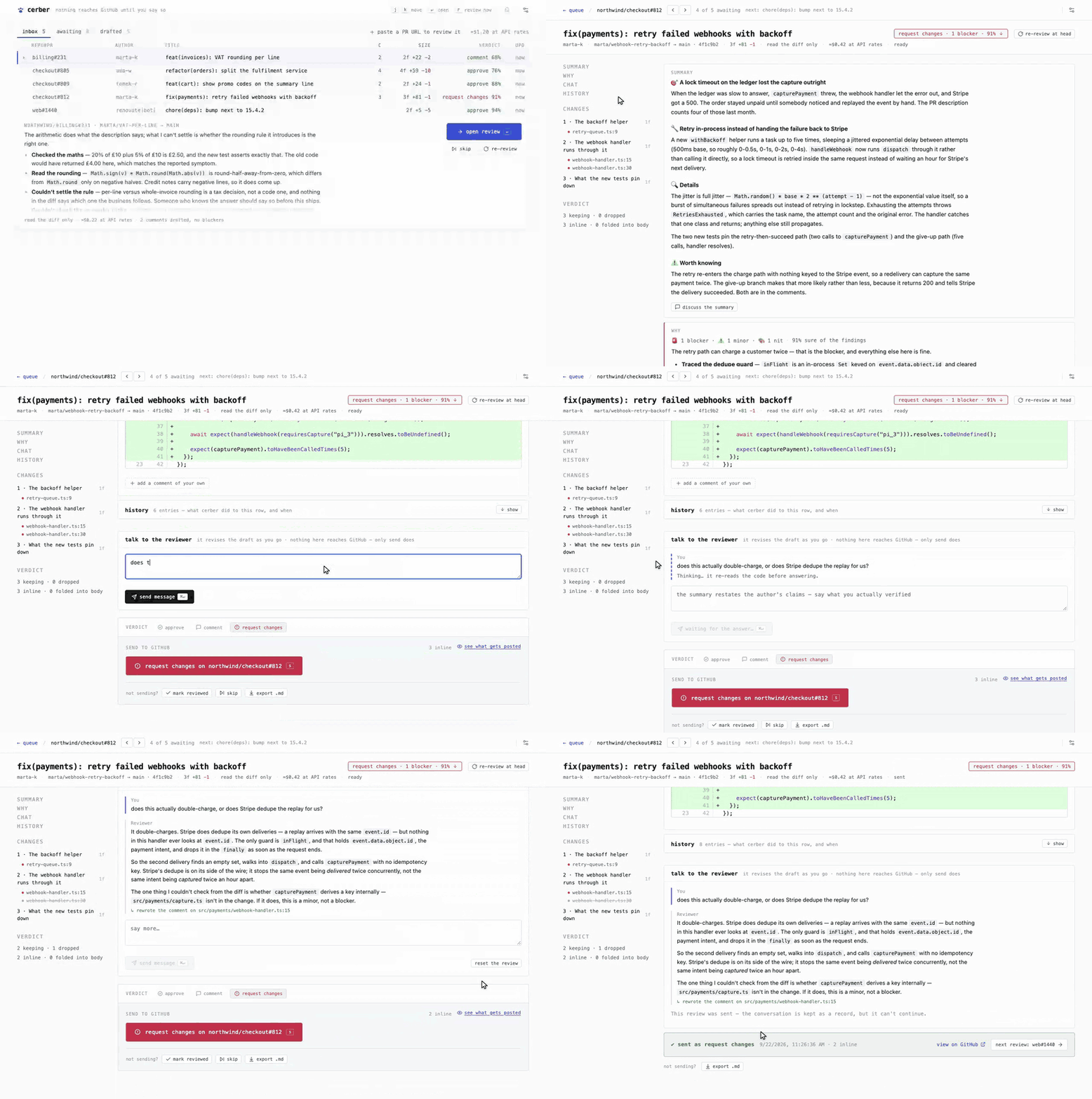
Same recording in full colour, if the GIF's palette is fighting the code:docs/demo.mp4.
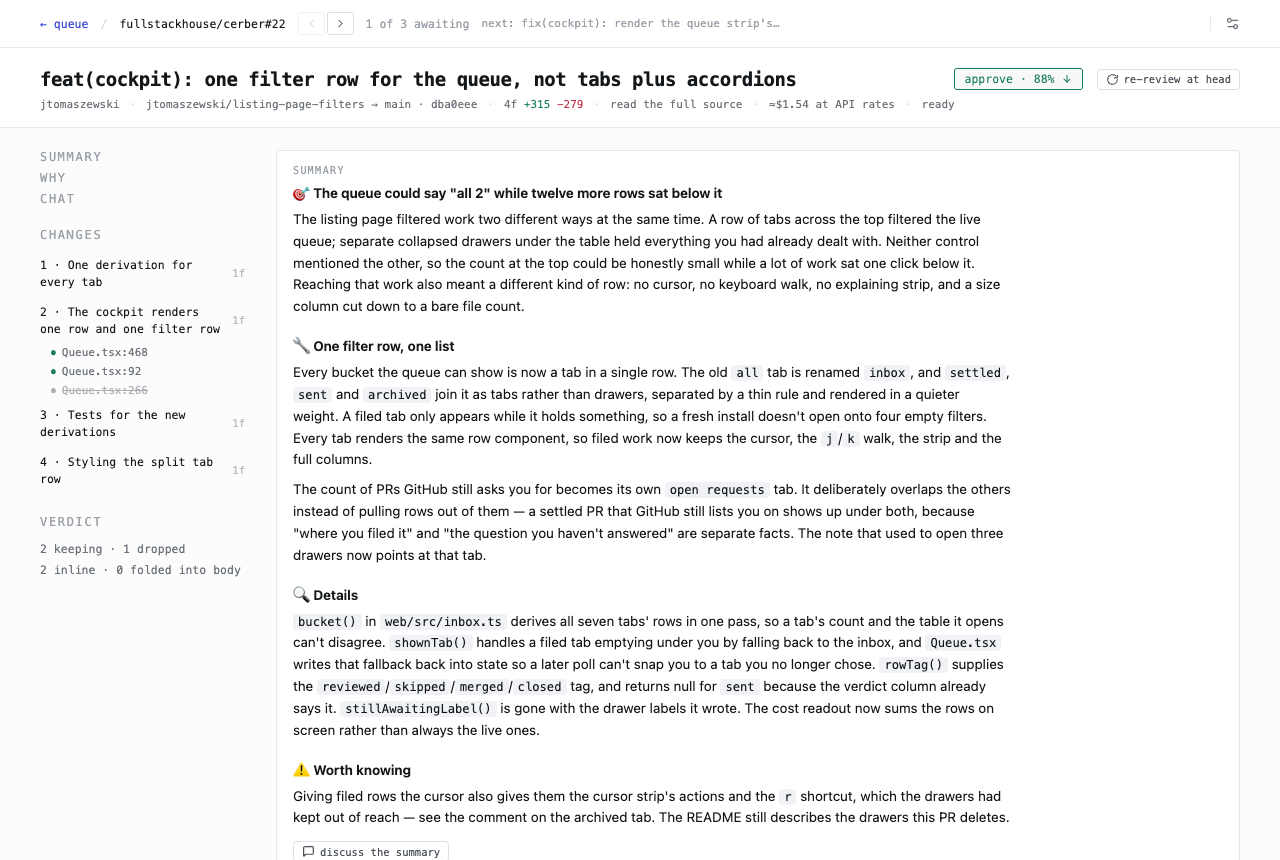
A drafted review, as you read it — verdict and confidence beside the PR
title, the walkthrough rail on the left, a summary written for someone who has
not read the diff:
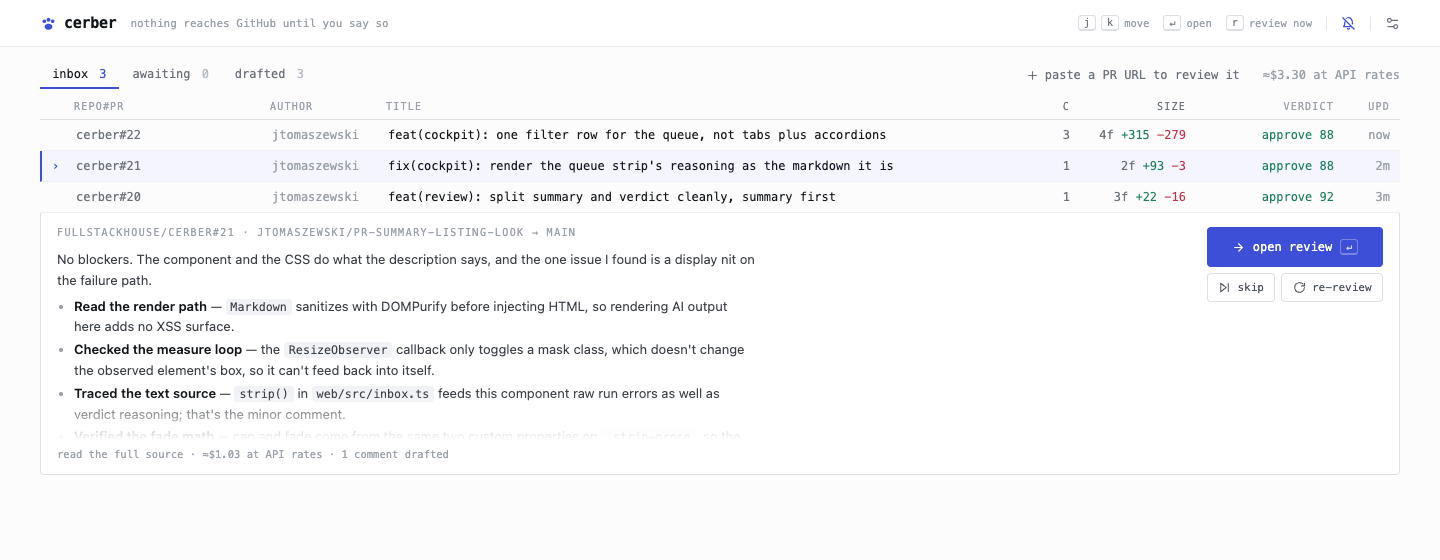
And the queue they arrive in — cerber serve polls GitHub for PRs awaiting
your review and drafts one for each, so they are written by the time you get
there:
Every screenshot in this README is cerber reviewing cerber's own pull
requests.
Quick start
Requires Node 20+, an authenticated gh, git, and
a logged-in claude CLI. No API keys, no
config, no database.
Claude Code is a hard requirement, and a paid one. Cerber drafts reviews by
running claude as you: it rides your existing Claude Code login and draws on
that plan's usage limits, so you need a Claude subscription that includes Claude
Code. There is no ANTHROPIC_API_KEY path — not as a fallback, not at all.
GitHub only; no GitLab or Bitbucket. Notifications are macOS and Linux.
Run cerber doctor first — it checks all three tools and tells you which one to
fix, instead of letting a missing login turn into an empty cockpit later.
# Open the cockpit — this is the whole product
npx @fullstackhouse/cerber serve        # → http://127.0.0.1:4820

# Or review one PR from the terminal (writes a local artifact to ~/.cerber,
# nothing else)
npx @fullstackhouse/cerber review https://github.com/owner/repo/pull/123

# Review several
npx @fullstackhouse/cerber review owner/repo#123 owner/repo#124
npx @fullstackhouse/cerber review 123 124 --repo owner/repo

# See what's in the queue
npx @fullstackhouse/cerber list
serve does the whole loop by default: discover → draft → wait for you.
Sending stays a human click. Tame it with --no-auto-review (list awaiting
PRs, review on click) or --no-poll (no GitHub polling at all) — or flip those
switches in the cockpit's Settings, which persist in ~/.cerber/config.json
and apply on the next poll.
Contents
- What a review looks like — what Claude writes and how you walk it
- The inbox — what the queue shows, what settles a row, the notifications
- It reviews the code, not just the diff
- Trusted PRs: reviews that can run things
- When the PR moves under you
- Arguing with the review before you send it
- Every row remembers what happened to it
- Status · Running on a VPS · How it works · Development
What a review looks like
Each review is a plain JSON artifact in ~/.cerber/reviews/ (override withCERBER_HOME) containing:
- Summary — what the PR actually does and why, written top-down
- Chapters — the changed files grouped into a logical walkthrough, each
with a title, an explanation, and its slice of the diff - Draft comments — inline, anchored to file/line, only things worth a
human's time. Findings are graded blocker / minor / nit — the words mean
what they mean everywhere, and only a blocker stands between the PR and
approval; a question or note carries no grade at all - Verdict — approve / comment / request changes, with a 0–100 confidence
score and reasoning that names the worst finding still standing - Run metadata — model, whether it read the source or only the diff, and
the token spend as an API-rate equivalent
The cockpit (cerber serve) renders the queue and the per-PR walkthrough with
diffs. Draft comments sit inline in the diff, anchored to the line they're
about, each waiting for you to keep, rewrite, or drop it:
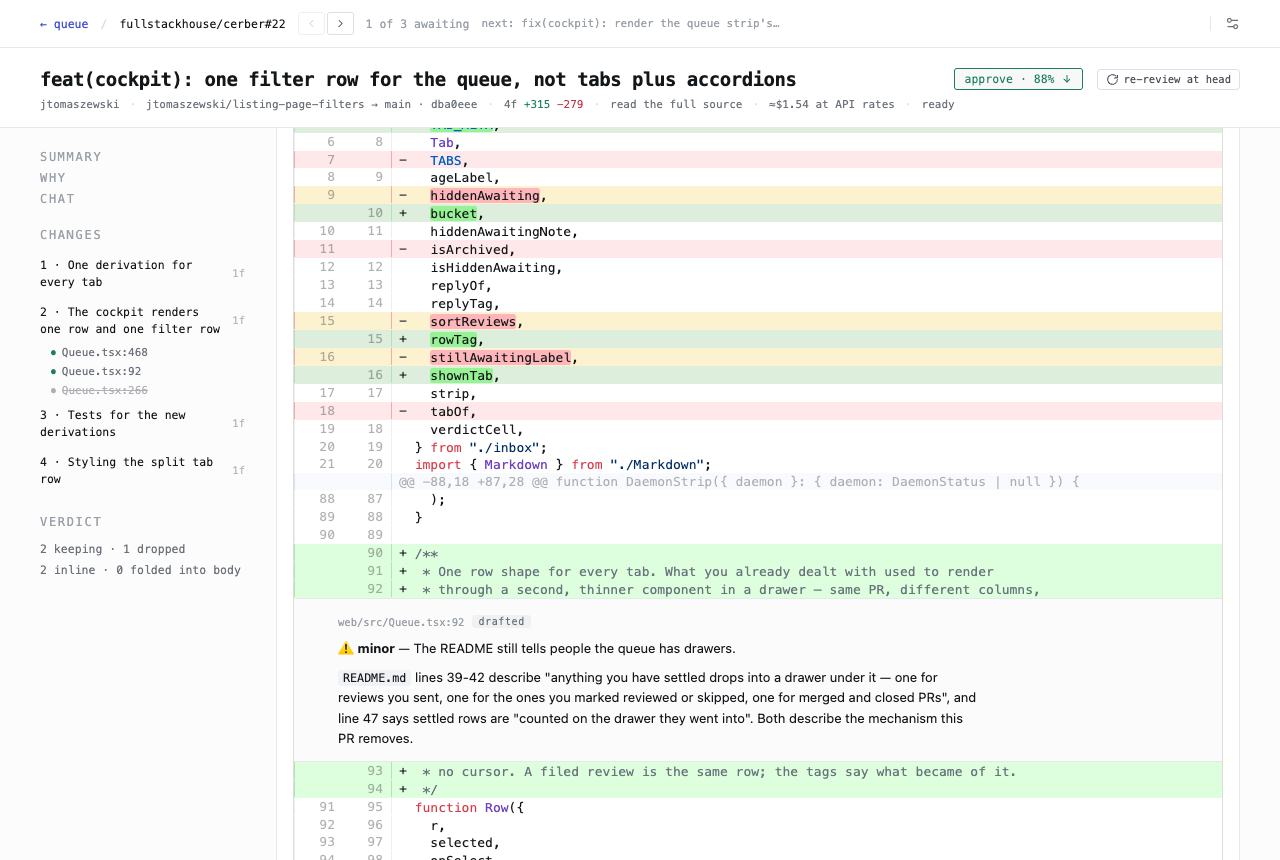
Any line of the diff is one click away from being talked about: hover it and a+ appears in the gutter, the way it does on GitHub. What opens is one box
with two exits — write the comment yourself, or ask the reviewer about that
line and get the answer in the conversation below. A line the PR removes can be
asked about too; a comment on one posts on the file, since GitHub only takes
inline comments on the new side of a diff.
A markdown file the PR adds opens as the document it is, not as a thousand
rows of + ## Heading — because reviewing a new spec means reading it, and
every line being an addition means the diff's markers say nothing. It is still
the review: the draft comments sit in the document under the paragraph they
point at, and any paragraph takes a comment or a question where it stands. A
markdown file the PR only edits stays a diff — there the change is the point
— with "read as a document" in its header when you want the prose instead.
Artifacts are plain JSON you can cat, edit, or pipe into anything.
The queue is meant to be walked, not clicked through: j/k move the cursor
and the strip under the table explains whatever it lands on — the verdict's own
reasoning, what the run read, how it sits against the auto-send bar — so most
rows can be judged without opening them. ↵ opens one, r drafts (or
re-drafts) it. Inside a review, [ and ] walk to the previous/next PR still
awaiting you, n steps through the chapters, and s sends.
The inbox
The queue only lists what still wants you: anything you have settled moves to
the filed tabs right of the thin rule in the filter row — reviews you sent,
ones you marked reviewed or skipped, merged and closed PRs — each tab appearing
only while it holds something. PRs in archived repos are never picked up at
all, since the repo is read-only and a review could never be sent.
Settled means you settled it
Settling a review is your decision, not GitHub's: skip a PR, or mark one
reviewed without sending, and GitHub still holds its review request open,
because nothing cerber does here reaches it. Those rows stay marked where they
sit, counted on the tab they went into, and named in place of the empty
inbox — cerber never tells you nothing awaits you while its own poll says
otherwise. It is a report, not a nag: what you decided here stands, and the
mark clears itself the moment GitHub hears from you.
Except when you reviewed it on GitHub
There is one thing you never have to settle by hand. Review a PR the ordinary
way — GitHub's own review button, cerber not involved — and the review request
clears, but nothing here hears about it: the draft cerber wrote for that PR
goes on sitting in the inbox as work still waiting on you, days after the PR
went back to its author. So the poll asks the other question too. When GitHub
has stopped requesting your review and already holds one of yours, the draft
is filed under settled, tagged reviewed on GitHub with the date it was
submitted. Nothing else happens to it — it was never sent, and it is still
yours to open, re-review or send. The one draft this leaves alone is one you
asked for after that review: a second opinion you went and requested is not
a row the queue forgot to close.
Whose move is it
An open request doesn't mean the ball is yours, though. You may have argued the
whole thing out in the PR conversation and never pressed GitHub's review
button, which leaves the request open with nothing blocked on you. So cerber
reads the conversation and says whose move it is: you haven't replied (they
are waiting), waiting on them (you had the last word), or they replied last
(it is back with you). Bots don't count as an answer, or a chatty CI would put
every PR back on you. If the conversation can't be read it says unanswered on GitHub and claims nothing further — guessing "you never replied" at someone
who did is the one mistake worth designing against.
It taps you on the shoulder
When a PR is ready for you, you get a desktop notification naming it, folded
into one popup when several land at once. Ready means there is something to
read: cerber drafts the review itself, so the tap waits for the draft and says
what it found — "widgets#7 draft ready · requests changes · 2 blockers" — rather
than walking you back to a row that says "no run yet". A PR nobody is going to
draft (auto-review off, or a run that failed) is announced as it arrives, since
that is all the news there will be — and if a retry drafts it after all, that is
new news and you are told. Nothing else is: a PR whose draft you have been told
about stays quiet however its next re-review ends. The tap comes from the poll, so it reaches
you with the cockpit closed, in another Space, or after a browser restart —cerber serve is the only thing that has to be running. It goes to whatever
this machine already has (Notification Centre on macOS, notify-send on Linux)
and stays quiet where there is neither. Off with daemon.notify in~/.cerber/config.json, or the checkbox in Settings.
On macOS, clicking it opens that review in the cockpit. It takes a small app
cerber builds once under ~/.cerber — the first tap asks you to allow
notifications from "Cerber" — because a notification can only open the app that
posted it, and one posted the usual way belongs to Script Editor, which is
where the click would otherwise land. A notify-send tap on Linux announces
the PR but has no click to give.
The cockpit has a bell of its own, which does the same from the page. But it is
a page notification — it needs a tab that is open, alive and permitted, which is
exactly what you don't have on the afternoons this feature is for. So it stands
down while the machine's own tap is on, rather than making one PR two popups,
and the bell in the top bar says so. Untick the machine one and this browser
takes over: click the bell, grant the permission, and click it again to stop.
The switch and the record of what has been announced are per-browser — the
permission they gate is the browser's, so a second browser starts its own
record — and it stays quiet while you're looking straight at cerber.
A cockpit served from somewhere else (cerber serve -H 0.0.0.0 --token on a
VPS) keeps its bell either way: the machine's tap would land on the VPS, where
nobody is looking.
The tab itself says it too, without asking anyone: while the inbox holds
anything, the favicon wears a red dot, and it goes away when the last review is
dealt with. No permission, no switch — just the paw with a mark on it, so a
glance at the tab strip answers "is there anything for me?".
It reviews the code, not just the diff
Cerber checks the PR's head out locally and lets the review read it. That
matters because a reviewer holding only a diff hedges over things it could have
just looked up — "I can't see the enclosing function, so this could be
wrong" — and burns its confidence score on missing context instead of on real
uncertainty. With the source there, it opens the enclosing function, follows
callers of a changed signature, checks whether a helper already exists, and
sees whether a test covers the new path.
On one real PR, same commit, the difference was: a speculative "this looks
like it sits after an early return" became a concrete finding; a permission
check the diff showed as a tidy gate turned out to hide a value the API
response still ships; confidence went 72% → 82%. It burned 3.3× the tokens and
took three minutes instead of one.
Cerber rides your claude login, so a review isn't billed per run: on a Claude
subscription it draws on your usage limits. The ≈$ figures in the CLI and
cockpit are what those tokens would cost at API token rates — read them as
"how much of the plan did this eat", not as an invoice.
If you want the old behaviour — faster, lighter, blind past the changed lines:
cerber review owner/repo#123 --no-source
cerber serve --no-source
The cockpit labels every review "read the full source" or "read the diff only",
and offers a one-click Re-review with full source on the diff-only ones.
Details worth knowing:
- The checkout is a shallow (
--depth=1) fetch ofrefs/pull/N/headfrom the
base repo, so fork PRs work with no extra remotes. Auth ridesgh's
credential helper, set on that clone only — your git config is untouched. - If git or
ghcan't produce a checkout, the run says so and reviews the diff
alone. A missing checkout never fails a review. - The run is read-only unless you have trusted the PR (see below):
Read,GrepandGlobare the only tools it gets. Without a checkout it gets none,
and runs in an empty directory, so it can never read whatever project cerber
happens to be started from and mistake it for the PR. - PR content is untrusted, and
claude -pskips the workspace-trust prompt, so
cerber does the distrusting itself: a.claude/settings.jsonor.mcp.json
in the checkout is renamed aside (still readable, no longer loaded), hooks
and non-cerber MCP servers are off, and the prompt tells the reviewer that
instructions found in files are material to review, not directions to follow.
What a hostile PR can still do is skew the review text — it cannot run
anything, write anything, or reach the network. Read the verdict, don't
rubber-stamp it. (All of this applies to PRs you have not trusted; a
trusted one is deliberately given the run of the place.) - Checkouts live in
~/.cerber/src/<owner>__<repo>__<n>and are reused by later
re-reviews. A big monorepo is a few hundred MB per PR, so the cache keeps only
the 8 most recently reviewed and evicts the rest as it goes — never one a
review is currently reading.cerber prunereclaims the space now;cerber prune --alltakes the ones for reviews still awaiting you too.
Trusted PRs: reviews that can run things
Reading beats guessing, but running beats reading. A review that ran the test
covering the change reports what happened; one that only read it guesses. So
for PRs you already trust — a teammate's, or anything in your own repos —
cerber can let the review run commands in the checkout: the test suite, a
typecheck, git log/git blame, a build.
Trust is about the people, and only about people — cerber has no way to
trust a repository, because anyone can open a PR against one:
cerber trust @fullstackhouse/*      # anyone in the org
cerber trust @fullstackhouse/devs   # anyone on that GitHub team
cerber trust @teammate              # one person, by login
cerber trust                        # show who is trusted today
Membership is resolved against GitHub when the review runs (your gh login
needs read:org), and a lookup that fails counts as "not a member" — a check
cerber could not complete never reads as trust. Writing a repo instead of a
person is rejected, in the CLI, the cockpit, and on config load:
$ cerber trust acme/widgets
"acme/widgets" is not a trust rule. Trust is about people, not repositories —
anyone can open a PR against a repo you own, so trusting the repo would trust
them too. Use @acme/* for everyone in that org, @acme/team for one team, or
@login for a person.
Rules live in ~/.cerber/config.json, and the cockpit has a settings
screen that reads and writes the same file — each rule shown with what it
actually grants. A ! rule denies and beats every grant, so @fullstackhouse/*
plus !@fullstackhouse/contractors does what it looks like. --trust and--no-trust override the config for one run; cerber trust <pattern> --delete
removes a rule.
A trusted review gets Bash, WebFetch and WebSearch on top of reading, and
the repo's own .claude config applies — it behaves as if you had checked the
branch out and opened it yourself. The cockpit labels it "ran the code" so you
know which kind you are reading.
It is handed no GitHub credentials, and that part is enforced rather than
requested. GH_CONFIG_DIR points at a fresh empty directory, GH_TOKEN andGITHUB_TOKEN are blanked, the fetch credential rides the fetch command
instead of being stored in the checkout, git's global and system config are
switched off so a keychain helper cannot stand in, and the ssh route is closed
too — no agent, no ~/.ssh/config, no default identity — since otherwise a run
could point the remote at [email protected] and ride your keys. Measured from
inside a checkout: git push over https and over ssh, and gh pr comment, all
fail to authenticate, while git log still works.
It is not a sandbox, and you should not read it as one. A trusted run hasBash and your filesystem: it can write files in the checkout, and a
determined one could read a key straight out of ~/.ssh and use it itself.
What cerber guarantees is that it hands the run nothing. The rest is what
trusting a person means — which is why trust is spelled @org/team, and why
the default is a review that cannot run anything at all.
What you are accepting. A trusted review executes code from that PR on your
machine — the branch's scripts, its dependencies, its test suite. That is the
same exposure as checking the branch out and running the tests yourself, which
is what you would otherwise do; it is not the same as reading a diff. Trust
orgs and people, not the whole of GitHub. And note that cerber serve reviews
unattended by default: with trust rules set, it will run matching PRs' code
with nobody watching. It warns at startup, the cockpit shows a ⚡ badge while
it's the case, and --no-trust (or --no-auto-review) turns it off.
When the PR moves under you
A review is written against one commit, but authors keep pushing. Opening a
review checks the PR's head and pulls the review forward: comments follow their
code to its new line numbers, and any whose code is gone are flagged and post
in the review body instead of inline — GitHub rejects an entire review over one
comment on a line that is no longer in the diff. Sends carry the reviewed
commit's SHA, so inline comments land where they were written.
The AI's summary and verdict still describe the commit that was reviewed. To
get its opinion of the new code, hit Re-review at the new head in the
cockpit (or cerber review <pr> --force).
⚠️ A re-review replaces the whole draft — including comments you wrote or
rewrote, and a send body you wrote yourself. They are dropped when the run
starts and they do not come back, on success or on failure. This is a
decision, not a bug (docs/lifecycle.md): the run owns
the draft. If you have written comments you want to keep, send the review or
copy them out first. Your decisions do survive — a send, areviewedorskippedyou set, and the chat transcript are all kept.
Arguing with the review before you send it
A draft you disagree with used to leave two options: rewrite it by hand, or
re-review and hope. Neither lets you say what was wrong. So every review has
a conversation attached — Talk to the reviewer, at the bottom of the
walkthrough.
Ask it why it said something, and it answers. Tell it the summary is restating
the author's claims rather than what it verified, and it rewrites the summary.
The reviewer revises the draft as it answers: there is no accept step, because
you already asked for the change. What it changed shows up in the transcript
("✎ rewrote the summary", "✎ dropped the comment on line 250").
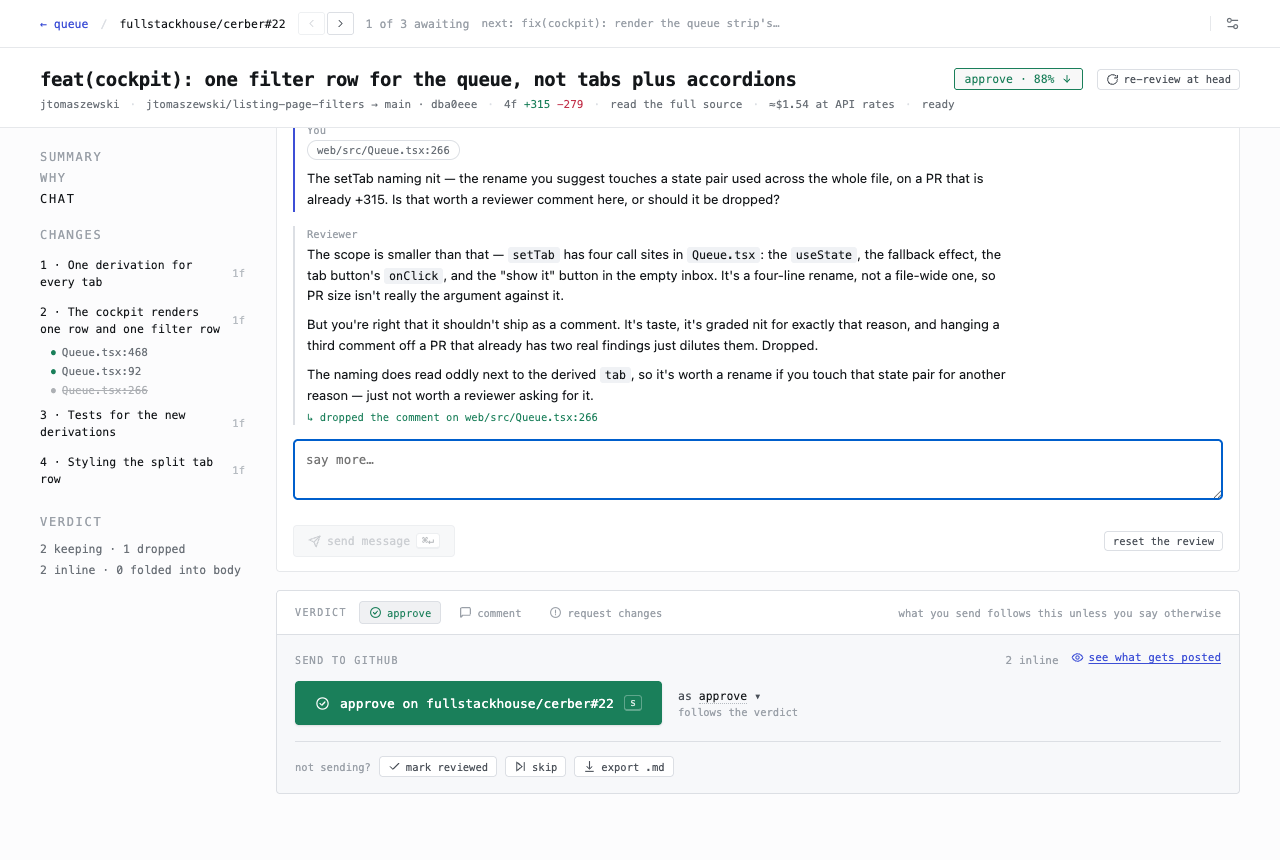
That conversation is real: pushed back on a nit, the reviewer re-checked the
code, corrected the push-back's own claim about the rename's size — and still
dropped the comment, because a nit hanging off a PR with two real findings
just dilutes them. The rail counts 2 keeping · 1 dropped, and nothing about
the exchange went anywhere near GitHub.
- It is the same reviewer. A turn resumes the Claude session the review ran
in, so it still holds everything it read. Asking "did you actually check
that?" gets an answer from the run that did or didn't — not from a fresh
agent re-deriving an opinion from the diff. - It reads the code to answer you. The checkout cache is small, so by the
time you argue with a review its source is usually evicted; a turn re-clones
it. If it can't, the turn still runs and the reviewer is told it is working
blind rather than left to describe files from memory. - It can say no. The prompt tells it not to fold under push-back. If you
are wrong about something it checked, it says so and changes nothing. - The wait is not a held request. Re-reading the code takes minutes, so a
turn runs detached the way a re-review does: your question appears in the
transcript straight away and the cockpit polls for the answer. Reload, close
the tab, or sit behind a proxy that times connections out at 60s — the answer
still lands on the review, and a turn that fails says so against the question
that caused it. - You can watch it work. Those minutes aren't a spinner: the run narrates
itself under your question — thinking…, reading src/core/refresh.ts,
searching for carryOverComments in src, not allowed to use Bash — so you
can tell a turn that is checking your claim from one that is about to answer
from memory.cerber reviewand the daemon log print the same lines. - Your words are yours. Comments you wrote or edited are off limits: it
will tell you one of them needs changing rather than rewriting it. Say so
explicitly and it will. - Point at things. discuss on any comment, chapter, or the summary drops
a reference into your next message. From the diff's own gutter, ask the
reviewer points at one line and sends the question there and then — the
line comes along quoted, so it answers about that line rather than counting
rows. - Reset puts the review back the way the AI first wrote it and keeps the
conversation — you lose the edits, not the reasoning.
Nothing in the conversation reaches GitHub. Send still builds its payload from
the summary, comments and verdict alone, and is still one deliberate click. A
review that has already been sent can't be argued with: that artifact is the
record of what GitHub has.
Every row remembers what happened to it
A review keeps one "last updated" time, which means every write erases the
answer to when did I skip this, and did they ask again afterwards? So each
one also keeps a history: the status changes with their timestamps, every push
it saw, each run and what it cost, sends, refreshes — and which part of cerber
did it, whether that was you in the cockpit, the CLI, an AI run or the poll.
The poll's silences are in there too. When it looks at a row and deliberately
leaves it alone — you settled it, so a new push does not reopen it; or GitHub
still lists you as a requested reviewer even though its own search has stopped
saying so — it writes that down instead of passing without a trace. That is
usually the answer when a PR is not where you expected it to be.
It's at the foot of every review in the cockpit, and:
cerber history owner/repo#123
Nothing about GitHub's own timeline is copied here — GitHub keeps that, andgh can be asked for it again. This is cerber's side of the story.
Status
Early, but whole: everything described above has shipped — reviewing,
editing and the gated Send, inbox discovery with parallel runs, confidence
calibration (cerber stats), shadow-mode and opt-in auto-send, re-anchoring
onto new commits, source-backed and trusted runs, the reviewer chat, and a
per-review history of everything that touched it (cerber history).cerber export writes a review out as markdown if you want it elsewhere.
Running on a VPS
cerber serve --host 0.0.0.0 --token "$(openssl rand -hex 16)" \
  --repo you/repo-a --repo you/repo-b --interval 10
The server polls GitHub, reviews anything new (skipping PRs whose artifact
already matches the head SHA), and the cockpit is always warm — open it any
minute and see pending/ready/sent reviews. Auth: ?token=… once in the
browser (sets a cookie) or Authorization: Bearer …. Binding a non-localhost
host without a token is refused. By default the daemon never sends reviews — Send stays a human click.
Auto-send (opt-in): add --auto-send --auto-send-threshold 90 and the
daemon will submit APPROVE verdicts at/above the threshold as you. It never
auto-sends COMMENT or REQUEST_CHANGES. Before enabling, run the default
shadow mode for a while: every would-send decision lands in~/.cerber/autosend.ndjson, and cerber stats shows how often the AI's
verdicts and comments survive your review — enable auto-send when its 90%
actually means 90%.
How it works
docs/lifecycle.md is the reference behind everything
above: the seven statuses and what sets each, which tab a PR lands in and why,
when the poll files or archives a row on its own, when a re-review happens and
what it will not overwrite, and what gets written to disk at each step.
SPEC.md is the full service specification — the artifact
schema, every lifecycle and filing rule, the runner's tool policy and
credential hygiene, the send path — written precisely enough to reimplement
cerber from. lifecycle.md is the operator's view of the product; SPEC.md is
the engineer's.
Development
pnpm install
pnpm dev review <pr>     # run the CLI from source
pnpm dev serve           # API on :4820
pnpm --dir . typecheck && pnpm test
pnpm build               # dist/ (CLI+server) + web/dist (cockpit)
Web cockpit dev with hot reload: pnpm dev serve in one terminal,npx vite --config web/vite.config.ts in another (proxies /api).
Contributing and security
Patches welcome — CONTRIBUTING.md has the gate
(pnpm typecheck && pnpm test) and the one rule that is not negotiable.
Cerber holds your GitHub credentials and, on a trusted PR, runs that PR's code.SECURITY.md says exactly what that means, what is stripped
from a trusted run, and where to report a vulnerability privately.
License
MIT © Full Stack House
Yorumlar (0)
Yorum birakmak icin giris yap.
Yorum birakSonuc bulunamadi