Kronik
Health Uyari
- License — License: NOASSERTION
- Description — Repository has a description
- Active repo — Last push 0 days ago
- Low visibility — Only 5 GitHub stars
Code Basarisiz
- fs module — File system access in .agents/skills/security-audit/validate-coverage-ledger.cjs
- spawnSync — Synchronous process spawning in .agents/skills/security-audit/validate-coverage-ledger.test.cjs
- fs.rmSync — Destructive file system operation in .agents/skills/security-audit/validate-coverage-ledger.test.cjs
- fs module — File system access in .agents/skills/security-audit/validate-coverage-ledger.test.cjs
- fs module — File system access in .agents/skills/security-audit/validate-findings.cjs
- spawnSync — Synchronous process spawning in .agents/skills/security-audit/validate-findings.test.cjs
- fs.rmSync — Destructive file system operation in .agents/skills/security-audit/validate-findings.test.cjs
- fs module — File system access in .agents/skills/security-audit/validate-findings.test.cjs
- rm -rf — Recursive force deletion command in .github/workflows/ci.yml
- rm -rf — Recursive force deletion command in .github/workflows/isolation.yml
Permissions Gecti
- Permissions — No dangerous permissions requested
Bu listing icin henuz AI raporu yok.
A deterministic application runtime for replaying production traffic, verifying changes, and running stateful Wasm actors.
Kronik
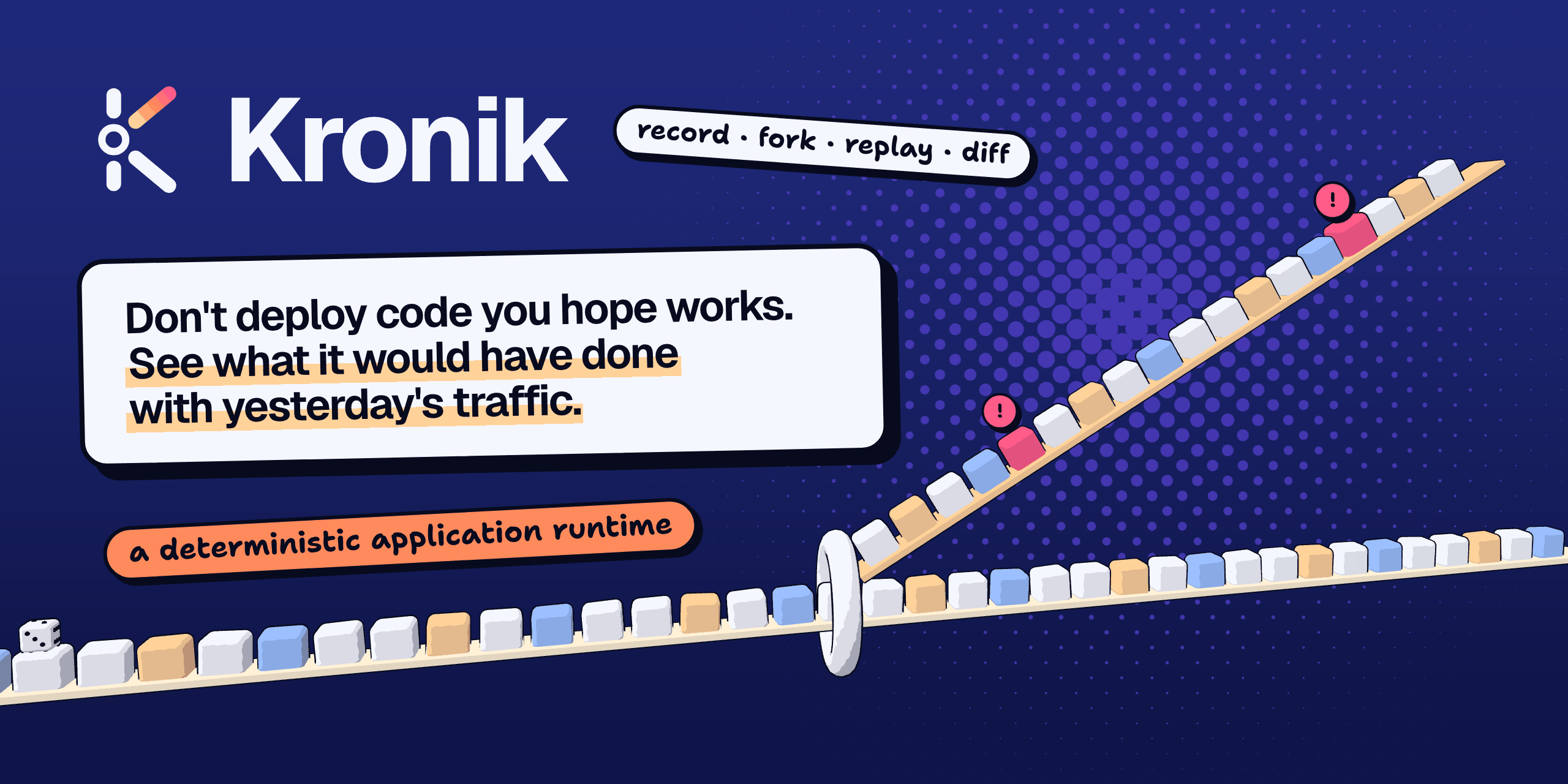
Don't deploy code you hope works. See what it would have done with yesterday's
traffic.
Kronik is a source-available runtime in which a system is a deterministic
function of its history. Every input, every effect result and every state
change is written to an append-only log before a turn is applied, delivered or
answered, so a change can be replayed against real production traffic and
reviewed as a behavior diff before it goes live.
The runtime is one kronik binary. It runs actors: Wasm components with
built-in key-value state and their own SQLite database, written in TypeScript,
Rust, Python or Go, or Linux programs from OCI images in gVisor. The CLI, the
JSON API and the MCP server are the primary interfaces; the embedded admin UI is
partial and unreleased.
Website · Quickstart ·
Documentation ·
Project status ·
Build brief
Status: pre-alpha. Kronik is not ready for production, and interfaces may
change between releases. See Status.
Why Kronik
Assistants and agents write code faster than anyone can read it. Tests pass and
staging is green, but neither shows what a change will do to the traffic a
system actually gets. Kronik records what a running system does — each request,
each outside answer, each state change — before it answers. A proposed change
can then run through yesterday's recorded traffic, with the outside world
answering as it did, and the result is a behavior diff: what would answer
differently, what would change, and what it would cost.
The idea in full, told from the beginning for readers who do not want to start
with the code, is at demo.kronik.se. Kronik is for
the agents that write and change software at machine pace, the people who
review their work without time to read all the code, and small teams that want
safe deploys on a VPS without Kubernetes.
How it works
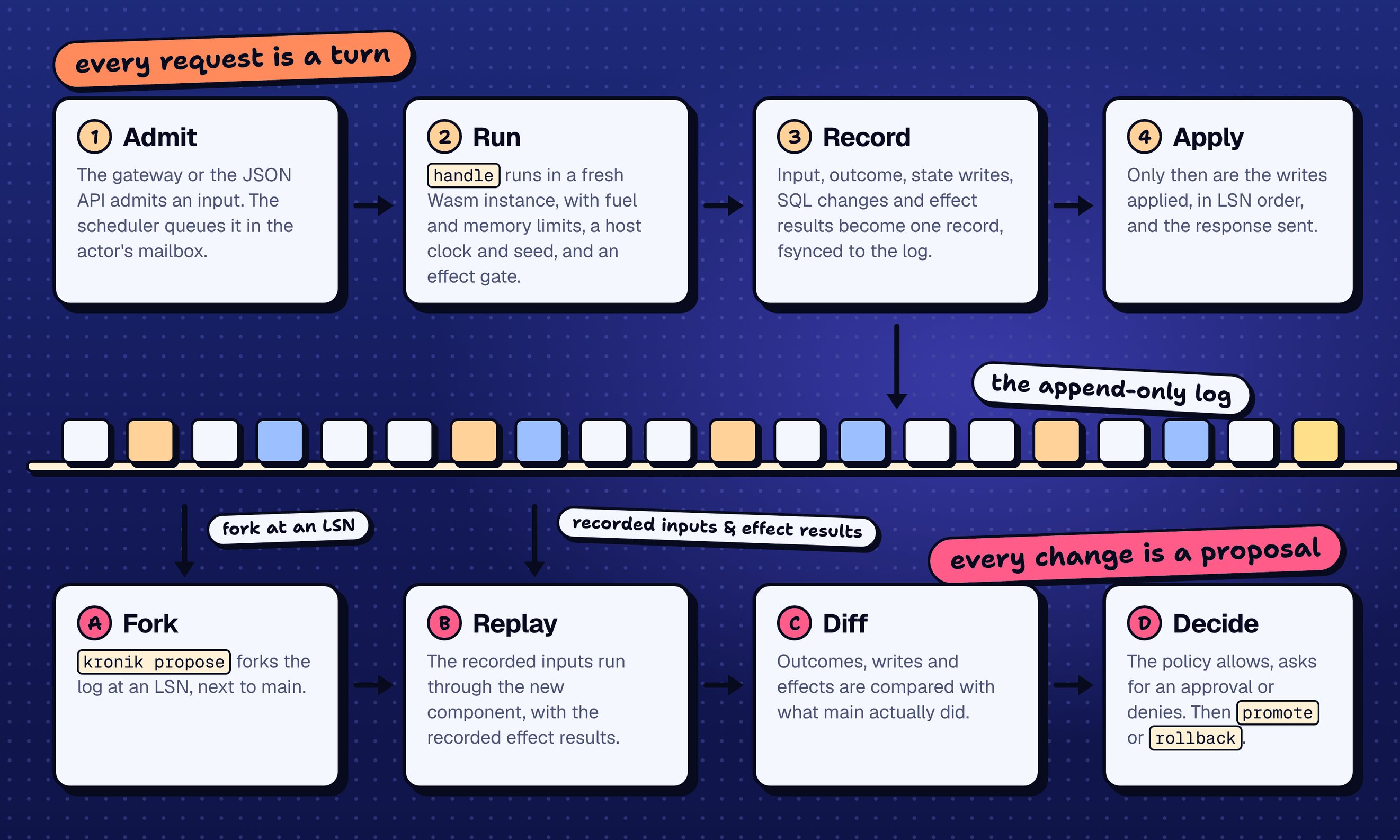
Every request is a turn. It is admitted by the gateway or the JSON API, runshandle in a fresh Wasm instance with fuel and memory limits, a host-provided
clock and seed, and a host-side effect gate. Before its first outside effect or
actor call, the turn's start (TurnBegin) is fsynced; each effect result is
recorded as it returns, so a crash can rerun the turn with the recorded answers.
The turn's record — input, outcome, state writes, SQL changes and effect
results — is then fsynced as one record and applied in LSN order; nothing is
delivered or answered before that.
Every change is a proposal. kronik propose forks the log at an LSN and
replays main's recorded root inputs through the new component, with the recorded
effect results. The outcome, writes and effects are compared with what main
actually did; a policy allows the change, asks for an approval, or denies it;promote and rollback move code forward and back.
Architecture and the
concepts cover the model in detail.
The behavior diff
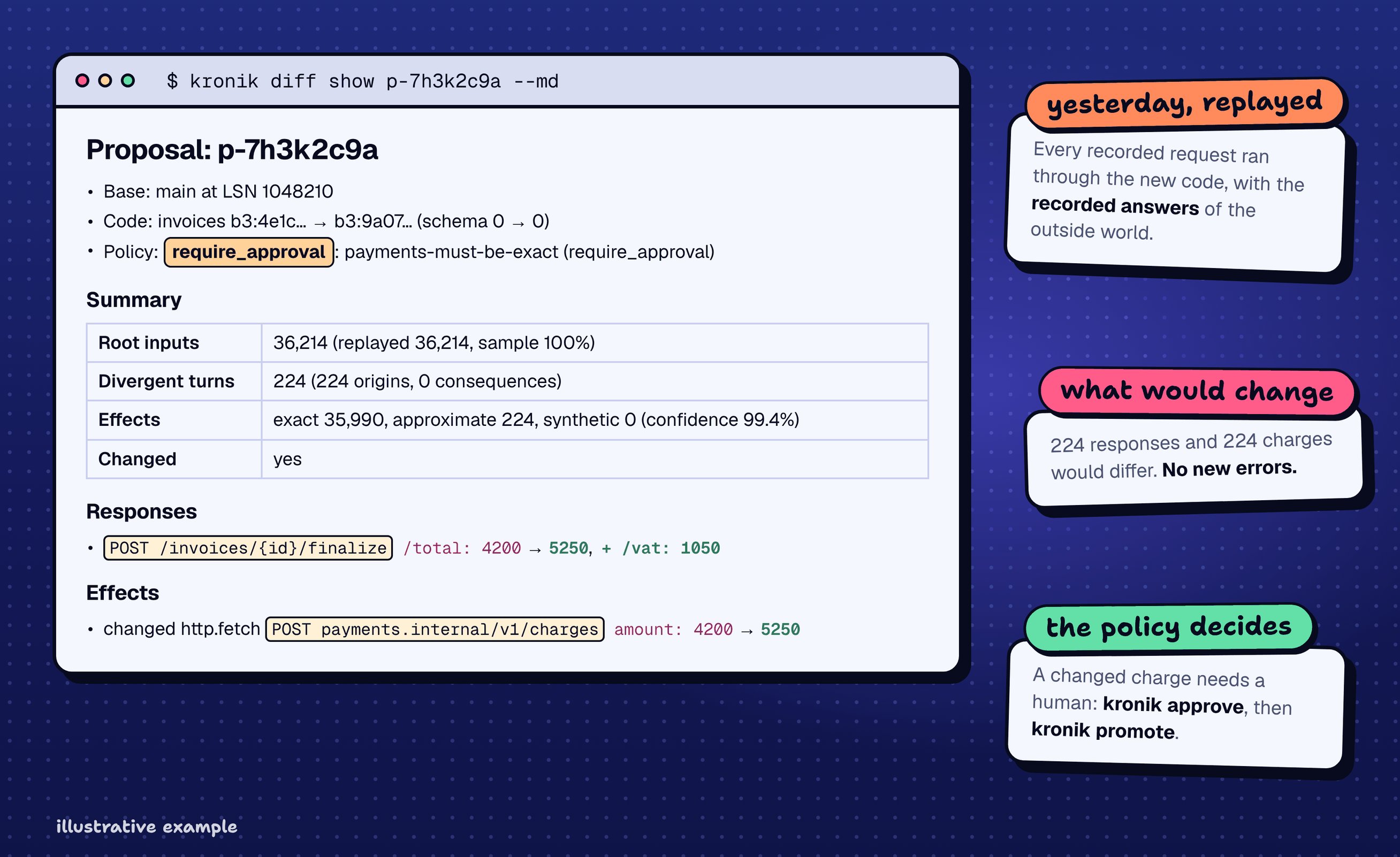
kronik diff show <proposal> --md answers the review question: what changes?
It reports the responses, state and effects that differ, what the new code
costs to run, and how well each outside answer is grounded in the record.
A change that touches payments can require a human approval, with a reason, on
the record; kronik promote then moves it live, and kronik rollback can take
the state back too.
Getting started
Install the latest release on Linux (x86_64 or aarch64):
curl -fsSL https://github.com/G-man3207/Kronik/releases/download/v0.5.0/install.sh | sh
kronik doctor
To build current main instead, from a trusted checkout with the prerequisites
in CONTRIBUTING.md:
cargo build --locked --release -p kronik
export PATH="$PWD/target/release:$PATH"
kronik doctor
kronik serve runs in the foreground, so start it in its own terminal:
kronik serve \
  --data-dir /var/tmp/kronik \
  --http-listen 127.0.0.1:8080 \
  --api-socket /var/tmp/kronik/api.sock
In another terminal, point the CLI at that socket, deploy a first actor, change
it and propose the change:
export KRONIK_API_SOCKET=/var/tmp/kronik/api.sock

kronik init --lang ts billing
cd billing && npm install && npm test && kronik build
kronik deploy dist/billing.wasm --reason 'first deploy'
curl -s -X POST http://127.0.0.1:8080/billing/acme/increment

# change the counter to step by 2, rebuild, and propose it
sed -i 's/?? 0) + 1;/?? 0) + 2;/' src/actor.ts
kronik build
kronik propose dist/billing.wasm --window 1h --reason 'count in steps of 2'
kronik diff show <proposal> --md
The TypeScript template needs Node.js 22.20 or later; --lang rust, python
and go build the same counter in the other SDKs. The
quickstart walks the full path from an empty
machine to a verified deploy, rollback and restore; installing
covers release contents and the SDK toolchains.
What works today
- Durable, deterministic turns. State writes, SQL changes and outgoing
messages commit together or not at all, and nothing is applied, delivered or
answered until the turn's record is fsynced. Time, randomness and SQL
functions such asrandom()come from values recorded with the turn, so a
re-run gives the same outcome; a deterministic simulation of the daemon with
injected crashes runs in CI, and a 1,000-cyclekill -9crash test runs in
the manual nightly workflow. - Effects and capabilities. Outgoing HTTP, actor-to-actor calls, timers and
host-side cryptography with secret handles; every effect is denied until the
operator grants a capability, and each result is recorded and returned on
re-execution. - Fork, replay and diff.
propose,approve,promoteandrollback,
policy rules, effect simulators,watch(which rolls a promotion back when a
guard breaks) and preview forks that take new requests on unproposed code. - Operations and observability. TLS from files or ACME, a systemd unit,
snapshots, shipping,restore,upgrade check,doctor, master-key
wrapping (keys) and/metrics; turns become OpenTelemetry traces, metrics
go to Prometheus and OTLP, andkronik audit verifychecks the audit export
against the log. - Long-lived connections and blobs. WebSocket and server-sent events (SSE)
routes whose frames are recorded with the turns that send them; uploads andfetchresponses above a kind's threshold stream through a
content-addressed blob store with constant memory, held by the actor and, in
privacy mode, sealed with its subject's key. - Privacy mode. Values with a subject can be sealed, erased and resealed;
a fork requested by a token withoutpii:readreplays personal text and blob
values as pseudonyms. The privacy guide has the
details and limits. - Foreign actors. Linux programs from OCI images run in gVisor behind the
same recorded boundary, and can be copied into a fork from a checkpoint; the
microVM level is opt-in. - Agent interface. The JSON API is described by OpenAPI, and
kronik mcp
serves the same operations as MCP tools with token scopes.
Status
Kronik is pre-alpha and single-node: it is not ready for production, and
interfaces may change between releases.
The latest release is v0.5.0 (15 November 2026,
release notes), the
"Isolation, standards and web" line (M20–M26): WebSocket and SSE connections,
streaming bodies and blob storage, external secret backends, and the opt-in
nonroot and microVM levels. Earlier attested releases are v0.4.1 and
v0.4.0; the historical v0.3.0 and v0.1.0 remain unsigned, and
current consumers refuse their unsigned artifacts. v0.5.0 ships static musl
binaries for x86_64 and aarch64 with install.sh, checksums, CycloneDX SBOMs
and two-build byte-equality evidence; install.sh verifies each archive's
Sigstore attestation.
main is the unreleased 0.6.0-dev line; the changelog lists
what changed since v0.5.0. As of v0.5.0, 140 of the 196 criteria in the
build brief are
implemented; the
compliance audit
maps each one to the tree, and the
project status page
tracks the milestones, the open questions and the known gaps.
Some claims were checked against pinned emulators and disposable hosted
runners, not production: ACME against Pebble rather than a public certificate
authority, the KMS and secret backends against emulators, blob shipping against
directory buckets and a local S3 server, and the nonroot and microVM levels on
GitHub-hosted Ubuntu 24.04 runners. There has been no independent external
security review, production pilot or three-node soak, and the cluster (M16–M19),
the WASI 0.3 remainder (M22), and the UI, fleet and hardening tracks (M27 and
M29–M34) are partial or absent.
Repository and documentation
| Path | Contents |
|---|---|
crates/ |
The daemon and its libraries: gateway, JSON API, scheduler, runtime, log, state, blob store, fork engine, MCP server, policy, privacy, shipping, admin UI, fleet API and OpenTelemetry/audit export |
sdk/, examples/ |
The TypeScript, Rust, Python and Go SDKs, and example actors in all four languages, plus app examples and foreign Linux programs |
docs/ |
The book: concepts, guides, reference, design notes and ADRs, indexed by docs/SUMMARY.md |
ui/, deploy/, action/ |
The dependency-free admin UI source, the systemd unit and the GitHub Action |
scripts/, demo/ |
CI, release, acceptance, simulation and chaos scripts, and end-to-end demos |
The introduction explains the five concepts;
writing actors covers kronik init, the SDKs and the
WIT interface; operating Kronik and the
security model cover running it; the
CLI reference and error codes cover
the interface; Kronik for agents is the same text askronik explain agent. The book is built from docs/ with mdBook byscripts/ci.sh book.
Development
Kronik builds with the Rust toolchain pinned in rust-toolchain.toml:
git clone https://github.com/G-man3207/Kronik.git
cd Kronik
cargo build -p kronik
scripts/ci.sh
scripts/ci.sh runs the same 17 checks as CI; scripts/ci.sh clippy test runs
a subset. It needs rustup with the pinned toolchain, cargo-deny, Node.js 22.20
or later and the pinned Python test runtime from
CONTRIBUTING.md, which also has the conventions.
AGENTS.md lists what each step needs and is the guide for automated
and human contributors. A missing prerequisite normally fails its step;foreign without root and gVisor's runsc, and s3 without Docker, skip with
a message instead.
CI, nightly, isolation and release workflows start only when someone runs them
(workflow_dispatch); only the GitHub Action demo runs on push and pull
request. The nightly adds the 1,000-crash test, deterministic simulation with
10,000 seeds and the release build.
Security
Do not report vulnerabilities in public issues. See SECURITY.md
for the private reporting process and the security model.
License
Kronik is licensed under the Elastic License 2.0. It is
source-available, not open source. External contributions require a signed
Contributor License Agreement.
Yorumlar (0)
Yorum birakmak icin giris yap.
Yorum birakSonuc bulunamadi