AynOps
Health Uyari
- License — License: MIT
- Description — Repository has a description
- Active repo — Last push 0 days ago
- Low visibility — Only 6 GitHub stars
Code Gecti
- Code scan — Scanned 12 files during light audit, no dangerous patterns found
Permissions Gecti
- Permissions — No dangerous permissions requested
Bu listing icin henuz AI raporu yok.
An Open Sourced Model Context Protocol (MCP) Local server that gives Claude real-time cybersecurity reconnaissance capabilities
A Model Context Protocol (MCP) server that gives Claude real-time cybersecurity reconnaissance capabilities. Instead of manually running tools across different terminals, just tell Claude "analyze google.com" and get a complete security breakdown instantly.


What is this?
Claude by default has zero native cybersecurity tooling. No WHOIS. No DNS enumeration. No port scanning. No SSL inspection.
This MCP server fixes that — extending Claude with real-world security tools that run live against any domain or IP. Reconnaissance that normally requires multiple specialized tools and 20+ minutes of manual work becomes a single prompt.
This is a local MCP server — it runs entirely on your machine. Your data never leaves your computer.
It is also listed on glama mcp registry.
Tools Available
| Tool | Description |
|---|---|
whois_lookup |
Domain registration data — owner, registrar, creation date, expiry, name servers |
dns_enumeration |
A, AAAA, MX, NS, TXT, CNAME, SOA records + common subdomain brute-forcing |
port_scan |
Nmap-powered scanner with service/version detection and security warnings |
ssl_inspect |
SSL/TLS certificate — issuer, expiry, cipher strength, SANs, TLS version |
tech_stack_detect |
Web server, CMS, JS frameworks, CDN, analytics, and security header scoring |
cert_transparency |
Subdomain discovery via crt.sh Certificate Transparency logs with an automatic fallback to HackerTarget passive DNS on timeouts |
asn_lookup |
Autonomous System Number (ASN) and network ownership lookup — identifies hosting provider, ISP, organization, geolocation, and infrastructure ownership for domains or IP addresses |
full_recon |
Runs all 7 core tools in parallel and returns combined results for Claude to analyze |
cve_lookup |
Search NVD for known CVEs by software name and version (no API key required) |
ip_reputation |
Check if an IP is flagged as malicious via AbuseIPDB (api key requied) |
📸 Demo
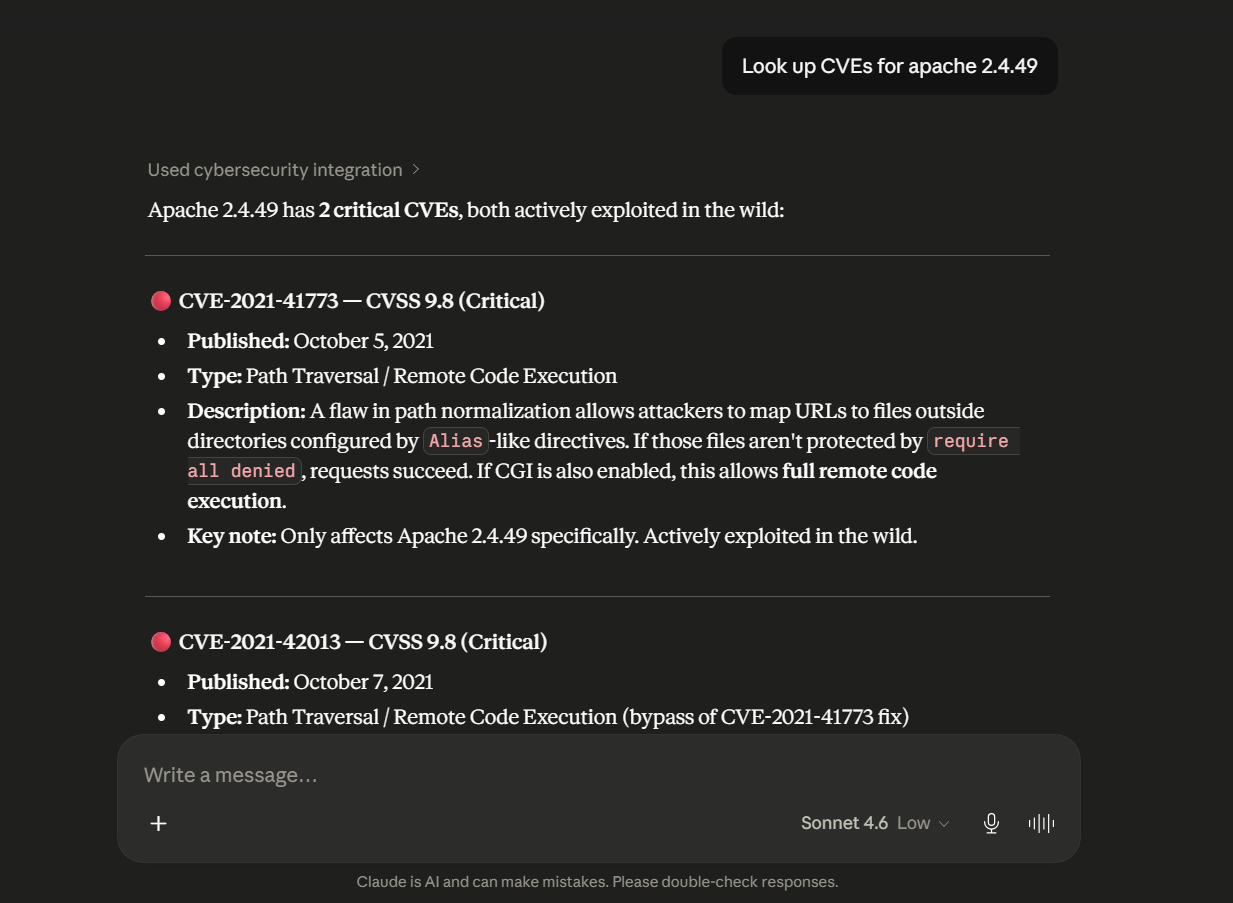
Single tool — CVE lookup
You: Look up CVEs for apache 2.4.49

Claude: Found 2 critical CVEs for Apache 2.4.49:
        CVE-2021-41773 (Score: 9.8 CRITICAL) — Path traversal vulnerability
        allowing remote code execution if CGI is enabled. Actively exploited
        in the wild...
Full recon
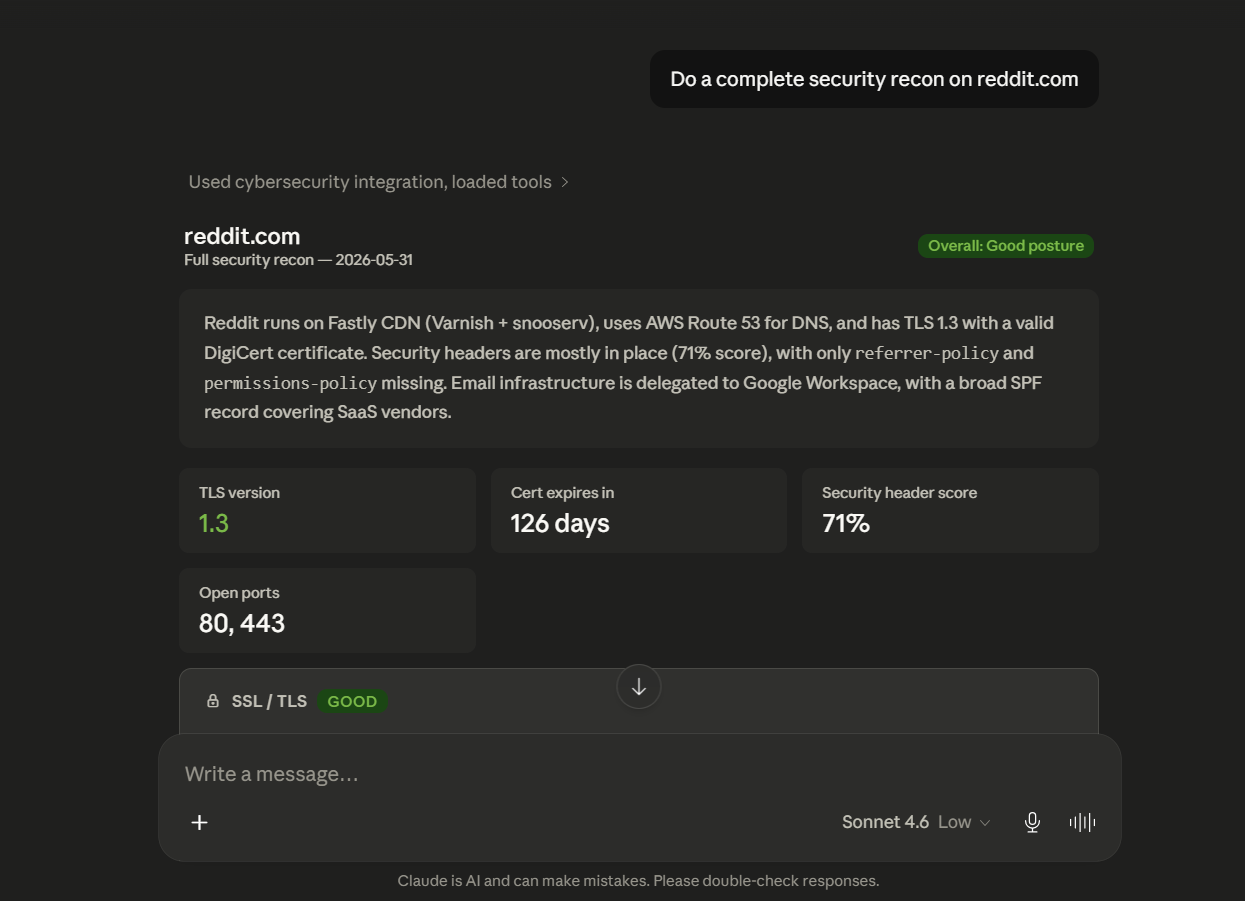
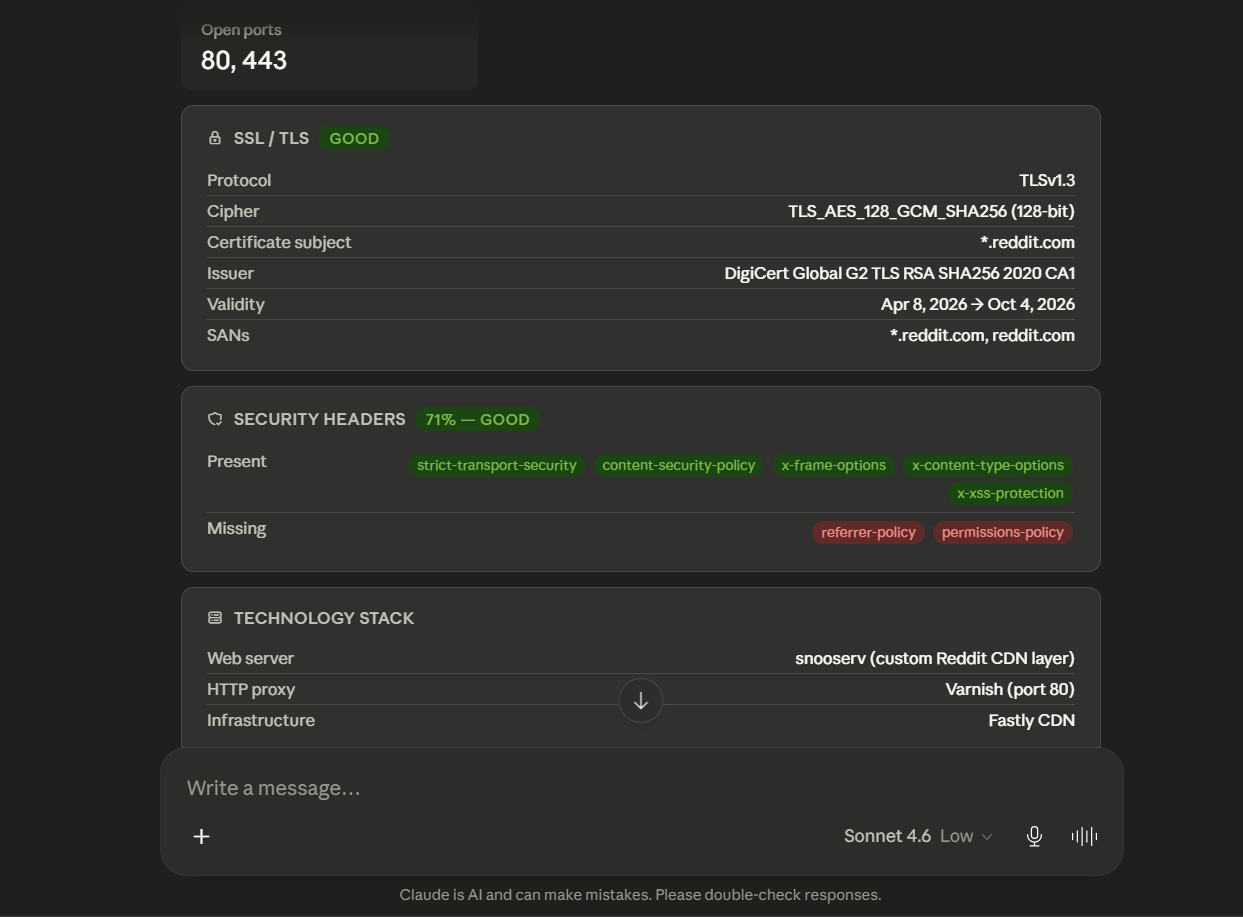
You: Do a complete security recon on reddit.com

Claude: [calls full_recon → runs 6 tools in parallel → delivers full analysis]
📋 Prerequisites
- Python 3.12+ — download
- Claude Desktop — download
- Nmap — required for port scanning (download)
- Git — download
⚙️ Installation
Step 1 — Clone the repository
git clone https://github.com/gaoharimran29-glitch/AynOps
cd AynOps
Step 2 — Install Python dependencies
pip install -r requirements.txt
Step 3 — Install Nmap
Windows:
- Download from nmap.org/download.html and run the installer
- Manually add Nmap to PATH:
- Press
Win + S→ search "Environment Variables" - Under System Variables → find Path → click Edit
- Click New → add
C:\Program Files (x86)\Nmap - Click OK on all windows
- Press
- Restart your terminal and verify:
nmap --version
Mac:
brew install nmap
Linux:
sudo apt install nmap
Step 4 — Connect to Claude Desktop
Open your Claude Desktop config file:
| OS | Path |
|---|---|
| Windows | %APPDATA%\Claude\claude_desktop_config.json |
| Mac | ~/Library/Application Support/Claude/claude_desktop_config.json |
| Linux | ~/.config/Claude/claude_desktop_config.json |
Add this configuration:
Windows:
{
  "mcpServers": {
    "cybersecurity": {
      "command": "C:\\full\\path\\to\\AynOps\\.venv\\Scripts\\python.exe",
      "args": ["C:\\full\\path\\to\\AynOps\\server.py"],
      "env": {
        "ABUSEIPDB_API_KEY": "your-api-key-here",
        "IP_API_KEY": "your-api-key-here"
      }
    }
  }
}
Mac/Linux:
{
  "mcpServers": {
    "cybersecurity": {
      "command": "/full/path/to/AynOps/.venv/bin/python3",
      "args": ["/full/path/to/AynOps/server.py"],
      "env": {
        "ABUSEIPDB_API_KEY": "your-api-key-here",
        "IP_API_KEY": "your-api-key-here"
      }
    }
  }
}
⚠️ Always use the full absolute path to your
.venvPython executable — not justpythonorpython3. Claude Desktop may use a different Python installation otherwise.
Note:
ABUSEIPDB_API_KEYis only required for theip_reputationtool. Get a free key at abuseipdb.com.IP_API_KEYis only required for theasn_lookuptool. get a free key at ipapi.com
Step 5 — Restart Claude Desktop
Fully quit and reopen Claude Desktop — closing the window is not enough. Check the system task manager and quit from there.
Verify tools are connected by asking Claude:
What cybersecurity tools do you have available?
Claude should list all tools.
🚀 Usage
Basic tool usage
Do a WHOIS lookup on example.com
Run DNS enumeration on github.com
Scan ports on scanme.nmap.org
Inspect the SSL certificate of stripe.com
Detect the tech stack of wordpress.org
Look up CVEs for apache 2.4.49
Look up CVEs for log4j 2.14.1
Check the reputation of IP 1.2.3.4
ASN Lookup for google.com
Port scan types
| Type | Description | Speed |
|---|---|---|
basic |
Top 100 ports | Fast (~5s) |
service |
Service & version detection | Medium (~15s) |
os |
OS detection (requires admin) | Medium |
full |
All 65535 ports | Slow (~5min) |
vuln |
Vulnerability scripts | Slow (~30s) |
Scan scanme.nmap.org with service detection
Full recon
Do a complete security recon on reddit.com
Claude will run all core tools in parallel and deliver a full security analysis.
Follow-up analysis
Based on the recon, what are the top security risks?
What do the open ports mean from an attacker's perspective?
Is this SSL configuration strong enough for a financial services company?
Cross-reference the open ports with known CVEs for the detected services.
⚠️ Legal & Ethical Usage
Only scan domains and IPs you own or have explicit written permission to scan.
- All tools use public data — safe on any domain
- Port scanning should only target your own infrastructure or authorized systems
- The only public host officially permitted for Nmap testing is
scanme.nmap.org - Unauthorized port scanning may be illegal in your jurisdiction
Intended for:
- Security researchers
- Penetration testers (on authorized targets)
- Developers auditing their own infrastructure
- Students learning cybersecurity concepts
🗂️ Project Structure
├── .github/              # GitHub Actions workflows and templates
├── tests/                # Unit tests
├── tools/                # MCP tool implementations
├── utils/                # Shared helper utilities
├── server.py             # MCP server entry point
├── pyproject.toml        # Project metadata and dependencies
├── requirements.txt      # Python dependencies
├── mcp.json              # MCP server metadata
├── glama.json            # Glama MCP metadata
├── Dockerfile            # Docker image definition
├── SECURITY.md           # Security policy
├── CONTRIBUTING.md       # Contribution guidelines
└── README.md             # Project documentation
Glama MCP Scoring

🤝 Contributing
Pull requests are welcome! Check contributing.md for guidelines and a list of open issues ready to pick up.
📜 License
MIT License — free to use, modify, and distribute.
👤 Author
Built by Gaohar Imran
- GitHub: @gaoharimran29-glitch
- LinkedIn: Gaohar Imran
⭐ If this project helped you, consider giving it a star on GitHub!
Yorumlar (0)
Yorum birakmak icin giris yap.
Yorum birakSonuc bulunamadi