pixeljury
Health Uyari
- License — License: MIT
- Description — Repository has a description
- Active repo — Last push 0 days ago
- Low visibility — Only 5 GitHub stars
Code Uyari
- process.env — Environment variable access in packages/cli/bin/pixeljury.js
- fs module — File system access in packages/cli/package.json
- process.env — Environment variable access in packages/cli/src/review.js
- process.env — Environment variable access in packages/cli/src/rubric-loader.js
- process.env — Environment variable access in packages/cli/src/terminal.js
Permissions Gecti
- Permissions — No dangerous permissions requested
Bu listing icin henuz AI raporu yok.
Visual QA CLI for AI-built frontends that renders pages, finds design and accessibility issues, and writes agent-ready fix prompts.
PixelJury
PixelJury is a visual QA CLI for AI-built frontends that renders your page, catches generic design and accessibility problems, and writes the fix prompt your coding agent can apply.




- Reviews the actual rendered page in Chromium, not just source files or component names.
- Flags hard failures developers can fix immediately: contrast, mobile overflow at 390px, small touch targets, tiny text, and repeated AI UI tropes.
- Scores typography, hierarchy, color, spacing, originality, and polish with your chosen vision provider.
- Writes
critique.md,fix-prompt.md, screenshots, andscore.jsonso an agent can run a review -> fix -> re-review loop.
Install
Run it directly:
npx pixeljury review http://localhost:3000
Or install it in a project:
npm install --save-dev pixeljury
pnpm add -D pixeljury
yarn add -D pixeljury
bun add -d pixeljury
Quickstart
Start your app, then point PixelJury at the local URL:
npx pixeljury review http://localhost:3000 --provider mock
That creates:
pixeljury/
  screenshot.png
  screenshot-390.png
  critique.md
  fix-prompt.md
  score.json
Open pixeljury/fix-prompt.md, give it to your coding agent, apply the fixes, and run the same command again. Use a model-backed provider when you want the full visual score:
npx pixeljury review http://localhost:3000 --provider anthropic
npx pixeljury review http://localhost:3000 --provider openai
npx pixeljury review http://localhost:3000 --provider claude-code
npx pixeljury review http://localhost:3000 --provider codex
What You Can Do With It
- Review a landing page before shipping it.
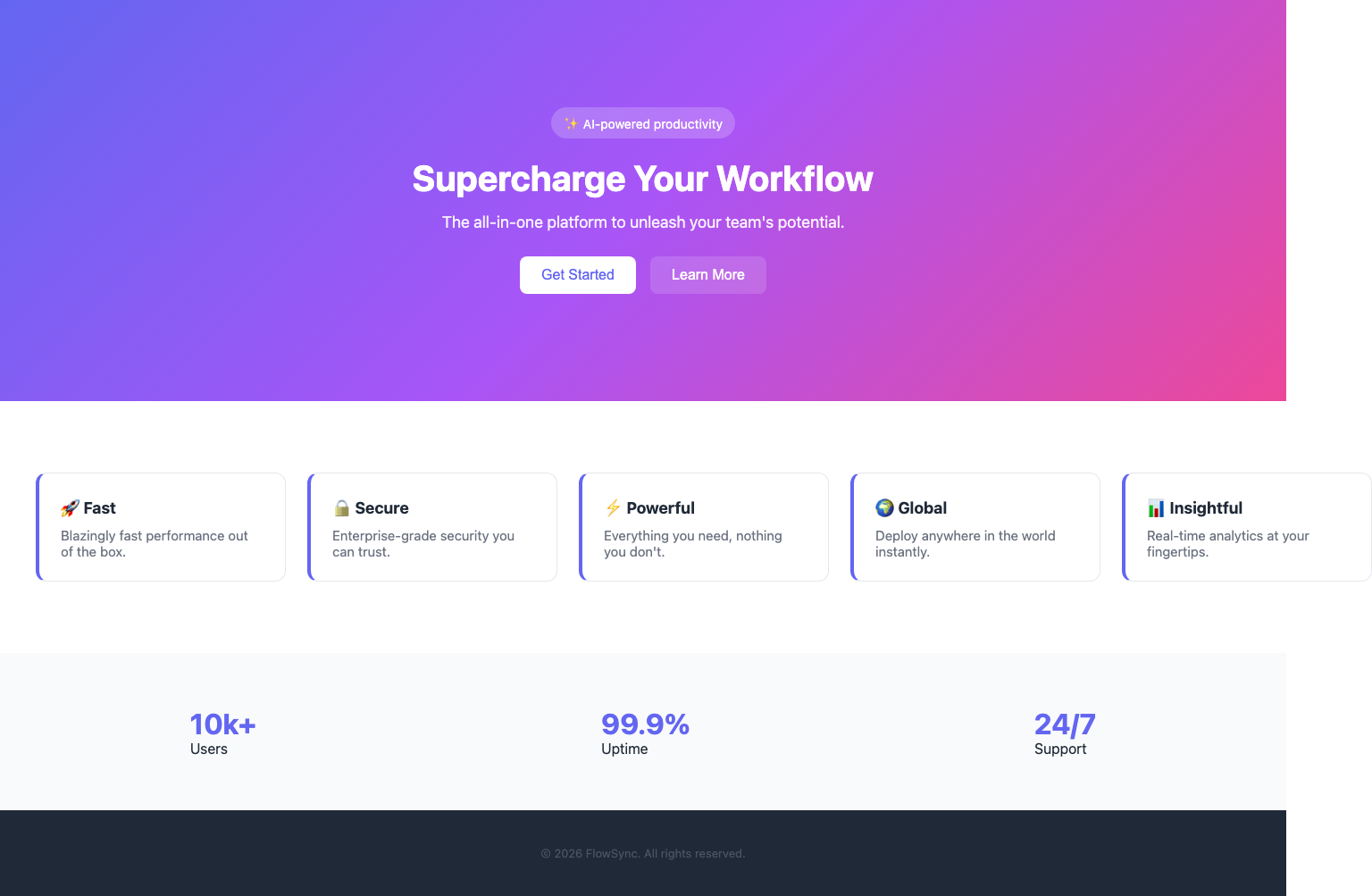
- Catch the common AI-generated UI tells: gradient heroes, emoji feature cards, fake metrics, repeated card grids, default fonts, and low-contrast footer text.
- Give Cursor, Claude Code, Codex, Windsurf, or another coding agent a concrete design-fix prompt instead of vague feedback.
- Keep before/after proof in CI or pull requests with screenshots and
score.json. - Tune design work against an open rubric instead of a private taste call.
Why PixelJury?
- It judges pixels, not intentions. PixelJury opens the URL in Chromium and reviews the page that users will actually see.
- Hard fails are deterministic. Contrast, mobile overflow, touch-target size, tiny text, and named slop-trope detections run without an API key.
- The output is agent-ready. The generated
fix-prompt.mdprioritizes hard fails first so a coding agent can make targeted changes. - No hosted service is required. Use provider API keys, local Ollama, Claude Code, Codex, or the deterministic
mockprovider. - The rubric is public. Scores trace back to
rubric.md, so the standard can be inspected and changed.
Compared To Alternatives
| Need | PixelJury | Common alternative |
|---|---|---|
| Accessibility smoke check | Checks contrast, mobile overflow, touch targets, and tiny text while also producing design feedback. | Axe/Lighthouse are stronger for broad accessibility coverage and performance auditing. |
| AI UI cleanup | Detects repeated cards, default fonts, gradient panels, fake stats, and generic AI copy in the rendered page. | Design-system rules or prompt snippets help before generation but do not inspect final pixels. |
| Agent handoff | Writes fix-prompt.md with concrete remediation instructions. |
Manual design review often leaves feedback in screenshots, comments, or chat. |
| Visual scoring | Combines deterministic findings with a vision-model rubric. | Pure linters are more deterministic but cannot judge originality, hierarchy, or polish. |
Use Lighthouse, Axe, Playwright tests, and visual regression tools when you need their specific coverage. Use PixelJury when the page works but still looks generic, broken, or unready.
Example Output
PixelJury  ·  rubric v0.1

Design score: 61/100   - Generic AI output

Hard fails
  x Page is 70px wider than the 390px viewport (horizontal scroll on mobile)   caps at 70
  x Text contrast 3.1:1 (needs 4.5:1) - e.g. "Copyright 2026 FlowSync..."     caps at 65

Problems
  x "inter" is the primary typeface - an AI/template default        -5
  x Large gradient background panel (1440x420px)                    -5
  x The same card pattern is reused 5x - reads as templated         -5
  x Pill/badge with AI-marketing copy                               -3

-> pixeljury/critique.md   pixeljury/fix-prompt.md   pixeljury/screenshot.png
See It Work
The repository includes a before/after SaaS page pair in examples/. PixelJury rendered and scored both pages.
Before: examples/sloppy-saas |
After: examples/polished-saas |
|---|---|
 |
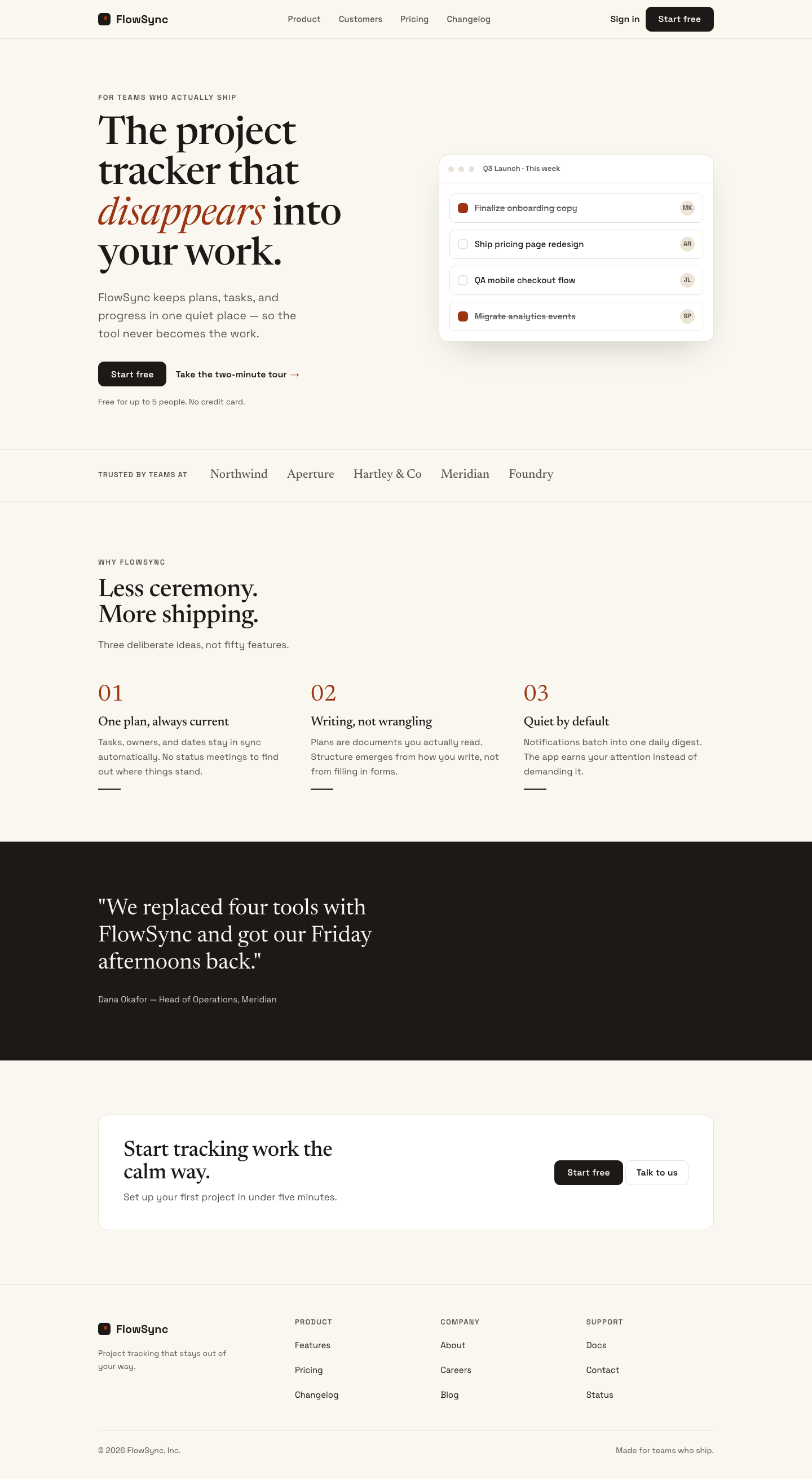 |
| 16 / 100 - Broken or pure slop | 84 / 100 - Good, fixable gaps |
| 3 hard fails, 6 slop-trope deductions | 0 hard fails, 0 deductions |
Full scoring artifacts: before.score.json and after.score.json.
Providers
npx pixeljury review <url> --provider anthropic     # ANTHROPIC_API_KEY
npx pixeljury review <url> --provider openai        # OPENAI_API_KEY
npx pixeljury review <url> --provider gemini        # GEMINI_API_KEY
npx pixeljury review <url> --provider ollama        # local model, no API key
npx pixeljury review <url> --provider claude-code   # local Claude Code login
npx pixeljury review <url> --provider codex         # local Codex / ChatGPT login
npx pixeljury review <url> --provider mock          # deterministic checks only
API providers read keys from --key, then PIXELJURY_KEY, then the provider's standard environment variable. Prefer environment variables for keys; command-line arguments can be visible in shell history and process lists. When no provider is selected and no key is available, PixelJury auto-selects mock; if you explicitly choose an API provider, you must provide that provider's key. The deterministic hard-fail and trope checks still run with mock.
--provider claude-code and --provider codex shell out to the local CLI you already have logged in. PixelJury stages screenshots in a temporary working directory for those passthrough runs so the local agent is not pointed at your project checkout. Use API-key providers for shared automation or public CI.
How It Works
Render with Playwright
  -> analyze deterministic static signals
  -> score screenshots with a vision provider
  -> compose the final score and write artifacts
The deterministic stage finds:
- WCAG contrast failures
- mobile overflow at 390px
- touch targets below 44px
- tiny body text
- overused default fonts
- large gradient panels
- repeated card patterns
- AI-marketing badges and fake-looking stats
The vision stage scores six rubric dimensions: typography, hierarchy, color, spacing, originality, and polish. The final score is capped by hard fails and reduced by deterministic deductions.
API Packages
Most developers should install pixeljury, the CLI. The lower-level packages are published for integrations:
pixeljury-core: Playwright rendering, deterministic static signals, contrast helpers, and score composition.pixeljury-vision: OpenAI, Anthropic, Gemini, Ollama, Claude Code, Codex, and mock vision-scoring adapters.
Compatibility And Limitations
- Requires Node.js 18 or newer.
- Uses Playwright and Chromium to render pages. If Chromium is not installed, run
npx playwright install chromium. - Reviews a URL, so your app must already be running.
- The
mockprovider runs deterministic checks but does not produce a model-backed visual critique. - PixelJury is not a replacement for full accessibility, performance, security, or visual regression testing.
Development
npm install
npm test
npx playwright install chromium
node packages/cli/bin/pixeljury.js review http://localhost:3000 --provider mock
Workspace layout:
packages/cli      # npx entrypoint and review command
packages/core     # Playwright render, static signals, score composer
packages/vision   # provider adapters and structured-output parsing
examples/         # before/after pages and gallery artifacts
rubric.md         # scoring rubric
Trust And Project Links
License
MIT © PixelJury contributors
Yorumlar (0)
Yorum birakmak icin giris yap.
Yorum birakSonuc bulunamadi