multivendor-ai-network-lab
Health Gecti
- License — License: MIT
- Description — Repository has a description
- Active repo — Last push 0 days ago
- Community trust — 11 GitHub stars
Code Gecti
- Code scan — Scanned 12 files during light audit, no dangerous patterns found
Permissions Gecti
- Permissions — No dangerous permissions requested
Bu listing icin henuz AI raporu yok.
26-device multivendor AI network lab — now closes the loop: detected anomalies auto-remediate, risk-gated (auto / approve / page-out) with RFC 6241 confirmed-commit rollback. Pydantic-AI orchestrator · 68 MCP tools · immutable GAIT audit. Juniper / Arista / Nokia SRL / FRR · on-prem.
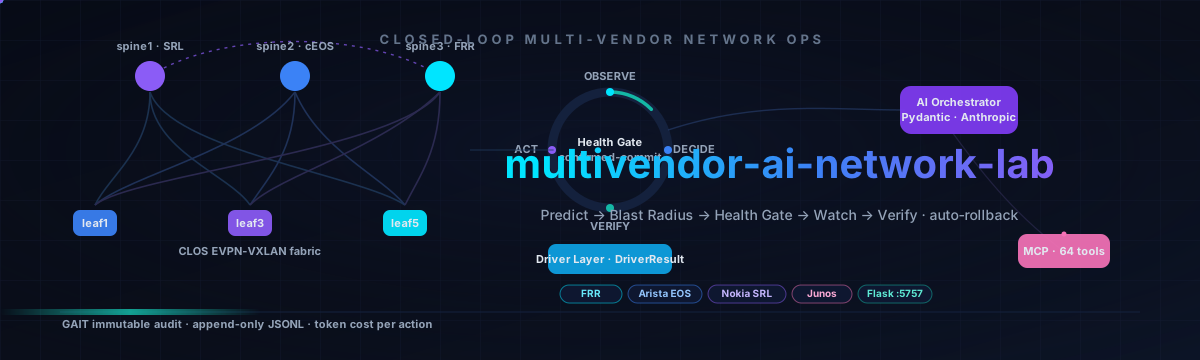
Multivendor AI Network Lab
📖 Live documentation
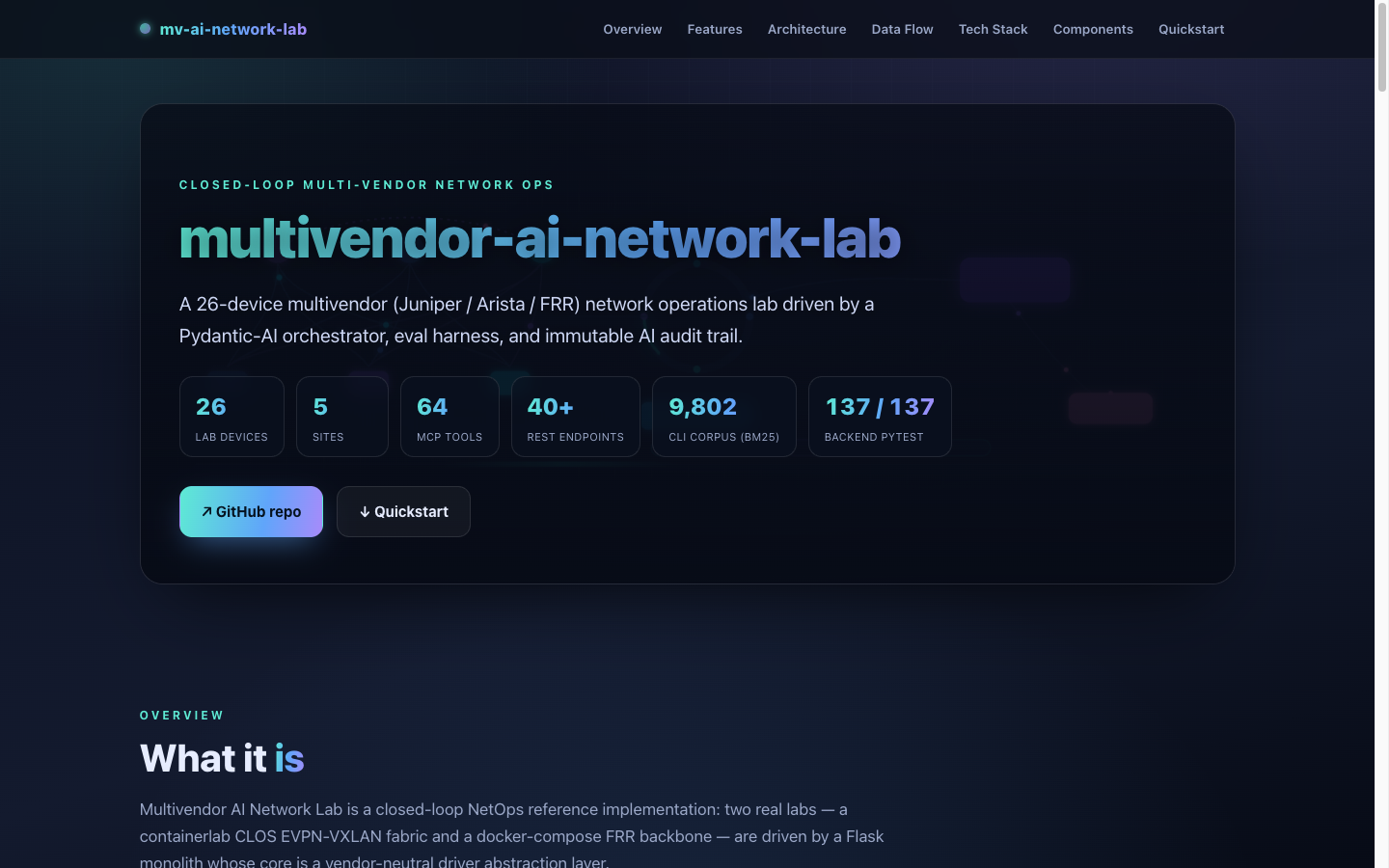
🌐 Live: https://gesh75.github.io/multivendor-ai-network-lab/ — an animated single-page guide: architecture diagrams, data flow, tech stack, and quickstart.
🗂️ Part of the gesh75 documentation hub — all my network & AI engineering project docs in one place.
🖥️ Fabric operations portal
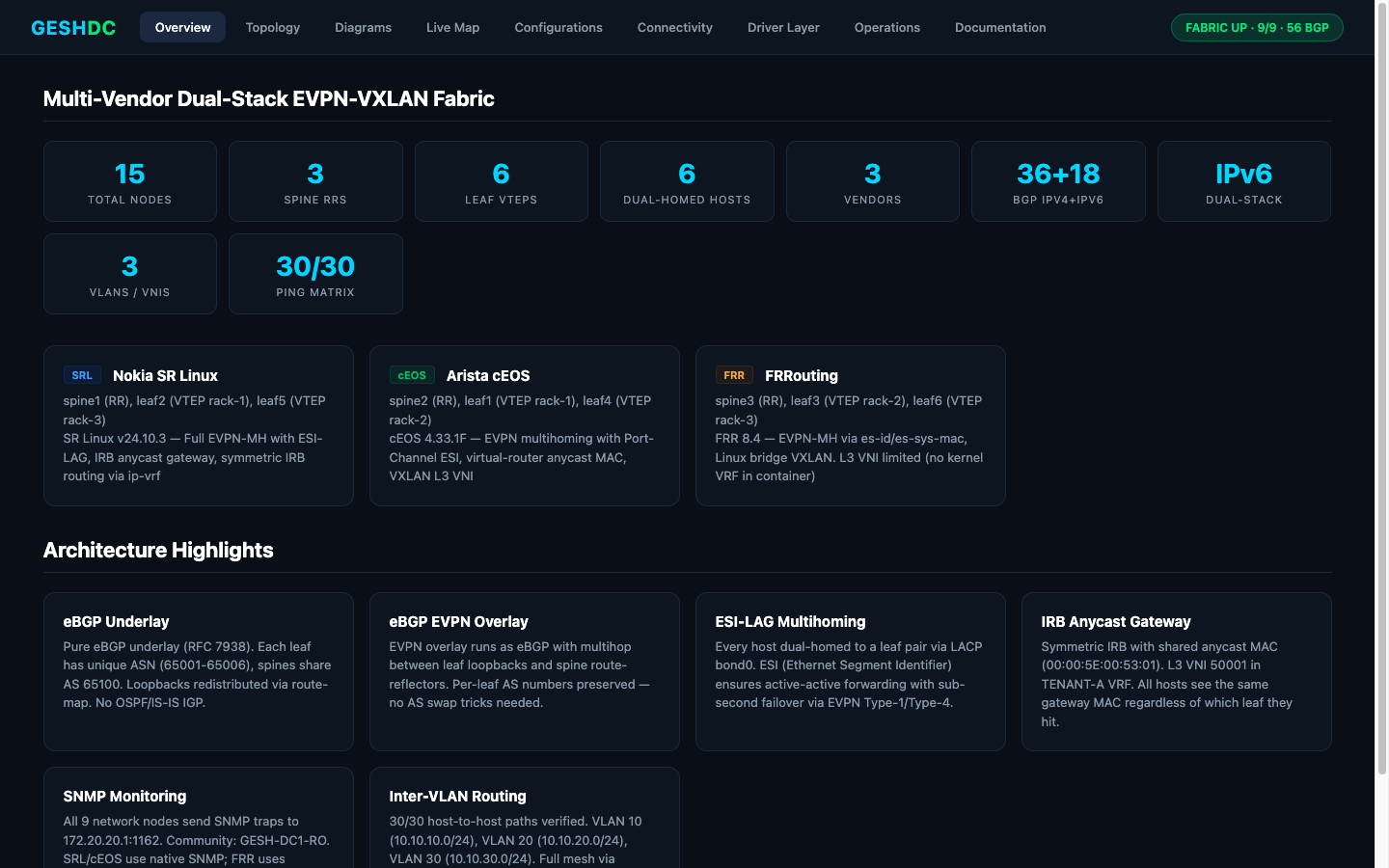
🌐 Open the live portal → — the CLOS EVPN-VXLAN fabric (Nokia SR Linux · Arista cEOS · FRR): topology, Mermaid L1/L3/BGP/EVPN diagrams, per-vendor device configs, a 30/30 connectivity matrix, and design decisions. The
FABRICbadge is live against a local backend, so it readsFABRIC ?on the public web.🛠️ Build it yourself: the step-by-step Build Your Own Docker Lab guide (macOS & Linux) stands the whole fabric up —
docker-composeFRR backbone + the containerlab EVPN fabric, with the--pid hostrecipe and image setup.
⚡ Phase 6 (Jun 2026) — event-initiated remediation: detected anomalies now
auto-trigger the closed-loop change pipeline, risk-gated — LOW auto-executes,
MEDIUM/HIGH queue for one-click approval, CRITICAL pages out and never auto-acts.
Blast-radius BFS tier escalation · confirmed-commit (RFC 6241 §8.4) auto-revert ·
8-runbook catalog · 6 endpoints · auto-remediation queue UI · 5 new MCP tools
(~68 total) · 34/34 tests. Release:
v0.6.0.🎯 Phase 5 (May 2026) — COMPLETE: RAG · gNMI streaming (SRL) · ADTK anomaly
detection · 6-stage closed-loop pipeline · predictive forecast · 68 MCP tools ·
41 PASS / 0 FAIL stress test.🛰 Phase 4 (May 2026) — the closed-loop phase: Health Gate (RFC 6241 §8.4
confirmed-commit) · NetBox SoT drift detector · Auto-Remediate proposal state
machine · Auto-Postmortem markdown writer · 9,802-command CLI BM25 retrieval ·
MCP layer extended to 49 tools (12 Phase-4 closed-loop). The lab now takes an
action and takes it back if any signal degrades during the watch window.Demo:
demo/linkedin-demo.mp4(0:52 · 1280×720) ·demo/LINKEDIN_POST.md· full feature map inFEATURES.md.🛡 2026-05-25 audit hardening: end-to-end functional audit closed 9 of 11
gaps in one session. Tool now reports honestly against the live 25-device
deployment: 19 network devices · 5 sites · 41/41 clab BGP up · 0 console
errors · 20/20 endpoints green. Collector under launchd KeepAlive, KPI
strip wired to live counts, gnmic freshness usessource-tag filter.
Full audit:GAPS_REPORT.md· post-audit architecture:docs/ARCHITECTURE_HARDENED.md.🔁 2026-05-25 closed-loop pipeline (roadmap #4): new
POST /api/change/closed-loopchains 6 stages — Predict → Batfish →
Apply (Health Gate) → Watch → POST diff → Intent verify — into a single
governed operation with auto-rollback. Verified live: APPROVED in 12s,
ROLLED_BACK in 6s on induced regression. Pushes the tool from
TM Forum ANL L2 → L3. Design + sequence:docs/CHANGE_PIPELINE.md.🩺 2026-05-25 round-2 audit + #3 ADTK: every previously-broken tab now
functional on both fabrics for all 4 vendor families (Juniper / Arista
EOS / Nokia SR Linux / FRR). NAPALM endpoints return real data (60 clab + 18
DCN peers); Nornir LLDP / Config Compliance work; Shadow Auditor reads live
running-config via docker exec; Chaos Monkey targets both fabrics; Postmortem
- AI Insights have fabric/device selectors. New
/api/anomaly/detect
endpoint runs Z-score + flap-count detectors over the live time series and
merges findings into/api/keep/correlate. Full evidence:docs/POST_AUDIT_FIXES_2.md.🎯 2026-05-25 Phase 5 COMPLETE: all 5 roadmap items shipped (#1 RAG, #2
gNMI for SRL, #3 ADTK, #4 closed-loop, #5 predictive forecast) plus 13 new
MCP tools (63 total), persistent docker-exec session pool, and cEOS+FRR
streaming migration script. Stress test: 41 PASS / 0 FAIL across every
feature × every fabric × every vendor. Post-Phase-5 architecture +
Phase-6 backlog:docs/ARCHITECTURE_PHASE_5.md·
agent handoff:docs/PHASE_5_HANDOFF.md.
A 26-device multivendor (Juniper / Arista / FRR) network operations lab driven
by a Pydantic-AI orchestrator, eval harness, and immutable AI audit trail.
Built as a working reference implementation of patterns from
NetClaw,
NIKA,
pydantic-ai,
and coding-networks-blog MCP+MPLS — all
adapted to be vendor-agnostic across Juniper JunOS, Arista EOS, FRR, with
hooks for Cisco IOS-XE / NX-OS.
What's in here
| Capability | Where | Source pattern |
|---|---|---|
| 🤖 Pydantic-AI orchestrator with structured outputs (Routing / ACL / Incident agents) | src/pydantic_ai_orchestrator.py |
Hugo Tinoco |
| 🧪 Eval harness — 10 incident scenarios, keyword + LLM-as-judge scoring | src/eval_harness.py, src/scenarios.json |
NIKA |
| 📜 GAIT immutable audit trail — every AI action JSONL with token cost | src/gait_audit.py |
NetClaw |
| 🛣️ Hop-by-hop path trace — vendor-colored SVG with BFS over BGP graph | src/multivendor_extensions.py /api/mv/path/trace |
NetClaw |
| 🎯 Intent verification — config-claimed vs SuzieQ-observed drift detector | src/multivendor_extensions.py /api/mv/intent/verify |
NetClaw |
| 🗺️ Vendor-agnostic command translator — 12 canonical tasks × 5 vendors | src/vendor_translator.py |
new |
| 📦 TOON serializer — ~60% smaller than JSON for tabular API payloads | src/toon_serializer.py |
NetClaw |
| 🛡️ Auto-remediation runbooks — YAML playbooks (BGP/OSPF/Interface/ACL) | src/runbooks/ |
NetClaw |
🔍 CVE scanner — static (vendor, OS version) lookup over fleet |
src/cve_db.json, /api/mv/cve |
NetClaw |
| ⚙️ MCP server — 69 tools so Claude Code can call any capability | src/mcp_dcn_server.py |
coding-networks-blog |
🩺 Single-device health snapshot — GET /api/health/<hostname> → one JSON doc with BGP/OSPF/interfaces/routes/mem/CPU in parallel |
src/health.py, docs/HEALTH_ENDPOINT.md |
what_a_NOS_could_be |
How does this compare to RANCID, Oxidized, SolarWinds NCM, Forward Networks, NetSpectraAI?
Most network-config tools are backup + diff (RANCID / Oxidized / NCM) or
formal verification at Fortune-500 prices (Forward Networks). A newer
generation of SaaS analyzers (NetSpectraAI) bolts an LLM on top of backup +
diff and sells it per-seat. This tool is in a different category: a live
closed loop — observe → diagnose → remediate → verify → document — with
confirmed-commit safety (RFC 6241 §8.4), auto-postmortems, and MCP-native
agent integration.
→ Full side-by-side comparison: COMPARISON.md
The lab
26 devices across 5 sites — DE-FRA · UK-LON · NL-AMS · EU-CDG · US-NYC
| Vendor | Count | Style | What's modeled |
|---|---|---|---|
| Juniper | 10 | sanitized real configs | SRX firewalls, MX core routers, EX switches |
| Arista | 6 | sanitized real configs | DCS-7280CR3K routers, DCS-7050CX3 switches |
| FRRouting | 10 | live Docker containers | core / edge / dist routers with BGP+OSPF mesh |
All sanitized configs use RFC 5737 / RFC 1918 ranges and placeholder credentials.
Real public ASNs (3356 / 13335 / 15169 / 16509) are retained because they're
public Internet routing data — useful for realism in BGP demos.
🏛️ Architecture
The lab is a closed loop: humans (web UI / Telegram) and AI agents (Claude Code
over a 69-tool MCP server) drive a Flask monolith on :5757 whose core is a
vendor-neutral driver layer; changes flow through a governed
Predict → Blast Radius → Health Gate → Watch → Verify pipeline with
auto-rollback, while telemetry streams to InfluxDB/Grafana.
flowchart TB
    operator(["NOC Operator - web UI and Telegram"]):::actor
    agents(["Claude Code - via MCP, 69 tools"]):::actor

    system{{"multivendor-ai-network-lab - Flask :5757 closed-loop ops"}}:::core

    labs["Two Labs - CLOS EVPN-VXLAN and FRR backbone"]:::infra
    anthropic["Anthropic API - claude-haiku-4-5"]:::ai
    tsdb["InfluxDB 2.7 and Grafana 10.4"]:::data
    sot["NetBox and Batfish - SoT and verification"]:::data

    operator -->|"symptoms, changes"| system
    agents -->|"tool calls"| system
    system -->|"docker-exec, SSH"| labs
    system -->|"diagnose, judge"| anthropic
    system -->|"line protocol"| tsdb
    system -->|"drift, what-if"| sot
    labs -.->|"live state"| system

    classDef actor fill:#475569,stroke:#94a3b8,color:#fff
    classDef core fill:#3b82f6,stroke:#60a5fa,color:#fff
    classDef infra fill:#0ea5e9,stroke:#38bdf8,color:#fff
    classDef ai fill:#7c3aed,stroke:#a78bfa,color:#fff
    classDef data fill:#059669,stroke:#34d399,color:#fff
📐 Full architecture — six colorful Mermaid diagrams (system context,
component map, closed-loop sequence, telemetry data flow, driver class map,
Health Gate state machine) + animated hero: docs/ARCHITECTURE.md.
You can also open the animated 8-layer in-app diagram athttp://localhost:5757/demo/architecture.html after starting the Flask app
(Reference projects → 26 devices → Transport → Flask + MCP server →
AI orchestration → LLM backbone → demo UI tabs → Storage).
Quick start
git clone https://github.com/gesh75/multivendor-ai-network-lab.git
cd multivendor-ai-network-lab

# 1. Bring up the FRR live container mesh
cd network-lab && docker-compose up -d

# 2. Start the Flask API + UI (port 5757)
cd ../src
python3 -m venv venv && source venv/bin/activate
pip install -r requirements.txt
python3 app.py

# 3. Open the demo UI
open http://localhost:5757/demo/index.html
Set ANTHROPIC_API_KEY in src/.env to unlock the orchestrator and LLM-as-judge.
Without a key, the orchestrator runs in deterministic offline mode.
API surface
55 endpoints under /api/mv/* — see network-lab/MULTIVENDOR_LAB.md
for the full table, request/response shapes, and curl examples.
The 12 Phase 3 endpoints:
POST /api/mv/orchestrator             multi-agent diagnose with structured output
GET  /api/mv/intent/verify            config-claim vs observed drift detector
GET  /api/mv/path/trace               BFS hop-by-hop path
GET  /api/mv/eval/scenarios           list 10 incident scenarios
POST /api/mv/eval/run                 run scenario + score
GET  /api/mv/gait/recent              audit log query
GET  /api/mv/gait/stats               aggregated counters
GET  /api/mv/runbooks                 list YAML runbooks
POST /api/mv/runbook/execute          dry-run with per-vendor CLI
GET  /api/mv/cve                      CVE scan over static configs
GET  /api/mv/translator               canonical task → CLI map
GET  /api/mv/toon                     TOON-serialized inventory
Demo UI tabs
5 Phase 3 tabs added on top of the existing inventory / fleet audit / SuzieQ /
gNMI / syslog / SNMP tabs:
| Tab | What you do |
|---|---|
| 🤖 Orchestrator | type a symptom, see auto-routed diagnosis with Pydantic JSON |
| 🎯 Intent Verify | one click → drift score across all BGP sessions |
| 🧪 Eval Harness | pick scenario, click Run (or Run All) — see keyword + judge scores |
| 🛣️ Path Trace | pick src+dst, BFS over BGP graph, vendor-colored SVG |
| 📜 GAIT Audit | live event stream with token costs |
Repository layout
multivendor-ai-network-lab/
├── network-lab/              # Docker lab + sanitized device configs
│   ├── demo-devices/         # 16 sanitized configs (junos + eos) + inventory.json
│   ├── configs/              # FRR container configs
│   ├── docker-compose.yml    # 10 FRR containers, ports 2201-2210
│   └── MULTIVENDOR_LAB.md    # full architecture + endpoint reference
├── src/                      # Flask app + AI ops modules
│   ├── app.py                # main Flask API
│   ├── multivendor_extensions.py    # /api/mv/* blueprint
│   ├── pydantic_ai_orchestrator.py  # multi-agent orchestrator
│   ├── eval_harness.py
│   ├── gait_audit.py
│   ├── toon_serializer.py
│   ├── vendor_translator.py
│   ├── mcp_dcn_server.py            # MCP server (69 tools)
│   ├── runbooks/             # 5 YAML auto-remediation playbooks
│   ├── scenarios.json        # 10 incident scenarios
│   ├── cve_db.json           # static CVE lookup
│   └── requirements.txt
├── demo/                     # static HTML/JS demo UI
│   ├── index.html
│   └── phase3.js
└── docs/specs/               # design specs
    └── 2026-05-05-multivendor-ai-features-design.md
Engineering notes & production roadmap
This is a portfolio/demo lab — not a production system. Phase 3 modules
follow modern Python hygiene: full type hints (PEP 604 syntax), Flask
Blueprints (the mv_bp blueprint cleanly separates the 20 multivendor
endpoints from legacy routes), specific exception handling withlogging.warning/exception and never swallowing exceptions silently,
and externalized credentials via env vars. The legacy src/app.py predates
the Phase 3 work and is the migration target.
Already in place (Phase 3)
- Type hints everywhere in the 8 new modules (
pydantic_ai_orchestrator.py,eval_harness.py,gait_audit.py,toon_serializer.py,vendor_translator.py,multivendor_extensions.py, runbooks, scenarios). - Flask Blueprints —
mv_bpseparates/api/mv/*routes into their own
module. The MCP server is a parallelfastmcpsurface. - Specific exception handling — Anthropic SDK errors caught individually
(APIError,RateLimitError,APIConnectionError); Pydantic validation
caught as(TypeError, ValueError); JSON parsing asJSONDecodeError. - Standard
loggingmodule instead ofprint()in all Phase 3 modules. - No hardcoded credentials —
ANTHROPIC_API_KEY, SSH keys, and theCLI_PROXY_PASSWORDcome from env. Missing values log a warning rather
than silently falling back to a known-weak password. - Sanitization tokens externalized to a gitignored
network-lab/demo-devices/sanitize_tokens.jsonso the public repo carries
none of the source-company identifiers.
Production migration roadmap
These are the right next steps if anyone wants to run this beyond a single
demo box. None of them are needed for the current lab to function.
- State out of memory.
_napalm_jobs,_PYATS_SNAPSHOTS, ring buffers
for syslog/traps, and the GAIT log all live in a single Python process.
Move to Redis (job/snapshot state), RQ or Celery (long-running
audits), and a rotated SQLite or PostgreSQL backend for GAIT so a
gunicorn worker farm can share state. - Replace regex CLI parsers with TextFSM / Cisco Genie templates. Netmiko
has native TextFSM support and the community templates already covershow bgp summary,show interfaces,show ip route, etc. for
Junos/EOS/IOS/NX-OS. This eliminates fragile regex per-vendor and survives
firmware upgrades. - Split legacy
src/app.pyinto Blueprints matching the Phase 3 pattern:routes/device_ops.py,routes/llm_agents.py,routes/librenms.py,routes/reports.py. Then add type hints across all of it. - CI gate:
mypy --strictoversrc/*.py,rufffor style, andpytestfor the parser unit tests. Fail the build on any new bareexcept Exception:clause. - Secrets manager: rotate from
.envto AWS Secrets Manager / Vault for
any deployment beyond a developer laptop. The code already reads from env,
so this is a deployment change, not a code change.
Licensing
MIT — see LICENSE.
Author
Built by Georgi Gaydarov — senior network
engineering leader exploring agentic AI for multi-vendor network operations.
Yorumlar (0)
Yorum birakmak icin giris yap.
Yorum birakSonuc bulunamadi