tori
Health Warn
- License — License: Apache-2.0
- Description — Repository has a description
- Active repo — Last push 0 days ago
- Low visibility — Only 5 GitHub stars
Code Fail
- spawnSync — Synchronous process spawning in dev/acp-probe.mjs
- process.env — Environment variable access in dev/acp-probe.mjs
Permissions Pass
- Permissions — No dangerous permissions requested
No AI report is available for this listing yet.
A cockpit for the coding agents you already run.

Tori
A cockpit for the coding agents you already run.
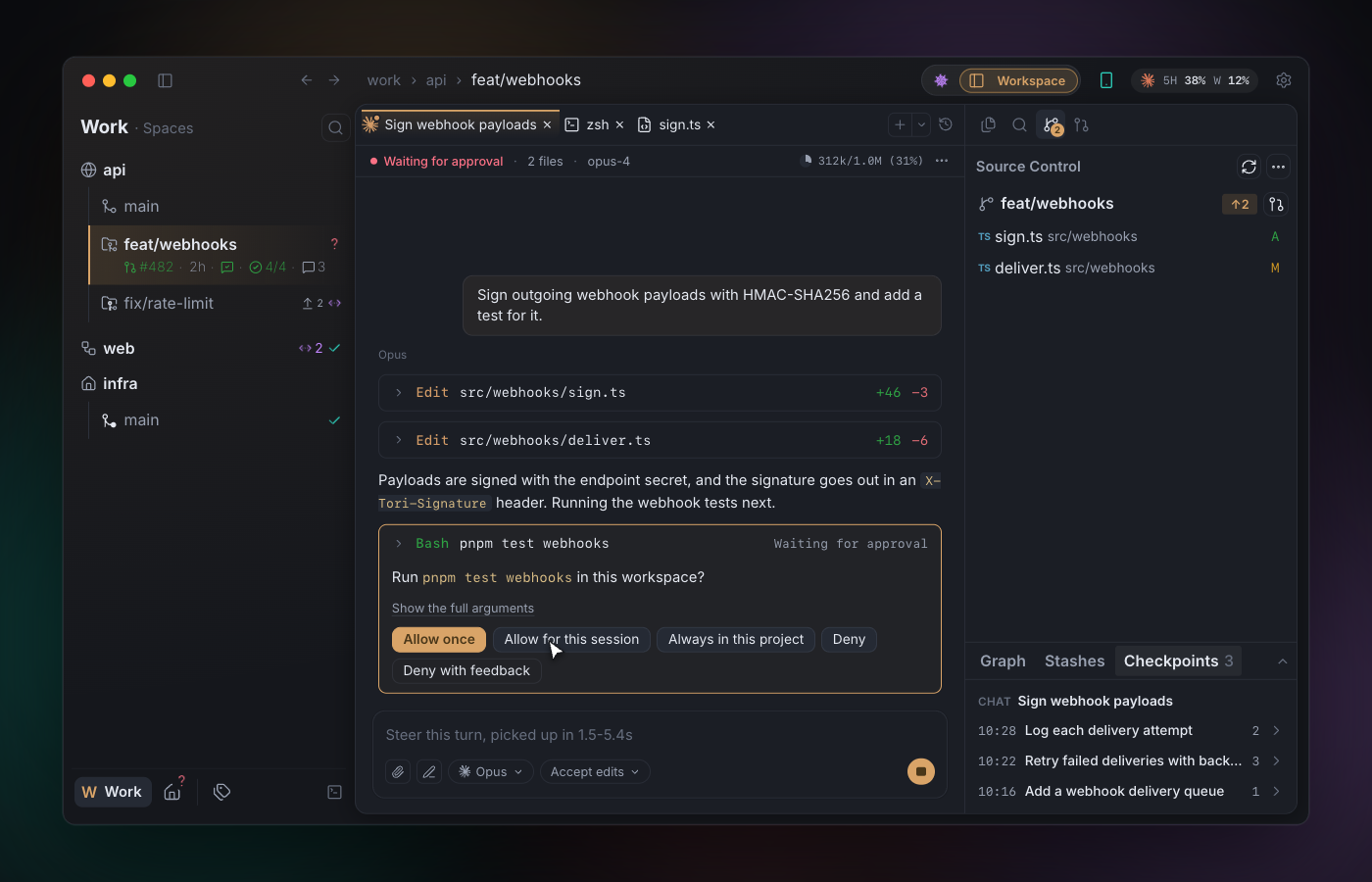
Tori is a macOS app that puts every agent session you have going into one
window: a tree of projects and branches, a real terminal per session, an editor
with LSP, and a review panel that stages and commits what the agent wrote. It
does not bundle an agent and it is not tied to one. Claude ships supported out
of the box, and any other CLI agent is a TOML file away.
Status: alpha. It is used every day by the person who builds it, it ships
often, and things still move. macOS only, on Apple Silicon and Intel, with a
companion Android app that shows a paired Mac's chats.
Why
Running one agent in one terminal is fine. Running four, across three
repositories and a couple of worktrees, is a tab-management problem, and the
part you actually care about (which one is waiting on you) is the part the
terminal cannot tell you.
Tori watches each agent's own session transcripts and process state, so every
row in the tree says working, needs you, or done, and a parent row
rolls its children up. You look at one list and know where to go next.
What it does
Sessions. A tree of sessions grouped into spaces, with a git-branch graph
and worktree support. Clicking a session focuses its terminal tab, or resumes
it if it is not running. Turn-level checkpoints snapshot the repo per prompt,
so you can diff or revert a single turn. A transcript viewer, a touched-file
list, and a context-window meter come along for adapters that report one.
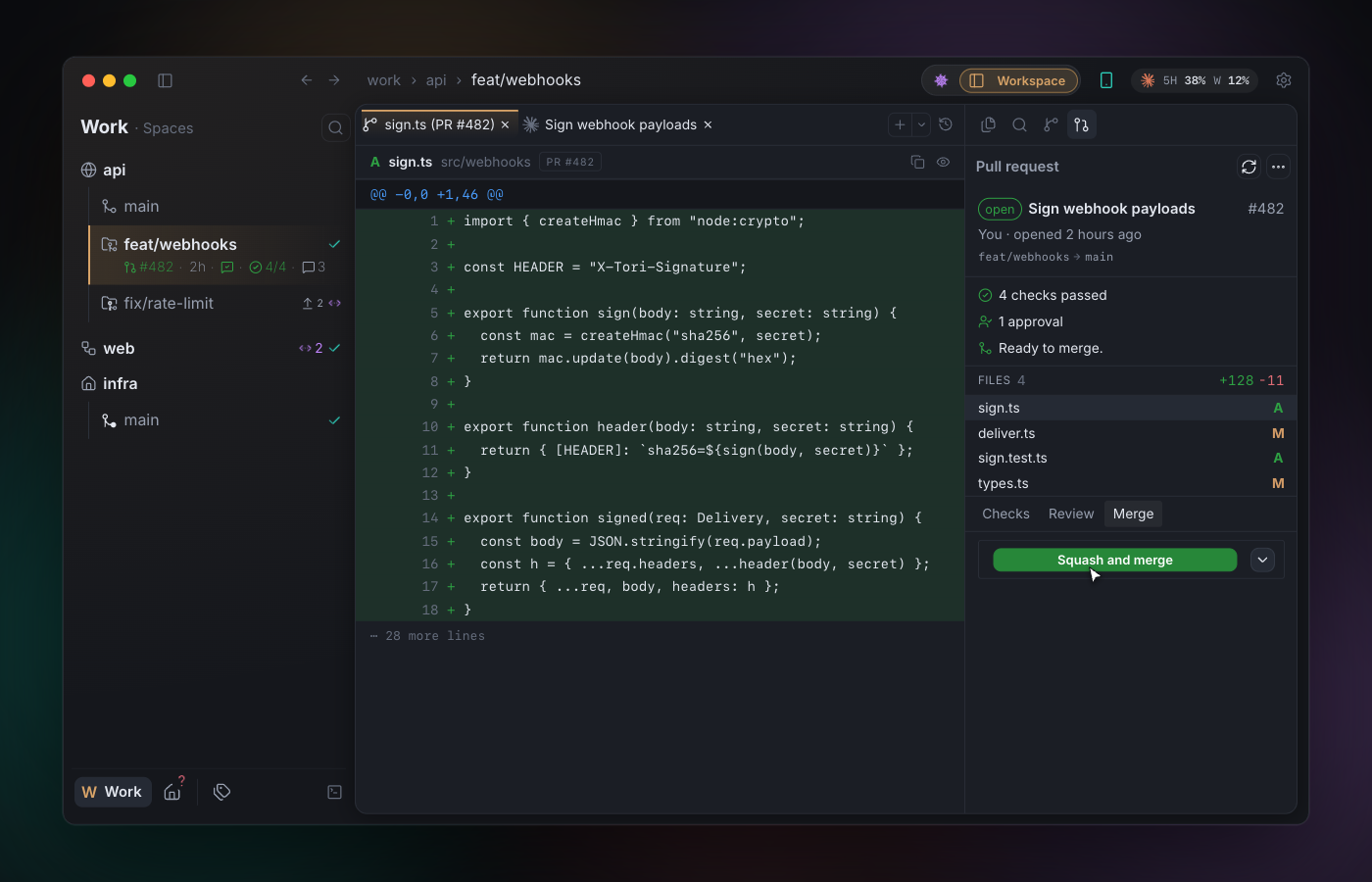
Editor and review. A CodeMirror editor with TypeScript/JavaScript LSP, diff
gutters, and markdown/image preview. The Changes panel stages, unstages,
commits, pushes, and opens a PR. You can send a hunk comment or an editor
selection straight into a session, and search across the whole project.
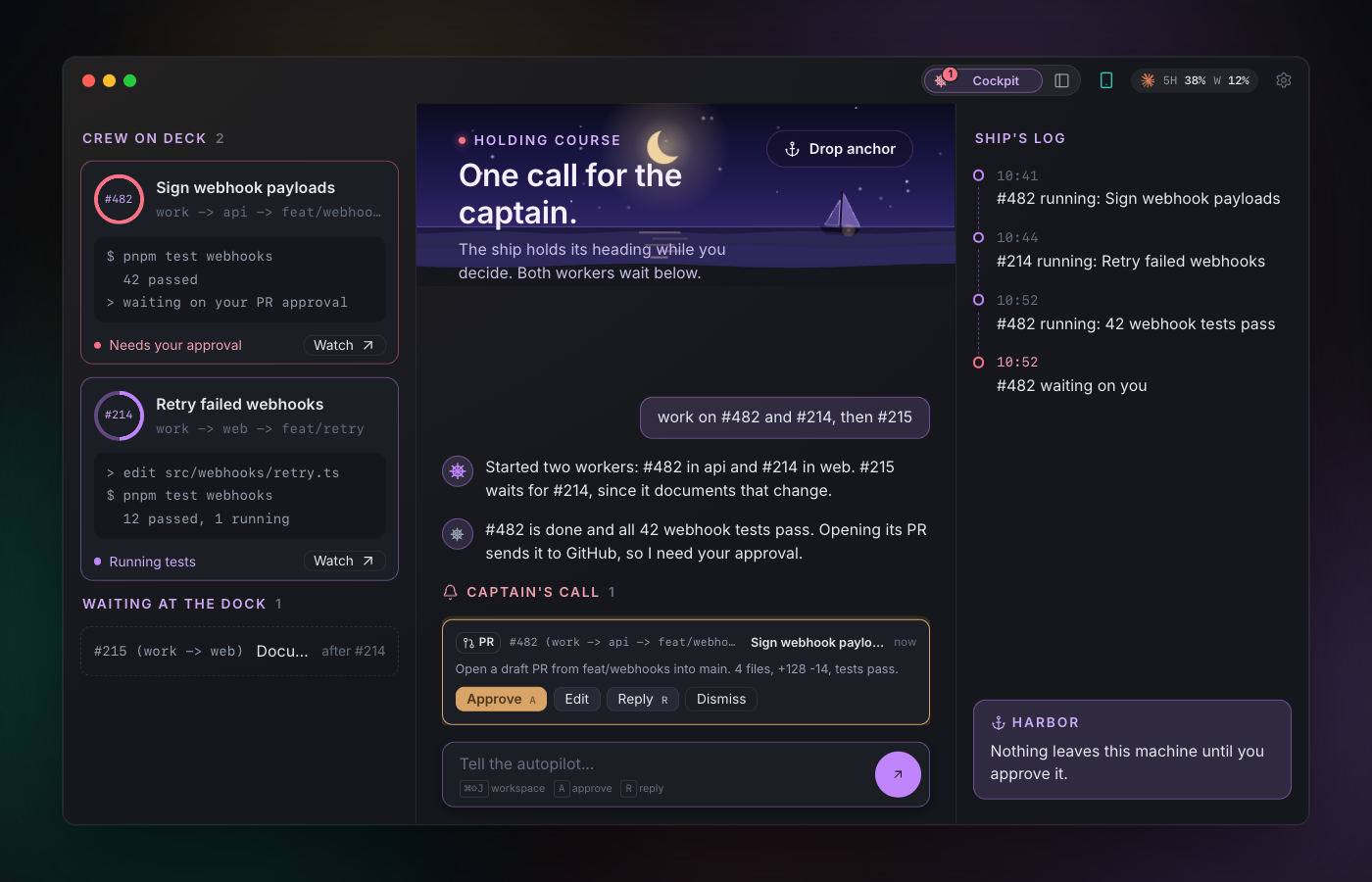
Autopilot. Hand it a list of tickets and it runs each one in its own
worktree with its own agent session, in the order their dependencies allow. It
stops and asks before anything leaves the machine, such as opening a pull
request, and a worker's permission prompts stay yours to answer.
Interface. Command palette (Cmd+K), quick open (Cmd+P), a shortcut
sheet on Cmd+/, and remappable hotkeys. Menu-bar tray, OS notifications, and
a dock badge for sessions that need you. Dark and light themes, and you can
import a VS Code theme file.
Supported agents
| Agent | Sessions read from | Status detection |
|---|---|---|
Claude (claude) |
~/.claude/projects |
Hook-driven, plus transcript and process state |
OpenCode (opencode acp) |
the agent, over ACP | The child process Tori started |
Gemini (gemini --acp) |
the agent, over ACP | The child process Tori started |
Tori drives the agent CLIs you have installed; it does not ship one. After
first launch, Settings > Agents shows which ones it found, at what version,
and what it can do with each - including what it cannot do with each, since
the three bundled adapters do not have the same capabilities.
Gemini ships untested. Nothing has measured it, Settings says so on its card,
and it is there because an ACP adapter is mostly launch instructions rather than
captured wire format. OpenCode is measured against opencode 1.18.3.
Adding another agent does not require a fork. Drop a TOML file into~/.config/tori/agents/ describing how to launch it. For an agent that speaks
the Agent Client Protocol that is the whole
file - four lines and no Rust, because the protocol carries the models, the
permission questions and the history itself. For one that does not, the TOML also
says where its transcripts live and how to spot a live process. The schema is
documented and stable at v2, and v1 files still load: see
ADAPTERS.md.
Settings > Agents also lists the ~40 other agents that speak ACP, read from
the official ACP Registry with
the command to launch each. Those are suggestions, not supported agents: Tori
has run none of them, each is labelled untested, and none can be started until
somebody writes its adapter - which is also the moment somebody decides it is
worth trusting.
An adapter that omits the optional [chat] table runs its agent as a PTY
tab, and that is the universal fallback: any CLI you can launch in a terminal
can be driven that way, with the session tree, checkpoints and the
working/needs-you dot around it. What a TOML alone cannot add is a transport
for a protocol Tori does not speak, or a parser for a transcript shaped unlike
claude's; both need Rust.
Shell tabs run your own login shell with your rc files intact; what Tori sets
in its environment, and how to keep a tmux auto-attach out of the tab, is in
docs/TERMINAL.md.
Install
brew install --cask gettori/tap/tori
The cask clears the quarantine flag as it installs, and brew upgrade --cask tori keeps it current. Otherwise download the latestTori_<version>_universal.dmg from the
Releases page, drag it into
Applications, then follow docs/INSTALL.md for the first
launch.
Tori is unsigned for now, so macOS will refuse to open it the first time. That
is expected. The fix is System Settings > Privacy & Security > Open Anyway,
or xattr -cr /Applications/Tori.app from a terminal. Both are written out
step by step in docs/INSTALL.md, along with updating and
uninstalling.
Requirements: macOS, on Apple Silicon or Intel (the DMG carries a universal
binary). Tori is developed and tested on macOS 15; the bundle sets no minimum
version, so older releases are untested rather than blocked. At least one agent
CLI installed. Node.js if you want the bundled TypeScript language server to
run.
Privacy
Tori sends no telemetry. There is no analytics, no crash reporting, and no
usage tracking of any kind. It makes two network requests on its own behalf,
both anonymous, both at most once a day, both silent on failure:
- GitHub Releases, to see whether a newer version of Tori exists. It never
downloads or installs anything. openrouter.ai/api/v1/models, for the published per-model context-window
sizes that the context meter reads. It is a public model list, unauthenticated,
and the response is cached to disk.
Nothing about you, your code, or your sessions is included in either. Use the
app offline to stop both.
Your agent's own traffic is its own. A chat tab runs the same claude on
your machine that you would run in a terminal, under your own subscription, and
that process talks to its vendor exactly as it always does. Tori starts it,
reads its output and writes to its stdin; it adds no endpoint of its own, proxies
nothing, and sees nothing the CLI would not already be sending. The same goes for
MCP servers: Tori reads and writes Claude's own config files, and Claude, not
Tori, connects to whatever they name. Git pushes and fetches go straight from
the system git to your remote.
Everything else is a plain file on your machine: preferences, spaces,
checkpoints, and adapter overrides under ~/.config/tori/, plus the cached
model list under ~/Library/Caches/tori/. Your agents' own transcripts stay
where the agents put them; Tori reads them and never modifies or uploads them.
Contributing
Issues are welcome: bug reports, feature requests and adapter requests. Pull
requests from outside the project are turned off for now, while one person
maintains it and the design is still moving. The reasons, the build steps for
a clean clone, and how to write an adapter are in
CONTRIBUTING.md.
Security
Found a way for a folder, a transcript or a document to run code it should not?
Report it privately, as SECURITY.md describes.
License
Apache-2.0. Third-party material is listed in NOTICE.
The licence covers the code. The name Tori and its logo are not part of it: a
fork is welcome, under a name and a mark of its own.
What that means if the project stops. One person maintains Tori and does
not take outside code, so it is fair to ask what you are relying on. The answer
is the licence, which cannot be withdrawn for anything already published: every
released version stays Apache-2.0 for good, and anyone may keep using it, build
it from source, or fork it and carry on. The worst case is a fork, not a loss.
Nothing of yours is held inside Tori either. As the Privacy section says, your
sessions are the agents' own transcripts and Tori's state is plain files under~/.config/tori/, so without Tori you lose a window onto your work and none
of the work.
Reviews (0)
Sign in to leave a review.
Leave a reviewNo results found