vitre
Health Pass
- License — License: MIT
- Description — Repository has a description
- Active repo — Last push 0 days ago
- Community trust — 11 GitHub stars
Code Pass
- Code scan — Scanned 10 files during light audit, no dangerous patterns found
Permissions Pass
- Permissions — No dangerous permissions requested
No AI report is available for this listing yet.
WebView automation for Kotlin Multiplatform. Run page workflows in an embedded WebView on Android, iOS and desktop, from your app, a test, or an LLM agent over MCP or Koog.
Vitre
WebView automation for Kotlin Multiplatform. Describe what you want done to a page as a list of
steps, then run it inside an embedded WebView on Android, iOS and the desktop: from your app, from
a test, or from an LLM agent over the Model Context Protocol or Koog.




val workflow = workflow("hn-top-story", "Hacker News top story") {
    navigate("https://news.ycombinator.com/")
    waitFor(".titleline > a", timeoutMs = 15_000)
    extract(".titleline > a", into = "headline")
    extract(".titleline > a", into = "url", from = Source.Attribute("href"))
}

WorkflowEngine(controller).run(workflow).collect { event ->
    if (event is WorkflowEvent.Completed) println(event.variables["headline"])
}
The same vocabulary is available four ways: as the Kotlin DSL above, as a Compose composable you
drop into a screen, and, for an agent that has never seen the page, as MCP tools or as Koog tools.
Those last two are two deliveries of one set of semantics rather than two implementations of them.
The block is a builder rather than a script. It runs once, up front, to assemble the step list thatWorkflowEngine then walks, so ordinary Kotlin control flow inside it chooses what the workflow
contains. It cannot branch on the page or on a variable an earlier step extracted. TheWorkflowStep constructors remain public and equivalent; they are what vitre-mcp uses, since
an agent's steps arrive as JSON rather than as Kotlin.
Why
Mobile apps already embed WebViews, and everything people want to do with them (read a page, fill a
form, talk to the page's own script, scrape a table, run four sites at once) ends up as one-offevaluateJavascript calls glued to a callback. Those calls race each other, they race the UI, and
none of it is shared between Android, iOS and the desktop.
Vitre makes the page something you can drive: one ordering guarantee, one step vocabulary, one
codebase for every platform, and a snapshot format an agent can read.
- The steps are declarative:
Navigate,LoadHtml,WaitFor,Click,Input,Extract,ExtractRows,Snapshot,EvaluateJs,PostMessage,AwaitMessage. - Elements are addressed three ways: CSS, XPath, and handles issued by a page snapshot.
evaluateJsreturns a script's result JSON-encoded on every platform, socontroller.evaluate<Boolean>(…)decodes it instead of comparing it against"true".postMessageworks in both directions, with an inbox so a message that arrives before you wait
for it is not lost. Payloads are typed on both ends:bridge.request<Ack, Token>(…)for a round
trip,decodePayload<Token>(…)for a workflow's.controller.cookiesreads, writes and clears the WebView's cookie jar, including theHttpOnly
cookie the site keeps its session in anddocument.cookiecannot see, with
host/path/Secure/SameSitescoping applied the way a request would apply it. Android and iOS
have this today; the desktop reportsnulluntil CEF's two jars are reconciled.- A lane pool drives up to four sites at once: one WebView per lane, one workflow engine each,
queued so six workflows on a two-lane device run three deep instead of losing four. vitre-mcpexposes the whole vocabulary as MCP tools over an in-process transport, andvitre-koogexposes it as native Koog tools with a plugin
that holds the page for the length of an agent run. Both read one set of semantics out ofvitre-agent, so neither can drift into telling a model something the other does not.- Every platform call is confined to the WebView thread and totally ordered, so the engine, your UI,
and an agent can drive the same page without special-casing each other.
Web is out of scope as a target. Browser CORS rules make a general-purpose web automation
framework impractical there; see docs/PLAN.md.
What it looks like
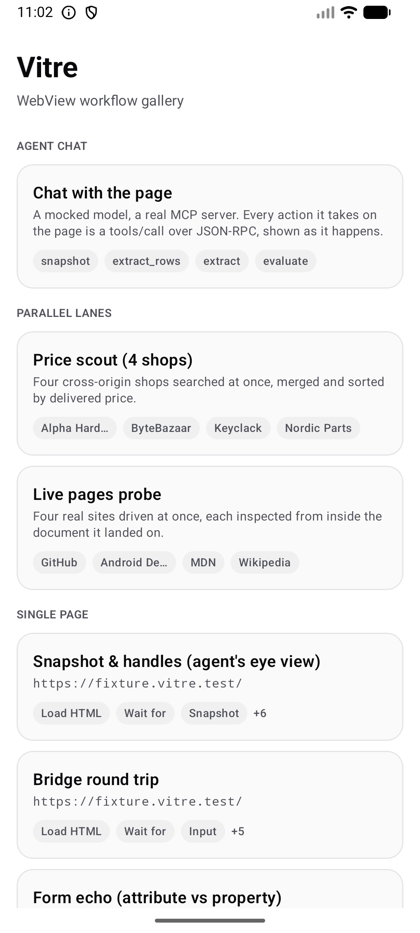
The sample gallery on Android. The same screens run on iOS and the desktop from the samecomposeApp; past 720dp wide the list and the runner sit side by side instead of taking turns.
 |
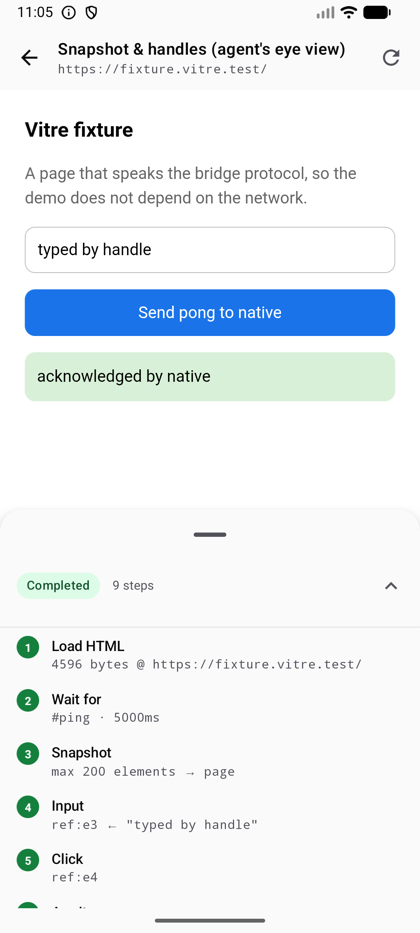 |
| The index. The agent chat, the parallel-lane scenarios, then one card per single-page workflow. | A workflow, run. The page on top, every step underneath with what it actually did. Steps 4 and 5 address elements by the handles Snapshot issued, not by selectors. |
 |
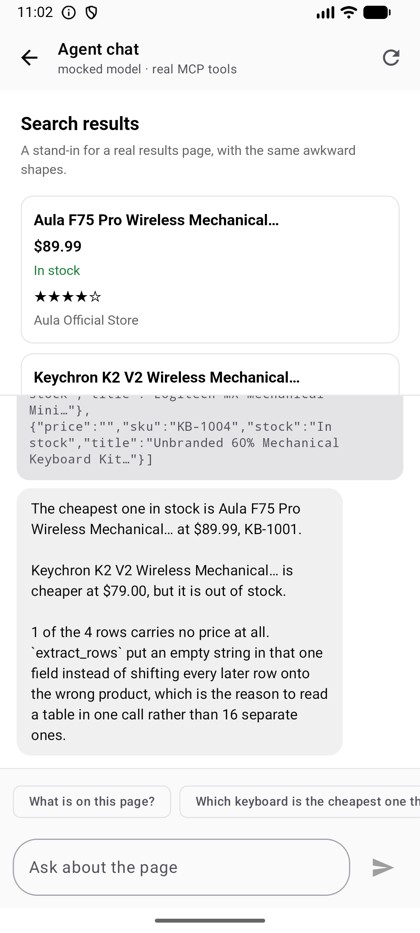 |
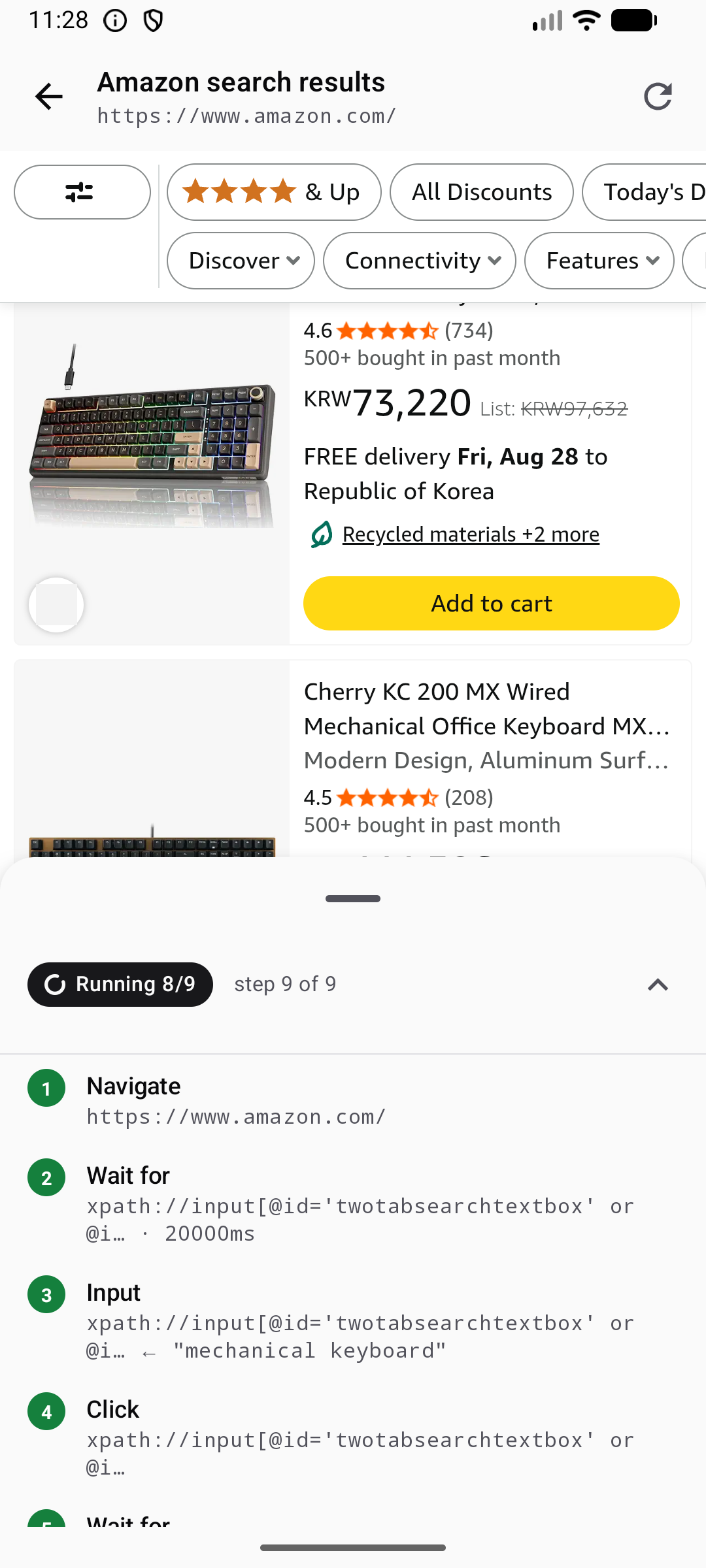
| Price scout. An example workflow to retrieve info from third-party websites. | Agent chat. A mocked model over a real MCP server: each action on the page is a tools/call, shown with the JSON that came back rather than hidden behind the answer. |
What each entry demonstrates is spelled out in
What's in the sample gallery; to run it yourself, see
Running the sample.
Requirements
| Kotlin | 2.3.10 (Multiplatform) |
| Android | minSdk 24, compileSdk 36 |
| iOS | 15.0+ (WKWebView) |
| Desktop | JVM 17+ on macOS, Linux and Windows (Chromium via KCEF) |
| UI layer | Compose Multiplatform, optional; vitre-core has no Compose dependency |
Installation
Published to Maven Central, so mavenCentral() in your repositories is all the setup there is:
// build.gradle.kts
kotlin {
    sourceSets {
        commonMain.dependencies {
            implementation("dev.ggoggam.vitre:vitre-core:0.1.0")
            implementation("dev.ggoggam.vitre:vitre-compose:0.1.0") // optional
            implementation("dev.ggoggam.vitre:vitre-mcp:0.1.0")     // optional
            implementation("dev.ggoggam.vitre:vitre-koog:0.1.0")    // optional
        }
    }
}
Or consume it as a source dependency: clone the repo next to your project, addincludeBuild("../vitre") to settings.gradle.kts and drop the versions above. If you vendor the
sources instead, add the modules directly with include(":vitre-core").
Quick start
Mount a WebView, take its controller, run a workflow against it:
@Composable
fun Screen() {
    val state = rememberVitreWebViewState("https://example.com")
    val controller = state.controller

    LaunchedEffect(controller) {
        val page = controller ?: return@LaunchedEffect
        WorkflowEngine(page).run(SampleWorkflows.ExampleDotComTitle).collect { event ->
            when (event) {
                is WorkflowEvent.StepStarted -> log("→ ${event.step}")
                is WorkflowEvent.Completed -> log(event.variables["title"])
                is WorkflowEvent.Failed -> log("step ${event.stepIndex}: ${event.message}")
                else -> Unit
            }
        }
    }

    VitreWebView(state = state, modifier = Modifier.fillMaxSize())
}
state.controller is null before the WebView mounts and null again after it leaves the composition,
so an effect keyed on it starts when the page arrives and tears down when it goes away, and nothing
runs against a dead WebView.
Example use cases
1. Read a page your app doesn't own
The smallest thing worth doing: navigate, wait for the element that means the page is ready, read
what you came for. Text is textContent; href is genuinely an attribute, so it is read as one.
workflow("hn-top-story", "Hacker News top story") {
    navigate("https://news.ycombinator.com/")
    waitFor(".titleline > a", timeoutMs = 15_000)
    extract(".titleline > a", into = "headline")
    extract(".titleline > a", into = "url", from = Source.Attribute("href"))
}
2. Pull a whole table out in one step
ExtractRows returns one JSON record per matching row, with each column resolved within that row.
That scoping is the point: a row missing a price yields an empty string in that record instead of
shifting every later record onto the wrong product.
extractRows(rows = xpath("//li[@data-sku]"), into = "results", limit = 10) {
    // "." is the row itself — read its own attribute.
    column("sku", xpath("."), from = Source.Attribute("data-sku"))
    column("price", xpath(".//span[@class='price']"))
    // Matched on the text a human reads, not on a class hook.
    column("stock", xpath(".//*[normalize-space()='In stock']"))
    // Up to the row and back down — CSS has no parent combinator.
    column("seller", xpath(".//span[@class='price']/ancestor::li[1]//span[@class='seller']"))
}
3. Talk to a page you do own (hybrid apps)
If the page is yours, the bridge beats scraping it. PostMessage sends aMessageEvent('vitre') into the page; AwaitMessage waits for window.vitre.postMessage
coming back. The inbox buffers, so a handler that posts synchronously on click is still matched by
an AwaitMessage that starts afterwards, which is the case that silently loses messages elsewhere.
@Serializable data class Ack(val seen: Boolean)
@Serializable data class Token(val value: String, val expiresAt: Long)

loadHtml(html = checkoutHtml, baseUrl = "https://app.example.com")
waitFor("#pay")
click("#pay")
awaitMessage(type = "payment-token", into = "token", timeoutMs = 5_000)
postMessage(type = "ack", payload = Ack(seen = true), id = "ack-1")
Payloads are classes rather than hand-typed envelope strings. id and type stay arguments because
they are protocol. The reply arrives in a variable, and the typing picks up again where the values
are:
if (event is WorkflowEvent.Completed) use(event.decodePayload<Token>("token"))
The split is deliberate. A workflow block is a builder: it runs once to assemble the step list, and
the steps run later, so there is no point in the block at which a reply could be returned to it.
When you want a round trip as one expression, you want the host API rather than a workflow.request posts, correlates the answer by replyTo, and gives it back typed:
val token: Token = controller.bridge.request<Ack, Token>("issue-token", Ack(seen = true))
Post-then-await does not race here either: the inbox buffers the reply from a page handler that
answers synchronously, which is the normal case, until the wait starts.
The same applies to a script's own result. evaluateJs hands back the JSON encoding of what the
expression produced, the one contract every platform was made to agree on, so a value read out of a
page can be decoded rather than string-matched:
val ready: Boolean = controller.evaluate("document.readyState==='complete'")
val rows: List<Product> = controller.evaluate("Array.from(document.querySelectorAll('li')).map(toRow)")
4. Search four sites at once
One WebView per lane, each loading its site as a top-level document, which is what keeps sessions
first-party and X-Frame-Options out of the picture. Hand the pool every workflow and it drains
them across however many lanes the device could carry.
var pool by remember { mutableStateOf<FramePool?>(null) }

VitreFrameHost(
    laneCount = 4,
    policy = InterceptionPolicy(handlers = shopFixtures),
    onPoolReady = { pool = it },
)

// Six workflows on a two-lane device run three deep — nothing is dropped.
pool?.run(shops.map { it.workflow(query) })?.collect { (taskIndex, laneId, _, event) ->
    if (event is WorkflowEvent.Completed) merge(event.variables["results"])
}
The sample's Price scout does exactly this: four synthetic shops at four distinct origins, merged
and ranked by delivered price, which for most of the catalogue is a different shop from the cheapest
sticker price.
5. Offline, deterministic page tests
A RequestHandler answers requests from memory, so a test drives a real WebView against a real
origin with no network and no flake. This is how the parallel-lane demo stays a usable smoke test.
val fixtures = RequestHandler { request ->
    when (request.host) {
        "shop-a.test" -> InterceptedResponse(body = shopAHtml.encodeToByteArray())
        else -> null // fall through to the network
    }
}

VitreFrameHost(policy = InterceptionPolicy(handlers = listOf(fixtures)), …)
Interception is real on Android and the desktop, which both let an application answer a request
outright: shouldInterceptRequest on one, CEF's resource pipeline on the other. iOS is the
exception, since WKURLSchemeHandler refuses to register for https, so fixtures there are served
from a private scheme and nothing can rewrite a response header. The failure modes are spelled out
in docs/PARALLEL-LANES.md.
6. Let an agent drive the page
Snapshot answers the question a hand-written workflow never has to ask: what is on this page? It
returns the interactive and text-bearing elements as an indented outline with a handle each, the
same information as the HTML at roughly a third of the tokens.
Vitre fixture — https://fixture.vitre.test/
heading "Vitre fixture" [ref=e1]
textbox value="typed by handle" [ref=e3]
button "Send pong to native" [ref=e4]
From there the agent names no selectors at all:
snapshot(into = "page")
input(handle("e3"), text = "typed by handle")
click(handle("e4"))
extract(handle("e5"), into = "status")
vitre-mcp puts that behind an MCP server: snapshot, navigate, click, type,wait_for, extract, extract_rows, evaluate, send_message, await_message, plusacquire_lease / release_lease for holding a page across several calls. The host registers its
WebViews and the server drives exactly those:
val sessions = WebViewSessions().apply { register("main", controller, "the shopping tab") }
val server = McpServer(sessions, scope)
val transport = InProcessMcpTransport(server)
It ships an in-process transport only, on purpose: a loopback socket would expose page automation to
anything on the device that can reach the port, and on a WebView signed into the user's accounts
that leaks the session, not merely the automation. See docs/MCP.md.
7. Give a Koog agent the same page
If the agent is written with Koog, vitre-koog hands it the
same thirteen tools as Kotlin objects, with typed arguments, no server, and the same names, so a
system prompt written for one adapter works against the other:
val driver = PageDriver(sessions, scope)

val agent = AIAgent(
    promptExecutor = executor,
    llmModel = OpenAIModels.Chat.GPT4_1,
    systemPrompt = PageToolDocs.INSTRUCTIONS,
    toolRegistry = ToolRegistry { vitreWebView(driver) },
)
A host that already runs the MCP server can bridge that instead. vitreMcpToolRegistry(server)
reads tools/list and translates the schemas, so there is one description of the toolset rather
than two. Point the typed tools at server.driver if you want both against one lease registry.
The plugin is VitrePageLease. Ordering already stops two callers corrupting each other's
individual steps, but it cannot make a sequence indivisible, and an agent is nothing but sequences.
A user tapping "next page" between the agent's wait_for and its extract yields a price read off
the wrong page, with every operation correctly serialised. acquire_lease fixes that, at the cost
of requiring the model to remember to use it. The plugin takes the lease itself, for the length of
the run, and the model never sees it:
val agent = AIAgent(
    promptExecutor = executor,
    llmModel = OpenAIModels.Chat.GPT4_1,
    systemPrompt = PageToolDocs.INSTRUCTIONS,
    // Lease tools off: the run already holds the page, and a model that asks for it again is
    // queueing behind itself until its own lease expires.
    toolRegistry = ToolRegistry { vitreWebView(driver, includeLeaseTools = false) },
) {
    install(VitrePageLease) { driver = pageDriver; ttlMs = 120_000 }
}
The lease is bounded by a TTL, because the page is held while the agent waits on an LLM, and a
WebView the user can see is a UI that has stopped responding to its own app. See
docs/KOOG.md.
Locators
Every element-addressing step takes a Locator: css("#results .item"), xpath("//li[@data-sku]")
or handle("e7"). A bare string still means CSS.
| Use it for | |
|---|---|
css(…) |
The common case. Short, familiar, fast. |
xpath(…) |
Matching on visible text, walking up the tree with ancestor::, selecting an attribute as a node, positional predicates, count(). |
handle(…) |
Addressing an element a Snapshot already found; the agent's locator. |
Neither CSS nor XPath pierces shadow DOM; that is the page's doing, not the query language's.
A handle is the third kind and behaves differently by design: the other two describe how to search,
a handle names an element. It is issued by the page, dies with the document that issued it, and is
never recycled, so a handle from the previous page fails loudly instead of resolving against a
same-shaped element on the new one.
Threading
A WebView owns a thread, the platform main thread, and that is not negotiable: WKWebView is UIKit,
and an Android WebView must be used on the thread that built it. So callers do not synchronise
with each other, they queue. One object, WebViewSerializer, confines every platform call to that
thread and totally orders them, which is what lets the workflow engine, the UI, and an agent drive
the same page without special-casing each other. The engine itself runs on Dispatchers.Default and
never sees the WebView thread.
See docs/CONCURRENCY.md for the model and the bugs it fixed.
Modules
| Module | Purpose |
|---|---|
vitre-core |
Pure KMP library: workflow DSL, engine, bridge protocol, WebViewController actuals, lane pool, network interception. |
vitre-compose |
Compose Multiplatform layer: VitreWebView and VitreFrameHost. |
vitre-agent |
What every agent adapter shares: PageDriver, the session registry, leases, and the prose each tool is described to a model with. |
vitre-mcp |
MCP server over one or more WebViews: JSON-RPC, tool schemas, transport. |
vitre-koog |
Koog tools over the same WebViews, plus a bridge for an MCP server you already run and a plugin that leases the page for an agent run. |
sample/composeApp |
Shared sample UI: a workflow gallery demonstrating the library. |
sample/androidApp |
Sample Android launcher hosting composeApp. |
sample/iosApp |
Sample iOS Xcode project hosting composeApp via the KMP framework. |
sample/desktopApp |
Sample desktop launcher hosting composeApp, with the KCEF startup gate. |
Building
mise install            # ktlint (mise.toml) + the android CLI (mise.local.toml)
mise run test           # library + sample allTests
mise run test:android   # the on-device Koog agent test (needs a device or emulator)
mise run build          # library artifacts + Android sample APK + iOS debug framework
mise run lint           # ktlint
mise run fmt            # ktlint --format
A JDK is not declared in mise.toml. Gradle uses whatever JDK is on your machine, and the
toolchain is resolved via foojay. CI installs its own from mise.ci.toml. mise run wrapper
regenerates the Gradle wrapper and is the one task that needs a system gradle; you only need it
when bumping Gradle.
Running the sample
mise run dev:android    # build + install + launch on a phone, or boot an AVD
mise run dev:ios        # build + install + launch on a simulator
mise run dev:desktop    # build + launch the desktop window
All three build and launch in one step, so none of them needs Android Studio or Xcode open.dev:android prefers a plugged-in device over an emulator and boots the first AVD if nothing is
attached; dev:ios reuses a booted simulator, or set VITRE_SIM to pick one by name. They
live in mise.local.toml (dev only, and CI never runs them). mise run android:install is the
plain fallback: gradlew installDebug onto whatever adb already sees, without the android CLI.
You can also open sample/iosApp/iosApp.xcodeproj in Xcode and hit Run, since the target's "Compile
Kotlin Framework" phase builds the KMP framework first either way.
dev:desktop is the odd one out on first run: unlike a WebView, Chromium is not already on the
machine, so KCEF downloads and unpacks a bundle of a few hundred megabytes into~/.vitre/kcef-bundle before the gallery appears. The sample shows that as a progress screen
and it happens once per machine; later launches go straight to the window.
What's in the sample gallery
The gallery opens on the agent chat: a WebView with a conversation under it, where every action on
the page arrives as an MCP tool call and the calls and their results are shown rather than hidden
behind the answer. The model is mocked, with no LLM API and no key, but nothing downstream of it is.
Each turn issues a real tools/call over JSON-RPC and the answer is computed from what came back.
One scripted exchange guesses a CSS selector that does not match, so the transcript shows a tool
failure arriving as an isError result the model reads and corrects, rather than as an exception
that ends the run.
Below it are two parallel-lane scenarios: Price scout (four synthetic cross-origin shops, ranked
by delivered price) and Live pages probe (four real sites, reporting from inside each, including
whether a cross-origin fetch got through).
Then the single-page workflows. Two of them drive a page the sample ships, loaded straight into the
WebView with no network. Those are the only ones that can demonstrate the bridge at all, sinceAwaitMessage waits for window.vitre.postMessage and no third-party site will ever call it, and
they double as the smoke test: a failure means the library broke rather than that a website was
redesigned. The other two hit the live web to show the same steps against real pages, and are the
ones that will eventually rot.
Releasing
VERSION_NAME in gradle.properties is the released version, and the only place it is written
down. Changing it on main is the release, so a release is a reviewable pull request like anything
else, and what reaches Maven Central is the value someone approved:
 # gradle.properties
-VERSION_NAME=0.1.0
+VERSION_NAME=0.2.0
Merging that fires .github/workflows/release.yml, which runs the
full CI suite against the merge commit, publishes all five library modules to Maven Central as one
atomic deployment and releases it, with no button to press afterwards. Only then does it tag the
commit v0.2.0 and open a GitHub release for it, with notes generated from the pull requests merged
since the last one. The tag records a release that happened rather than causing one; pushing one by
hand publishes nothing.
A version with a prerelease component (0.3.0-rc.1, 1.0.0-beta.2) publishes to Maven Central
like any other, but its GitHub release is flagged so it does not show up as Latest.
gradle.properties also holds Kotlin, Gradle, Android and POM settings, so most edits to it are not
releases. The workflow diffs VERSION_NAME against the previous commit and exits quietly when it
has not moved. It refuses outright, before Gradle starts, on a malformed version, on the0.0.0-LOCAL placeholder, and on any version already tagged, because a Maven Central version can be
superseded but never withdrawn.
It publishes from macOS because the iOS targets need it: Kotlin/Native only builds Apple klibs on a
Mac, and on Linux they are skipped silently rather than reported, which would ship module metadata
advertising variants that are not there.
Publishing needs four secrets on the repository's maven-central environment: a
Central Portal user token for the verified dev.ggoggam namespace,
and a GPG key to sign with.
| Secret | What it is |
|---|---|
MAVEN_CENTRAL_USERNAME / MAVEN_CENTRAL_PASSWORD |
Central Portal user token, from Account → Generate User Token. Not the portal login. |
SIGNING_IN_MEMORY_KEY |
The armoured private key: gpg --armor --export-secret-keys <key-id>, newlines included. |
SIGNING_IN_MEMORY_KEY_PASSWORD |
That key's passphrase. |
SIGNING_IN_MEMORY_KEY_ID |
Only needed if the exported ring holds more than one key; leave unset otherwise. |
The public half has to be on a keyserver Central checks (gpg --keyserver keyserver.ubuntu.com --send-keys <key-id>), or validation rejects every signature.
To try the modules from another project without releasing anything, mise run publish:local puts
them in ~/.m2 at whatever VERSION_NAME currently says.
Documentation
| Doc | What's in it |
|---|---|
| docs/PLAN.md | Architecture, module layout, bridge design, the TDD use-case matrix. |
| docs/CONCURRENCY.md | The threading model, the bugs it fixed, how MCP slots in on top. |
| docs/PARALLEL-LANES.md | Lanes, interception, CORS, the traffic tap, platform differences. |
| docs/MCP.md | Tool list, handle lifetime, leases, protocol and transport decisions. |
| docs/KOOG.md | The Koog tools, the MCP bridge, the lease plugin, and why the semantics sit under both adapters. |
| docs/ASYNC-BRIDGE.md | The postMessage bridge protocol end to end. |
Contributing
Issues and pull requests are welcome.
mise install
mise run fmt:check      # ktlint, same check CI runs
mise run test
The repo uses prek pre-commit hooks (mise run pre-commit), and
ktlint with the official Kotlin code style. A few conventions worth knowing before you send a patch:
- Comments explain why. Much of this codebase's value is in the reasoning recorded next to
non-obvious decisions: platform seams, ordering guarantees, failure modes. Keep that up. - Tests come first for anything in
vitre-core. The engine, bridge and pool are covered bycommonTestagainst a fake controller; a behaviour change should show up there before it shows up
in a WebView. - Both platforms or neither. If a change can only work on one, say so where a caller will read it,
the way interception does.
License
MIT © 2026 Joon Kwon
Reviews (0)
Sign in to leave a review.
Leave a reviewNo results found