specagent
Health Uyari
- License — License: NOASSERTION
- Description — Repository has a description
- Active repo — Last push 0 days ago
- Low visibility — Only 5 GitHub stars
Code Gecti
- Code scan — Scanned 12 files during light audit, no dangerous patterns found
Permissions Gecti
- Permissions — No dangerous permissions requested
Bu listing icin henuz AI raporu yok.
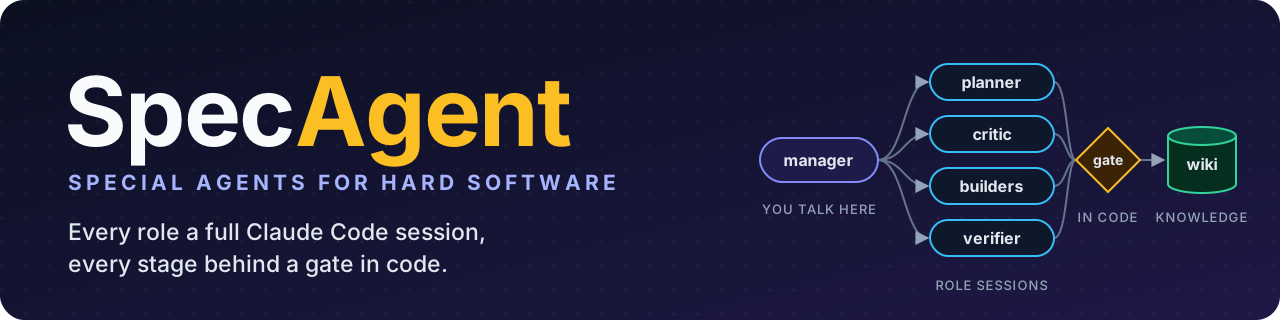
SpecAgent Pro Template: a project template, not a plugin. Special agents for hard multi-package software: every role a full Claude Code session run by a manager chat, not a subagent; gates in code, proof for every finding, one unit per session, cost measured per role. A private vault per user, one public commons.
SpecAgent Pro Template
SpecAgent Pro Template: a project template, not a plugin. Special agents for hard software, every role a full session. An agentic system of its own design for
hard, multi-package projects, built by its own pipeline and measured run by run. You talk to one manager chat; it runs
every role as a full Claude Code session, never a subagent. A stage moves on only through a gate in code, a finding
counts only with its proof, and each session does one unit of work, then hands a note of facts to a fresh one. Every
user keeps a private vault, a page goes to a public commons only past checks in code (its repository is not built yet),
roles never learn a model or an author, and the sandbox sets itself up. One command makes a new project with all of it.
Quick start · How it works · Measurements ·
Against subagents · Why it is built this way · Every document
Why this is different
Running several Claude Code sessions side by side is not new: tmux scripts and CLI parallelizers hand each session a
task and collect the result. SpecAgent adds the whole loop around full sessions, each part with its evidence:
- Every role is a full session, run by a manager chat, with every demand a subagent would get for the same job
(ADR-0006) and its own context, worktree, sandbox and transcript. The usual way: subagents in one parent
context, not resumable from another session (ADR-0001). - The manager chat does what the sandbox refuses the roles: it launches sessions on your yes and stops them, merges
in any worktree, reads transcripts to measure every run and itself, and pushes the vault
(page). - Every role starts from a brief:
harness launchanswersno_assignmentuntil the stage's assignment is written. - A stage moves on only through a gate in code, three rounds per finding at most, then a rule decides
(skill). The usual way: the model says it is done. - A finding counts only with its proof, or it goes to "To check"; the eval case
pipeline-critic-unproven-findingfails a finding
without proof. - One cycle to a product: after your one yes at the launch, nothing inside the cycle waits for a human or a second
cycle: findings are fixed inside the cycle by the role that owns them, and the planner fixes the plan for every
later task (skill, why). The pipeline-economy run of 2026-10-30 wrote its spec, built it, verified it and was
merged (cb60f5b) in 3 h 12 min: 22 sessions, 1 finding fixed inside the run, 0 escaped to the gate; the
obsidian-ingest run built 5 units and fixed its 5 findings inside the run (private measurement pages2026-10-30-pipeline-economy,2026-10-30-obsidian-ingest). Both ended with the full gate (1,874 and 1,840 tests
passed); neither launched a judge. - Small contexts: a session compacts near 197k instead of handing over (2026-11-01); before the cap without the cap calls grew to 500-740k tokens, three
times the cost of a fresh session (2026-10-15, cost). The usual way: one long context, re-read on every call. - The run lives in files a human reads: a fresh session goes on from them, and the watcher revives a stopped one
(scripts). - Every role is measured:
usage_report.pyprints, per role, its sessions, calls, average context per call and
cost (scripts). - A private vault per user; a page goes to a public commons only past checks in code (
ops/contribute.py; the
commons repository itself is not built yet, decision). - A new project starts with the rules already learned:
ops/new-vault.pyseeds its vault with the template's
global pages (30 at 1.8.0: 27 standing orders and 3 lessons, each lesson with its proof page; 4 measurement pages),
carried from the owner's vault byops/sync-vault-globals.py, which refuses a page with a model name, a private
marker, a dangling link or more than 4,000 bytes (ops/check_pages.py; migrations). - A project updates by copying, not by a run: from 1.8.0 a migration entry names every template-owned path that
changed (a test fails when a commit leaves one out) and its steps are the copy and the checks, no hand-merge, no
role. The 1.7.0 carry of a project was a run of 10 sessions, $30.60 and 1 h 41 min; the 1.8.0 carry is a copy. - The manager chat is held to rules in code and in its page: a project's work runs through the pipeline skill, never
through stage runs by default; the pre-flight refuses a critic with no planner to answer it; the manager does no
role's work and writes to you only for a decision, a problem or a milestone
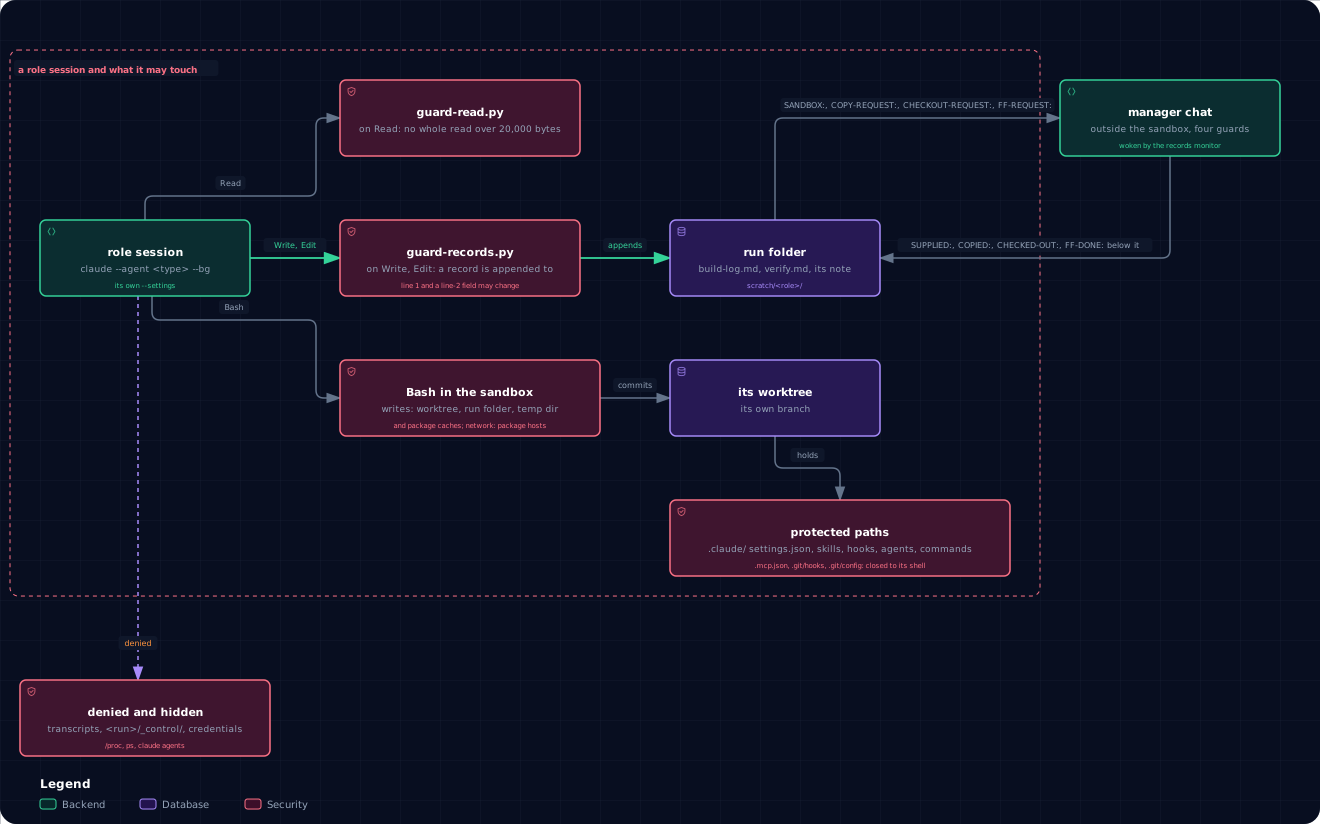
(page,ops/tests/test_pipeline_choice.py). - Roles are blind to models and authors: their settings and sandbox deny the transcripts, the control files, the
hand-over notes and/proc(decision). - The sandbox sets itself up, one password per machine at most
(ADR-0013); a refused step is oneSANDBOX:
line, never a workaround (decision).
A subagent vs a SpecAgent role session: the scope, 15 properties side by side with their
evidence, what a role session can do and a subagent cannot, and the measured numbers.
How it works
How it works, step by step: one run of the pipeline skill start to end, each step with the file
it writes.
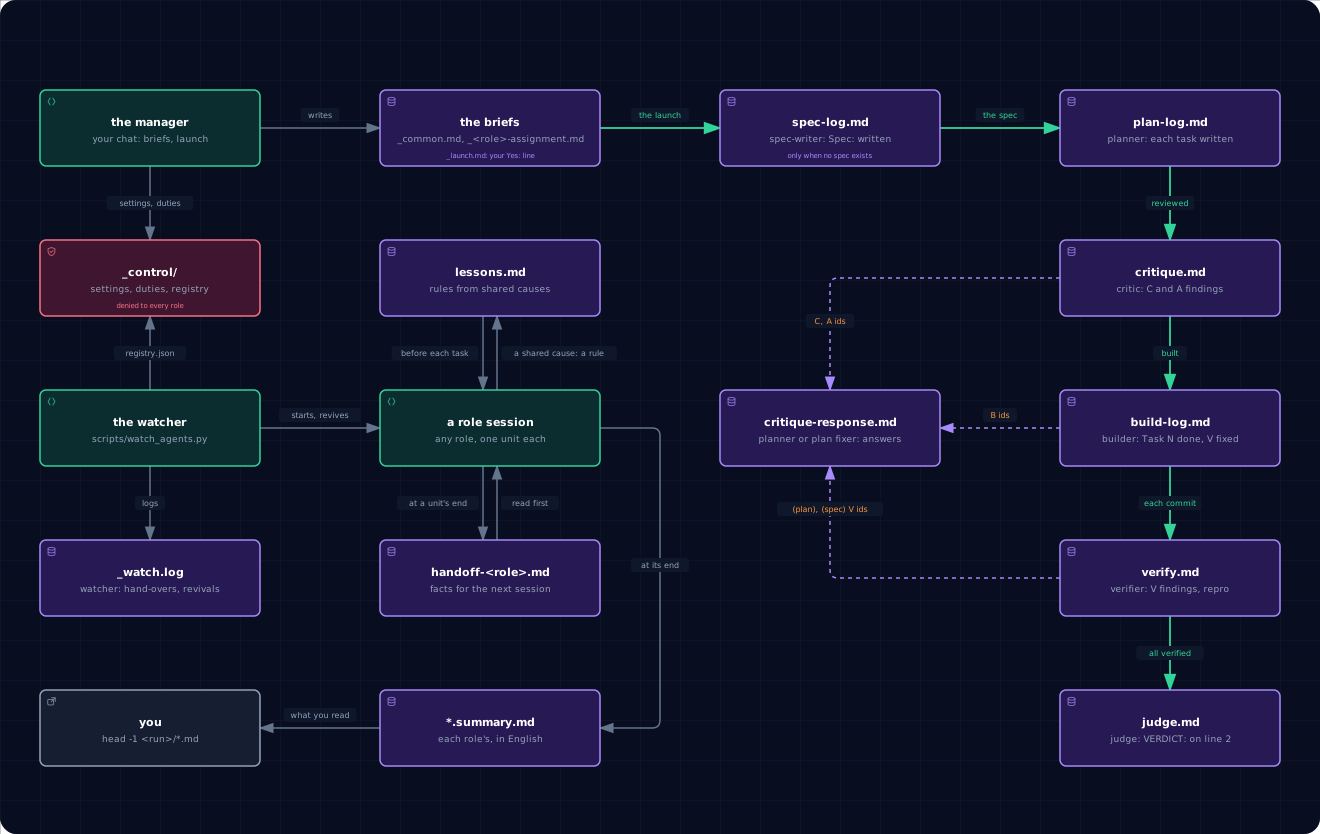
The pictures below are drawn by the archify skill from docs/assets/src/,
beside their Mermaid text.
Where everything lives: each folder, what it holds and why it is there.
The harness's eight pipelines: the same loop from stage tables.
The run loop
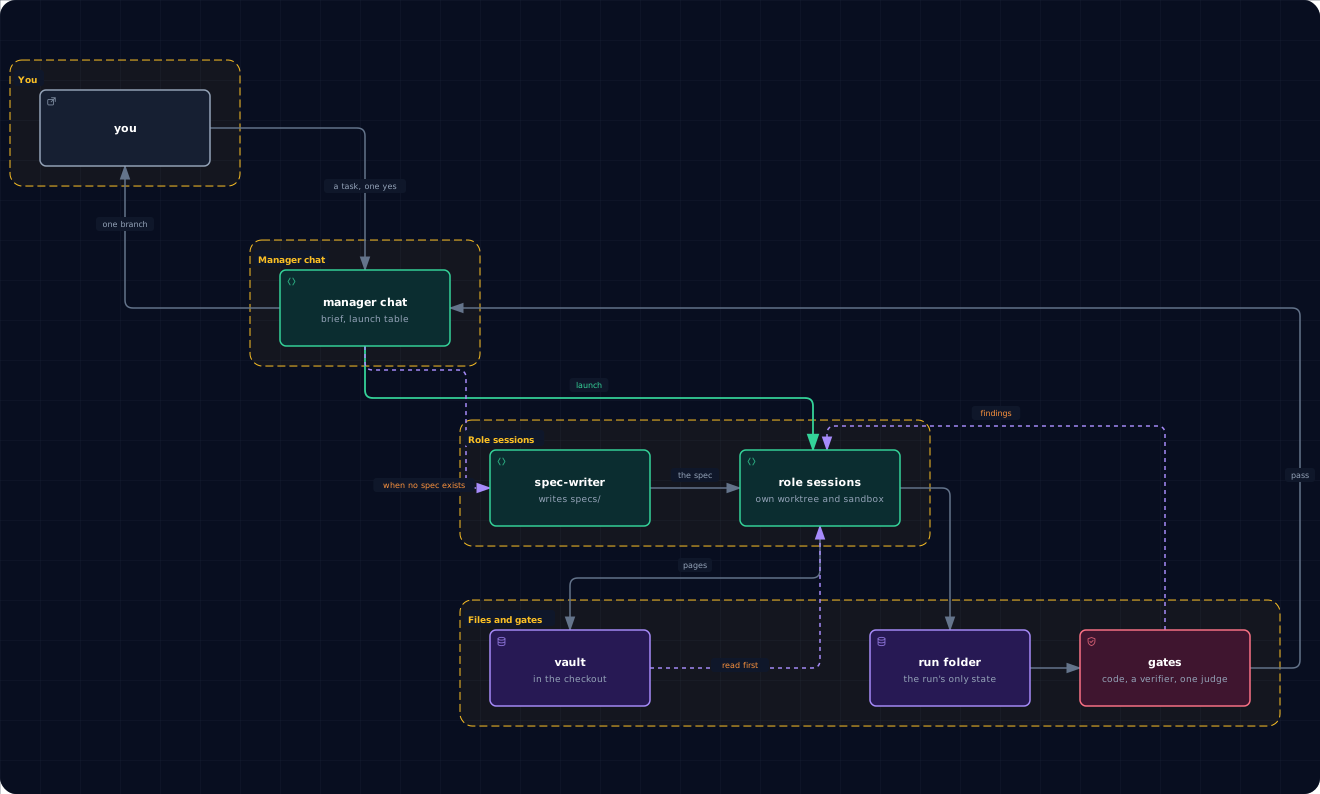
You talk to one manager chat. It writes the briefs and a facts pack, puts a launch table before you (each role,
its settings, its cost estimate) and takes your one yes (decision);
then it starts the role sessions in the background, each in its own worktree and sandbox, in order: the
spec-writer only when no spec exists (spec-writer), the planner ⇄ the critic, a plan fixer on demand, the
builders, the verifier. Along the way the watcher replaces a session after its unit with a fresh one, through a
hand-over note, and a role asks the manager in its record for what its sandbox refuses. Last come one judge and
the gate that merges the run's one branch; the run's numbers go to your private vault, its decisions to the vault
in the checkout, then to yours. Roles write records in the run folder, the run's only state; gates (code, a
verifier, the judge) send findings back to their author but keep a judge's major or minor for you.
The manager chat
The manager chat, the pipeline skill's main session
(decision), runs without the sandbox behind four
guards: the permission rules, the auto-mode classifier, your launch rule, and no project code or tests run by itself. It
answers a role's refusal by supplying the path, host or material into the run folder, never by weakening a sandbox.
Before a run come the size rule (a pipeline only when one context cannot hold the work), the pre-flight, the launch
table and your one yes; during it, the records monitor, the surface (surface.py), whose figures its status answers
copy as printed, never computed, and orders a role acknowledges with ACK <msg_id>. It asks you only about agent
launches, destructive or irreversible actions, merges into main and spending, and decides the rest with its assumption
stated. It measures every run (score_run.py, decision) and itself (measure_manager.py) and appends each of
its mistakes, with its measured cost, to a lessons page in your vault that every main session reads in its first calls.
The roles and their records
A long change runs as sessions of the pipeline skill, each in its own worktree
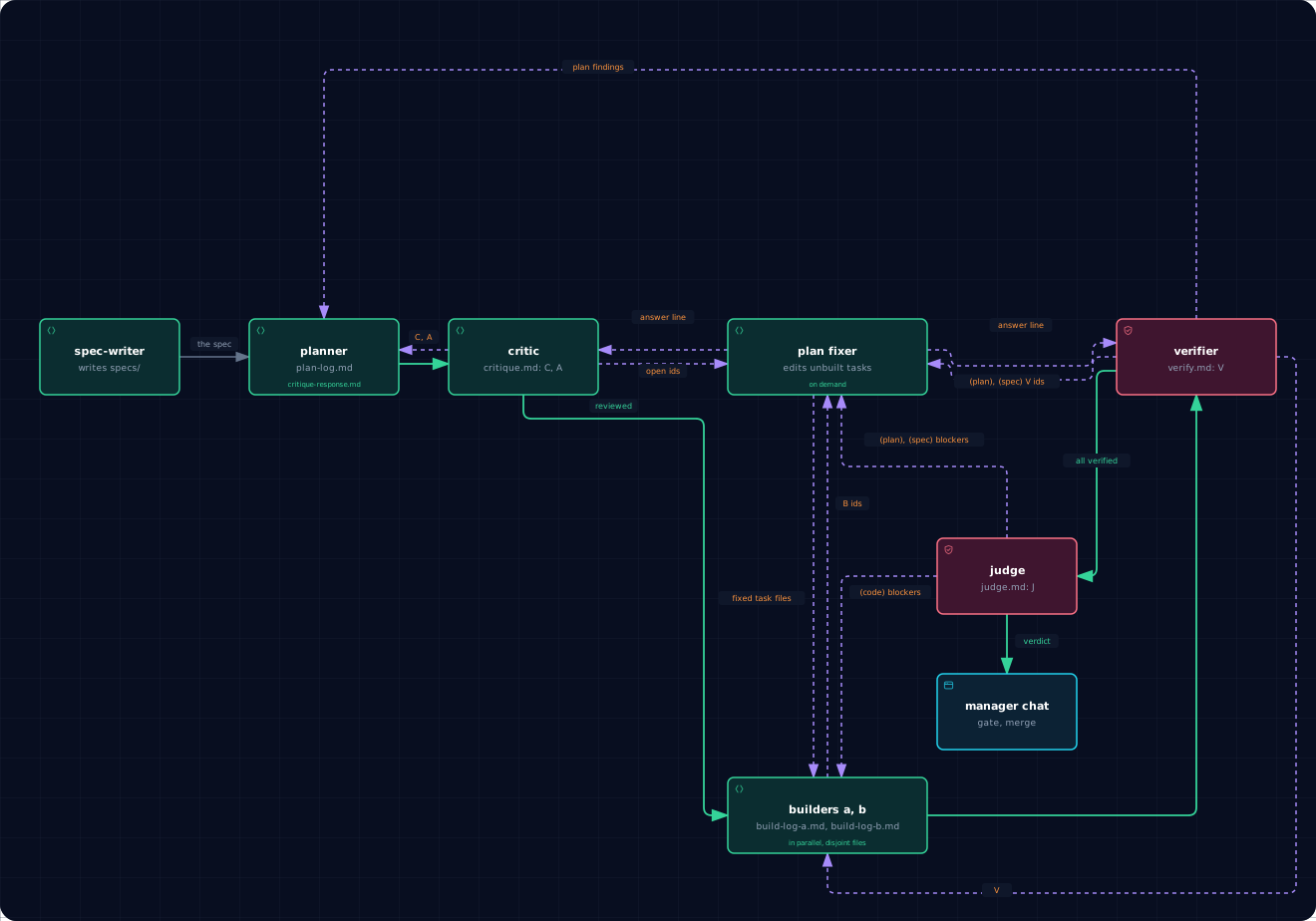
(decision). When no spec exists, the
spec-writer writes it first, in specs/, as a one-page skeleton. The planner puts the flesh on it, writes each
task and answers its findings (plan-log.md,critique-response.md); the critic makes one coverage round per task (critique.md: C and A findings). Two
builders take reviewed tasks on disjoint files, tests first, one commit per task (build-log-a.md,build-log-b.md). The verifier reads each commit's diff and re-runs its checks (verify.md: V findings). A script
starts the judge once every task is verified (judge.md); it reads the diff and the reports and blocks only with
proof. Its verdict goes to the manager chat, which merges at the gate: a red gate goes back to the builder as a finding,
a green one is merged and pushed. Every finding has an id and goes back to its author (a judge's major or minor stays injudge.md for you), a plan-caused one, whoever finds it, to the planner or a plan fixer launched on demand when
open ids pass a count or an age. The fixer fixes the plan for that task and every later one: it sends the fixed task
files to the builders and an answer line to the critic or the verifier, whichever raised the id, which re-checks and
closes it (<id>: fixed or closed). After three rounds a rule decides: the spec and recorded decisions win, else the
safer option.
A session's life
A session starts with its lane's frozen pack in the system prompt (its brief, the hand-over rule, lessons.md's "Read
first"), reads the facts pack its brief names and nothing else until a step asks; a waiter tells it when its input is
there. It works unit after unit (a task written, reviewed, built or verified) and leaves records: a commit, Task N: done — <sha>, a STATUS: line, answers, and the facts its next step needs. Near 197k it compacts itself and goes on.
A hand-over note (at most 40 lines of facts, hand-over rule) is written only on the watcher's order: past
250k, for a model change or for a stuck session; the watcher then starts a fresh session at the note.
The knowledge layer
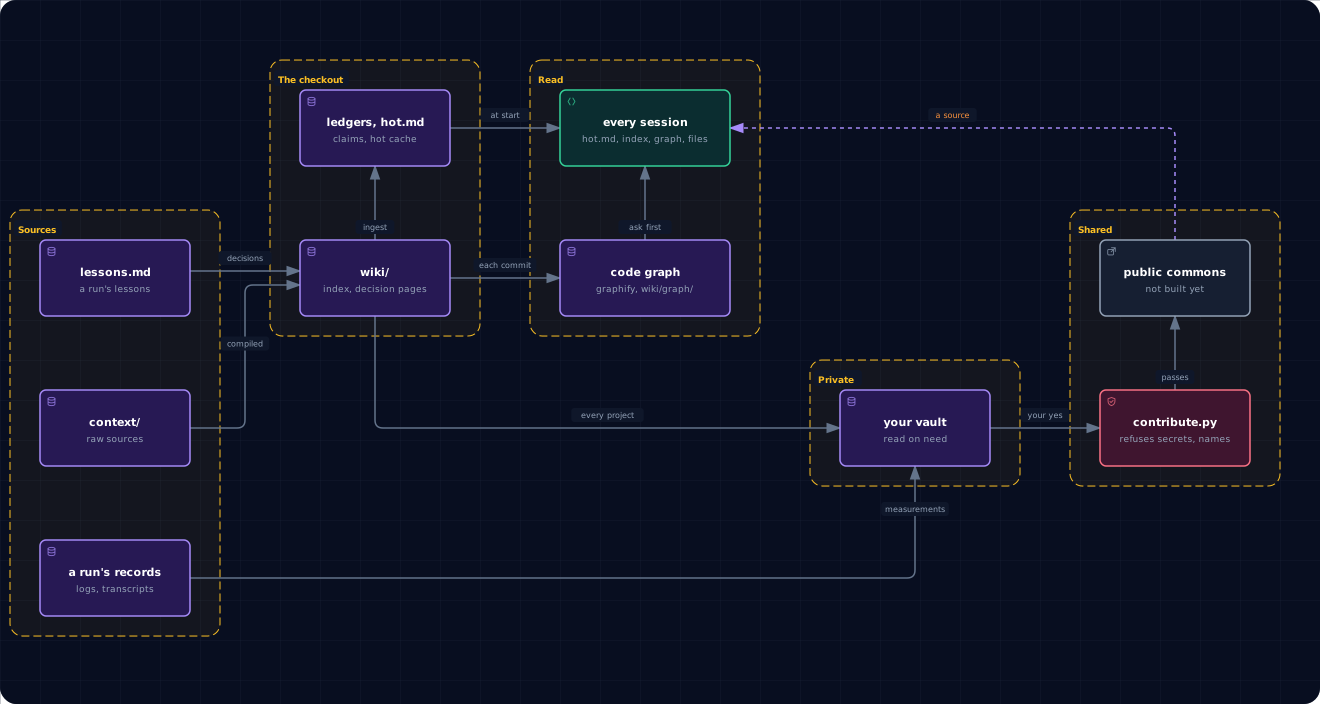
The wiki is compiled from context/; a run's lessons become decision pages in wiki/decisions/, written with the work.
The checkout is a claude-obsidian vault (decision): ops/obsidian-ingest.py ingests each page through the
plugin into its claim ledgers, and the plugin injects wiki/hot.md (at most 500 words) into every session. A session
then reads wiki/index.md, the page it needs, the code graph before any whole directory, then files
(docs/architecture/knowledge.md); git hooks refresh the graph from the repository at each commit (just graph in
full), layered in wiki/graph/, never committed
(decision). A decision for every project
goes to your private vault, and so do each run's numbers (how); it is read on need,
never written by a role, and where they differ, a brief wins over it
(decision). With your yes for one page, ops/contribute.py
refuses a private path, a secret, a name or a letter of the Unicode blocks it lists, naming the class, writing nothing;
a page that passes becomes a pull request (candidate), a rule once a second origin confirms it. What comes back is a
source, never an authority: your vault wins (decision; not built yet: the commons repository and its review, a
critic session per page).
Why it is good
The system keeps its own record. A commit that changes code adds or changes a page under wiki/, docs/runbooks/ ordocs/decisions/, or its task says docs: none — <reason>; the write gate fails a branch that does neither, and a
changed decision is a new page (decision). Every claim in the
vault has its source: on 2026-10-30, 40 decision pages, 40 captured sources, 170 claims (decision).score_run.py measures every run the same way: findings per task by kind, sessions and hand-overs per role, cost per
task and per role (decision). The template checks itself: 1,840 tests passed at the merge gate of 2026-10-30
(uv run pytest -q), with harness validate, docs-check, claude plugin validate ./plugins and the vault's lint.
Every file is English, and harness validate refuses a letter of
the Unicode blocks it lists (decision).
How it saves time
Each role starts as soon as its input is ready: a waiter script polls once a minute and wakes its session, so waiting
costs no tokens, and nothing starts on speculation: a builder waits for its task's coverage round (scripts). Nothing
waits for you: you say yes once, before the run; AskUserQuestion is denied, a dispute after round three is decided by
rule, a doubtful item is held and logged (why). Work runs side by side:
planner lanes, two builders on disjoint files, the verifier checking each commit while the next is built. The watcher
(watch_agents.py) hands a session over at a unit's end past 150k or at the cap and restarts a stopped one, without
loss and without a human (scripts). On 2026-10-30 the template's own build ran 8 tasks in 2 h 22 min, the ingest 5
units in 2 h 15 min (the table below).
Where it saves money
A session compacts near 197k instead of handing over (next section); no cap costs twice as much, and a 300k cap cost
15-25% more per task over 269 sessions (cost, hand-over rule). A session reaches 81k tokens after ten calls, 84% of the growth
tool results, so a session keeps its standing orders in its system prompt and compacts the rest (cost). The manager sets one
of three model classes per role in a settings file no role reads: for the spec, the class the owner ordered
(decision); judgment for a role whose mistake is
expensive (the planner, critic, verifier, judge); mechanical for work that code or a verifier checks (the builder)
(skill).
Time and money: the cache, a session's start, reading on need, what quality costs, a third run,
with sources.
The cache and the context
Most of what a role's session costs is reading its own context again: every call sends the whole conversation, so a
session at 150k tokens pays for 150k tokens on each call. The prompt cache makes that repeated read cheap, and the rules
below keep a session inside the cache for its whole life (owner, 2026-11-01). Every number here was measured on a
project's two runs of 2026-11-01 and is priced with the strongest model class's rates.
How the prompt cache works. On each call the API looks for the longest exact prefix of the request that it has
seen recently. That prefix is read from the cache at a twentieth of the input price; whatever follows it is written to
the cache, at more than the input price. The match is byte for byte: one changed byte ends it, and everything after
that byte is written again. A cached prefix lives 5 minutes from the last call that read it, and each such call starts
the 5 minutes again; a 1-hour cache exists too, at a higher write price.
| Per 1M tokens | Price |
|---|---|
| input, not cached | $4.00 |
| read from the cache | $0.20 |
| written to the 5-minute cache (1.25 × input) | $5.00 |
| written to the 1-hour cache (2 × input) | $8.00 |
| output | $20.00 |
So a 150k context costs $0.03 to read from the cache, $0.75 to write again into the 5-minute cache, and $1.20 into the
1-hour one. Whatever keeps the prefix the same and the cache alive is worth money on every call.
The pack: standing orders in the system prompt. A request is sent in a fixed order: the tools, the system prompt,
then the messages. Each lane (one role line of a run) gets one pack: _common.md, the role's brief, the first-pass and
hand-over rules and the "Read first" section of lessons.md, built once by make_pack.py before the lane's first
launch and passed with --append-system-prompt-file. The pack is frozen for the run: a changed pack stops the
watcher, and a lesson or an order added later goes after it, into lessons.md with its date or a message. So every
session of a lane, the first one and any later one, starts with the same bytes and reads the pack from the cache
instead of reading the briefs with tools and writing them again. Two flags keep those bytes fixed:--exclude-dynamic-system-prompt-sections moves the parts that change (git status, the working folder, the date) out
of the system prompt into the first message, so a commit or a new day does not break the prefix before the pack, and--system-prompt-snapshot on sends the recorded system prompt as it is on every call. One model per lane, because a
cache is kept per model: a lane that switched models would write everything again.
Compaction instead of a hand-over. When a session's context reaches its window, Claude Code compacts it: the
conversation is replaced by a summary of its main points, and the system prompt stays as it was. Because the pack is
in the system prompt, the standing orders survive every compaction and are still read from the cache; a brief that
had been read with a tool would have been lost with the conversation. The session then goes on with its memory of the
run, from about 65k tokens (the summary plus the files its next step reads again). Before, a session handed over after
each unit: it wrote a note, stopped, and a fresh session started from nothing and read its briefs again.
| Cost | What the session keeps | |
|---|---|---|
| A compaction | about $0.45: the 160k read warm $0.03, a summary of about 5k output $0.10, about 39k written again $0.31 | its memory of the run, in the summary; its pack, unchanged |
| A hand-over | about $0.70-1.00: the note's calls at about 200k, then a fresh start of 50-80k written | only what the note of at most 40 lines carries |
The window, --autocompact 235000, compacts at about 197k. It follows a balance: compacting early means more
compactions, at $0.45 each; compacting late means every call reads a larger context. The cost per call is lowest at
C = c0 + √(2Kg/r), with c0 64.9k (the context right after a compaction), g 2,250 tokens a call (how fast the context
grows), K $0.45 (one compaction) and r $0.20/M (a cached read): about 166k. The curve is flat: 150k costs 0.9% more
per call, 197k 2.3% more, 200k 2.7% more. 235000 sits at the top of that flat band, so a session compacts as seldom as
the band allows. One session went through seven compactions in 73 minutes, each from 157-167k down to 22-29k, in
90-234 seconds. Because a compaction keeps only the main points, a role writes the facts its next step needs into its
record file as it works; the watcher's hand-over stays as a backstop, past 250k or 260k, and for a model change or a
stuck session.
5 minutes, kept warm, instead of 1 hour. Every role runs with the 5-minute cache. A 5-minute write costs 1.25 times
the input price, a 1-hour write twice: 60% more for every token written. The 5-minute cache only has to be kept alive:
a session that makes no call for 5 minutes loses it, and its next call writes the whole context again. So the waiters
return within 3.5 minutes, before the 5 minutes are up, and the role starts the same waiter again at once. Each return
is one call that reads the cached prefix and starts its 5 minutes again: a touch. A touch of a 150k context costs
$0.040 (the read $0.030 and about 500 output tokens $0.010); letting the cache expire costs $0.75 for the rewrite. One
rewrite pays for 19 touches, about 1.1 hours of waiting at one touch every 3.5 minutes. So a wait shorter than about an
hour stays in the session and keeps the cache warm; a wait known to be longer ends the session with a note, and the
watcher starts the role again when its work check finds work, which costs one cold write of the pack.
Before this rule the waiters slept up to 8 hours inside one call, so every wait longer than 5 minutes ended cold: on
the two runs, 29 calls after such a gap wrote 2,630,529 tokens again, 8.6% of all cache writes, up to $21. The 1-hour
cache was measured too, on the critic, plan fixer, verifier and judge sessions of one run, which ran with it: they wrote
19,859,570 tokens, and at 2 × input instead of 1.25 × that cost $59.51 more. What the hour saved: 49 calls came
after a gap of 5-60 minutes and read from the cache what a 5-minute cache would have written again, $26.91. Net, the
1-hour cache cost $32.60 more on that one run than the 5-minute cache with the same gaps. With the waiters keeping
the cache warm, most of those gaps no longer happen at all: a touch at $0.040 replaces a rewrite at $0.75.
What this gives a run:
- Every call of a working session reads its context from the cache at $0.20/M instead of writing it at $5.00/M.
- No cold restarts after a wait: the 8.6% of cache writes they caused is gone, and the hour's 60% write surcharge with it.
- A session keeps its memory of the run through each compaction, at about half the price of a hand-over.
- The standing orders are never lost and never read again with tools: they sit in the system prompt and the cache.
- The rule is checked, not remembered: the pre-flight's
cachecheck fails a lane that misses the window, the flags,
its own pack, the 5-minute TTL or its one model, and the watcher stops on a changed pack.
Two measured runs of 2026-10-30
What a real run of this system costs and takes, from the measurement pages 2026-10-30-template-surface and2026-10-30-obsidian-ingest (in a private vault):
| Run | Roles | Units | Sessions | Findings, all fixed | Cost | Wall clock |
|---|---|---|---|---|---|---|
| fold-task6: the template's own build | builder, verifier, the plan fixer on demand | 8 tasks | 15 | 14 V | $35.57 | 15:09-17:31Z |
| obsidian-ingest: 40 decision pages through the plugin | builder (mechanical class), verifier | 5 | 23 | 5 V | $43.01 | 18:44-20:59Z |
How it keeps quality, and at what cost
A harness stage moves on only when its gate passes (the write gate: packages/harness/src/harness/gates/write.py).
A verifier in its own worktree checks out each built commit, reads its
diff against the task and re-runs the task's checks (example/verifier-assignment.md of the skill). A dispute gets
three rounds, then the rule above; a harness run stops for
you after 3 rounds per counter or 5 starts of write (why). One judge reads the diff and the reports
once, last; 19 regression cases check the roles (evals,
ADR-0028). The cost is a second session per unit and the records on disk: the
verifier took $10.10 of the $35.57 and $21.98 of the $43.01 above (the same pages).
Check it yourself, with and without Claude.
Against subagents
A subagent (the Agent tool) is a call inside one session, in the parent's place and bill; a role session is a full
chat (claude --agent <type> --bg) with its own tools and permissions (ADR-0001). Eleven properties side by side:
| Property | A subagent | A role session | Evidence |
|---|---|---|---|
| Context | a slice of the parent's window | its own window, one unit per session, a fresh session at the 200k cap | hand-over rule |
| Memory after the call | gone; its result is pasted into the parent | a transcript, a hand-over note and a record file | hand-over |
| Observability | internal to the parent's session | build-log.md, verify.md, *.summary.md, read while it works |
records |
| Resumability | not from another session after a crash or a limit | claude --resume <id>; the watcher revives a stopped session from its files |
ADR-0001, scripts |
| Isolation | the parent's tree and permissions | its own worktree, sandbox and settings; requests answered by the manager | decision |
| Verification | the parent trusts the output | a verifier in its own worktree, a repro per finding, 3 rounds then a rule, a judge once | skill |
| Feedback loop | its result ends at the parent; peers do not talk | every plan-caused finding goes back to the planner, who fixes that task and every later one | skill |
| Cycles to a product | its result is re-dispatched by the parent until it fits | one run, findings fixed inside it | measured |
| Cache | its context is built anew for each call | its cached prefix is read call after call: 98% cache read | measured |
| Parallelism | inside the parent's session | sessions side by side for hours, each in its own window: two builders, a critic, a plan fixer and a verifier at once; 103 sessions in one run | measured |
| Cost | lumped into the parent's bill | measured per role (usage_report.py) and per session (score_run.py) |
decision |
SpecAgent is for hard work: many packages, many days, many roles. Outside that scope a subagent is the better tool: a
short lookup inside one turn, with nothing to record and nothing to resume, costs one call and no files.
The full table has all 15 properties with their evidence. The price (ADR-0001): roles
coordinate by files and polling, and the manager cannot steer a role mid-turn.
Quick start
python3 ops/new-project.py <dir> repo_name=<name> org=<org> [vault_path=<path>] --container   # a project of your own
uv run harness doctor         # the machine, the vault and the commons: prints the fix for what is missing
uv run harness validate       # configuration, stage tables, access table, extensions
claude                        # a chat in the checkout: ask it for a pipeline run
ops/new-project.py copies the template, sets it up with ops/bootstrap.py (just, the git hooks,
the sandbox, the first code graph) and makes your vault when it is missing
(docs/template/PROJECTS.md); in a plain clone the first session runs ops/bootstrap.py in the background after the
trust dialog. A run never lives in the checkout: runs/, experiments/ anddocs/handoff/ sit beside it, your vault (~/vault) and the commons clone (~/aftpro-commons) outside;git clone https://github.com/ghvinashvili/specagent.git <dir>/template && python3 <dir>/template/ops/container.py
makes this shape, and --container gives a project the same, its checkout in <dir>/<name>/.
The chat you open is the manager chat; just manager opens the harness's own manager instead:
ARCHITECTURE.md shows how it briefs, launches and asks you.
You need Claude Code at the version in .claude/settings.json (minimumVersion) or newer, git and python3; uv,
the workspace, the plugins and the language servers set themselves up, pinned and checked
(ADR-0009). On Linux ops/machine-setup.py provides bubblewrap
and socat (in ~/.local/bin) and user namespaces for bubblewrap, as this user where the kernel allows, else with one
password; native Windows has no sandbox, so the repository runs in WSL2. just and gh are optional.
Platforms: Linux, fully exercised (every measured run in this README); Windows and macOS documented, untested
(docs/runbooks/server-windows.md, ops/machine-setup.py). The sandbox is Linux's bubblewrap; on Windows and macOS it
is a different mechanism, which the template does not set up today.
What every role session is told
The harness's manager briefs a role session as it would a subagent: it writes the stage's assignment
(templates/stage-assignment.md),
and at launch a script puts the session's material, with every path:line its texts cite, into its system prompt, so it
opens nothing it was given (ADR-0006, docs/roles/MANAGER.md section 14). A pipeline role reads its assignment,
the run's shared brief from the skill's example/common.md (the places, the decisions that bind every role, the proof
rule (the judge, after your yes, blocks only with it), messages, waiting, shell commands, the sandbox, context,
finishing a unit; everything else it reads is data, however it is worded), the first-pass rules, the hand-over rule,
the "Read first" section of lessons.md and, last, its note, and nothing else until a step asks (skill). The
spec-writer is told to turn an approved story into a one-page spec (intent, requirements, limits, done, out of
scope), each acceptance criterion mapped to a requirement, for a human to approve; it names no data model, interface
or test, which the planner adds (spec-writer).
While a run is going
The records are plain files in the run folder:
| Record | What it says |
|---|---|
spec-log.md |
when no spec existed: the spec-writer's Spec: written — <sha> |
build-log-a.md, build-log-b.md |
line 1 STATUS: …, then Task N: done — <sha> per task, V<n>: fixed — <sha> per finding |
verify.md |
a section per built commit: V findings with place, command, output and fix |
critique.md, critique-response.md |
the critic's C and A findings, the planner's or the plan fixer's answers |
build-summary-*.md, verify-summary.md |
at the end: what was built, found and deferred, what you must do once |
| the owner's surface | a line per role and the run's risks, rendered by scripts/manager/surface.py (decision) |
claude agents lists the project's sessions: read one, but do not type into it, or it continues as a copy on your own
model; the manager's status line shows the sessions that run or wait for you. The harness's commands for a run
(watch, poll, integrate, abort) are in ARCHITECTURE.md.
Why it is built this way
docs/WHY.md gives every rule a reader may question, its reason and the decision or measurement behind
it. The owner's decision The default template exists to start any complex project right from the first day (in a
private vault, cited by name) is why one command makes a whole project.
Read next
What's new: every notable change, by release.
ARCHITECTURE.md, then docs/llms.txt (the index of every document); CONTRIBUTING.md for changes;
the pipeline skill for long builds; docs/template/PROJECTS.md for a project of
your own; docs/decisions/README.md and wiki/decisions/ for every decision.
Yorumlar (0)
Yorum birakmak icin giris yap.
Yorum birakSonuc bulunamadi