lux-ide
Health Pass
- License — License: Apache-2.0
- Description — Repository has a description
- Active repo — Last push 0 days ago
- Community trust — 10 GitHub stars
Code Warn
- process.env — Environment variable access in .github/scripts/prepare-release-config.mjs
- process.env — Environment variable access in .github/scripts/resolve-release-metadata.mjs
- process.env — Environment variable access in .github/scripts/test-release-policy.mjs
- process.env — Environment variable access in .github/scripts/verify-release-policy.mjs
- process.env — Environment variable access in .github/scripts/write-release-notes.mjs
- process.env — Environment variable access in .github/scripts/write-updater-manifest.mjs
Permissions Pass
- Permissions — No dangerous permissions requested
No AI report is available for this listing yet.
Rust-first desktop IDE for fast, typed, AI-native developer workflows.

Lux IDE
Rust-first desktop IDE for fast, typed, AI-native developer workflows.







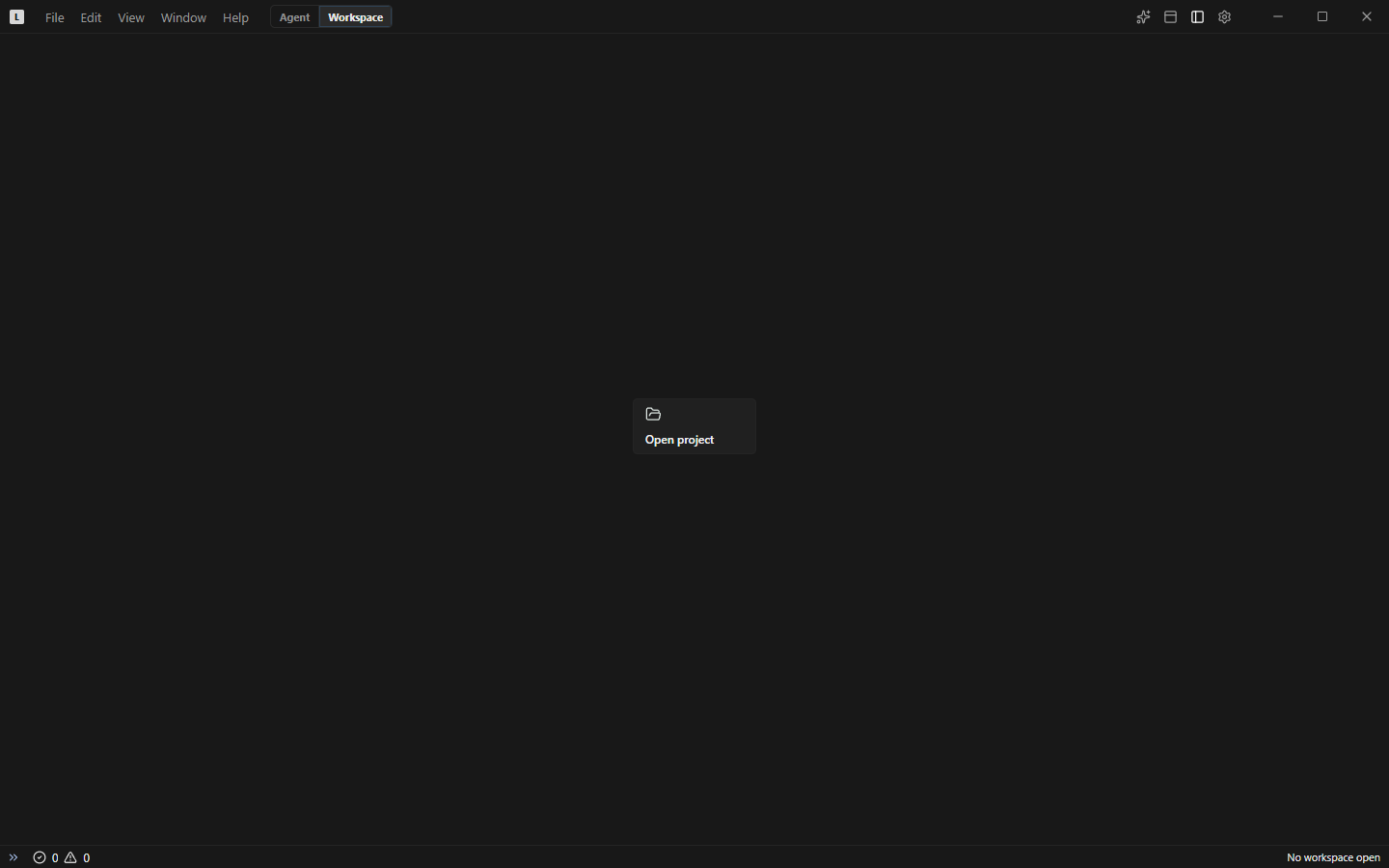
Lux IDE is an open-source desktop IDE built around a native Rust product engine and a React workbench. The goal is a serious Cursor/VS Code-class tool: real workspace operations, typed IPC, native services, polished editor UX, and AI workflows that can inspect and change a project without turning the app into a browser-only shell.
The project is early alpha. The core workbench is real and usable for development, while release signing, updater channels, extension hosting, and full debug session execution are still in progress.
Why Lux
- Rust owns the hard work. Workspaces, filesystem mutations, document persistence, search, Git, LSP, terminal PTY, settings, keybindings, extension metadata, and installer/update policy stay native.
- React owns the surface. The frontend focuses on layout, Monaco integration, panels, dialogs, command composition, and fast interaction.
- Typed boundaries. Tauri commands and
lux://eventpayloads keep frontend/backend contracts explicit instead of stringly typed glue. - AI is a product surface. Chat, agent workspace, provider settings, local voice input, context budgeting, and guarded file/shell tools are treated as first-class IDE workflows.
- Open by design. The roadmap, architecture boundaries, contribution rules, and distribution policy are kept in the repo.
Current Features
- Native folder picker, recent workspaces, recursive explorer, file create/rename/delete/copy/reveal.
- Monaco editor lifecycle backed by Rust
DocumentStore: open, edit, save, save as, save all, dirty close guard, tabs, split editors, minimap, word wrap, and font zoom. - File watcher refresh, workspace search with include/exclude, case, regex, and whole-word filters.
- Git status and diff plumbing for workspace files.
- Integrated terminal surface backed by a Rust PTY service and xterm.js.
- LSP manager with diagnostics, hover, definition, references, symbols, folding, inlay hints, semantic tokens, completion, code actions, formatting, signature help, rename, and workspace edits.
- Settings UI for editor, keybindings, themes, profiles, AI providers, model/runtime options, and voice input.
- AI chat and agent workspace with tool approval modes, file read/write/replace/patch/delete tools, web fetch, shell execution, test health, symbol context, and local STT hooks.
- Extension discovery/status with stable contribution-point metadata.
- DAP workspace inspection for
launch.jsonand adapter detection. Debug session lifecycle is not wired yet.
Screenshots
| Editor | AI Chat |
|---|---|
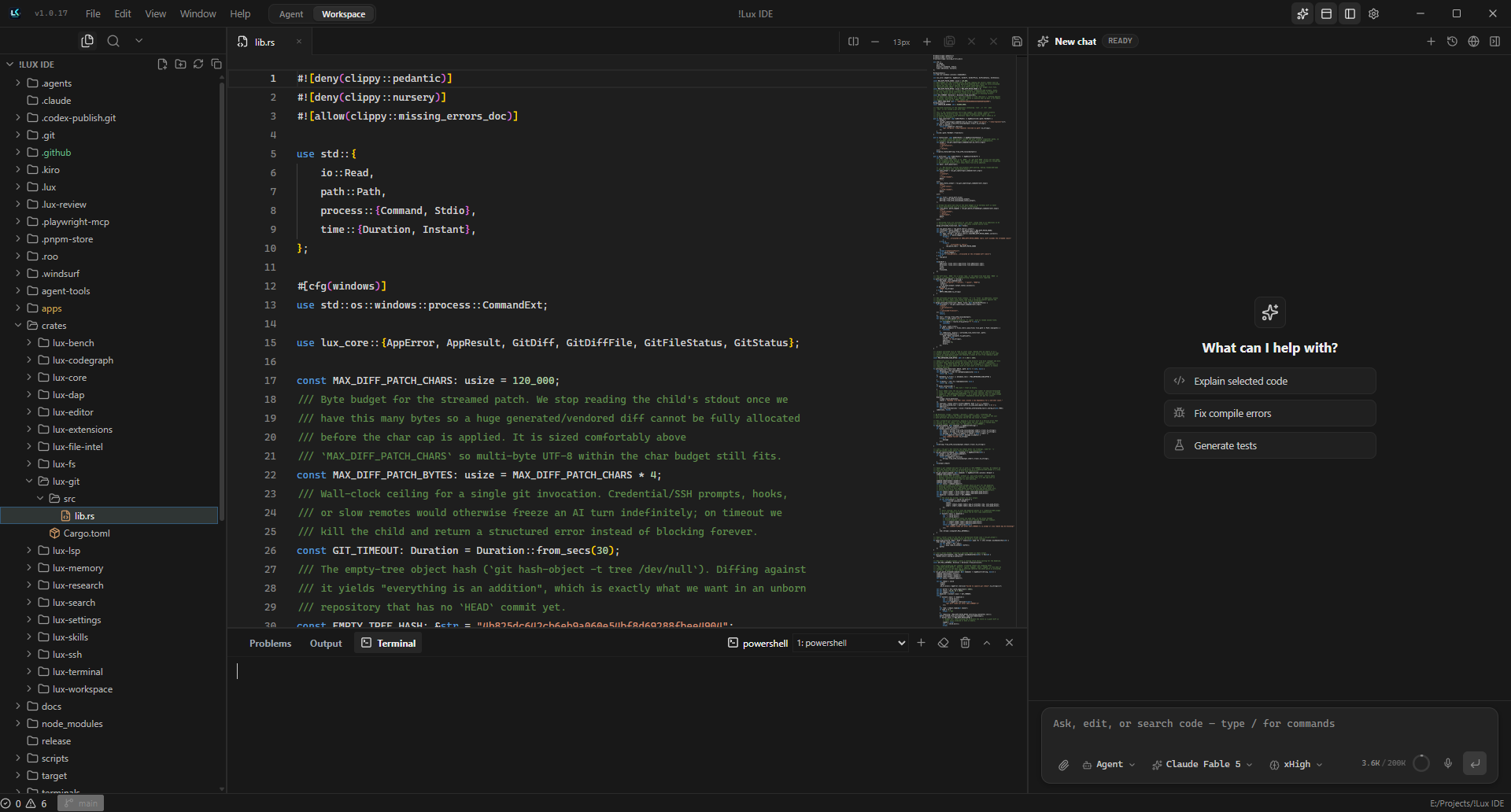 |
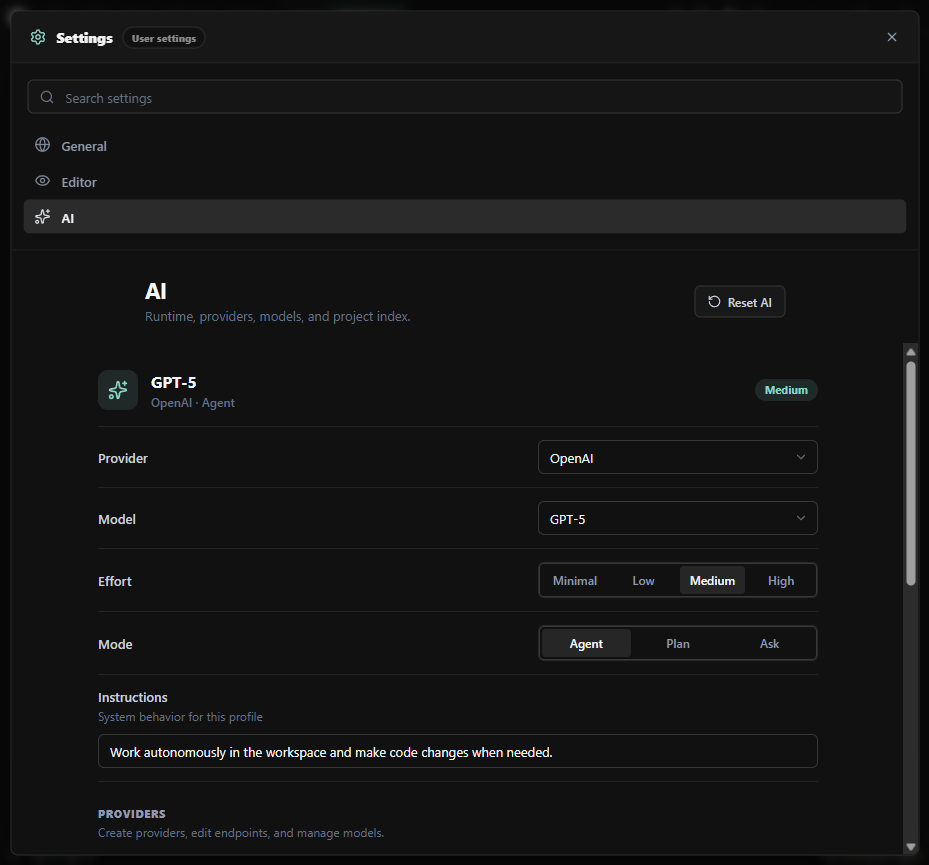 |
| Agent Workspace | Settings |
|---|---|
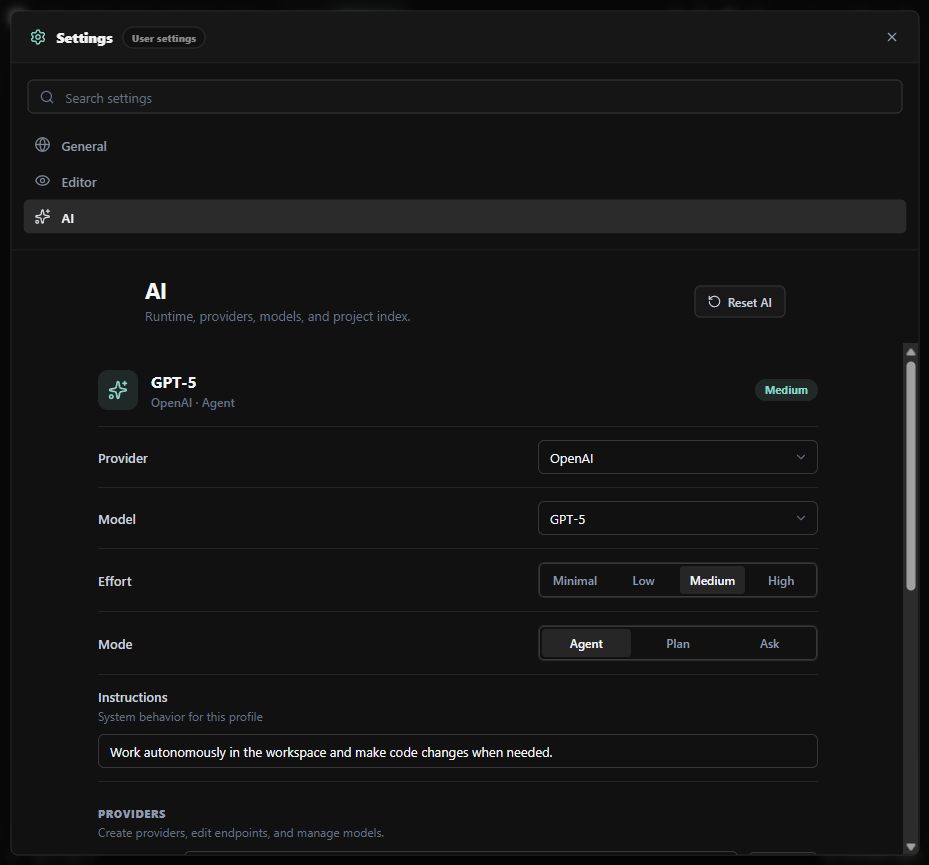 |
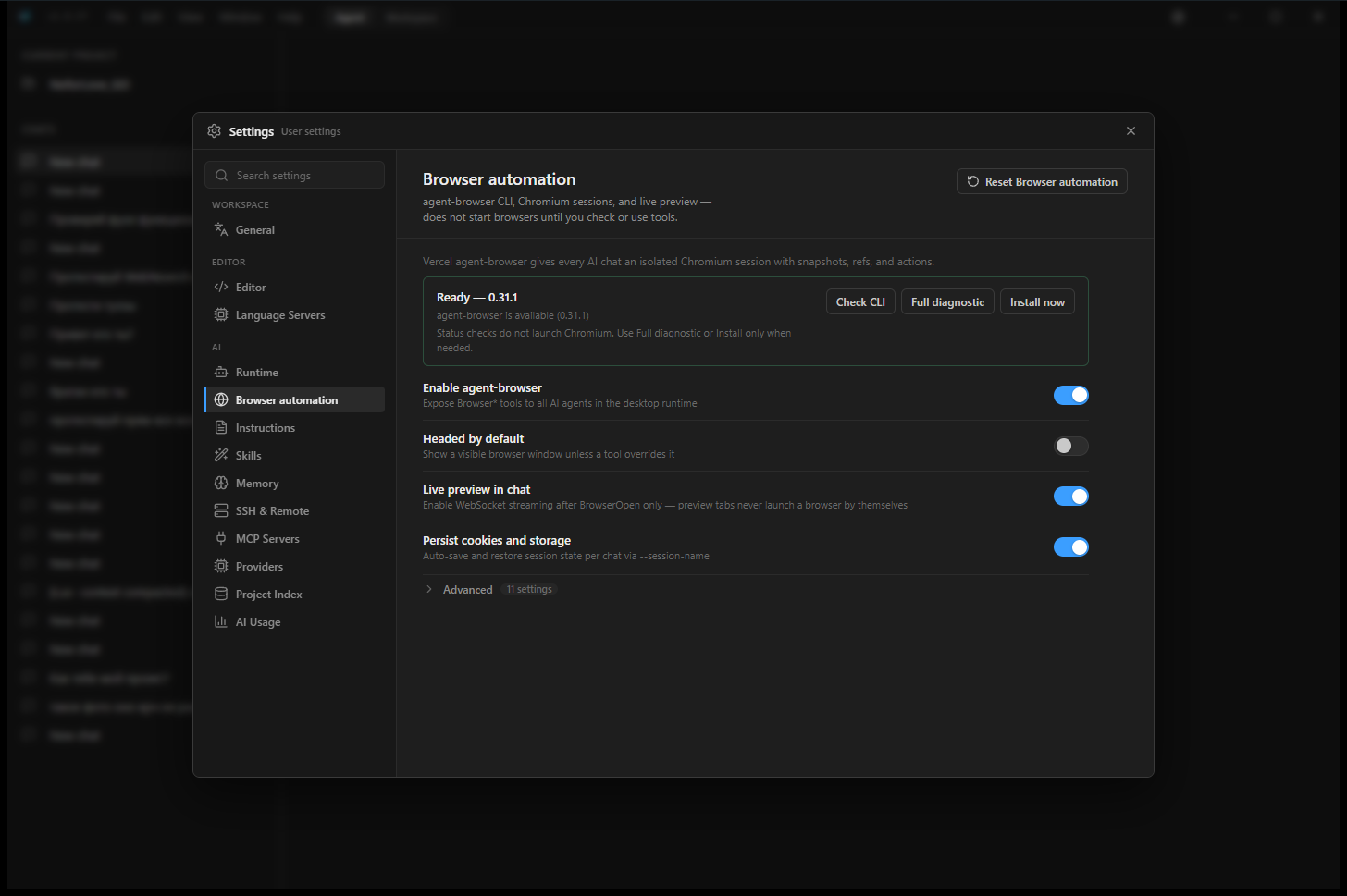 |
Architecture
The desktop shell is one Tauri 2 application; the product engine is a Cargo workspace of focused, mostly I/O-free crates that the shell wraps in Tauri commands and lux://event payloads.
apps/desktop Tauri 2 shell, React workbench, Monaco, xterm.js
Core and runtime:
crates/lux-core       shared DTOs, typed errors/events, scan concurrency, generated TypeScript bindings
crates/lux-workspace  workspace open/normalize and metadata
crates/lux-fs         filesystem mutations and recursive workspace scanning with file watching
crates/lux-editor     document store and open/edit/save/save-as lifecycle
crates/lux-search     parallel workspace search with include/exclude, regex, and whole-word filters
crates/lux-terminal   PTY service backing the integrated terminal
crates/lux-ssh        non-interactive OpenSSH/scp argument building, ~/.ssh/config discovery, session registry
crates/lux-git        Git status and diff plumbing over the system git binary
crates/lux-settings   persisted settings, recent workspaces, and keybinding profiles
Language and code intelligence:
crates/lux-lsp        language server lifecycle, transport framing, and LSP request/response translation
crates/lux-dap        debug adapter discovery and DAP protocol transport helpers
crates/lux-file-intel office/PDF/spreadsheet/archive/database extraction and structured file previews
crates/lux-codegraph  tree-sitter structural code graph: symbols, kinded edges, resolve, metrics, query
AI:
crates/lux-memory     per-project durable agent memory (SQLite + FTS5, relevance/importance/recency ranking)
crates/lux-skills     discoverable Markdown skill modules (project and global scope) for the agent
crates/lux-research   Perplexica-style web research core: search-URL building, result parsing, lexical rerank
Infrastructure:
crates/lux-extensions WASM extension host: manifest discovery, contribution points, sandboxed activation
crates/lux-bench      deterministic core-performance gate for indexing, search, and event batching
Read the architecture contract in docs/architecture/rust-first-boundaries.md and the milestone plan in docs/architecture/milestones.md.
Quick Start
Prerequisites:
- Rust stable toolchain
- Node.js 22+
- pnpm 10+
- Platform dependencies required by Tauri 2
pnpm install
pnpm dev
For web-only frontend iteration:
pnpm dev:web
pnpm dev:web is an explicit browser-preview mode for UI iteration only. Production behavior requires the Tauri desktop runtime; browser fallbacks for documents, settings, AI chat history, terminal echo, and LSP no-op responses are disabled outside dev preview. To inspect a built browser preview intentionally, build/run with VITE_LUX_BROWSER_PREVIEW=1.
For a production desktop bundle:
pnpm tauri:build
Quality Gates
Run these before opening a PR:
pnpm typecheck
pnpm build
cargo fmt --all --check
cargo check --workspace
cargo test --workspace
cargo run -p lux-bench -- --assert --output target/lux-bench-report.json
UI changes should also be verified in the running app, including console health, panel layout, keyboard flow, and the affected workflow.
lux-bench is the repeatable core-performance gate. It generates a deterministic temporary workspace and checks Rust-owned file indexing, literal search, and workspace event batching against conservative thresholds, printing a JSON report and optionally writing it with --output for CI artifacts or local comparison.
Roadmap
- Harden the real workspace loop: explorer, document lifecycle, search, Git, settings, and terminal reliability.
- Complete LSP ergonomics across common languages and make diagnostics/navigation feel native.
- Wire full DAP debug sessions from detected configurations.
- Build the WASM extension host and stable public contribution API.
- Add signed release channels, installer QA, and updater artifacts.
- Add startup/search/indexing benchmarks and publish repeatable performance targets.
Contributing
Read CONTRIBUTING.md before opening a change. Good contributions keep Rust as the product engine, preserve typed IPC, avoid placeholder UX, and include focused tests for shared behavior.
If you are new to the codebase, start with docs, reproducible bugs, focused UI polish, Rust unit tests, LSP/DAP adapters, extension manifest validation, and installer QA.
License
Lux IDE is licensed under the Apache License, Version 2.0. See LICENSE and NOTICE.
Community
Join the discussion on Telegram: https://t.me/lux_ide
Reviews (0)
Sign in to leave a review.
Leave a reviewNo results found