cymbal-air-toolbox-demo
Health Gecti
- License — License: Apache-2.0
- Description — Repository has a description
- Active repo — Last push 0 days ago
- Community trust — 336 GitHub stars
Code Gecti
- Code scan — Scanned 12 files during light audit, no dangerous patterns found
Permissions Gecti
- Permissions — No dangerous permissions requested
Bu listing icin henuz AI raporu yok.
Demo of a customer service agent (Cymbal Air) using LangGraph, Tools, and RAG to interact with Google Cloud Databases via MCP Toolbox.

[!NOTE]
This project is for demonstration only and is not an officially supported
Google product.If you're a Googler using this demo, please fill up this
form. If you're interested in using our
hosted version, please fill up this
form.
Introduction
This project provides a production-quality reference implementation for building
Agentic applications that use Agents and Retrieval Augmented Generation
(RAG) to query and interact with data stored in Google Cloud Databases.
This demonstration features Cymbal Air, a fictional airline. The application
showcases a customer service assistant that helps travelers manage flights and
find information about San Francisco International Airport (SFO), Cymbal Air's
hub. The agent can answer questions like:
- Are there any luxury shops in the terminal?
- Where can I get coffee near gate A6?
- I need to find a gift for my colleague.
- What flights are headed to NYC tomorrow?
Table of Contents
Understanding the demo
Retrieval Augmented Generation (RAG)
One of the best tools for reducing hallucinations is to use Retrieval Augmented
Generation (RAG). RAG is the concept of retrieving some data or information,
augmenting your prompt to the agent, and allowing it to generate more accurate
responses based on the data included in the prompt. This grounds the model’s
response, making it less likely to hallucinate. This technique is also useful
for allowing the agent to access data it didn’t have when it was trained. And
unlike fine-tuning, the information retrieved for RAG does not alter the model
or otherwise leave the context of the request - making it more suitable for use
cases where information privacy and security are important.
Cloud databases provide a managed solution for storing and accessing data in a
scalable and a reliable way. By connecting an agent to a cloud database,
developers can give their applications access to a wider range of information
and reduce the risk of hallucinations.
Agent-based Orchestration
This application uses an Agent-based orchestration model. Instead of a static
chain of calls, the LLM acts as an intelligent Agent that decides which tools to
use and in what order. It is given a set of available tools, each with a
specific function (e.g., find_flights, list_amenities). Based on the user's
query, the agent reasons about the best tool to use to find the answer. This
"thought process" allows the agent to handle a wider variety of queries and to
break down complex questions into smaller, manageable steps.
Architecture
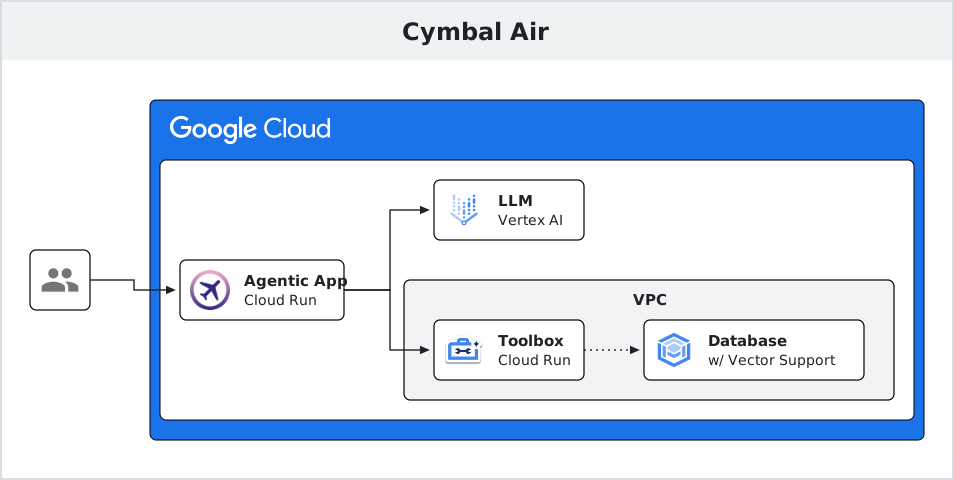
The architecture consists of three main components:
- Application -- The user-facing agentic app that orchestrates the
interaction between the user and the agent. - MCP Toolbox -- MCP Toolbox
is a middleware server that exposes the database operations as a set of
tools. The LLM agent connects to the Toolbox to execute these tools. This
provides a secure, scalable, and modular way to manage database interactions. - Database -- The database containing the data the agent can use to answer
questions. For this application, the database used was intentionally designed
to be interchangeable in order to make it easier to run this on your
preferred database.
Using the Toolbox as an intermediary offers several advantages:
- Better Security - The Toolbox handles authentication and authorization,
preventing the agent from directly accessing the database and reducing the
risk of security vulnerabilities. - Better scalability - Toolbox allows multiple different Agents to leverage
it, as well as allowing it to scale independently. It allows for production
best practices such as connection pooling or caching. - Better recall - Agents perform better when given smaller, discrete tasks
they can use to accomplish larger goals. By mapping a specific action to a
specific, pre-determined query, via tools, it significantly improves the
agent's ability to leverage it successfully.
Head over to the official MCP Toolbox
docs
for more details.
Deployment
Deploying Cymbal Air app is a three-step process. You will first download the
necessary tools, then perform a one-time setup for your database and Toolbox
configuration, and finally launch the Toolbox server and the app.
Before you begin
First, clone this repository and download the MCP Toolbox binary.
Clone the repository:
git clone https://github.com/GoogleCloudPlatform/cymbal-air-toolbox-demo.git
cd cymbal-air-toolbox-demo
Download MCP Toolbox binary:
Follow these
steps
to download the binary. This involves running the following commands:# See the releases page for the latest version export VERSION=0.8.0 curl -O https://storage.googleapis.com/genai-toolbox/v$VERSION/linux/amd64/toolbox chmod +x toolbox
One-Time Database & Tool Configuration
Next, you must perform a one-time setup to create your database instance,
populate it with data, and create the tools.yaml configuration file. This
process uses the Toolbox binary you just downloaded.
[!IMPORTANT]
For detailed, step-by-step instructions, follow the Database Setup
Guide.
[!NOTE]
If you have already configured your own database, you can skip this section.
Launch the Toolbox Server (Choose One)
After your database is initialized and your tools.yaml file is created, you
must run the Toolbox server so the agentic app can connect to it. You can either
run it locally for development or deploy it to Cloud Run for a more robust
setup.
Option A: Run Toolbox Locally
For local development and testing, you can run the Toolbox server directly from
your terminal. This is the quickest way to get started.
For instructions, follow the guide to running the Toolbox
locally.
The basic command will be:
./toolbox --tools-file "tools.yaml"
Option B: Deploy Toolbox to Cloud Run
For a scalable and production-ready setup, you can deploy the Toolbox as a
service on Google Cloud Run. This provides a stable, shareable endpoint for your
application.
For instructions, follow the guide to deploying the Toolbox on Cloud
Run.
Running the Agentic Application
Instructions for running app locally
Clean Up
Instructions for cleaning up resources
Customizing Your Tools
This demo can serve as a starting point for building your own Agentic
applications. You can customize the tools available to the agent by modifying
the MCP Toolbox configuration file.
Please refer to the MCP Toolbox documentation for more information on creating
and configuring tools.
Yorumlar (0)
Yorum birakmak icin giris yap.
Yorum birakSonuc bulunamadi