fable
Health Warn
- License — License: MIT
- Description — Repository has a description
- Active repo — Last push 0 days ago
- Low visibility — Only 7 GitHub stars
Code Warn
- network request — Outbound network request in fable/embeddings.py
Permissions Pass
- Permissions — No dangerous permissions requested
No AI report is available for this listing yet.
High-fidelity transcript memory for Claude Code — index every session, recall byte-identical, search, prune, compose. Local-first, stdlib-only, MCP.

fable Recall
Your Claude already has a memory. fable unlocks it.
Quickstart · Why fable · Benchmarks · Roadmap · Discussions




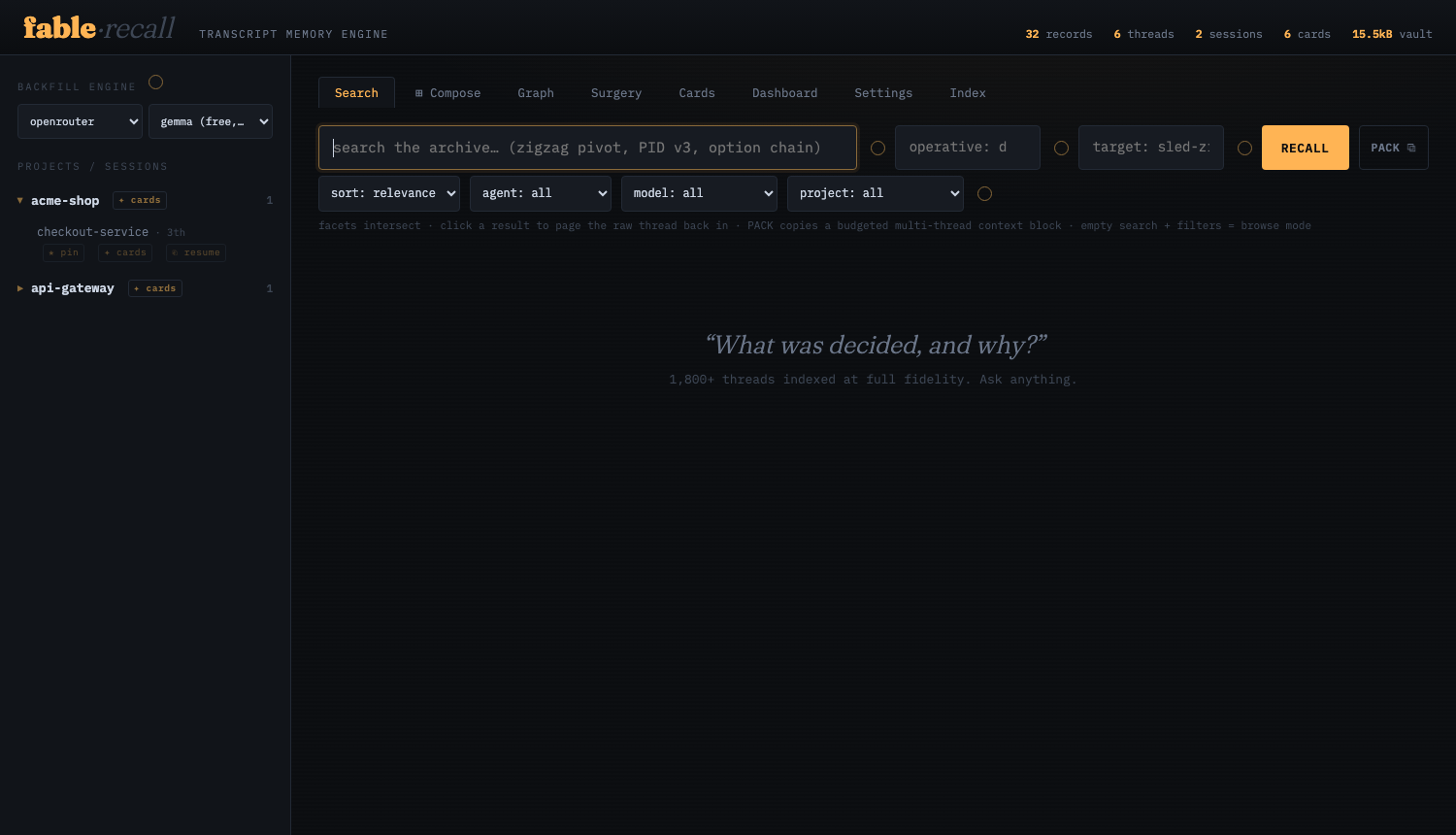 |
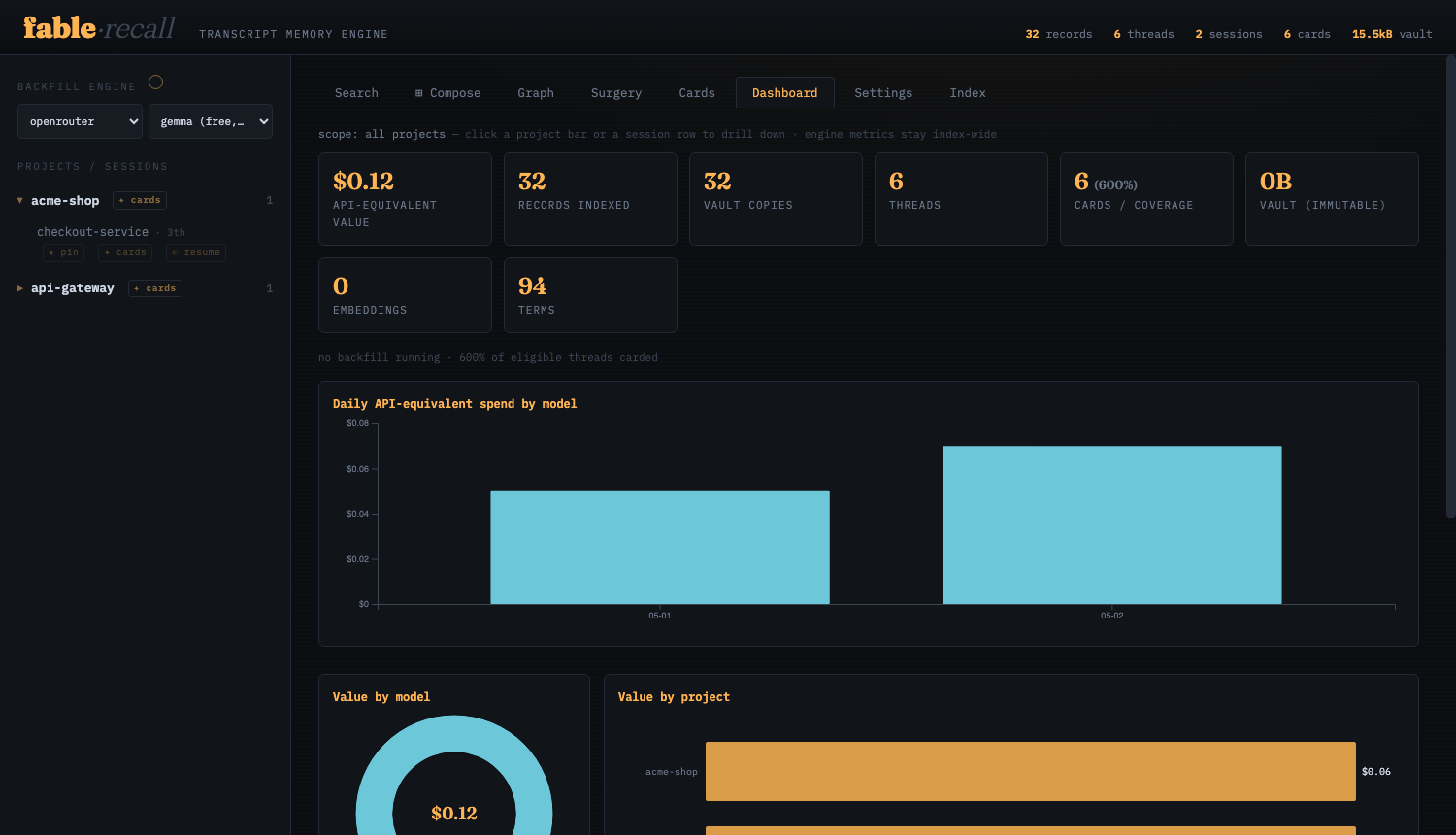 |
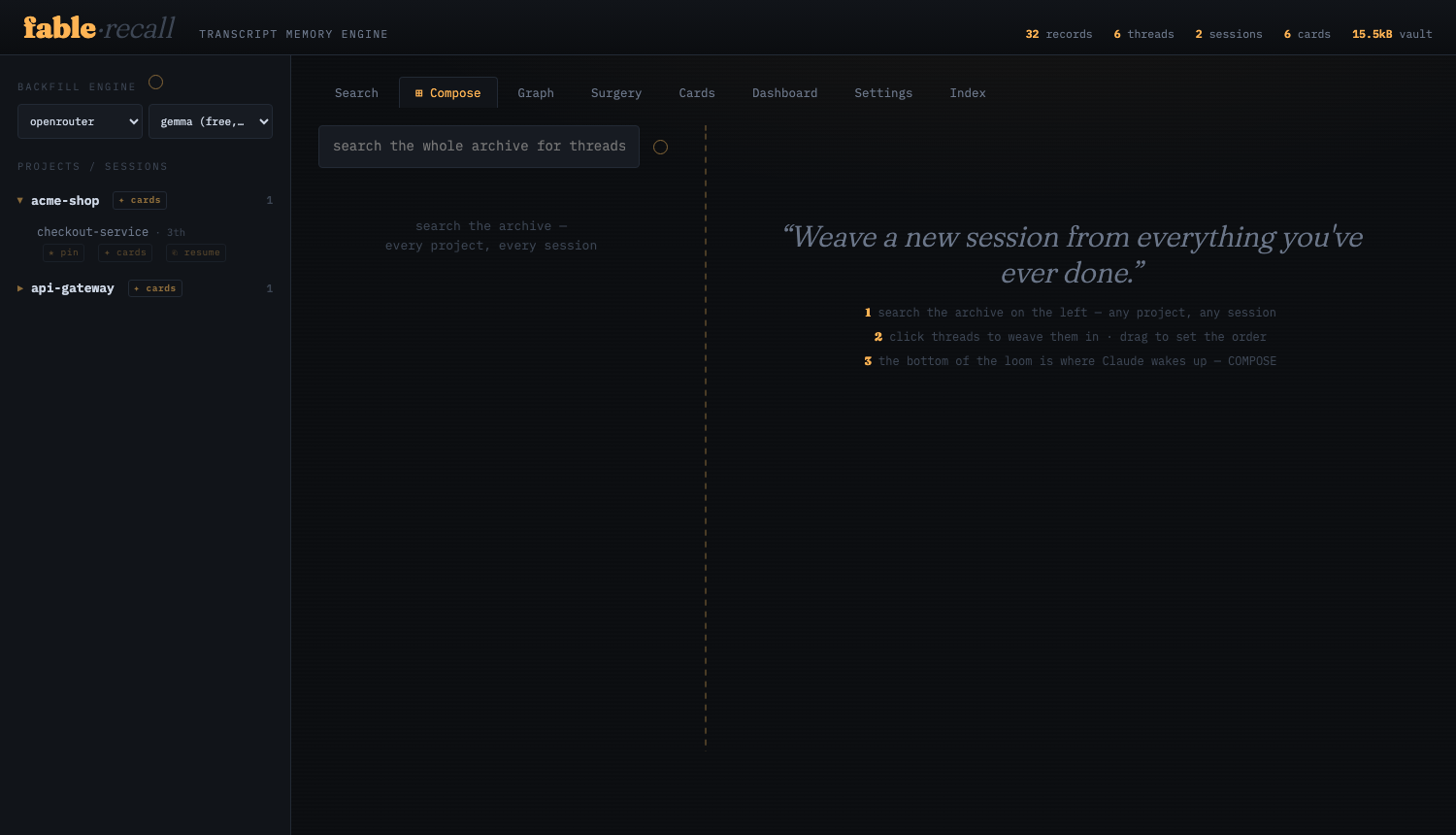 |
Every conversation you've ever had with Claude Code is already saved on
your machine — every decision, every debugging hunt, every 2 AM
breakthrough, word for word. Claude just isn't allowed to use it.
Mid-session, compaction builds a wall: everything behind it is locked away
to save tokens, and Claude carries on with a thin summary. /clear wipes
the slate. And after 30 days, Claude Code quietly deletes the files
themselves. Your project's real memory — locked, then destroyed, by
design.
Everyone else sells you a replacement memory: summaries, extracted
facts, vector stores. fable does something different — it unlocks the
real one.

pipx install git+https://github.com/grooverLab/fable
fable install       # one command: register the MCP, install hooks, index your history
fable serve         # browse your memory in a dashboard
100% local · no API keys · no cloud · no daemons. Your conversations
never leave your machine.
pipx install git+https://github.com/grooverLab/fable   # install the CLI
fable install        # one-shot: claude mcp add + Claude Code hooks +
                     # ~/.fable home + index every transcript
fable serve          # dashboard at http://127.0.0.1:8765
pipx upgrade fable-recall   # update later (pulls latest from GitHub)
fable install is idempotent — safe to re-run; it skips anything already wired.
To do it by hand: fable setup (home) · claude mcp add fable -- fable mcp (MCP) · fable discover (index).
| command | what it does |
|---|---|
fable search <q> |
rank threads by relevance (--project, --kind, -n) |
fable context <q> |
assemble a budgeted context pack |
fable thread <id> |
a thread's raw turns, byte-identical |
fable file <path> |
a file's full edit history across sessions |
fable cards run |
generate AI summary cards (background) |
fable discover |
(re)scan + index all Claude Code projects |
fable prune · fable export · fable stats |
slim a session · export · index stats |
fable serve |
the dashboard |
- Ask about past conversations with Claude — get the real answer.
"What did we decide about auth last month?" Claude searches its own
history mid-session (via MCP) and quotes the actual transcript —
not a summary, not an extracted "fact." The conversation itself. - The wall stops costing you. fable catalogs everything before
compaction walls it off, and hands back exactly what Claude lost —
on demand, under a token budget you set. - The 30-day deletion becomes irrelevant. Sealed into a local vault,
byte-identical, for as long as you decide.
First of its kind — five things no other tool does
🧵 Composed Sessions. Hand-pick conversations from any project, any
month — put them in your order — and fable builds a brand-new session
that Claude resumes as its own lived history. A workspace with curated
memory. (Empirically verified: restitched sessions resume cleanly,
signatures intact.)
🕰️ File time-travel. Your transcripts accidentally versioned
everything. fable reconstructs every file's edit history — every Edit
and Write Claude ever made, across every session — with side-by-side
comparison between any two moments of a file's life, and a jump back to
the conversation that made each change. (fable file src/loader.py)
✂️ Transcript Surgery. Your 80 MB session is paying rent on dead
threads. Remove whole conversations — fable re-stitches the timeline,
shows you the simulation first, and keeps every removed byte recallable
forever. Reversible by construction.
🪶 Pruning that loses nothing. Slim every message (tool noise, images,
bloat) before resuming a heavy session — with an itemized preview of the
savings, and the original sealed in the vault first.
🔍 Memory Diff. See exactly what any prune or cleanup cost any
conversation — generation by generation, byte by byte. Nobody else can
even show you what was lost.
🔇 Run cold. Mute recall for a session or a fleet of sub-agents and they
work with no prior context at all - no injected memory, no recall tools - while
capture keeps running, so the muted work is still recorded verbatim and
searchable the moment you lift it. The point is an unbiased second opinion:
an audit that cannot be anchored to yesterday's conclusion.
(fable mute on · FABLE_MUTE=1 claude · a toggle in Settings)
How it works (the short version)
fable indexes your transcripts into a local SQLite archive: an immutable
vault (every byte, forever) plus a search map (keyword + semantic,
optional local embeddings via Ollama). Hooks run before Claude Code's
compaction and cleanup; an MCP server gives Claude search / recall /
remember tools. Measured on a real archive — 191,000 records, 6,000
conversations:
| recall@1 | recall@5 | search (p50) | full re-index |
|---|---|---|---|
| 76.7% | 90.0% | 135 ms | 6.6 s |
Reproduce it: python3 scripts/benchmark.py. No competitor publishes
retrieval numbers.
Why fable — and not another memory layer
| fable | claude-mem | mem0 / Letta | native Claude Code | |
|---|---|---|---|---|
| Memory = your actual conversations | ✅ | ❌ summaries | ❌ fact snippets | ⚠️ locked behind the wall |
Survives the 30-day deletion & /clear |
✅ | ⚠️ its summaries do | ❌ | ❌ |
| Claude searches its own history (MCP) | ✅ | ✅ | ❌ | ❌ |
| Composed sessions / file time-travel / surgery / diff | ✅ first of its kind | ❌ | ❌ | ❌ |
| Zero API keys, fully offline | ✅ | ✅ | ❌ | ✅ |
| Footprint | one SQLite file | Node + Chroma daemon | cloud / Docker | — |
(Fair is fair: mem0 fits multi-LLM production agents; ccusage goes deeper
on billing analytics. Different jobs, both compatible with fable.)
Trusted the hard way
fable's first user is the session that built it: mid-build, that session
was pruned by fable (7.8 MB → 3.0 MB), kept working through compaction via
its own hook, and is now searchable through its own MCP server — andfable file fable/recall.py replays its own source code being written,
18 versions deep. The build history eats its own dogfood — all $83k of
API-equivalent work in the author's archive included.
What people use it for
- "Why did we choose X?" — architecture archaeology, weeks later
- "When did this function break?" — file time-travel to the exact edit
and the conversation around it - Picking up a debugging hunt exactly where the wall cut it off
- A composed "workspace" session: threads from three projects, one memory
- Slimming a heavy session before
--resume, reversibly fable remember "we deploy Fridays only"— standing rules, every session
Try it on a fictional sample first:python3 demo/seed_demo.py && fable --db demo/demo.db serve
MIT · local-first forever (non-goals) · built with Claude
Code, for Claude Code · @claude answers issues here — the butler is
Claude ·
architecture deep-dive ·
Reviews (0)
Sign in to leave a review.
Leave a reviewNo results found