harness-ledger
Health Warn
- License — License: MIT
- Description — Repository has a description
- Active repo — Last push 0 days ago
- Low visibility — Only 5 GitHub stars
Code Fail
- rm -rf — Recursive force deletion command in .github/workflows/release.yml
- fs module — File system access in .github/workflows/release.yml
Permissions Pass
- Permissions — No dangerous permissions requested
No AI report is available for this listing yet.
Names the harness piece behind each problem in your sessions, what it cost, and whether the fix worked.
harness-ledger
Every piece of your coding agent's harness, with what it costs you and the receipts.
Reads the sessions your agent already saves, names the piece behind each problem, and checks whether the fix worked. Works with Claude Code, Codex and Cursor.



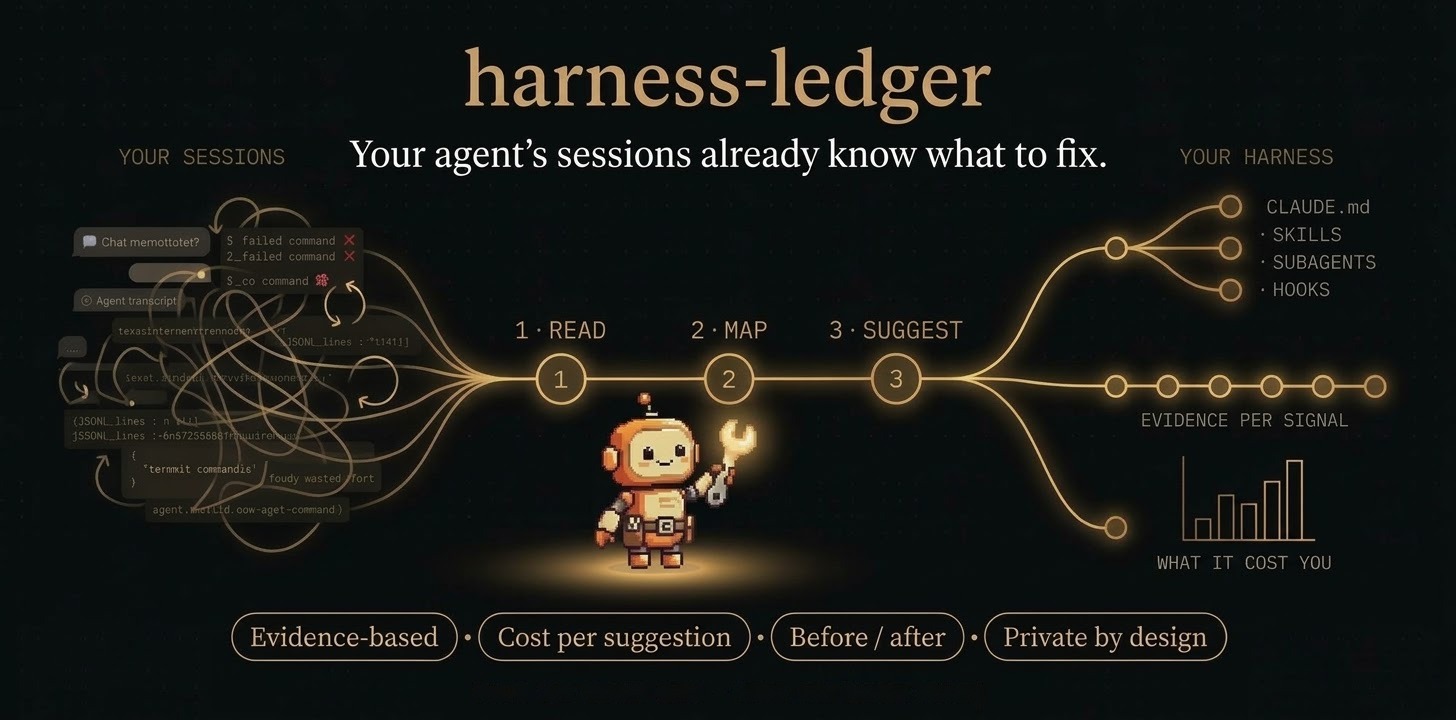
You added a skill because it seemed useful. You gave a subagent a stronger model "just in case". Your AGENTS.md grows every time something goes wrong. Which of those changes actually helped?
Your harness is everything around your coding agent: the instructions file, skills, subagents, commands, hooks, MCP servers and plugins. It decides how well the agent works, yet it is usually tuned by gut feeling.
harness-ledger reads the session transcripts your agent already saves on your machine, maps your current harness, and tells you which piece is causing which problem, what it cost you in time and tokens, and what to change, with the exact session and step behind every suggestion. Then it checks whether the change helped.
More text is rarely the fix. When a rule is already written and the agent ignores it, the answer is a hook or a check, not a longer prompt. The skill tells those cases apart.
What you get
|
Findings with evidence Every finding points to the session, the transcript line and the thread it came from. No evidence, no finding. |
A cost on every suggestion Time, tokens and money per suggestion, counted by a local script, never estimated by the model. Two suggestions never share the same cost. |
|
The right kind of fix Each finding gets a class (rule ignored, instruction missing, structure change...) and the class decides the fix: enforce, rewrite, add, restructure or remove. |
Before and after Accept a suggestion and later runs compare the piece before and after the change, in errors, corrections, time and cost. |
Quick start
1. Install
npx skills add guilhermebkel/harness-ledger -g
The skills CLI asks which of your agents (Claude Code, Codex, Cursor) should get the skill. Name them to skip the question (-a claude-code -a codex -a cursor), or drop -g to install only in the current project. The skill carries its own script, so there is nothing else to install. Running the script needs Node.js 20+; the skills CLI itself asks for 22.20+. Update later with npx skills update.
2. Analyze your sessions
Open your agent in the project, pick its strongest reasoning model, and run the skill, the same way in Claude Code, Codex and Cursor:
/audit-harness
It works on the sessions you already have, from the first run. No extra logging, no setup.
3. Keep going
# Focus on one piece or period
/audit-harness only the code-reviewer subagent, last 2 weeks

# Check whether a change helped
/audit-harness did my change to code-reviewer help?

# Review what was suggested before
/audit-harness show pending suggestions
Suggestions are never applied on their own. Applying one always asks first and only touches harness files.
Example
Illustrative output.
Analyzed 41 sessions (last 30 days) · 3 suggestions
What these problems already cost: failures ≥ 52 min · re-reads ~18 min · corrected turns ≤ 40 min
Claude Code itself reports $16.20 for these sessions; the script estimates ~$14.

#1  Enforce a rule that already exists                    subagent: test-runner
    Ran `npm test` 11 times in 6 of 41 sessions; the repo uses `pnpm test`,
    and AGENTS.md line 3 already says so.
    Cost:  at least 38 min · 210k tokens · $1.90
           from each failed `npm test` until `pnpm test` ran, reasoning included
    Proof: session 3f2a… line 14 · session 91bc… line 7 · +4 more
    Fix:   a hook that rewrites `npm test` to `pnpm test` in this repo, not more text.
    Then:  compare test-runner after a few sessions to see if it stopped.

#2  Fix an instruction                                     subagent: code-reviewer
    Re-read 9 files the main session had just read, in 5 of 41 sessions.
    Cost:  about 12 min · 340k tokens · $1.10
    Fix:   pass the changed-files summary when delegating. [proposed text]

#3  Change the structure                                   repeated request
    "Generate the changelog entry from the last PRs", asked in 7 of 41 sessions.
    Cost:  about 25 min · 180k tokens · $0.95
    Fix:   turn it into a skill. [draft SKILL.md]
What it finds
| Class | When | Suggested fix |
|---|---|---|
| Rule exists, but is ignored | The instruction is there; the agent doesn't follow it | Enforce it: a script, hook or check |
| Partial or outdated instruction | It exists but is incomplete or contradicts the repo today | Fix the text in the right piece |
| Missing instruction | Nothing in the harness covers it | Add it where it belongs |
| Structure change | A pattern repeats across sessions | Turn it into a skill, subagent or script, or remove an unused piece |
| Out of scope | The problem is in a piece you don't control | Recommendation only |
| Already handled | Already suggested, rejected or changed | Listed, never repeated |
The signals behind them: failed commands and the fix loops around them, wrong commands that a different one fixed, repeated file reads, subagents re-reading what the main thread just read, corrections and rejected plans, permission denials, repeated requests, procedures done by hand again and again, files and outputs that keep filling the context, unused or oversized pieces, and API errors.
How it works
  your sessions ──▶ 1. READ ──▶ 2. MAP ──▶ 3. SUGGEST ──▶ 4. COMPARE
  (already saved)    local       your        classified     before vs after,
                     script      harness     and costed     once you change it
The work is split on purpose:
| Part | Does | Why |
|---|---|---|
Local script (dist/harness-ledger.mjs) |
Parses transcripts, inventories the harness, extracts signals, counts time, tokens and cost, compares before and after | Numbers must be reproducible. The model never estimates one. |
| Your agent, running the skill | Groups signals by cause, tells real friction from ordinary work, classifies each finding and writes the change | That's judgment, and it's where a weaker model goes wrong. |
Run it on the most capable reasoning model you have. The script does the reading and counting, so the model only sees a compact summary; what it adds is judgment.
How the numbers work
The numbers are why you'd trust a finding, so they come with their limits:
- Each one says what kind of number it is: at least (a lower bound), at most (an upper bound) or about (an estimate). Numbers of different kinds are never added together.
- Each one says how often: "11 times in 6 of 41 sessions", so one bad session doesn't pass for a habit.
- They measure what was spent, not what you'll save. A saving is only claimed after a before/after comparison shows it.
- Your agent's own figure sits beside the estimate. Claude Code records its cost per session; the report shows both and never sums them.
- Thin evidence is marked partial, with the reason, instead of being rounded up into a finding.
The full rules, signal by signal, are in docs/cost-model.md.
The skill calls the bundled script, and you can too:
node dist/harness-ledger.mjs analyze --since 14d --pretty   # inventory, signals and per-piece usage
node dist/harness-ledger.mjs evidence <signal-id>            # every occurrence behind one signal
node dist/harness-ledger.mjs compare --piece agent:code-reviewer
node dist/harness-ledger.mjs --help
Everything it prints is JSON. It writes only to .harness-ledger/ in your project.
To see what a run of the skill cost you, look at its own row the next time you analyze: node dist/harness-ledger.mjs analyze --piece skill:audit-harness.
Supported agents
| Agent | Status |
|---|---|
| Claude Code | ✅ Supported |
| Codex | ✅ Supported. Cost is partial: some token counts are not recorded |
| Cursor | ✅ Supported. Cost is partial: transcripts record no tokens, tool results, model or times, so failure signals that need a result don't appear |
Point the script at another agent with --provider codex or --provider cursor. HARNESS_LEDGER_CODEX_HOME and HARNESS_LEDGER_CURSOR_HOME relocate their folders (~/.codex, ~/.cursor) when yours live elsewhere.
Each agent is a provider: one folder that reads its own transcripts and settings into a shared model. Want yours? docs/adding-a-provider.md walks through it.
Privacy
- Everything runs locally. Transcripts are read in place, never copied, never sent. Only derived, redacted findings are stored, in
.harness-ledger/. - Secrets stay out. Every string that can reach a report goes through redaction. Hooks and MCP servers are kept as names and shapes, never their commands, arguments or env values.
- No telemetry. When the script meets something it can't map (a new transcript format, a model with no price), the report offers a link to a prefilled GitHub issue holding only names and counts. You read it and decide whether to send it.
- Your retention, untouched. Claude Code deletes transcripts older than 30 days by default; Codex and Cursor keep theirs. The skill tells you how much history you have and never changes that setting.
Found a way around any of this? See SECURITY.md.
How it compares
Better Harness is the closest project, and broader: it reviews your whole agent work loop (task understanding, execution, validation, delivery, learning) across a dozen coding agents, with visual reports. If you want a review of how your team works with agents, start there.
harness-ledger is narrower and more quantitative. It answers three questions about the harness itself:
- Which piece is causing the friction? Every step is attributed to the skill, subagent or command that was running, and each finding names the piece to change and the kind of fix (a rule that's ignored needs a hook, not more text).
- What did it cost? Time, tokens and money per occurrence, from the first failure to the call that worked, each marked as a lower bound, an upper bound or an estimate. Suggestions never share a cost.
- Did the fix work? Accepted and rejected suggestions are tracked, and later runs compare the piece before and after the change.
Other tools in the space:
- Session viewers and usage dashboards show what happened, not which piece should change.
- Plugin and skill eval tools test a piece in a clean workspace, not in your real sessions.
- Setup recommenders suggest pieces from your project's shape, not from what went wrong.
FAQ
Does it change my harness?Only if you ask it to, one suggestion at a time, with confirmation, and only in harness files (instructions, skills, subagents, commands, hooks, settings). Pieces from plugins or managed settings are never edited; findings about them become recommendations.
How much history does it need?It works from the first run, on whatever sessions you have. Patterns across sessions need a few sessions to show up, and before/after comparisons need a minimum on each side; below that, the report says the evidence is partial instead of guessing.
How accurate are the costs?They're estimates with a stated method: time excludes idle gaps, tokens come from the transcripts, money from a price table you can override in .harness-ledger/config.json. Each signal says whether its number is a lower bound, an upper bound or an estimate. The rules are in docs/cost-model.md.
Reject it (it won't come back), and if the rule behind it seems off, ask for a rule question: the script builds a prefilled issue with the signal and your own words, nothing from your sessions. Those reports are how the rules get better.
Roadmap
- Insights: history analysis, harness inventory, classified and costed findings, suggestions, before/after comparison.
- Bench (#2): prove a suggestion before adopting it. Replay tasks from your sessions with different models, reasoning effort, subagents or pieces; filter by tests; blind review with a calibrated judge; recommend the cheapest configuration that still does the job.
- Cross-agent comparison: when a project uses more than one agent, compare which harness fails less on similar tasks.
- Team mode: aggregate sessions across a team.
- Scheduled runs: periodic analysis that opens a PR with suggested changes for human review.
Contributing
Issues and pull requests are welcome, and the most useful contributions are often small: a mapping gap the report linked you to, a rule that misjudged your project, a new provider. Start with CONTRIBUTING.md; vocabulary is in GLOSSARY.md and design decisions in docs/adr/.
pnpm install
pnpm check   # typecheck, lint, dead code, duplication, tests and a build
Stop tuning your harness by feel. Let your sessions show you.
MIT License © Guilherme Mota
Reviews (0)
Sign in to leave a review.
Leave a reviewNo results found