lorekit
Health Uyari
- License — License: MIT
- Description — Repository has a description
- Active repo — Last push 0 days ago
- Low visibility — Only 5 GitHub stars
Code Gecti
- Code scan — Scanned 12 files during light audit, no dangerous patterns found
Permissions Gecti
- Permissions — No dangerous permissions requested
Bu listing icin henuz AI raporu yok.
Personal LLM Wiki toolkit — let AI build and maintain your knowledge base. Based on Karpathy's LLM Wiki pattern. TypeScript, ollama+bge-m3, works with any AI coding agent.
lorekit
A personal LLM Wiki toolkit — let AI build and maintain your knowledge base.
Based on Karpathy's LLM Wiki pattern, lorekit gives any AI coding agent a local knowledge-base workflow: raw sources → LLM compilation → persistent wiki. Compile once, keep updating — no RAG. The default install is just the lorekit CLI; project-local research skills, central-corpus routing, and GBrain are optional modules you can add when your workflow needs them.
Hand the GitHub link to your AI, say "install this for me" — it reads CLAUDE.md / AGENTS.md and does the rest.
For a long-form feature introduction to the CLI, workflow, safety model, optional modules, and Obsidian experience, see docs/INTRODUCTION.md.
Core Idea
"Instead of just retrieving from raw documents at query time, the LLM incrementally builds and maintains a persistent wiki." — Andrej Karpathy
Traditional RAG: every query re-retrieves from raw documents. Nothing accumulates.
lorekit (LLM Wiki): the LLM incrementally compiles raw material into a structured wiki. Knowledge is compiled once and continuously updated — cross-references in place, contradictions flagged, every source reflected.
Three layers:
- Raw layer (
原料/): read-only source material, the LLM never mutates it - Artifact layer (
知识库/): the compiled wiki — cross-linked, synthesized, continuously updated - Schema (
CLAUDE.md/AGENTS.md): per-corpus configuration, co-maintained by human + LLM
Project-local evidence folders such as _工作台/课程原文/ are not automatically part of the LM Wiki raw-source layer. The retrieval chain starts from index.md / 知识库/; open 原料/ only when full source provenance is needed, and promote project evidence into 原料/ only through an explicit ingest. Doctor frontmatter coverage is calculated on durable layers by default; lint flags 知识库/** pages that cite _工作台/** directly as a canonical source.
Data safety: lorekit has zero tolerance for data loss. Existing notes are backed up before init;
原料/is immutable; normis ever used — deletions go throughtrash(recoverable from macOS Trash). See the data-safety rules inAGENTS.mdanddocs/INSTALLATION.md.
Feature Map
| Feature | Command | Notes |
|---|---|---|
| Launch screen | lorekit |
No-arg invocation prints the blue logo + corpus status |
| Init | lorekit init |
Scaffolds the corpus, deploys the Obsidian plugin, auto-backs up pre-existing content |
| Doctor | lorekit doctor |
Directory integrity, frontmatter coverage, Obsidian hints, enabled/explicit optional integration health; supports --json and strict --section <name> filters |
| Stats | lorekit stats |
Page count, type breakdown |
| Search | lorekit search |
Text search + vector semantic search (hybrid) |
| Web fetch | lorekit fetch <url> |
Pulls WeChat / generic pages into the workbench; auto-extracts publishDate, writes spec-compliant frontmatter, detects duplicate / in-progress URLs from state.json |
| Ingest state | lorekit ingest <sub> |
list / pending / record / forget / reconcile — the single source of truth for ingest pipeline progress |
| Lint | lorekit lint |
Broken wikilinks, orphan pages, workbench-as-source links, duplicate detection; --quick is accepted as a compatibility alias for agent self-checks |
| Snapshot | lorekit snapshot |
Full-corpus tarball + manifest |
| Restore | lorekit restore |
Recover missing / changed files from a snapshot |
| Remove | lorekit remove |
Dry-run impact report, then safely move selected sources/pages to OS Trash with provenance-aware cleanup |
| Audit | lorekit audit |
Create / list / resolve human feedback on wiki pages |
| Vector sync | lorekit vector sync |
Incrementally embed the corpus into sqlite-vec + FTS5 |
| Vector query | lorekit vector query |
Search modes: --layered (vector), --bm25 (FTS5), --hybrid (both + RRF) |
| Vector status | lorekit vector status |
Inspect the index; returns mode: text|vector recommendation based on indexed_files vs MODE_THRESHOLD_FILES (default 100) |
| Directory index | lorekit index |
Recursively generate _INDEX.md for every subdirectory (including folder-packaged sources like 原料/文章/<slug>/article.md) |
| Sync | lorekit sync |
One-shot for durable corpus changes: index → vector sync --layered → doctor; supports --json and --report for agent-readable step receipts |
| Obsidian tune | lorekit obsidian-tune |
老用户升级一键应用 Obsidian graph filter(默认只读检查 / --write 备份后写 / --print 管道用) |
| GBrain | lorekit gbrain <sub> |
Optional read-only bridge: compile 知识库/ into GBrain-native staging, then call external import/extract; never writes canonical wiki pages |
The CLI is named
lorekit. Project-local Agent Skills keep thewiki-prefix (a nod to Karpathy's LLM Wiki), includingwiki-ingest,wiki-query,wiki-fileback,wiki-lint,wiki-enrich,wiki-audit,wiki-remove, andwiki-output. They operate on the current corpus/project and are the recommended skill layer for research corpora. Cross-projectcorpus-*skills andwiki-dailystill exist, but they are explicit optional installs for users who deliberately maintain a central corpus or personal diary gateway.
Ingest Pipeline (single-source-of-truth state machine)
Every ingest is tracked in <corpus>/.wiki/ingest-state.json. This file is the only authority on pipeline progress — no filesystem scans, no duplicate heuristics.
Three top-level states: started / completed / failed.
Fine-grained progress is tracked in a stepsDone[] array so an interrupted ingest can resume exactly where it left off. The top-level status only changes when the pipeline as a whole ends.
{
  "version": 1,
  "ingests": {
    "https://example.com/post": {
      "url": "https://example.com/post",
      "title": "…",
      "sourceDate": "2026-04-15",
      "status": "started",
      "stepsDone": ["fetch", "archive", "wiki"],
      "archivedTo": "原料/文章/post",
      "wikiPages": ["知识库/概念/foo.md"],
      "startedAt": "2026-04-17T10:00:00.000Z",
      "updatedAt": "2026-04-17T10:05:00.000Z"
    }
  }
}
Status transitions driven by lorekit ingest record --step <X>:
| Action | status |
stepsDone |
|---|---|---|
lorekit fetch <url> (success) |
started |
[fetch] |
lorekit ingest record <url> --step archive |
started |
[fetch, archive] |
lorekit ingest record <url> --step wiki |
started |
[fetch, archive, wiki] |
lorekit ingest record <url> --step lint |
completed |
[fetch, archive, wiki, lint] |
Only --step lint auto-promotes to completed. Every other --step keeps the top status at started — all progress detail lives in stepsDone. Explicit --complete and --fail <reason> are also available.
What lorekit fetch does before hitting the network, consulting state.json:
- Record with
status: completed→ returns{"status":"duplicate", duplicate}, does not re-fetch - Record with
status: started→ returns{"status":"in_progress", ingestState, nextStep}, does not re-fetch - No record, but a matching
source_urlexists in原料/→ sameduplicatepath (legacy fallback) - Otherwise → fetches normally, writes
status: started, stepsDone: [fetch]
--force bypasses every check.
Extensibility — adding a new step (e.g. embed) is just appending "embed" to stepsDone. The status enum stays at three. No switch-case in the caller needs to change.
Install Routes
Default install is lorekit-only: install the global lorekit CLI and initialize a corpus. This is enough for fetch, ingest state, search, sync, doctor, snapshot, restore, safe remove, Obsidian tuning, and optional vector search. Skills and integrations are add-on modules, not part of the base route.
AI installer rule: if the user just says "install lorekit", recommend and run CLI-only first. Ask before adding project-local skills, central-corpus entrypoints, diary automation, or GBrain, because each module adds concepts and configuration the user must maintain.
Composable modules:
| Module | Add when | Command / config | Extra learning cost |
|---|---|---|---|
| CLI only | You want the default route | no install-skills; use lorekit init + lorekit doctor |
lowest |
| Agent skills | You want Claude Code / Codex to expose current-project lorekit workflows as named skills | lorekit install-skills --target <claude-code|codex> |
learn skill triggers |
| Project-local research skills | You want one corpus/project to carry its own wiki-* workflows and domain routes |
lorekit install-skills --target project --mode copy |
maintain project routes in AGENTS.md |
| Codex diary gateway | You want a personal diary / daily compile entrypoint | lorekit install-skills --target codex --only wiki-daily --mode copy + ~/.config/lorekit/daily.json |
maintain daily config |
| Central corpus entrypoints | You want any project to query / capture / ingest into one configured corpus | lorekit install-skills --target codex --only corpus-query,corpus-capture,... --mode copy + ~/.config/lorekit/global-corpus.json |
maintain central corpus routing |
| GBrain bridge | You want optional graph / hybrid retrieval and multi-hop candidate discovery | lorekit gbrain <sub> reads a staging export; canonical wiki stays in lorekit |
maintain external GBrain |
For Codex personal diary use, install the optional daily workflow explicitly:
lorekit install-skills --target codex --only wiki-daily --mode copy
This copies wiki-daily into Codex's ~/.agents/skills skill root. Configure its target corpus paths in ~/.config/lorekit/daily.json.
Optional Feishu / Lark notifications can be enabled in daily.json so scheduled daily / rolling / weekly runs send a bot DM when fileback candidates need review. The message is a reminder only; copy its confirmation sentence back into Codex to approve specific 知识库/ writebacks.
For project-local research corpora, install the current-project workflow skills into the corpus itself:
cd ~/Desktop/my-research-corpus
lorekit install-skills --target project --mode copy
Then keep AGENTS.md short: list the domain skills for this project, and route durable knowledge-base actions back to skills/wiki-ingest, skills/wiki-fileback, skills/wiki-query, skills/wiki-lint, and skills/wiki-remove. Domain skills may classify sources, name research units, and decide when a finished package is ready to promote; they should not reimplement LoreKit ingest/fileback semantics.
For optional cross-project central-corpus access, install the corpus-* entrypoint skills explicitly:
lorekit install-skills --target codex --only corpus-query,corpus-capture,corpus-ingest,corpus-fileback --mode copy
Configure them with ~/.config/lorekit/global-corpus.json. These skills are optional routing entrypoints for users who intentionally maintain a central corpus. They are no longer the Codex default.
Optional combinations:
| Route | Use when | Result |
|---|---|---|
| CLI only | You want the smallest default setup | lorekit manages the corpus; no agent skills required |
| CLI + agent skills | You want named current-project workflows inside Claude Code / Codex | Skills call lorekit; CLI remains source of deterministic actions |
| Project-local research | You want a research corpus with project/domain skill routes | skills/wiki-* live in the project; AGENTS.md declares routes |
| Central corpus entrypoints | You intentionally maintain one corpus for cross-project routing | install selected corpus-* skills explicitly |
| lorekit + GBrain | You want graph / hybrid retrieval and multi-hop candidate discovery | lorekit remains source of truth; GBrain reads a staging export |
For detailed central vs project-local setup, see docs/INSTALLATION.md.
Project-local install is the main skill path for research corpora. In that mode, skills/*/SKILL.md lives inside the corpus and AGENTS.md provides the short routing descriptions. These skills act on the current project/corpus. lorekit treats skills/ and node_modules/ as tooling directories, so lint / index / sync do not treat their markdown as canonical corpus pages.
Hybrid setup is also valid, but optional: install selected corpus-* entrypoint skills only when you deliberately want cross-project requests to route into a configured central corpus.
Quick Start
Option 1: let AI install it (recommended)
Send the repo link to your AI coding agent and say "install this project." If you do not specify anything, the agent should use the default route:
- clone and build lorekit,
- link the
lorekitCLI globally, - initialize a corpus,
- run
lorekit doctorto verify the corpus.
The agent may ask whether you also want optional agent skills, central corpus entrypoints, project-local isolation, and/or GBrain enhancement. It then reads CLAUDE.md / AGENTS.md and runs: dependency check → clone → build → link → init corpus → doctor. Optional modules are added only after that base install is working.
If the user chooses an optional module, keep the install path separate:
- Codex current-project skills:
install-skills --target codex --mode copyinstallswiki-*workflows, not central-corpuscorpus-*skills. - Project-local research skills:
install-skills --target project --mode copy, then route fromAGENTS.md. - Codex diary only:
install-skills --target codex --only wiki-daily --mode copy. - Central corpus entrypoints: install selected
corpus-*skills with--only ...; do not treat them as default. - GBrain: use
lorekit gbrainread-only bridge; do not install GBrain mutating skills by default.
Option 2: manual install
# 1. Clone
git clone https://github.com/GYF0311/lorekit.git ~/code/lorekit

# 2. Install deps + build
cd ~/code/lorekit && npm install && npm run build

# 3. Link to global PATH
npm link

# 4. Verify
lorekit --version   # → 0.4.0
lorekit             # no-arg invocation shows the brand banner

# 5. Initialize a corpus
lorekit init ~/Desktop/my-corpus
cd ~/Desktop/my-corpus
lorekit doctor

# 6. Optional: install Agent Skills where useful
lorekit install-skills --target claude-code
# Codex current-project workflows:
lorekit install-skills --target codex --mode copy
# Project-local research corpus workflows:
lorekit install-skills --target project --mode copy
# Codex personal diary gateway:
lorekit install-skills --target codex --only wiki-daily --mode copy
# Optional central corpus entrypoints:
lorekit install-skills --target codex --only corpus-query,corpus-capture --mode copy

# 7. Start a conversation from the corpus directory
claude  # or codex / cursor / kimi …
(Future: once published to npm, npm install -g lorekit will be enough.)
What Success Looks Like
You can start real use when these five checks work in the same corpus:
lorekit init ~/Desktop/my-corpus
lorekit fetch <url>
# AI ingest compiles the fetched source into 知识库/
lorekit sync --json
lorekit snapshot
At that point, stop polishing the tool and use the corpus for 1-2 weeks. The next iteration should come from actual friction, not imagined completeness.
Dependencies
| Tool | Purpose | Install | Required |
|---|---|---|---|
| Node.js ≥ 18 | JS runtime | brew install node |
✅ |
| git | Version control | ships with macOS/Linux | ✅ |
| ripgrep | Text-search acceleration | brew install ripgrep |
Optional |
| ollama | Local embedding runtime | brew install ollama |
Optional |
| bge-m3 | Embedding model | ollama pull bge-m3 |
Optional |
| Bun + GBrain | Graph retrieval bridge | git clone https://github.com/garrytan/gbrain.git && cd gbrain && bun install && bun link |
Optional |
Only Node.js is required. No bash / Python / uv / pip. lorekit is pure TypeScript, cross-platform (macOS / Linux / Windows).
Vector retrieval is optional — without ollama, the AI still navigates via index.md.
Optional GBrain Bridge
GBrain is an optional graph / hybrid retrieval layer. lorekit remains the source of truth:
lorekit writes 知识库/
GBrain reads an exported staging copy
No GBrain runtime / engine is vendored into lorekit, and GBrain is not a package.json dependency. lorekit only keeps a small projection compiler plus an external gbrain process boundary.
cd ~/Desktop/my-corpus
lorekit gbrain status
lorekit gbrain export --dry-run
lorekit gbrain export
lorekit gbrain sync --dry-run
lorekit gbrain sync
lorekit gbrain doctor
lorekit gbrain query "RAG"
export writes only under .wiki/integrations/gbrain-export/ by default. Custom --out paths must stay under .wiki/integrations/; pass --allow-outside-corpus only when you intentionally want an unsafe export target. export skips _INDEX.md, local index.md, and 知识库/模板/, projects canonical pages to slugs such as concepts/rag, rewrites staging wikilinks/frontmatter relations to those slugs, normalizes complete-date timeline bullets, removes frontmatter slug, and injects lorekit_source_path, lorekit_hash, and lorekit_exported_at. manifest.reverseMap maps GBrain slugs back to canonical 知识库/ paths.
sync first checks the external GBrain binary, then exports, runs gbrain import <export/pages> --fresh, and runs gbrain extract all --source db --include-frontmatter --json, writing .wiki/integrations/gbrain/sync-report.json. If the binary is missing, sync writes a failure report without refreshing staging unless --export-even-if-missing is explicit.
Default lorekit doctor skips inactive GBrain. It checks GBrain only when the integration is explicitly requested (doctor --section integrations / lorekit gbrain doctor), configured by env/config, or already has .wiki/integrations/gbrain* state.
query requires a corpus and checks the export manifest + last sync report before calling GBrain. If the export or sync report looks stale, it warns with GBrain index may be stale. Run lorekit gbrain sync. but still calls gbrain query; candidates are mapped back through manifest.reverseMap so answers and context can cite canonical 知识库/ pages. Lorekit asks GBrain for candidate recall with --no-expand by default and keeps already-returned mapped candidates if the external CLI times out after printing results. Use --no-stale-check only for debugging noisy freshness checks.
Boundary: GBrain must not write back to 知识库/ or 原料/. Persisting new knowledge still goes through wiki-fileback / audit / snapshot review.
For project-local wrappers, skill mapping, and install prompts for AI agents, see docs/INSTALLATION.md and docs/integrations/gbrain.md.
Using It
cd ~/Desktop/my-corpus
claude  # or codex / cursor / kimi …
Talk in natural language; the AI routes to the right skill:
> Ingest this article: https://mp.weixin.qq.com/s/xxx
# → wiki-ingest: fetch → store in 原料/ → compile into 知识库/ → update index.md

> Have I filed anything about RAG before?
# → wiki-query: read index.md → locate pages → synthesize answer

> Save that analysis into the knowledge base
# → wiki-fileback: route to the right wiki page by subject

> Check the health of the knowledge base
# → wiki-lint: scan broken links, orphans, stale workbench

> Back up the corpus
# → lorekit snapshot → .wiki/snapshots/xxx.tar.gz
Vector Retrieval
Default stack: ollama + bge-m3 (BAAI, 1024-d, 100+ languages, strong on Chinese+English).
Embeddings are produced through ollama's local API. No torch, no pip, no API key, nothing leaves your machine.
# One-time setup
brew install ollama
ollama pull bge-m3

# Standard workflow (layered + FTS5 by default)
lorekit sync                               # closeout: index → vector sync → doctor

# Three query modes (pick based on the problem, not the index)
lorekit vector query --hybrid --text "xxx" # BM25 + vector + RRF fusion (production default)
lorekit vector query --layered --text "xxx" # vector-only layered (debug)
lorekit vector query --bm25    --text "xxx" # FTS5-only BM25 (debug precise keywords / dates)

# Agent-readable receipts
lorekit sync --json
lorekit sync --report                       # writes .wiki/reports/sync/<timestamp>.json
Run lorekit sync after durable 知识库/ fileback, new 原料/ import, index/routing changes, stage closeout, or commit/push verification. Workbench notes, temporary learning records, and display artifacts can wait for closeout instead of forcing immediate sync.
Swappable embedding models (any ollama-hosted model works):
| Model | Install | Size | Dim | Best for |
|---|---|---|---|---|
| bge-m3 (default) | ollama pull bge-m3 |
1.2 GB | 1024 | Chinese+English, balanced |
| nomic-embed-text | ollama pull nomic-embed-text |
274 MB | 768 | English-heavy, lightweight |
| mxbai-embed-large | ollama pull mxbai-embed-large |
670 MB | 1024 | Strong English |
| all-minilm | ollama pull all-minilm |
45 MB | 384 | Ultra-lightweight |
Progressive Disclosure
The agent's context window is scarce. lorekit uses three-layer progressive disclosure on both the document side and the vector side, reading only what's needed.
Document retrieval (L0 → L1 → L2)
L0 (auto-injected, ~2k tokens)
  CLAUDE.md + index.md
  → Agent immediately knows "what this corpus is and what each page roughly covers"

      ↓ pick the right subdirectory

L1 (on-demand, ~1k tokens/pull)
  知识库/概念/_INDEX.md
  → the full entry list for one shelf

      ↓ narrow to a specific page

L2 (targeted)
  知识库/概念/RAG.md
  → full page content

      ↓ still not enough?

L3 (semantic fallback)
  lorekit vector query --hybrid
  → BM25 + vector + RRF hybrid, only when text drill-down misses
Like a human looking for a book: floor directory (L0) → shelf (L1) → take the book off the shelf (L2) → ask the librarian (L3). Total budget typically < 5k tokens.
The same archive is read by humans/LLMs (via Read) and embedded by vectors (via lorekit sync) — one source of truth, no drift between text index and vector store.
Vector retrieval shares the same archive as document retrieval
This is the key design: one archive, two reading modes. The vector side does NOT synthesize its own summaries — it reads index.md and each _INDEX.md directly. So updating index.md automatically updates the L0 semantics on next lorekit sync.
              Document mode (small corpora, < 100 files)         Vector mode (≥ 100 files)
              ─────────────────────────────────────────          ──────────────────────────
L0            Read corpus/index.md                               Embed each `## section` of index.md
              (LLM picks 1-3 sections semantically)              → vec_dirs + fts_dirs
                          ↓                                              ↓
L1            Read {section}/_INDEX.md                            Embed each `- [[slug]] — summary` line
              (LLM picks candidate pages)                         → vec_pages + fts_pages
                          ↓                                              ↓
L2            Read specific .md file                              Chunk every page by `## heading`
              (LLM reads full page)                               → vec_chunks + fts_chunks
Mode switch is automatic. lorekit vector status returns a mode field (text | vector) based on indexed_files vs MODE_THRESHOLD_FILES (default 100, defined in src/lib/vectordb.ts). Skills read the mode field and route accordingly — no numeric threshold in skill files.
Hybrid retrieval (vector mode default)
In vector mode, --hybrid runs three-tier BM25 (via SQLite FTS5, trigram tokenizer for CJK) in parallel with three-tier vector, then merges results by Reciprocal Rank Fusion (score = Σ 1/(k+rank), k=60).
| Signal | BM25 (FTS5) | Vector (bge-m3) | RRF fusion |
|---|---|---|---|
| Exact entity names | ✅ nails it | ⚠️ averaged out | takes the BM25 winner |
Dates like 2026-04-15 |
✅ exact | ⚠️ cosine-similar to other dates | BM25 dominates |
| Fuzzy intent ("relationship between X and Y") | ⚠️ AND-too-strict | ✅ embeddings shine | vector dominates |
| Mixed (entity + intent) | partial | partial | both contribute → stable |
LLM re-rank (the 4th stage in the qmd reference architecture) is not yet implemented — see docs/IDEAS.md for the rationale and four possible routes when the time comes.
Corpus Layout
corpus/
├── CLAUDE.md           ← per-corpus schema (auto-loaded by AI agents)
├── AGENTS.md           ← mirror of CLAUDE.md for Codex / Kimi / GPT
├── index.md            ← wiki table of contents (LLM updates on each ingest)
├── log.md              ← operation timeline (append-only)
│
├── 原料/               ← Raw sources (read-only, immutable)
│   ├── 文章/           ← web articles
│   ├── 论文/           ← academic papers
│   ├── 书籍/           ← book notes
│   ├── 会议/           ← meeting notes
│   ├── 录音/           ← transcribed audio
│   ├── 剪藏/           ← WeChat / web clippings
│   └── 引用/           ← pointers to large external files
│
├── 知识库/             ← Wiki (LLM-compiled artifact layer)
│   ├── 概念/           ← mental models, methodologies
│   ├── 实体/           ← people, tools, orgs, projects
│   ├── 摘要/           ← per-source summaries
│   └── 专题/           ← cross-source thematic syntheses (optional)
│
├── 每日/               ← daily notes (YYYY-MM-DD.md)
├── 写作/               ← outgoing drafts
│
├── 反馈/               ← human-feedback loop (Obsidian plugin + CLI)
│   ├── 待处理/
│   └── 已处理/
│
├── _工作台/            ← workbench / project-local evidence (TTL-driven; not raw source unless ingested)
│   ├── 收件/           ← 7 days
│   ├── 草稿/           ← 30 days
│   ├── 临时/           ← 14 days
│   └── 待整理/         ← 3 days
│
├── _归档/              ← cold storage
└── .wiki/              ← lorekit metadata
    ├── ingest-state.json   ← ingest pipeline single source of truth
    ├── vector.sqlite       ← vector index (optional)
    └── snapshots/          ← snapshot archives
Subdirectory layout under 知识库/ is not fixed — it's declared by CLAUDE.md and can be customized per use case.
Customization
lorekit is a skeleton, not a fixed structure:
- Edit
CLAUDE.mdscope — declare what the corpus covers and doesn't - Adjust
知识库/subdirectories — interview use case adds知识库/面经/, reading use case swaps for知识库/角色/章节/, etc. - Edit filing rules — append routing rules in
系统/filing-rules.md - Swap the embedding model —
lorekit vector sync --model <ollama-model-name>
Backup & Restore
# Create a snapshot
lorekit snapshot --tag before-migration

# See what would change (no mutation)
lorekit restore --from .wiki/snapshots/xxx.tar.gz --dry-run

# Restore
lorekit restore --from .wiki/snapshots/xxx.tar.gz
lorekit init also offers backup automatically when it detects pre-existing content.
Obsidian Integration
lorekit init deploys the lorekit-audit Obsidian plugin to corpus/.obsidian/plugins/. Enable it in Settings → Community plugins.
Leaving feedback (shortcut Cmd + ')
Open any wiki page, select some text, press Cmd + ' (or run "Add feedback on selection" from the command palette):
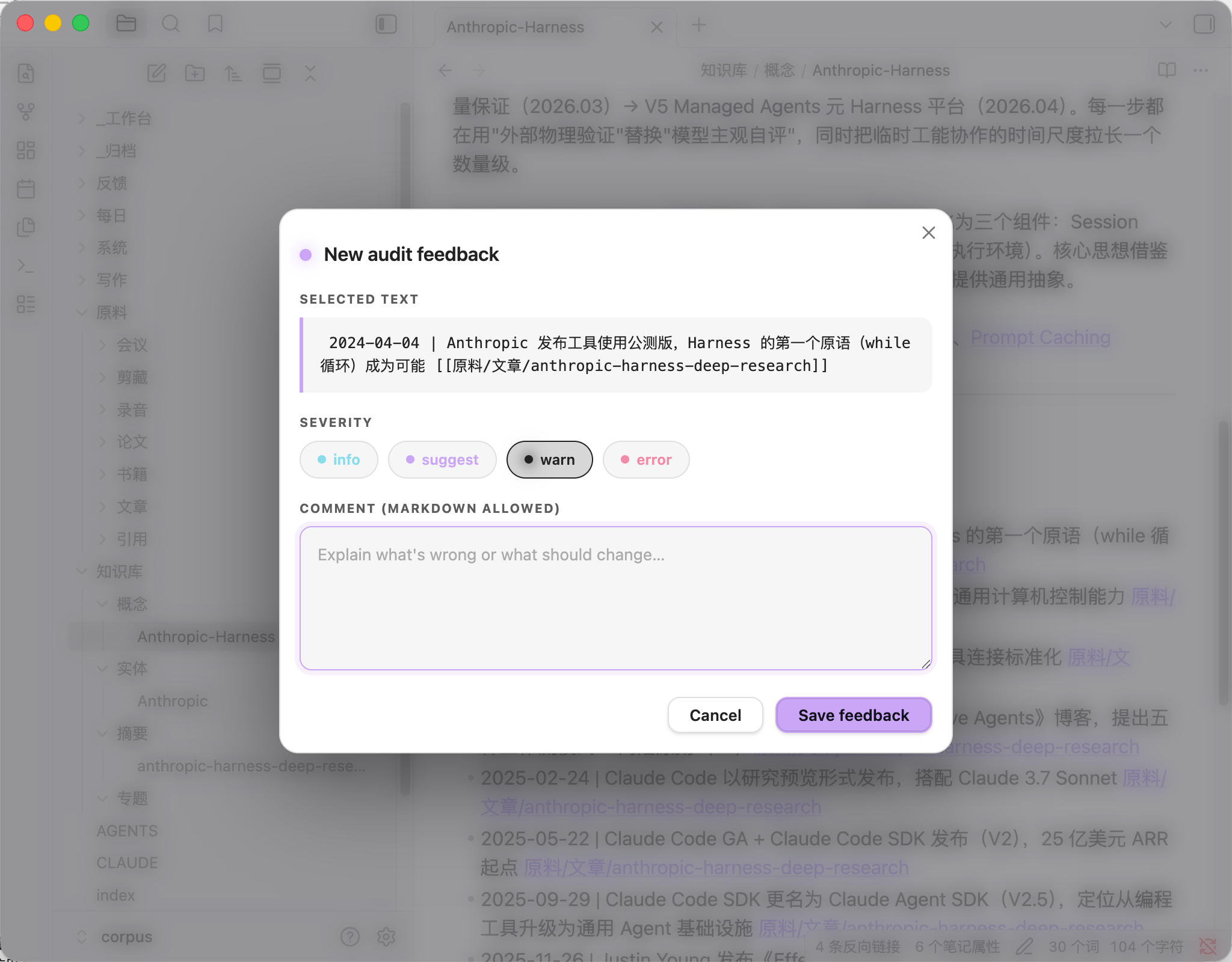
Four severity levels:
| Level | Meaning |
|---|---|
info |
Additional context, not an error |
suggest |
Improvement suggestion |
warn |
Needs attention |
error |
Must fix |
Click Save feedback → written to 反馈/待处理/<timestamp>-<slug>.md with anchor context (resilient to page edits).
Resolving feedback
lorekit audit --list              # list all feedback
lorekit audit --list --open       # open items only
Or in Claude Code say "process the feedback" → the agent triggers wiki-audit: read 反馈/待处理/ entries → fix by severity → move to 反馈/已处理/ with a resolution note.
Graph filter (recommended)
lorekit init writes a recommended graph filter to <corpus>/.obsidian/graph.json that excludes process/system nodes (workbench / archive / feedback / schema and template dirs + auto-generated indexes). Root metadata files such as README.md, AGENTS.md, CLAUDE.md, and MEMORY.md stay visible by default because they can be useful entry and context nodes. If the corpus already has .obsidian/graph.json, init leaves it untouched — copy the filter below into Obsidian's "Graph view → Filters" manually:
-path:"_工作台" -path:"_归档" -path:"反馈" -path:"系统" -path:"模板" -file:"_INDEX" -file:"index" -file:"log"
What stays visible: 知识库/ (compiled wiki), 原料/ (raw sources, heavily back-linked), 每日/ (daily notes — Karpathy keeps these in the graph too), 写作/ (outgoing drafts).
Toggle the graph tab off and on after editing graph.json for Obsidian to re-read it.
Other niceties
[[wikilinks]]are clickable in Obsidian- Graph view visualizes the knowledge network
- Plugin writes to
反馈/待处理/by default — no config needed
Project Layout
lorekit/
├── bin/
│   └── lorekit.js           Node.js CLI entry
├── src/                     TypeScript sources
│   ├── cli.ts               command dispatch + banner
│   ├── commands/            subcommand implementations
│   ├── lib/                 core library (corpus / ollama / vectordb / chunker / fetcher / ingest-state)
│   └── utils/               logger, fs helpers
├── dist/                    tsup build output (committed so users don't need to build)
├── skills/                  Agent Skills (plain markdown, agent-agnostic)
│   ├── wiki-ingest/
│   ├── wiki-query/
│   ├── wiki-fileback/
│   ├── wiki-lint/
│   ├── wiki-enrich/
│   └── wiki-audit/
├── plugins/
│   └── obsidian-audit/      Obsidian audit plugin
├── templates/
│   └── default-corpus/      corpus scaffold template
├── docs/
│   └── QUICKSTART.md        30-minute onboarding guide
├── package.json
├── tsconfig.json
├── tsup.config.ts
├── CLAUDE.md                auto-install instructions for Claude Code
└── AGENTS.md                auto-install instructions for Codex / Kimi / GPT
Acknowledgements
lorekit would not exist without the following projects and people.
Core inspiration
| Source | Author | Contribution |
|---|---|---|
| LLM Wiki Gist | Andrej Karpathy | The core idea — three-layer architecture (raw / wiki / schema), the ingest / query / lint triad, the philosophy that "the wiki is a compilation cache, not the content itself." lorekit's soul comes from this gist. |
| llm-wiki-skill | Lewis Liu | Audit feedback system design, Obsidian audit plugin, references-doc structure. lorekit's 反馈/ directory and audit plugin directly reference this project. |
Referenced projects
| Project | Author | Contribution |
|---|---|---|
| OpenViking | nicepkg | Context Database design, inspired lorekit's layered vector retrieval |
Key dependencies
| Project | Author | Purpose |
|---|---|---|
| bge-m3 | BAAI | Default embedding model (1024-d, 100+ languages) |
| sqlite-vec | Alex Garcia | Vector storage (single-file sqlite extension) |
| ollama | Ollama Inc. | Local model inference, zero-config embedding API |
| qmd | Tobi Lütke (Shopify CEO) | Karpathy-endorsed local markdown search — our search design references it |
Indirect influences
| Source | Influence |
|---|---|
| Vannevar Bush, "As We May Think" (1945) | The Memex concept Karpathy cites — curated personal knowledge where the links matter more than the documents |
| ByteDance RAG field guide | Chunking strategies, hybrid-retrieval engineering |
| Coze Studio source | Four-step knowledge-base pipeline design |
| MTEB Leaderboard | Embedding-model selection |
Design principles
| Principle | Origin |
|---|---|
| "Thin CLI, fat skills" | Garry Tan (YC CEO) — latent judgment in markdown |
| "Filesystem is all you need" | Unix philosophy + Obsidian's plain-file design |
| "Compiled Truth + Timeline" | Wikipedia — editable body + append-only history |
| Per-corpus CLAUDE.md / AGENTS.md | Karpathy's schema concept + Claude Code / Codex conventions |
License
MIT
Yorumlar (0)
Yorum birakmak icin giris yap.
Yorum birakSonuc bulunamadi