sloop
Health Warn
- License — License: Apache-2.0
- Description — Repository has a description
- Active repo — Last push 0 days ago
- Low visibility — Only 6 GitHub stars
Code Pass
- Code scan — Scanned 12 files during light audit, no dangerous patterns found
Permissions Pass
- Permissions — No dangerous permissions requested
No AI report is available for this listing yet.
Agentic coding scheduler, a Rust agent harness that runs background coding agents autonomously


Sloop runs agentic coding work autonomously: each ticket gets its own Git
worktree and agent (Claude Code, Codex, or OpenCode), and Sloop reviews the
result and merges it when it passes.
The model is small: flows are behaviour, tickets are work, projects are
scope. A flow says how work proceeds, a ticket says what the work is, and a
project says which work belongs together.
- Agent orchestration — each ticket picks its agent, model, and effort:
design with a powerful model, send implementation and review to specialized
workers. - Agentic loops — combine predefined flows, parallel multi-agent
execution, and scheduled runs. - Runs while you sleep — background agents work unattended within your
running hours; wake up to finished work. - Repeatable — tickets are Markdown files in your repo, easy to share and
re-run.
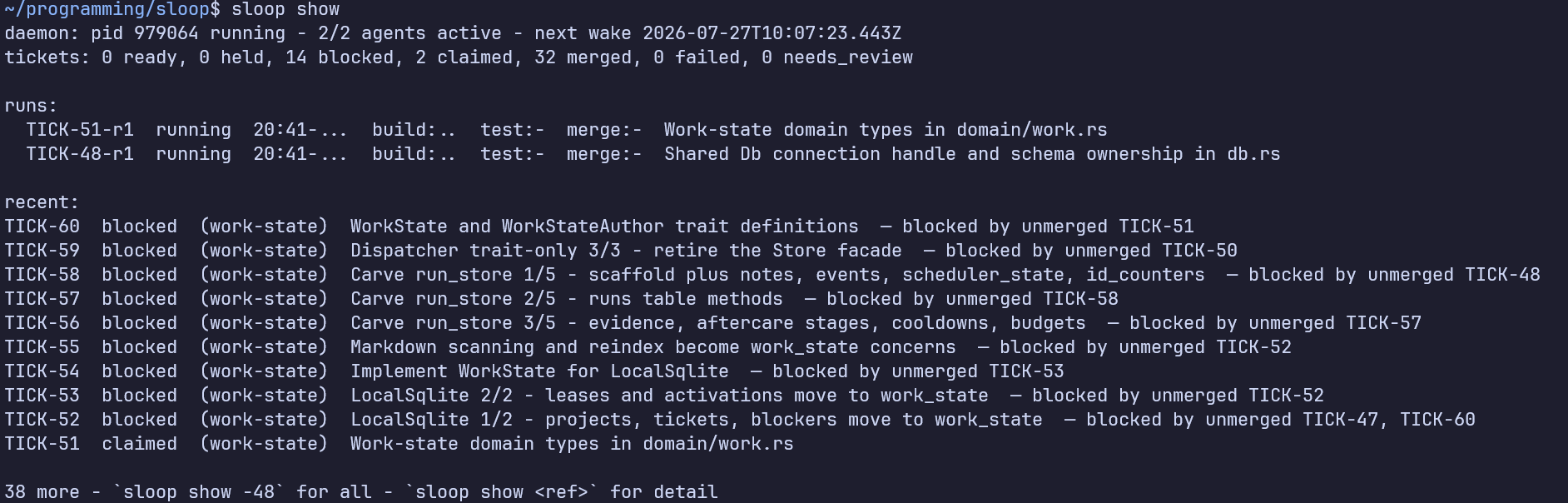
More: ticket detail · live event feed · CLI help
Under the hood it's a small deterministic kernel that checks what untrusted
processes propose. A Rust daemon supervises each run, enforces shared rate
limits, and derives every verdict from evidence it observed itself — process
exit, commits, tests — rather than from the agent's word.
Full documentation lives in docs/.
Install
curl --proto '=https' --tlsv1.2 -LsSf \
  https://github.com/hamish-mackie/sloop/releases/latest/download/sloop-installer.sh | sh
Prebuilt binaries are also on the releases page.
Initialize
sloop init    # Configure this repository
sloop daemon  # Start the scheduler
Write a ticket (my-ticket.md)
---
name: Add request logging
blocked_by: []
target: claude
model: sonnet
effort: medium
---

Log each HTTP request with its method, path, status, and duration.
Post it
sloop post my-ticket.md
sloop show                # Ticket status, and why pending ones aren't running
sloop logs <run-id>       # Follow a run's output
Configuration
sloop init creates .agents/sloop/config.yaml with working targets for
Claude Code, Codex, and OpenCode. To change when work runs or which agent Sloop
uses, edit the generated config:
version: 1

scheduler:
  max_parallel_tasks: 2
  running_hours:
    start: "22:00"
    end: "06:00"

agent:
  default_target: claude
  targets:
    claude:
      model: opus
      effort: high
      cmd: ["claude", "--print", "--model", "{model}", "--effort", "{effort}", "{prompt}"]
    opencode:
      cmd: ["opencode", "run", "--model", "{model}", "--variant", "{effort}", "{prompt}"]
    codex:
      model: gpt-5.6-sol
      effort: high
      cmd: ["codex", "exec", "--model", "{model}", "--config", 'model_reasoning_effort="{effort}"', "--sandbox", "workspace-write", "--ephemeral", "{prompt}"]
Running hours use local time and may cross midnight; omit them to run at any
time. Custom agent commands must include {prompt} exactly once; {model}
and {effort} come from the ticket, falling back to the target's model:
and effort: defaults. Keep secrets in environment variables.
Flows
A flow is the ordered list of stages a ticket walks before its work can merge.
Every stage is three things: an action that does the work, a result_check
that judges it, and a fail_action saying what a failure does to the walk.
stages:
  - name: build
    action: agent
    result_check: { builtin: commits }
  - name: test
    action: { exec: [cargo, test] }
    result_check: none
  - name: merge
    action: { builtin: merge }
    result_check: none
The split is the whole idea: an action never grades itself. build spawns the
ticket's agent, and { builtin: commits } passes it only when Sloop observes a
new commit on the run branch — an agent that exits cleanly having written
nothing has not passed. test runs an argv in the run worktree and is judged by
its exit status. merge applies the branch using Sloop's merge policy.
fail_action defaults to fail, which halts the walk and leaves the branch for
review. fail_action: continue instead records the failure and carries on, for
advisory stages that report without blocking the merge;fail_action: { return_to: build, attempts: 2 } sends the walk back to an
earlier stage and re-runs the span from there, handing the re-entered agent the
failure it has to fix. Both are covered in
docs/configuration.md.
The filename is the flow name. Select one with flow: <name> in the ticket or
with sloop post my-ticket.md --flow <name>.
sloop init writes two flows. default.yaml is build → review → merge, where
review is a second agent that reports its own verdict with sloop verdict;train.yaml is an opt-in merge train that syncs the default branch in and
verifies the result before a fast-forward-only merge, so nothing lands that the
verify stage did not run against. See
docs/configuration.md.
To add a test gate to every flow without editing each one, set:
flow:
  test_cmd: ["cargo", "test"]
This command runs as an implicit test stage at index 1, before the flow's
own later stages.
Logs
Each run's full output is kept as runs/<run-id>/output.ndjson under Sloop's
state directory (on Linux, ~/.local/state/sloop/repositories/<repository>/).sloop daemon prints the exact log and socket paths on startup, andsloop logs <run-id> is the normal way to read them.
Tickets and projects
Tickets live under .agents/sloop/tickets/ and projects under.agents/sloop/projects/ (both configurable). Every ticket belongs to one
project; sloop init creates a default for unassigned tickets. Projects group
and scope tickets, nothing more.
blocked_by lists the ticket IDs that must finish first; [] means none.
Posting rejects a missing name, an empty body, unknown blockers, and
dependency cycles, and assigns an ID and worktree branch (sloop/<id>) unless
you set your own. Reposting an edited file updates the ticket in place.
sloop show <project> lists recent notes and commits per ticket; add --json
for structured data.
Design
Human-authored content lives in committed files. Runtime state lives in a
local SQLite database that only the daemon writes (bundled, nothing to
install). sloop reindex rebuilds whatever can be derived from committed
files and Git; runtime history such as notes may not survive it.
License
Copyright 2026 Hamish Mackie. Licensed under the
Apache License, Version 2.0.
Reviews (0)
Sign in to leave a review.
Leave a reviewNo results found