nudgy
Health Pass
- License — License: MIT
- Description — Repository has a description
- Active repo — Last push 0 days ago
- Community trust — 10 GitHub stars
Code Fail
- rm -rf — Recursive force deletion command in .github/workflows/release.yml
Permissions Pass
- Permissions — No dangerous permissions requested
This is a native macOS menu bar application that sends you desktop notifications when AI coding agents (like Claude Code) finish tasks, need permissions, or require input. It allows you to focus on other work without constantly watching your terminal.
Security Assessment
The overall risk is Low. The tool operates entirely locally and explicitly states it has zero telemetry or remote logging. It does not make external network requests; the only network activity is receiving local events over `127.0.0.1` from your own agent process. It parses local transcripts to track token usage but does not exfiltrate this data. There are no hardcoded secrets, and the tool requests no dangerous system permissions. The only flagged issue is a recursive force deletion command (`rm -rf`) located inside an automated GitHub release workflow. While this is standard for cleaning up build environments during packaging, users should be aware of it if modifying the automation pipelines.
Quality Assessment
The project is active and healthy, with its most recent code push happening today. It is properly licensed under the standard MIT license. The repository has clear documentation and features 10 GitHub stars, indicating early but growing community adoption. It relies on zero external dependencies, utilizing only native macOS frameworks (SwiftUI, AppKit), which significantly reduces the attack surface and maintenance overhead.
Verdict
Safe to use.
Native macOS menu bar app that notifies you when AI coding agents (Claude Code) finish tasks, need permissions, or ask questions. Privacy-first, zero dependencies, localhost-only.







What is Nudgy?
Nudgy is a free, open-source macOS menu bar app that sends you native notifications when AI coding agents like Claude Code finish a task, need permissions, or ask a question. It sits in your menu bar and watches your agent sessions so you can context-switch to other work without constantly checking your terminal.
Nudgy is privacy-first and fully local — your conversations and code never leave your machine. No telemetry, no analytics, no remote logging. The only network activity is receiving hook events from your own Claude Code process over 127.0.0.1.
Currently supports Claude Code (CLI, VS Code, Desktop App), with architecture designed for additional AI coding agents (Aider, Codex CLI, Cursor, etc.) in the future.
Key Features
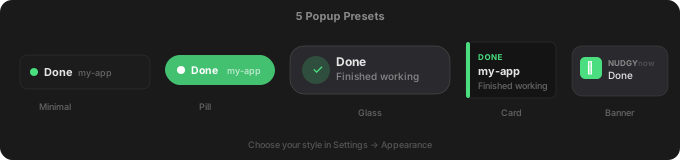
- Floating popup notifications — 5 visual presets (Minimal, Pill, Glass, Card, Banner), configurable screen position
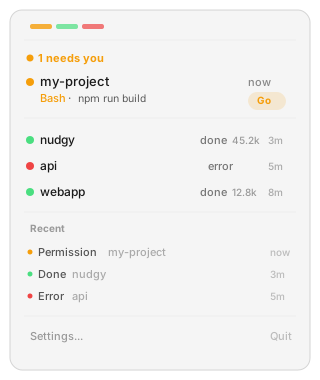
- Menu bar session tracker — live session indicators, attention alerts with "Go" button, per-session token usage
- Multi-session support — color-coded sessions with real-time state (working, done, waiting, error)
- Smart notification suppression — prevents notification fatigue during rapid-fire agent events
- Configurable sound alerts — different sounds mapped to different event types
- Token usage tracking — parses Claude Code transcripts to display tokens consumed per session
- Zero external dependencies — built entirely with native macOS frameworks (SwiftUI, AppKit, Network.framework)
- Per-notification toggles — enable or disable specific event types individually
Menu Bar
Track all your active Claude Code sessions at a glance. Sessions needing attention float to the top with a "Go" button to jump straight to the right terminal window.
Popup Presets
Pick the notification style that fits your workflow — from a tiny dark chip to a full macOS-style banner.
Installation
Download (Recommended)
Grab the latest .dmg from GitHub Releases, open it, and drag Nudgy to Applications.
Build from Source
git clone https://github.com/Hamma111/nudgy.git
cd nudge
make package
open .build/release/Nudgy.app
Requirements: macOS 14.0+ (Sonoma or later), Swift 5.9+
How It Works
Nudgy runs a lightweight HTTP server on 127.0.0.1:9847 that listens for Claude Code hook events. All requests are authenticated with a per-install token stored in macOS Keychain. When Claude Code fires a hook event, Nudgy receives the JSON payload and shows the appropriate notification.
Claude Code ──hook──> POST http://127.0.0.1:9847/event?token=... ──> Nudgy ──> Floating Popup
Automatic Setup
Nudgy automatically installs the required hooks into your ~/.claude/settings.json on first launch, including a unique auth token. Hooks are refreshed on every launch to keep the token current.
Manual Setup
If you prefer to configure hooks yourself:
{
  "hooks": {
    "Stop": [
      {
        "hooks": [
          {
            "type": "http",
            "url": "http://127.0.0.1:9847/event?token=YOUR_TOKEN"
          }
        ]
      }
    ]
  }
}
Nudgy hooks into these Claude Code events: Stop, StopFailure, Notification, PermissionRequest, SessionStart, SessionEnd.
Supported Events
| Event | What Nudgy Does |
|---|---|
| Stop | Agent finished — success popup with token usage |
| PermissionRequest | Agent needs permission — warning popup with tool and command detail |
| Notification (idle/question) | Agent is asking a question — question popup |
| StopFailure | Error during generation — error popup |
| SessionStart | New session tracked — dot appears in menu bar |
| SessionEnd | Session cleaned up — dot removed |
Architecture
Nudgy is built with SwiftUI + AppKit using zero external dependencies:
| Component | Technology |
|---|---|
| HTTP Server | NWListener (Network.framework) on localhost |
| Session Manager | Swift Actor for thread-safe state |
| Floating Popups | NSPanel pool (max 3, auto-dismiss, 5 presets) |
| Menu Bar | NSStatusItem with dynamic icon and session dots |
| Smart Suppression | Rules engine to prevent notification fatigue |
| Token Tracking | JSONL transcript parser for per-session usage |
| Window Focus | Detects active terminal/editor for "Go" button |
See the architecture directory for detailed design docs.
Building from Source
make build      # Release build
make debug      # Debug build
make test       # Run all tests
make clean      # Clean build artifacts
make package    # Create .app bundle
make dmg        # Create distributable DMG
Privacy
Nudgy is fully local. Your conversations, code, and session data never leave your machine. There is no telemetry, no analytics, no crash reporting, and no remote logging. The only network activity is the localhost HTTP server (127.0.0.1) receiving hook events from your own Claude Code process. Nothing is sent to the internet.
The source code is open — you're welcome to audit every line.
FAQ
Does Nudgy read my code or conversations?
No. Nudgy only receives structured hook event payloads (event type, session ID, timestamps) from Claude Code. It does not read your source files, conversation history, or terminal output. The only content it parses is the Claude Code transcript file for token counts, and that data stays entirely on your machine.
Does Nudgy work with AI coding agents other than Claude Code?
Currently Nudgy supports Claude Code (CLI, VS Code extension, and Desktop App). The architecture uses a generic HTTP hook protocol, so support for other agents like Aider, Codex CLI, and Cursor can be added in the future.
Does Nudgy send any data to the internet?
No. Nudgy binds exclusively to 127.0.0.1 (localhost). It makes no outbound network requests. There is an optional Usage Quota feature that, if enabled by the user, fetches quota info from the Anthropic API — but this is off by default and requires explicit opt-in.
Is Nudgy free?
Yes. Nudgy is free and open-source under the MIT License.
What macOS versions are supported?
macOS 14.0 (Sonoma) and later. Nudgy uses SwiftUI and modern Apple frameworks that require macOS 14+.
How do I uninstall Nudgy?
Quit Nudgy from the menu bar, then delete Nudgy.app from your Applications folder. Nudgy will automatically clean up its hooks from ~/.claude/settings.json when you quit.
Contributing
Contributions are welcome! Please read the Contributing Guide before submitting a pull request.
License
This project is licensed under the MIT License — see the LICENSE file for details.
Reviews (0)
Sign in to leave a review.
Leave a reviewNo results found