pam-benchmark
Health Warn
- License — License: Apache-2.0
- Description — Repository has a description
- Active repo — Last push 0 days ago
- Low visibility — Only 9 GitHub stars
Code Pass
- Code scan — Scanned 12 files during light audit, no dangerous patterns found
Permissions Pass
- Permissions — No dangerous permissions requested
No AI report is available for this listing yet.
Industrial benchmark for AI memory – measuring how accurately LLM and agent memory systems recall long-term context, with uniform, reproducible scoring across datasets and memory products.

Pam Benchmark
An open industrial benchmark for AI memory — how well do memory systems recall long-horizon conversational and organizational context?



Harmix · Pam (product) · Blog · Research
This is the benchmark Harmix uses to validate Pam's memory layer against other AI-memory systems. Pam (Proactive AI Manager) is an enterprise AI assistant that learns continuously from organizational data — documents, ERP/CRM, Linear, Slack — to anticipate problems and automate work. The whole product hinges on accurate long-horizon recall, so this harness answers one question repeatedly, with reproducible numbers: is Pam's memory better than other best memory systems on the tasks our customers care about?
We're publishing it for transparency behind the results we cite in our blog posts.
📊 Headline Result
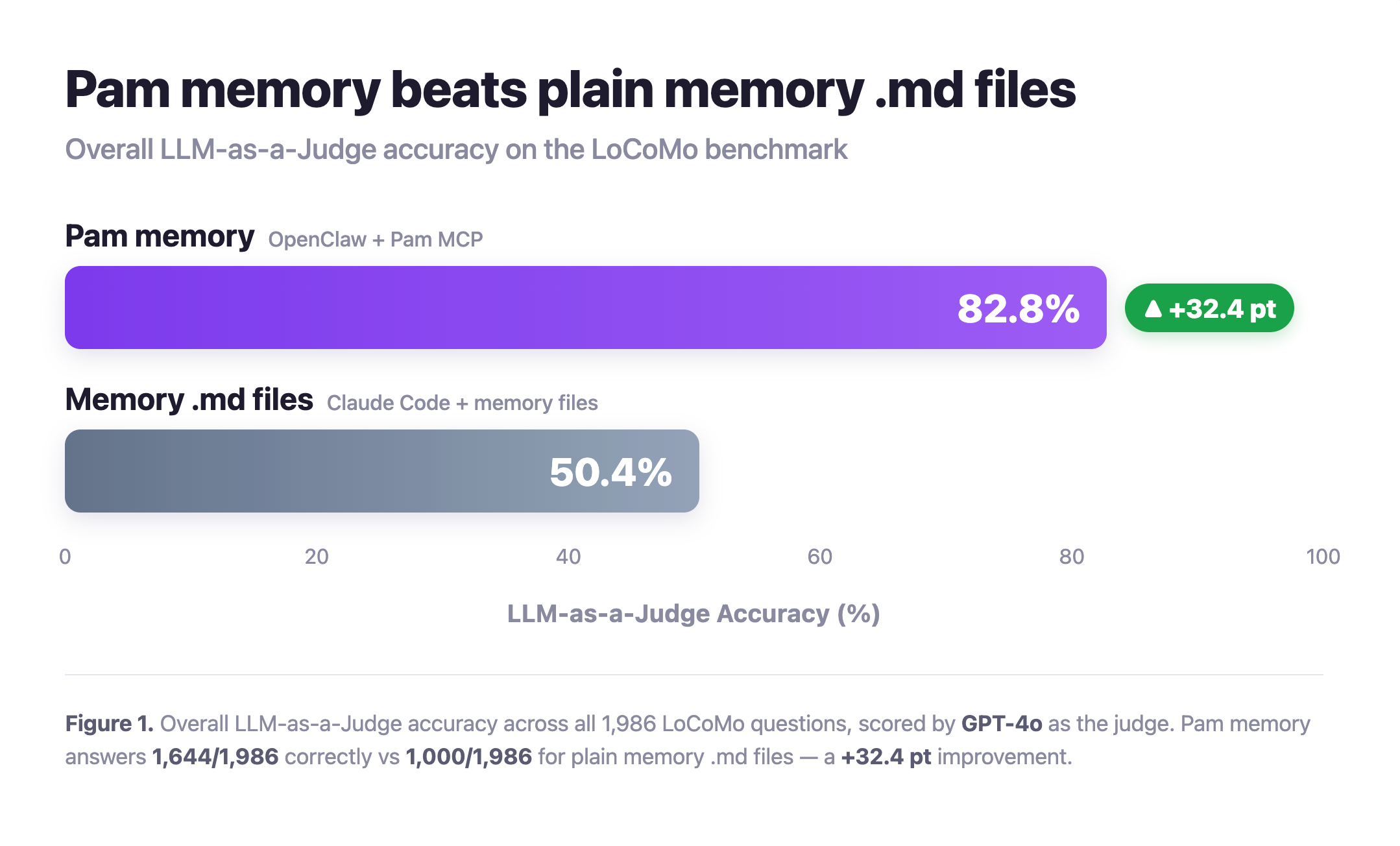
On the full LoCoMo benchmark (1,986 questions, LLM-as-a-Judge scored by GPT-4o), Pam's memory answers 1,644/1,986 (82.8%) correctly versus 1,000/1,986 (50.4%) for plain Memory.md files on a coding-agent harness — a +32.4 pt improvement. See docs/blog_post_notes_locomo.md for our broader LoCoMo results write-up.
🧠 What This Repo Is
A single, uniform harness that runs different systems-under-test over the same datasets, with the same scoring, so the numbers are directly comparable. Each run:
- Loads a dataset of long multi-session conversations with QA pairs.
- Feeds each conversation to a baseline (a plain LLM, Pam's memory API, or a memory system running on an agentic harness).
- Asks the baseline every question and scores answers with token-F1 and an LLM-as-a-Judge rubric.
- Records per-question tokens, latency, and cost, and renders an HTML/Markdown report.
Why a custom benchmark? Public memory benchmarks are saturating for top models, don't cover Harmix-shaped workloads (multi-tool coordination, long retrospectives), and don't run competitors uniformly on the same data with the same scoring. This harness does.
📚 Datasets
| Dataset | Status | Samples | Task | Source |
|---|---|---|---|---|
| LoCoMo | ✅ Shipped | 10 conversations · ~1,986 QA total | Multi-session dialogue QA across single-hop, temporal, open-domain, multi-hop, and adversarial recall | snap-research/locomo (ACL 2024) |
| MemTrack | 🚧 Planned | — | Long-term memory & state tracking for agents across multi-platform workflows (Slack + Linear + Git) with async events and conflicting information — close to Pam's production workload | Deshpande et al., NeurIPS 2025 SEA Workshop |
| LongMemEval | 🚧 Planned | — | Long-conversation memory eval | LongMemEval |
Dataset details and licensing live in each dataset's README, e.g. src/datasets/locomo/README.md.
🏆 Baselines
A baseline is one system-under-test, implemented against the Baseline protocol in src/baselines/base.py.
| Baseline | What it is | Memory | Status |
|---|---|---|---|
LiteLLM models (gpt-4-turbo, gpt-4o, …) |
Any LiteLLM-supported model; the full conversation is packed into each prompt (no external memory) | None | ✅ Shipped |
Pam (pam) |
Harmix's in-house memory layer via the Pam HTTP API — uploads the conversation, builds a memory, answers in batches | External (Pam) | ✅ Shipped |
Claude Code + Memory.md (memory_md_mcp) |
A filesystem-Markdown memory backend running on the Claude Code agentic harness | External (Markdown files) | ✅ Shipped |
| Dedicated memory products (mem0, Zep, Supermemory, Honcho) | Other memory APIs run through the same harness | External | 🚧 Planned |
See src/baselines/README.md, src/baselines/pam/README.md, and docs/mcp_harness_benchmark_plan.md.
🛠️ Dependencies
- Python 3.12 and uv ≥ 0.5 (the only thing you install by hand;
uv syncdoes the rest). - Core libraries:
litellm+instructor(model calls),pydantic+typer+rich(CLI),pymongo(result store),tiktoken/nltk/scipy(scoring & stats),jinja2(reports),asyncpg(Pam metrics). Full pin set inpyproject.toml/uv.lock. - Optional services: MongoDB (result store — skip with
--no-mongo); a Claude Code CLI + Vertex AI access for the agentic-harness experiment; Pam API credentials for thepambaseline.
Secrets are read from a gitignored secrets.env (see How to Use).
📁 Repository Structure
.
├── src/                         # PYTHONPATH=src
│   ├── cli.py / mcp_cli.py      # CLI definitions for the two run modes
│   ├── runner.py registry.py    # run loop + name→object lookups
│   ├── config.py seeds.py mongo.py
│   ├── datasets/<name>/         # one loader per dataset (locomo shipped)
│   ├── baselines/<name>/        # one system-under-test per baseline
│   ├── harnesses/<name>/        # agentic harnesses (claude_code)
│   ├── tasks/<name>/            # per-dataset pipeline + prompts
│   ├── evals/                   # metrics: qa_f1, llm_judge, efficiency, runtime, stats
│   └── reporting/               # Mongo → HTML/MD renderer
├── scripts/                     # entrypoints (run_benchmark, run_mcp_benchmark, generate_report, download_data)
├── cluster/                     # Dockerfiles + image build/push scripts (Cloud Run Jobs)
├── tests/                       # ~200 unit tests; no live LLM calls
├── docs/                        # design docs, plans, blog notes
├── pyproject.toml uv.lock       # uv-managed dependencies
└── LICENSE                      # Apache-2.0
🚀 How to Use
Prerequisites: uv ≥ 0.5, Python 3.12, a secrets.env, and the LoCoMo data at src/datasets/locomo/data/locomo10.json.
# 1. Install dependencies
uv sync

# 2. (optional) install git pre-commit hooks
uv run pre-commit install

# 3. Verify the dataset is in place
uv run python scripts/download_data.py --dataset locomo

# 4. Smoke run — 1 sample, 5 questions, gpt-4-turbo
uv run python scripts/run_benchmark.py \
  --dataset locomo --baseline gpt-4-turbo \
  --exp-name local_smoke --sample-index 0 --max-questions 5

# 5. Render the HTML report
uv run python scripts/generate_report.py --exp-name local_smoke
open reports/local_smoke/report.html
--exp-name is the key that groups results, artifacts, and reports. For multi-seed runs, call run_benchmark.py N times with the same --exp-name and different --seed. Everything works without Mongo via --no-mongo.
Run Pam (needs PAM_API_* secrets): swap in --baseline pam and tune --pam-batch-size.
Run a memory system on an agentic harness (needs a claude CLI + Vertex secrets):
uv run python scripts/run_mcp_benchmark.py \
  --dataset locomo --harness claude-code --baseline memory_md_mcp \
  --harness-model <vertex-claude-model-id> --exp-name mcp_locomo_md_v1 \
  --mcp-batch-size 10
secrets.env
A gitignored file with the keys for whatever you run. Minimal set for an LLM baseline:
OPENAI_API_KEY=sk-...
CONNECTION_STRING=mongodb+srv://...   # omit and pass --no-mongo to skip Mongo
DB_NAME=your-db
The pam baseline additionally needs PAM_API_* (and DATABASE_* for agent-side token metrics); the agentic-harness experiment needs VERTEX_PROJECT_ID / VERTEX_REGION / VERTEX_CREDENTIALS. The full per-baseline list is in src/baselines/pam/README.md and docs/mcp_harness_benchmark_plan.md.
Outputs
- Local:
outputs/<exp-name>/<seed>/withconfig.yaml(resolved run config) andmetrics.json(aggregate metrics). - Mongo: one document per
(exp_name, sample_id, seed)in<dataset>_results, with the full per-question payload (question, expected, answer, F1, judge verdict, tokens, latency). - Reports:
reports/<exp-name>/report.html, rendered on demand from Mongo.
Running on the cloud
Dockerfiles and image build/push scripts live in cluster/ — one set for the standard runner (cluster/run_benchmark/) and one for the agentic-harness experiment (cluster/run_mcp_benchmark/, which bundles the Claude Code CLI). Build & push with the relevant build_and_push.sh, then run the image as a Cloud Run Job. Point the scripts at your own GCP project, Artifact Registry repo, and Secret Manager entries.
🧪 Tests & Quality
env PYTHONPATH=src uv run pytest -q     # ~200 unit tests (no live LLM calls)
uv run ruff check src scripts tests     # lint
uv run ruff format src scripts tests    # format
uv run pre-commit run --all-files       # everything CI runs
CI (.github/workflows/ci.yml) runs lint, format, and tests on every PR to main.
➕ Adding a Dataset or Baseline
- Dataset: add
src/datasets/<name>/{loader.py,schemas.py}implementingDatasetLoader, then register it insrc/registry.py. - Baseline: subclass
Baselinefromsrc/baselines/base.py(reuseLiteLLMBaselinefor plain LLMs), then register it insrc/registry.py.
Patterns and conventions: src/baselines/README.md.
📖 Documentation
| Doc | What's in it |
|---|---|
docs/blog_post_notes_locomo.md |
LoCoMo results write-up and blog notes (Pam vs. other memory systems) |
docs/mcp_harness_benchmark_plan.md |
Design of the memory-on-agentic-harness experiment |
docs/benchmark_rewrite_plan.md |
Architecture, decisions, and roadmap of the harness |
docs/init_memory_bank.md |
Methodology standards (datasheets, model cards, reproducibility) |
src/baselines/pam/README.md |
How the Pam baseline talks to the Pam API |
📄 License
Code in this repository is licensed under the Apache License 2.0.
Datasets keep their own upstream licenses and are not redistributed here — the LoCoMo data file is gitignored and bound by its upstream terms. Review a dataset's license before redistributing it.
🔗 Links
- Harmix — https://www.harmix.ai
- Pam product — https://manager.harmix.ai
- Blog — https://manager.harmix.ai/blog
- Research — https://manager.harmix.ai/research
Reviews (0)
Sign in to leave a review.
Leave a reviewNo results found