EduOrchestrate
Health Warn
- License — License: MIT
- Description — Repository has a description
- Active repo — Last push 0 days ago
- Low visibility — Only 9 GitHub stars
Code Fail
- spawnSync — Synchronous process spawning in .eduorchestrate/mcp/server.js
- spawnSync — Synchronous process spawning in src/adapters.js
- exec() — Shell command execution in src/cli.js
- process.env — Environment variable access in src/cli.js
Permissions Pass
- Permissions — No dangerous permissions requested
No AI report is available for this listing yet.
Turn any AI coding agent into a daily learning command center — adaptive role plans, sourced research, daily emails. CLI-first.
EduOrchestrate
Turn any AI coding agent into a daily learning command center.
One command turns a target job role into an adaptive plan, trend-aware research, daily emails, and a skill progression card — running locally inside the agent you already use. Your data, your machine.




Quickstart · Features · Agents · CLI · How it works · FAQ
Why EduOrchestrate?
Most learning tools are SaaS dashboards that collect courses you never finish. EduOrchestrate is the opposite: a vendor-neutral learning coach that lives in your CLI. It turns "I want to become an Agentic AI Engineer" into a concrete daily loop — one core topic, one build artifact, one review — with sourced research and proof of progress.
Job boards use AI to filter candidates. EduOrchestrate gives the learner AI to build a daily, sourced path to the job — one artifact at a time.
 Role → plan in one command. Pick a target role and a first skill; get an adaptive plan with a fixed 30-day minimum.
 AI-native & agnostic. The same
 /eduorchestrateskill works across Claude Code, Codex, Gemini, OpenClaw, Antigravity, Hermas, and any MCP agent. Local-first & private. Learning state stays in
 data/; SMTP secrets live in.env.localor GitHub Actions — never committed. Zero dependencies. A dependency-free Node CLI. Audit it in an afternoon.
 Open source, MIT. No account, no paywall, no telemetry.
 Quickstart
From an agent terminal in your project:
npx eduorchestrate
That's it. The interactive setup captures your profile (name, email, target role, current topic, first-skill focus, stage, plan length, daily email time, timezone, SMTP), writes the agent adapters, and generates your first 30-day plan.
npx handles it. What it does
| Feature | Description | |
|---|---|---|
 | Adaptive role plans | Learner-chosen length with a fixed 30-day minimum. One topic, one build artifact, one review loop per day. |
 | Trend-aware research | Daily digests of dated, sourced updates from official docs, YouTube search, and GitHub sample code — and only reshapes the roadmap when a trend improves employability. |
 | Daily email delivery | Preview with --dry-run, then send the day's plan over your own SMTP. |
 | Autonomous runner | A generated GitHub Actions workflow delivers your daily plan hands-free — no browser or agent session needs to stay open. |
 | Skill progression cards | Prebuilt, GitHub-style SVG terminal cards showing role, skill, momentum, and next action. |
 | Course source packs | Role-specific official catalogs, free-course discovery links from major vendors, and newsletter feeds. |
 | Token-conscious harness | Tells the agent what to load first, when to research, and what not to paste into chat. |
 | Progress & reviews | Evidence logging, weekly summaries, and a recommend-next that suggests your next skill after the plan window. |
Built-in role blueprints
 Agentic AI & LLM Engineer RAG, evals, agent workflows |
 Full-Stack Developer Web, cloud, CI/CD |
 Cybersecurity Analyst SOC, SIEM, cloud security |
 Data Scientist Data eng, analytics, ML |
For other roles, EduOrchestrate infers the closest blueprint and keeps the plan artifact-driven.
 Supported agents
The same /eduorchestrate command is honored across runtimes — setup writes the right adapter for each. Where a runtime can't register slash commands, it treats use EduOrchestrate as equivalent to /eduorchestrate.
| Agent | Adapter written on setup |
|---|---|
| Claude Code | .claude/skills/eduorchestrate/SKILL.md |
| Codex / generic coding agents | AGENTS.md |
| Gemini | GEMINI.md |
| OpenClaw | .eduorchestrate/adapters/openclaw/SKILL.md |
| Antigravity | .eduorchestrate/adapters/antigravity/manifest.json |
| Hermas | .eduorchestrate/adapters/hermas/manifest.json |
| MCP-capable agents | .eduorchestrate/mcp/manifest.json |
 The CLI
Everything runs from one dependency-free CLI. State writes to data/ and is git-ignored by default.
# Plan
npx eduorchestrate plan --role "Agentic AI and LLM Engineer"
npx eduorchestrate plan --role "Agentic AI and LLM Engineer" --skill "RAG evaluation" --days 45

# Daily loop
npx eduorchestrate harness                     # load the token-conscious harness
npx eduorchestrate courses                      # role-specific course + newsletter packs
npx eduorchestrate research --day 1             # dated, sourced trend digest
npx eduorchestrate send-today --dry-run         # preview the daily email
npx eduorchestrate send-today                   # send for real (your SMTP)
npx eduorchestrate log-progress --day 1 --completed "Built setup" --evidence "Repo link"

# Review & cards
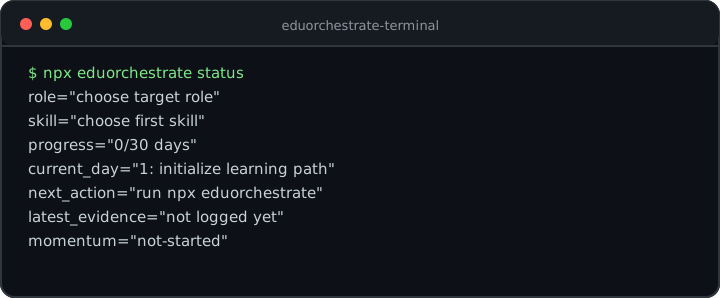
npx eduorchestrate status                       # current role, skill, day, next action
npx eduorchestrate weekly-summary --week 1
npx eduorchestrate progress-card                # GitHub-style skill card (md + json)
npx eduorchestrate terminal-card                # terminal-style SVG card
npx eduorchestrate recommend-next               # next skill after the plan window

# Setup helpers
npx eduorchestrate setup-secrets                # prints `gh secret set` commands for Actions email
npx eduorchestrate doctor                       # verifies skill, adapters, config, env files
| Command | What it does |
|---|---|
plan |
Generate an adaptive plan (--role, --skill, --days; 30-day minimum enforced). |
harness |
Write the compact execution harness (data/eduorchestrate-harness.json / .md). |
courses |
Write role-specific learning sources (data/learning-sources.json / .md). |
research |
Produce a dated, sourced trend digest for a given --day. |
send-today |
Send today's plan email (--dry-run previews without sending). |
log-progress |
Record completed work + evidence for a day. |
status |
Print current role, skill, progress, current day, and next action. |
weekly-summary |
Summarize a --week of progress. |
progress-card / terminal-card |
Render learner-specific progression cards. |
recommend-next |
Suggest the next skill once the plan window completes. |
setup-secrets |
Print the gh secret set commands for Actions email delivery. |
doctor |
Diagnose the repo's skill, adapter, config, and environment files. |
 How it works
EduOrchestrate models the system as a typed multi-agent workflow — even when a single model executes it:
flowchart LR
    R["Target role<br/>+ stage"] --> GM[GoalMapper]
    GM --> CP[CurriculumPlanner]
    CP --> RS[Researcher]
    RS --> BM[BuildMentor]
    BM --> FC[FocusCoach]
    FC --> EV[Evaluator]
    EV -->|next action| CP
| Agent | Responsibility |
|---|---|
| GoalMapper | Translate target role + stage into priority skills. |
| CurriculumPlanner | Create milestones and a daily focus plan. |
| Researcher | Gather dated, sourced updates from official docs and release notes. |
| BuildMentor | Turn topics into practical projects with deliverables. |
| FocusCoach | Limit scope and prevent resource overload. |
| Evaluator | Review evidence and adjust the next action. |
Each day becomes one build action with visible proof — research current references, practice one focused skill, preview or send the email, log evidence, keep the next action visible.
 Autonomous daily delivery
EduOrchestrate doesn't need a browser window or an open agent session to deliver. On setup it writes .github/workflows/eduorchestrate-daily.yml, which runs in GitHub Actions at your configured time:
- Runs
node bin/eduorchestrate.js send-todayon schedule. - Pulls SMTP credentials from GitHub Actions secrets (
setup-secretsprints the exactgh secret setcommands). - Advances the day from
schedule.startDateand stops after the plan window instead of repeating the same day forever.
send-today --dry-runis always a safe preview.send-todaysends real email. Adapters follow the same resume rule everywhere: on resume, load the harness/status, resolve today's day, and only send after SMTP setup is approved.
 Configuration & state
| What | Where | Committed? |
|---|---|---|
| Plans, digests, logs, cards | data/ |
No — git-ignored |
| SMTP secrets | .env.local or GitHub Actions secrets |
No — never |
| Schedule / profile config | eduorchestrate.config.json |
Yes (no secrets) |
 Architecture
src/
├── cli.js                 # dependency-free command router
├── planner.js             # role blueprints + adaptive plan generation
├── adapters.js            # writes per-agent adapter files
├── workflow.js            # GitHub Actions runner generator
├── research.js            # official docs / YouTube / GitHub-sample digests
├── courses.js             # role-specific course + newsletter source packs
├── harness.js             # token-conscious execution harness
├── progress.js            # progress log, status, weekly summaries
├── progression-card.js    # role/skill + terminal card generation
├── card-components.js     # compact SVG component renderer
├── email.js               # SMTP mailer
└── config.js              # config + data-dir resolution
skills/eduorchestrate/     # canonical universal skill + assets + references
tests/node/                # Node regression tests
 Development
git clone https://github.com/haroontrailblazer/EduOrchestrate.git
cd EduOrchestrate
npm test            # run the Node regression suite
npx .               # run the CLI locally before publishing
The whole CLI is dependency-free and runs on Node 18+. There is no build step.
 FAQ
FAQ
Is it really free? What's the license?
Yes — MIT-licensed and open source, with zero runtime dependencies. No account, no paywall, no telemetry. The only thing you pay for is whichever AI coding CLI you already use.
Where does my data go?Local. Plans, research digests, progress logs, and cards write to data/, which is git-ignored. SMTP credentials live in .env.local or GitHub Actions secrets — never in committed config.
A month is the floor for building real, demonstrable momentum on a job role. You can request a longer plan, but if you ask for fewer than 30 days it still generates 30.
Which agents does it work with?Claude Code, Codex and generic coding agents (AGENTS.md), Gemini, OpenClaw, Antigravity, Hermas, and any MCP-capable agent. See Supported agents.
A generated GitHub Actions workflow runs send-today on schedule using your stored secrets. Run setup-secrets to print the commands that store SMTP credentials as Actions secrets.
 Contributing
Contributions are welcome! Whether it's a new role blueprint, an agent adapter, better course sources, or docs — open an issue or PR.
- Fork & branch from
main - Keep it dependency-free and add/adjust tests in
tests/node/ - Run
npm test - Open a PR with a clear description
 Star history
 License
MIT © EduOrchestrate — your data, your machine.
Reviews (0)
Sign in to leave a review.
Leave a reviewNo results found