Mirofy
Health Uyari
- License — License: MIT
- Description — Repository has a description
- Active repo — Last push 0 days ago
- Low visibility — Only 5 GitHub stars
Code Basarisiz
- exec() — Shell command execution in benchmarks/authors/claude-cli.mjs
- spawnSync — Synchronous process spawning in benchmarks/authors/claude-cli.mjs
Permissions Gecti
- Permissions — No dangerous permissions requested
Bu listing icin henuz AI raporu yok.
Repository diagrams that cite their sources. Every edge names the file, line and commit it came from — and every file it could not read is listed by name. Six languages, zero dependencies, one self-contained HTML file.

Diagrams of your system that cite their sources — and say what they could not see.





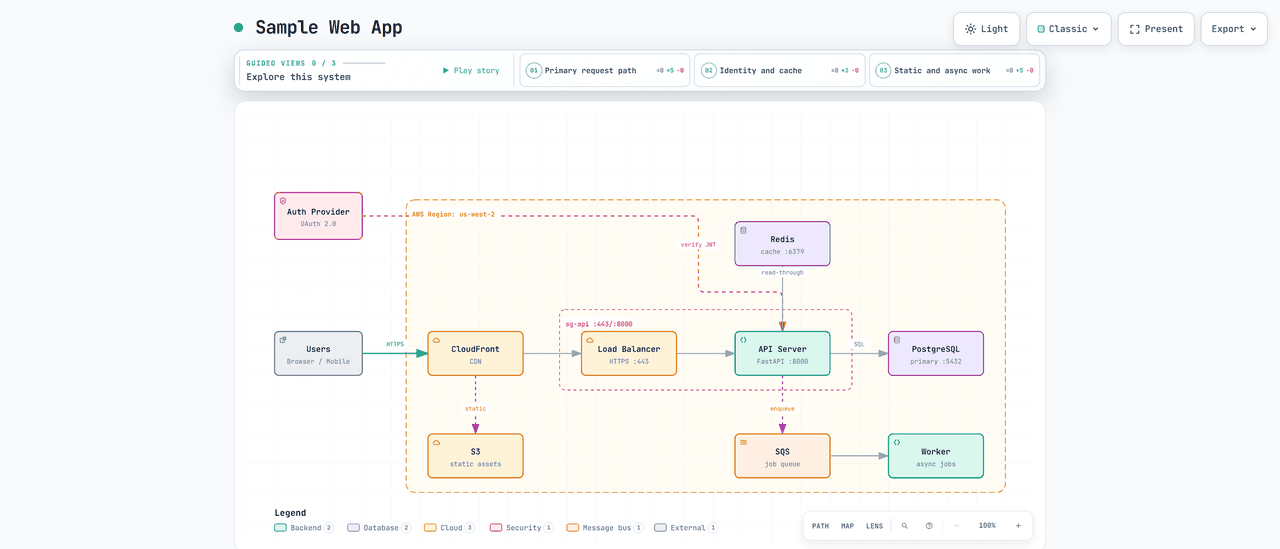
This is the whole product: one HTML file, open in a browser. Every colour
in it is the system’s own vocabulary — backend, database, cloud,
security, message bus, external — and nothing else. Colour never marks
where an arrow goes, only what a thing is.
Open this exact file ↗ —
click any node for its evidence, trace what reaches it, search it, present it.
What it is
Point Mirofy at a repository. It reads the code into an evidence graph,
builds a model from that graph, and compiles the model into one HTML
file you can open, search, share and check.
Every relationship it draws can answer one question: what is the evidence for
this? Each carries the file, the line range and the commit it came from. Where
nothing is known, the diagram says so instead of filling the gap.
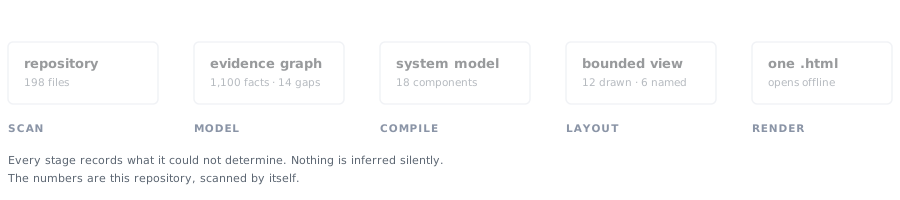
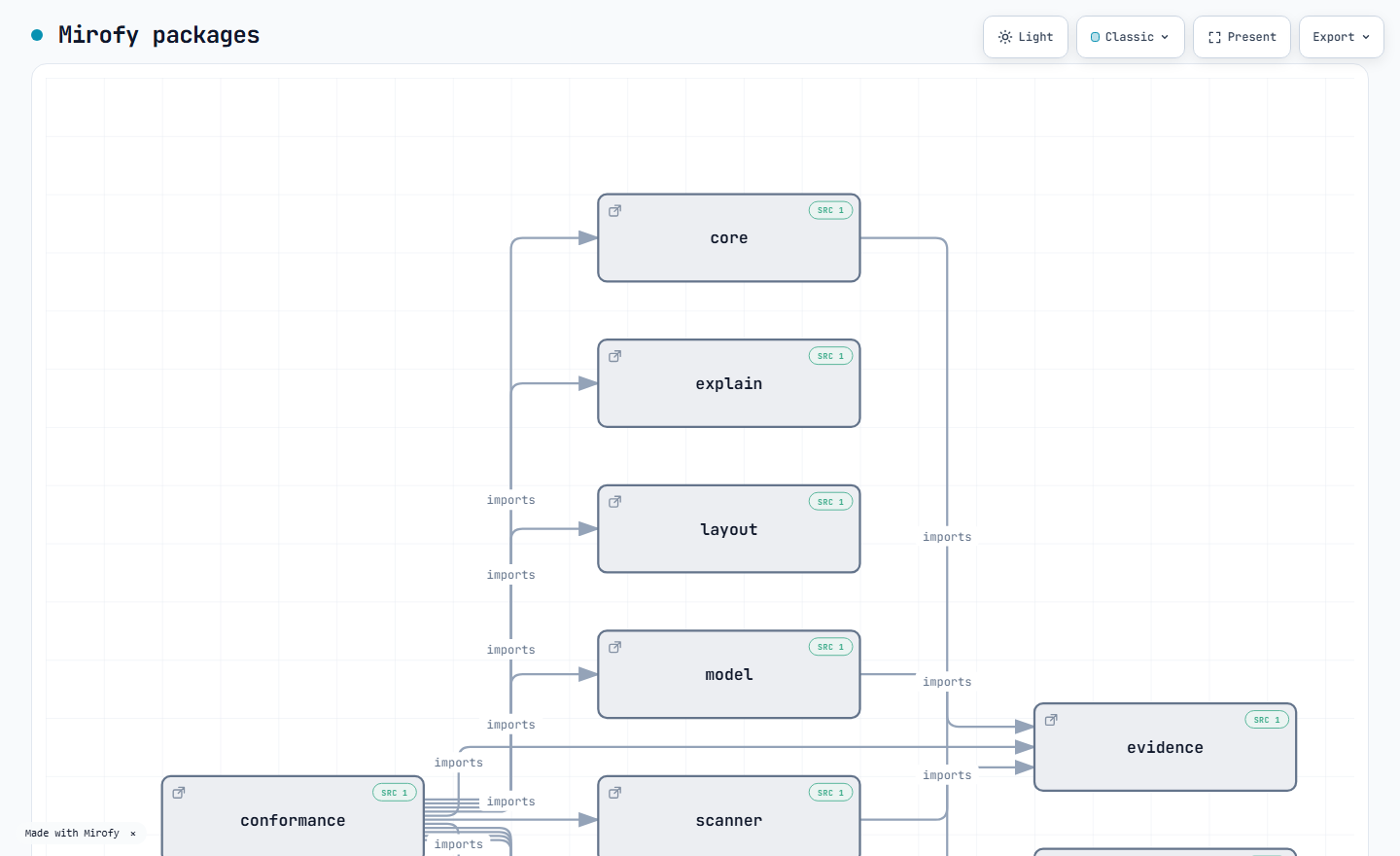
Run it against this repository and you get this — not a mock-up, and not drawn
by hand:
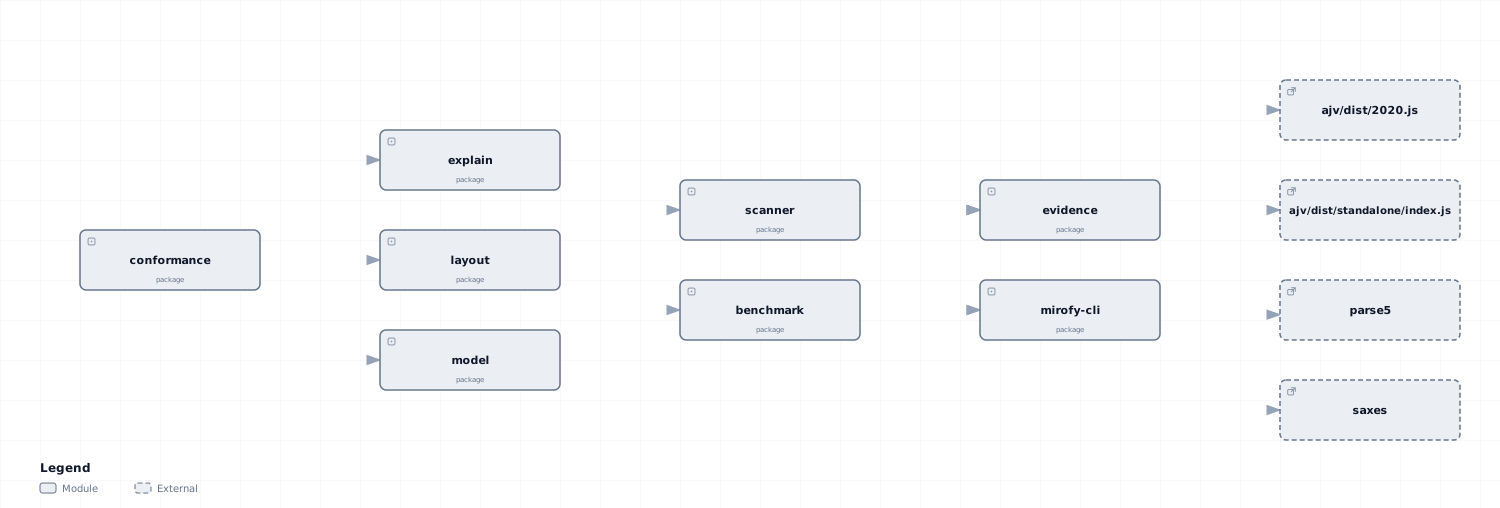
Every box is the same colour here, and that is the point. All twelve of
these are the same thing — a package, derived from a manifest — so there is
nothing for colour to say, and it says nothing. The picture at the top is
colourful because that system genuinely has six kinds in it. A tool that
tinted these boxes to look livelier would be inventing a distinction it had
not found.
Open the live one ↗ — click any
node for the file, line range and commit behind it.
Install
Nothing to install — one command, and a diagram opens:
npx mirofy-cli map .    # YOUR repository, mapped, in one command
npx mirofy-cli demo     # a finished artifact, to see what this produces
npx mirofy-cli init     # a starter document of your own to edit
npx mirofy-cli render architecture architecture.json
map runs the whole pipeline in the directory you point it at — scan, model,
compile, layout, render — and writes architecture.html next to your code.map --out <dir> sends the diagram and the intermediates there instead, so
nothing lands in your repository; without it the intermediates go to<target>/scan. Naming an output path still wins over both. It works on a repository that declares no
workspaces: where there are no packages to draw, it models the source
directories and the imports between them.
What it reads
JavaScript and TypeScript imports · Python imports · Go imports ·
Java imports · Rust imports · Kotlin imports ·package.json workspaces · Express and Next routes · docker-compose.
That is the whole list, and the list is the point. Everything else is
reported, not skipped: coverage.md names every file no adapter opened,
grouped by type, and map says so on its way out when the unread files
outnumber the read ones. Point it at a Ruby repository and you get an honest
empty answer naming every unread .rb file — not a confident small one drawn
from the two JavaScript files in an examples/ folder.
Python resolves by file existence, not by convention: relative imports
against the importing file's directory, absolute ones against the repository
root and any directory that actually holds a package. A specifier that matches
two source roots is a gap naming both, because which one wins depends onsys.path, which is configuration and not in the source.
Go resolves against the module path go.mod declares, and decides the
standard library the way the toolchain does — a first path segment containing a
dot is a domain, and a domain means a module fetched from somewhere. Java
builds its index from the package statements files declare, not from
directory layout: Maven convention puts com.acme.store undersrc/main/java/com/acme/store and convention is not always, but the
declaration is what the compiler reads.
Rust peels a use from the right until a real file appears, becauseuse crate::a::b::C does not say which of a, b or C is the file. It reads the
crate name and the source root from Cargo.toml — including a declared[lib] path, since src/ is only the default — and knows that Cargo compiles
every direct child of tests, benches and examples as its own crate.
Kotlin reads its type index from the declarations themselves — class, interface,object, typealias and fun interface among them — rather than from file
names, because a Kotlin file need not be named after the type
it holds and may declare several. It shares that index with Java: the two
compile to one namespace and import each other freely, so an index of one
extension reports a real edge to the other as a missing type.
In every one of them, an import that names something inside this repository
which is not there is a gap — never a dependency on a published copy of
yourself.
npx mirofy-cli guide "show an API request with a cache miss" picks the
diagram type for you if you are not sure which one you want.
As a CLI you keep — npm install -g mirofy-cli. The command it installs ismirofy; the package carries the -cli suffix because npm refused the bare
name as too close to the existing minify.
From source — no install at all, because there is nothing to install:
git clone https://github.com/Hasan-Laraib/Mirofy.git
node Mirofy/packages/core/bin/mirofy.mjs demo
That works on a bare checkout with no npm install, because every package here
has zero runtime dependencies.
As an agent skill — build the bundle and copy it where your agent looks:
git clone https://github.com/Hasan-Laraib/Mirofy.git
cd Mirofy && npm install && npm run build:skill

cp -r dist/mirofy ~/.claude/skills/      # Claude Code
cp -r dist/mirofy ~/.agents/skills/      # Codex CLI, opencode
Then ask: Use mirofy to map this repository's runtime architecture.
The bundle is 2.8 MB and named for the skill inside it — copying packages/core
instead installs a skill called core that says in its own frontmatter it is
called mirofy, and drags the test suite along with it. Before writing the
bundle, build:skill copies it somewhere with no repository around it and
renders a diagram: a bundle that only works inside its own checkout is not a
bundle.
Nothing is downloaded at runtime and nothing phones home — there is no update
check, because a tool that reaches the network to tell you about itself is a
tool that reaches the network.
The pipeline, one step at a time
mirofy map is these five steps in order. Run them yourself when you want to
keep an intermediate, or point a step somewhere else:
npm run scan                    # repository  → evidence graph
npm run model -- --from-graph --graph scan/evidence-graph.json
npm run compile                 # model       → a bounded view
npm run layout                  # view        → positioned document
node packages/core/bin/mirofy.mjs render architecture scan/diagram.json out.html --repo-root .
Against this repository it records 1,100 facts across 198 files,
with 14 gaps it could not read; derives 18 components and 20
relationships — every one citing the file and line it came from — and draws
twelve, recording what it left out and why.
Those figures are checked, not remembered — see
the numbers on this page below.
Those commands reproduce the diagram at the top of this page. It is checked in
under assets/ as documentation; the interactive artifacts are built, never
stored.
No repository? Author a JSON document, or convert a Mermaid diagram:
node packages/core/bin/mirofy.mjs import mermaid design.mmd
node packages/core/bin/mirofy.mjs render architecture design.json out.html
node packages/core/bin/mirofy.mjs validate architecture design.json --json
What you get
Open any edge and it tells you why it is on the page: the relation, its
provenance class, the file and line it came from, and the commit it was
checked against. Underneath is the half most tools leave out — what the
scanner could not determine, written down instead of guessed.
That record is real, and taken from this repository. So is the gap.
Three claims about the pictures below, each with the thing that keeps it honest.
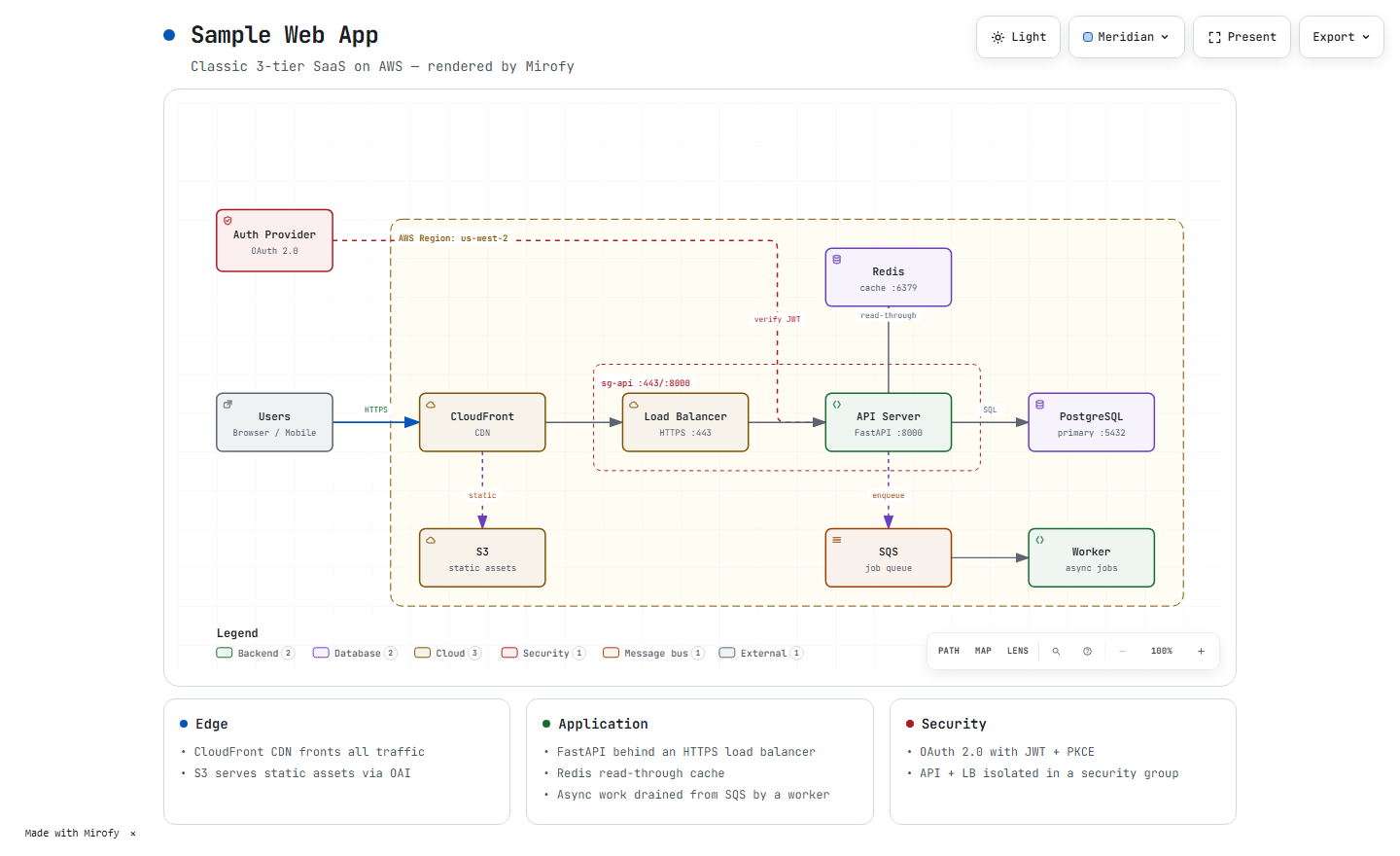
Colour tells you what a node is, never where an arrow goes.
Six presets, light and dark. |
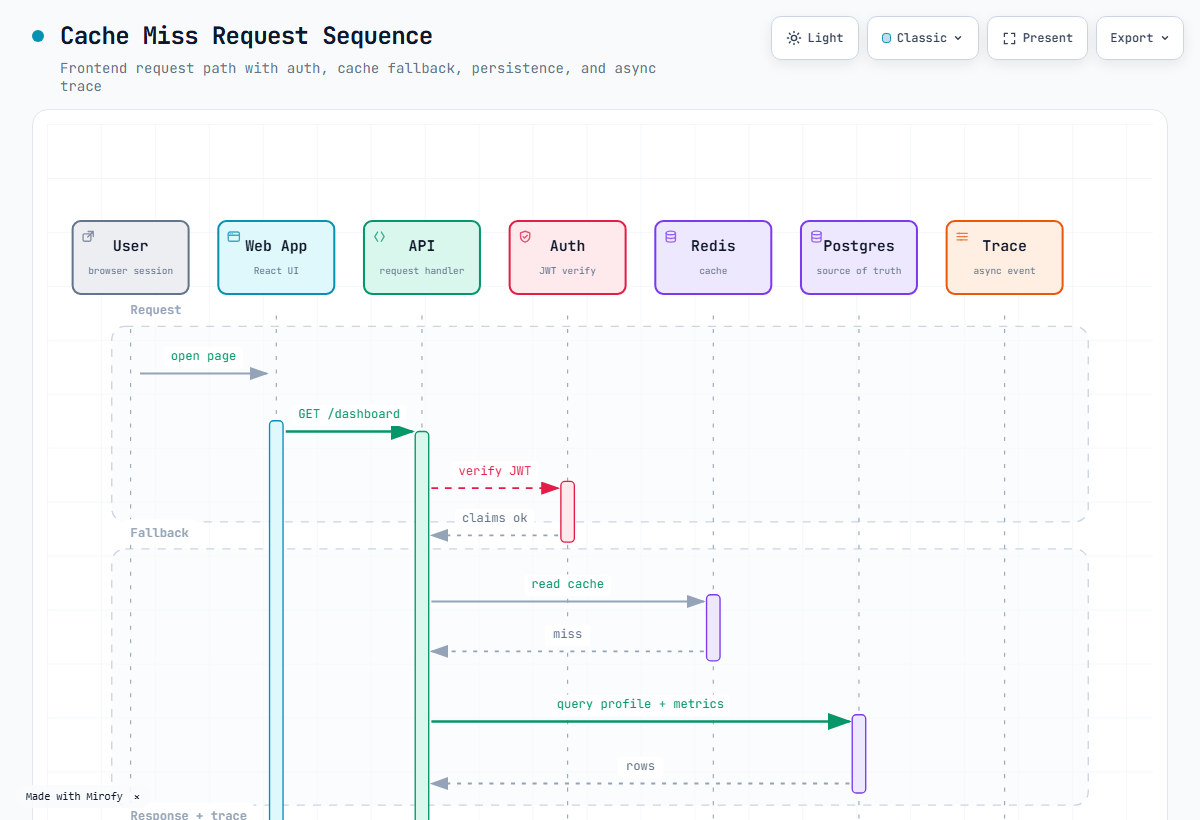
Five diagram types, one schema, one validator.
architecture · workflow · sequence · dataflow · lifecycle — the same typed IR
behind all of them.
|
One file. No server — and nothing it needs from the network.
The diagram, the evidence, the search and every interaction are in the
file. The one thing it ever asks the internet for is a webfont
it does not wait for and does not need, and it falls back to
your system monospace without it.
Checked on every run by scripts/check-readme-claims.mjs,
which fails the build the moment a reference appears that could block first
paint or change what the diagram says — and which fails just as loudly if this
sentence ever overstates what the artifact actually fetches.
All thirty are live ↗ — five types × six presets, rebuilt from every commit.
The viewer, actually being used
Not mock-ups. Every frame below is a capture of the shipped viewer, driven
through real clicks by scripts/build-screenshots.mjs — which fails rather than
reuse an old picture if a control is renamed or a panel stops opening, and
refuses to save a shot of a feature that did nothing.
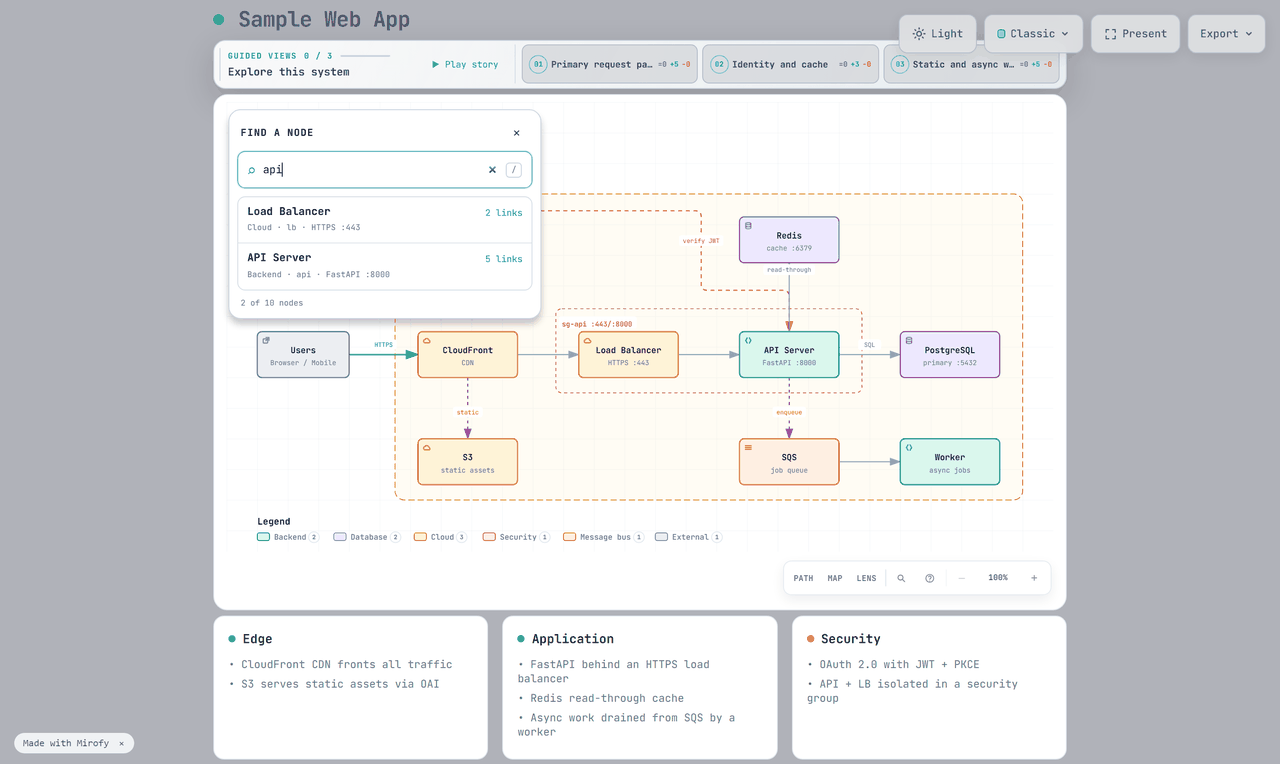
Find anything. Typing |
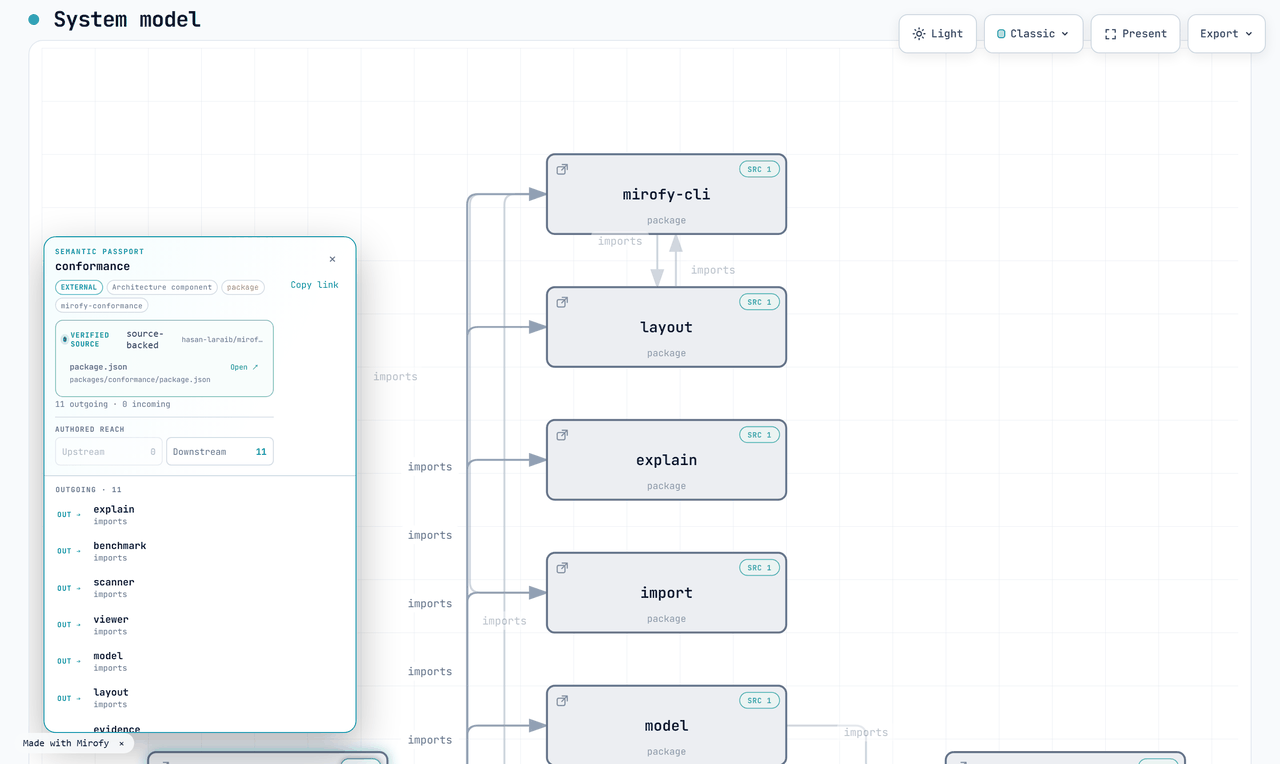
Ask a node where it came from. |
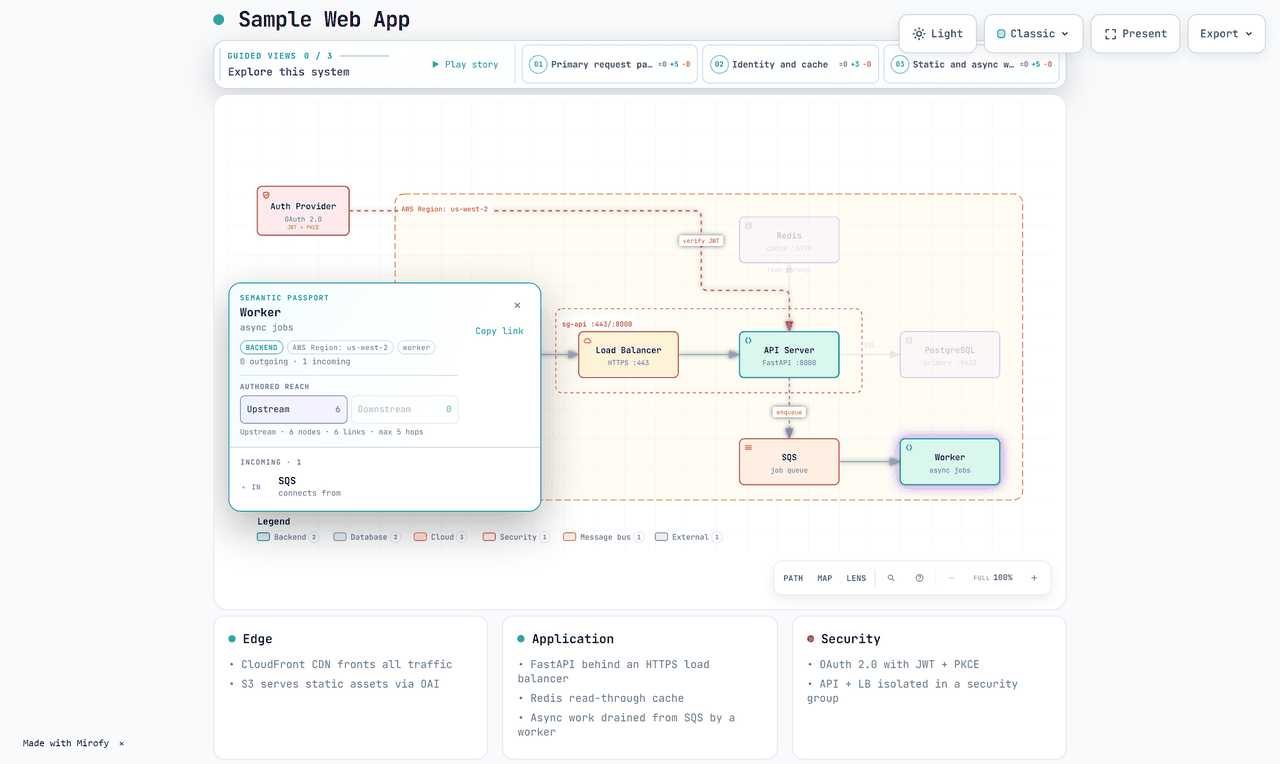
Follow what reaches what. Upstream of |
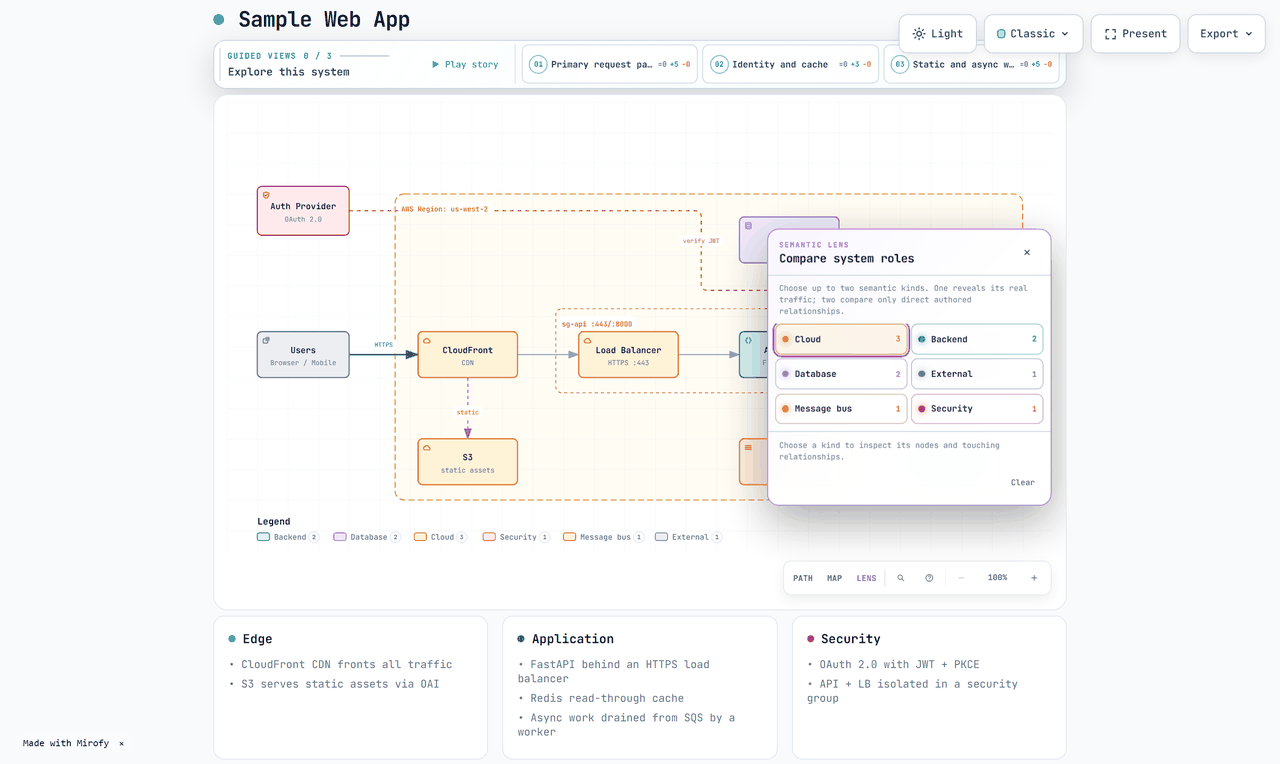
Compare roles across the whole system. The Semantic Lens answers provenance and kind for every node at once, rather than one node at a time. |
What it does that a diagram tool doesn't
It refuses to guess
A file the scanner cannot parse becomes a recorded gap, never a silent
omission. Every fact is labelled with one of six provenance classes, sosource-backed and inferred never look alike.
The same rule holds where a decision has to be made that evidence cannot
settle. A derived component's kind is package — the scanner knows a manifest
exists, not whether something is a "backend". 784 imports of Node builtins are
counted and named, not drawn and not dropped in silence. In Python a computedimportlib.import_module(name) is a gap with its line, and docstrings are
blanked before parsing — a docstring full of example imports would otherwise
become edges the code does not have, cited to prose. A citation with no
pinned commit to verify against is discarded rather than shown, because a
citation nobody can check is worse than none — map reads the commit from
your origin remote, or takes --repo-url and --revision when there is no
remote to read.
A passport lists at most three sources, because forty-three links is not a
passport. It says “Showing 3 of 43 cited sources” when it does, so a bound on the
drawing is never mistaken for a claim about the evidence.
It answers questions about your system
npm run explain -- callers api     # what points at api
npm run explain -- impact api      # what is downstream of it
npm run explain -- find payment    # id, label, kind or metadata match
npm run explain -- gaps            # what the scan could not read
Every answer names the unread files that could change it. "Nothing calls
PaymentService" is useful if the scanner read everything and reckless if six
files failed to parse — so an empty result means not found, never does not
exist.
impact answers as reachability and refuses to be more. What is connected is
a fact about the graph; whether a change breaks it is a judgement about a
running system, and Mirofy has no evidence for that.
Your agent can ask too
The same queries over MCP — nine tools, the same engine, not a second
implementation that could disagree with the CLI:
{ "mcpServers": { "mirofy": { "command": "node", "args": ["packages/mcp/bin/mcp.mjs"] } } }
The incompleteness warning is in the prose an agent reads, not only the
JSON. Most clients feed the text to the model and drop the rest.
It checks architecture rules — with three outcomes, not two
npm run assert # reads architecture-rules.json
pass, fail, and unproven. A rule that found no violation over a scan
with unread files has not been shown to hold, so it never counts as passing.
Turning a gap into a green check is the one failure this project exists to
avoid.
Some gaps are permanent — a dynamic import whose base path is a variable cannot
be resolved without guessing. Those can be acknowledged, one path at a
time, quoting the gap's reason and carrying a written argument. An
acknowledgement written for a dynamic import stops applying the day that file
fails to parse instead. And a rule that passes on the strength of one says so:
[ok  ] no-cycles — No violation. 8 unread file(s) are acknowledged as unable
       to hide one; this rests on that judgement, not on a complete scan.

2 passed, 0 failed, 0 unproven of 2
2 of those rule(s) rest on acknowledged gaps, not on evidence.
It tells you what is moving
npm run timeline                                # cited-file churn, newest first
npm run drift -- --base a.json --head b.json    # what two scans say differently
Drift reports changed facts and nothing else — no score, no risk label, no merge
recommendation. It runs on every pull request and can never fail one.
The number we would rather not publish
A benchmark asks one question: hand a model a written brief, and how often does
the diagram it writes come out usable on the first attempt?
Right now, over eight briefs authored by Claude Code: 2 of 8.
node scripts/benchmark.mjs --author "<your command>" --model "<id>" --keep benchmarks/corpus/mine
node scripts/benchmark.mjs --replay benchmarks/corpus/mine
That is not a good number and it is the real one. Three things make it worth
printing anyway.
Usable means clean, not accepted. A warning is the diagram telling you it
needs a second look, which is exactly what a first-pass rate is supposed to
exclude. Two more documents in that set validate with zero errors and are still
not counted.
It is measured against a saved corpus, not a fresh one. --keep stores what
the model produced; --replay re-runs the tool over those exact documents
without calling the model again. Without that split, every re-run changes both
the documents and the tool, and any movement can be attributed to either — which
is why the rate sat at zero for weeks without anyone being able to say what was
wrong. A replay cannot even claim a different author: the model is read from the
saved manifest, and --model is refused if it disagrees.
It moves for reasons you can name. The last change to the layout engine took
the same eight documents from 0 of 8 to 2 of 8, and total composition errors
from 121 to 34, because a diagnostic that said "shorten the label or widen
size" was asking an author to rename part of their system to fit a box the
renderer had picked. The renderer now widens the box.
If you compare this to a number published elsewhere, check what was measured.
A rate for an agent that can call a validator and repair its own output, reviewed
by a person at the end, is a different measurement from a blind single-shot
model — not a worse one, a different one. Ours is the second kind.
Inside the artifact
- Node Finder, Semantic Lens, Semantic Radar — search, filter and
overview a diagram too large to read at once - Route Probe — resolve a directed path and see it traced, hop by hop
- Semantic Passport — click a node for its type, tags and cited evidence,
with a Verified Source Beacon on anything backed by a pinned commit - Your code, drawn apart from everyone else’s — a module you wrote is
solid, a third-party package is dashed. Not a colour: the colour-blind-safe
preset already spends all seven of its hues on the seven semantic roles, so
an eighth would be a distinction only some readers could see - Guided views, presentation mode, motion governor, and
?embed=1 - Three exports, copied straight to the clipboard:
- Export → Share Card — a 1200×630 PNG in the current theme and preset
- Export → Route Share Card — the exact route a Route Probe resolved
- Export → Reach Share Card — the set a reachability query returned
A card shows what the reader actually did. None of them claim validation, and
none are produced from a query that returned nothing.
npm run gallery      # every type in every preset → preview/index.html
npm run build:site   # the same, plus this repo's self-model → site/
The second is what CI publishes to
hasan-laraib.github.io/Mirofy on every commit. Nothing
is committed: the site is built from the code at the commit it describes, so it
cannot go on quietly describing an older one.
Taking it elsewhere
The interactive file is ~720 KB and earns it. None of that survives a README, a
pull request or a Notion page, though — all of them strip scripts. So:
# 19 KB standalone SVG: no scripts, no stylesheet needed
node packages/core/bin/mirofy.mjs render architecture in.json out.svg --format svg-static

# or open it in an editor you already own
npm run export -- drawio     architecture in.json
npm run export -- excalidraw architecture in.json
| where it goes | how |
|---|---|
| README, pull request, Notion, Confluence | svg-static |
| Figma, Canva, Illustrator, Sketch | svg-static — styling is written as attributes, so it arrives with its colours |
| diagrams.net · draw.io VS Code extension | drawio — real shapes and connectors |
| Excalidraw · Obsidian · VS Code | excalidraw — bound arrows, movable boxes |
The SVG carries its styling twice: in a stylesheet and on the elements. In
SVG a stylesheet outranks an attribute, so a browser renders from the CSS, and
the attributes speak only where the CSS is ignored — which is exactly what
Figma, Canva and Illustrator do. Without them the diagram imports shape-correct
and colour-dead.
Both editor exports say exactly what they lost, computed from your document
rather than recited as a disclaimer. A diagram you can only edit in the tool
that made it is a diagram held hostage.
What is proved
The conformance matrix has 105 rows. 85 are proved without a browser;
19 more need headless Chrome (MIROFY_CHROME), bringing the total to 104.
npm run check # lint, types, 1,000+ tests, golden parity, conformance, size, audit
Every row names a test, and the title must match character-for-character — a row
whose proof file passes while its own test was renamed counts as unproven,
never as passing. One row (6.10, deterministic ZIP packaging) is UNPROVEN and
counted as such rather than quietly dropped.
Skipped is not passed. Browser rows never count toward the proved total
unless a browser actually ran them.
And the numbers on this page are checked too:
node scripts/check-readme-claims.mjs
It counts the matrix, reads the tool list the MCP server serves, renders an
artifact to measure it, and re-runs the benchmark. This exists because a review
found three numbers here wrong at once — none of them dishonest, all of them
true when written and left behind by the repository. A page that argues for
checking claims has no business making unchecked ones.
Evidence and provenance
Six classes, never blurred:
| class | means |
|---|---|
authored |
a human wrote it |
source-backed |
read out of a cited file and line range |
statically-derived |
computed from code without running it |
config-derived |
read from a manifest — configuration, not code |
runtime-observed |
seen in a real run |
inferred |
a guess, and labelled as one |
Source citations verify against a pinned 40-character commit in a real local
checkout before they render. A path that does not exist at that revision is an
error, not a broken link.
Several repositories can be declared at once, and a citation names which one it
belongs to. Verifying against a repository rather than the right one is how
a path from a sibling repo passes as evidence for this one.
Packages
| package | does |
|---|---|
scanner |
adapters that read a repository into facts and gaps |
evidence |
append-only evidence graph, query, honest coverage |
model |
the system model: stable ids, evidence refs, human overrides |
compile |
view compiler and the planner seam |
explain |
graph queries, architecture rules, drift, timeline |
mcp |
the model as agent context |
import |
Mermaid into typed documents |
export |
draw.io and Excalidraw escape hatches |
layout |
constraint layout: intent to coordinates (dev-time) |
core |
renderers, schemas, validators, CLI |
viewer |
the interactive viewer, built into one template |
benchmark |
first-pass usable rate, over a saved corpus |
conformance |
the matrix, and the tests every row names |
Zero runtime dependencies in every package. The artifact ships nothing but
itself.
packages/core/assets/template.html is generated from packages/viewer/.
Never edit it directly — edit the source and run npm run build:template.npm run check:template rebuilds from source and fails if the committed file
has drifted.
Attribution
Every artifact says what made it. The viewer footer is dismissible — the
diagram is yours, and a banner you cannot close is an imposition on someone
else's document. Share Cards carry a permanent one, because a card travels
without its context and lands where nothing says where it came from.
It names the tool and claims nothing about the diagram, and carries no URL: a
link baked into every shared artifact outlives the address it points at.
MIT. packages/core/LICENSE retains, verbatim, the required third-party
copyright notice for the imported rendering core; the root LICENSE covers this
project's own work.
Yorumlar (0)
Yorum birakmak icin giris yap.
Yorum birakSonuc bulunamadi