horizonX
Health Uyari
- License — License: NOASSERTION
- Description — Repository has a description
- Active repo — Last push 0 days ago
- Low visibility — Only 5 GitHub stars
Code Gecti
- Code scan — Scanned 12 files during light audit, no dangerous patterns found
Permissions Gecti
- Permissions — No dangerous permissions requested
Bu listing icin henuz AI raporu yok.
Long-horizon agent execution harness — reliable autonomous runs for Claude Code, Codex, OpenHands, and custom agents. Goal graphs, spin detection, HITL gates, fork/merge, 8 strategies, 6 validators.
HorizonX
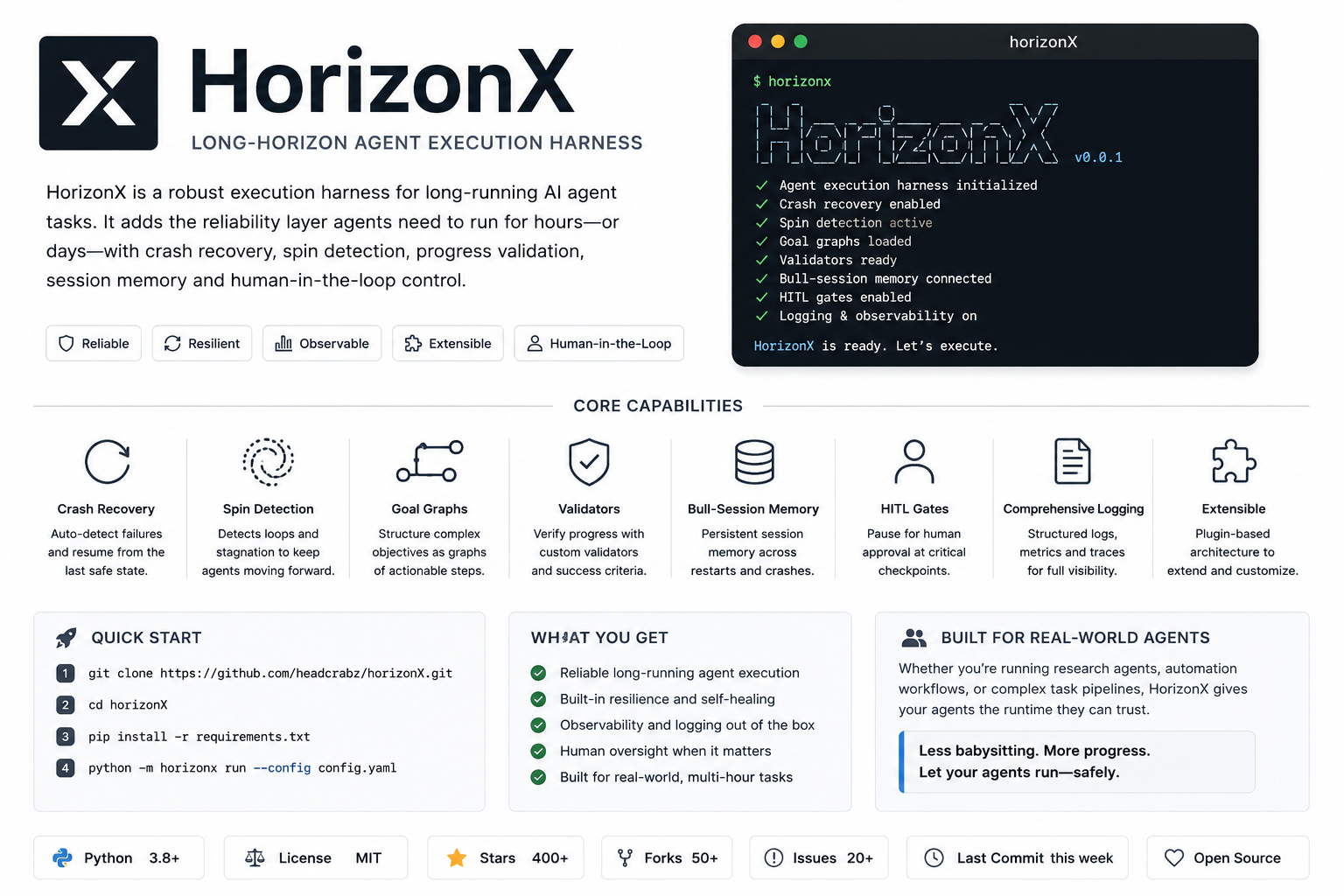
Alpha research preview of a vendor-neutral control plane for long-horizon agent tasks.
HorizonX coordinates Claude Code, Codex, OpenHands, and custom agents around durable run state,
goal graphs, validation, resource policies, and operator controls. The repository contains tested
building blocks for those capabilities, but several end-to-end guarantees are still being
hardened. It is suitable for local evaluation and development—not unattended or production use.




What it does
HorizonX is not an agent. It is an experimental runtime layer around existing agent harnesses.
The current alpha includes:
- Durable records — SQLite stores runs, attempts, sessions, append-only events, leases,
validations, HITL records, and usage. Goal persistence is authoritative and run-scoped;
topology-specific exact crash recovery is still under hardening. - Spin analysis — seven detectors cover repetition, oscillation, plateaus, and cross-session
stagnation. Every strategy uses the shared detector path; richer recovery actions are planned. - Resource-policy components — token, cost, time, and workspace-budget models exist. Uniform
enforcement across all strategies and providers is under hardening. - Knowledge components — FTS5 knowledge storage and Markdown handoff sync exist as modules.
Automatic cross-run sync and prompt injection are not yet wired into the production run path. - Goal graphs and validators — DAG planning and six validator types are implemented. Database
recovery, a complete evidence contract, and unattended operation are under hardening. - Eight strategy modules — single, sequential, pair, tree, self-critique, decomposition,
monitor, and ralph. Their agent calls share one session, recording, limit, charging, spin,
validation, and cleanup lifecycle. - Operator and observability components — Slack HITL, dashboard SSE, and CLI watch exist.
Durable authenticated operator controls, callback handling, restart-safe HITL decisions and
cancellation, and cursor-replay SSE are implemented for the local single-daemon alpha.
See the support matrix before relying on a capability.
Quick start
Prerequisites: Python 3.11+ and one supported agent CLI. This repository is not yet
published as a stable package, so install it from source:
git clone https://github.com/headcrabz/horizonX.git
cd horizonX
python3.11 -m venv .venv
source .venv/bin/activate
python -m pip install -e .

# Confirm the CLI is available
horizonx --help
Install and authenticate one of the supported agent harnesses, then run
the smallest example:
horizonx run examples/demo_word_counter/task.yaml

# Inspect the run ID and persisted status
horizonx list
horizonx show <run-id>
To run against an existing Git repository, pass its local path. HorizonX checks out the requested
ref into an isolated worktree and leaves the source checkout unchanged:
horizonx run path/to/task.yaml --repo . --ref HEAD
By default, orchestration state is written to ./horizonx.db. From-scratch runs use./horizonx-workspaces/; local repository runs use a hidden sibling directory so the source tree
does not become dirty. The CLI prints the exact run ID, status, and workspace path. Keep the
database on a local filesystem and use one HorizonX process. To choose explicit locations, use--db path/to/horizonx.db before the command and --workspace-root after run.
Optional operator views:
# Follow a run from another terminal
horizonx watch <run-id>

# Install and launch the dashboard
pip install -e ".[dashboard]"
horizonx serve
serve binds to 127.0.0.1 by default. If you use a non-loopback serve --host, configureHORIZONX_OPERATOR_TOKEN so dashboard launch, HITL, cancellation, and command-writing endpoints
require a bearer token. This remains a local, single-daemon alpha service.
Resume is experimental and operates at supported attempt/session boundaries. Startup reconciliation
can continue a captured provider thread when its adapter supports it; it cannot reattach a lost
local process. Terminal runs cannot be resumed; fork them to begin new work:horizonx run task.yaml --resume <run-id>.
The checked-in Compose file is currently a development stub, not a supported quick start. Image
packaging, container binding, and health checks remain under hardening.
Examples to try
| Example | What it demonstrates | Command |
|---|---|---|
| Word counter | One bounded agent session with a final test gate | horizonx run examples/demo_word_counter/ |
| Self critique | Implementer/reviewer iterations with an acceptance score | horizonx run examples/demo_refactor/ |
| Coding | A multi-session sequential goal graph | horizonx run examples/coding/ |
Examples can invoke paid agent/model APIs. Read each task.yaml and its resource limits before
running it. The longer examples describe intended evaluation scenarios; they are not production
recipes.
Task definition
id: refactor-auth-001
name: Refactor authentication to JWT
prompt: |
  Replace session-cookie auth with JWT tokens.
  Use RS256 signing. Update all protected routes.
  All existing tests must continue to pass.

strategy:
  kind: sequential
  config:
    max_attempts_per_goal: 3
    git_commit_each_session: true

agent:
  type: claude_code
  model: claude-opus-4-8

# Optional for tasks that operate on an existing repository.
# Use `url` instead of `path` to clone a remote source.
repository:
  path: .
  ref: HEAD
  branch: horizonx/jwt-refactor
  submodules: false

environment:
  type: local
  setup_commands:
    - python -m venv .venv
    - .venv/bin/pip install -r requirements.txt
  inherit_env: [PATH, HOME, ANTHROPIC_API_KEY]

milestone_validators:
  - id: tests_pass
    type: test_suite
    runs: after_every_session
    on_fail: pause_for_hitl
    config:
      command: pytest tests/ -q

hitl:
  notification_type: slack
  notification_target: "#eng-alerts"
  timeout_minutes: 30
  escalation_action: approve

resources:
  max_total_usd: 5.0
  max_total_tokens: 500000
How goal graphs are created
Choose graph behavior through strategy.kind rather than hand-editing runtime state:
single,pair,tree,self_critique,monitor, andralphcontrol their own loops and do
not require a user-authored goal graph.sequentialstarts with an initializer session that createsgoals.json, then executes one
verifiable leaf goal per session.decompositionasks a planning model for a structured graph before starting executor sessions.
For graph strategies, every leaf should fit in one session, state a concrete deliverable, and have
binary verification criteria. Dependencies must point to existing nodes and the graph must remain
acyclic. SQLite becomes authoritative after graph creation; workspace goals.json is an atomic,
human-readable projection for inspection and handoff. On resume or fork, HorizonX loads the
persisted graph instead of silently starting a new plan.
g.root  Deliver the feature
├── g.api    Implement endpoint     [API tests pass]
├── g.auth   Add authorization      [unauthorized requests fail]
└── g.e2e    Verify complete flow   [depends on g.api and g.auth]
See the goal-graph design and schema
for node fields, validator inheritance, and transition rules.
Execution strategies
| Strategy | Use when |
|---|---|
single |
Quick tasks under ~30 steps |
sequential |
Feature builds, migrations — one sub-goal per session with filesystem handoffs |
pair |
Quality-critical output — driver codes, navigator reviews each step |
self_critique |
Code quality — agent critiques its own output before marking done |
decomposition |
Complex tasks — LLM decomposes into sub-tasks first |
tree |
Ambiguous problems — parallel branches, best result wins |
monitor |
Long-lived watching — fires when conditions trigger |
ralph |
Iterative optimization — time-boxed loops with metric-driven retention |
Spin detection layers
HorizonX checks for loops every five recorded agent steps:
| Layer | Catches |
|---|---|
ExactLoop |
Identical tool calls repeated ≥ N times |
BucketedHash |
Semantically similar calls with minor argument variation |
EditRevert |
A→B→A→B file flip-flop oscillation |
ToolThrashing |
Same tool dominating with no new outputs (idempotent reads) or same mutating args |
ScorePlateau |
Validator scores flat across N sessions — no real progress |
SemanticProgress |
LLM judge: is the agent actually advancing on the stated goal? |
CrossSession |
Multiple sessions completed but zero goal nodes transitioned to DONE |
An advisory response lets the session continue; a hard response cancels it with a distinctspin outcome. Durable retry and operator-escalation commands are still under hardening.
Budget governance
resources:
  max_total_usd: 10.0          # hard stop
  max_total_tokens: 1_000_000

workspace:
  workspace_id: my-project
  daily_budget_usd: 25.0       # across all runs today
- Every built-in attempt charges its run-scoped governor; usage writes and threshold events are awaited
- Per-session token, step, and time caps plus total token, known-cost, wall-time, and session caps are enforced at attempt and streamed-usage boundaries
workspace.max_concurrent_runslimits overlapping runs within one local HorizonX daemon- The configured HITL path is invoked at the 75% threshold
- Cost velocity detection monitors accelerating known dollar spend
- Pre-flight checks block new runs when known workspace spend exhausts the daily budget
- Codex does not report direct dollar cost, so HorizonX displays cost as
unavailableinstead of$0; configure token limits when using providers without cost data
Knowledge and handoff components
HorizonX includes an experimental FTS5 knowledge store and Markdown handoff format. A knowledge
file looks like this:
# workspace/knowledge/auth.md
---
tags: [jwt, security, python]
---
PyJWT 2.8+ requires explicit algorithm parameter in decode().
Use: jwt.decode(token, key, algorithms=["HS256"])
The storage, search, and handoff modules have focused tests, but automatic indexing, retrieval, and
prompt injection are not yet connected across every normal run path. Treat this as an extension
surface, not a durable cross-run memory guarantee in the current alpha.
Agent harness setup
HorizonX ships drivers for four agents. Each needs its own binary or API key:
Claude Code (default)
# Install Claude Code CLI
npm install -g @anthropic-ai/claude-code

# Authenticate (subscription or API key)
claude /login
# OR
export ANTHROPIC_API_KEY=sk-ant-...
agent:
  type: claude_code
  model: claude-opus-4-8        # or claude-sonnet-4-6, claude-haiku-4-5
  extra:
    permission_mode: default             # acceptEdits | default | dontAsk | plan
    max_budget_usd: 2.0                  # native claude budget cap (optional)
bypassPermissions is rejected unless the same agent config explicitly setsallow_unsafe_permissions: true.
Codex (OpenAI)
npm install -g @openai/codex
export OPENAI_API_KEY=sk-...
agent:
  type: codex
  model: codex-mini-latest      # or o4-mini
OpenHands
pip install openhands-ai
export ANTHROPIC_API_KEY=sk-ant-...   # or OPENAI_API_KEY
agent:
  type: openhands
  model: claude-opus-4-8
Custom subprocess
Point the built-in custom driver at any executable that reads a prompt and streams text or JSONL:
agent:
  type: custom
  model: my-agent-v1
  extra:
    command: /opt/my-agent/run
    prompt_mode: stdin
    output_format: jsonl
For an in-process Python callable, use the SDK driver below. Third-party packages can register
agents through an entry point; see CONTRIBUTING.md.
Pluggable architecture
All extension points use Python entry-points — ship a pip package and it works:
# Your plugin's pyproject.toml
[project.entry-points."horizonx.agents"]
my_agent = "my_package.agents:MyAgent"

[project.entry-points."horizonx.strategies"]
my_strategy = "my_package.strategies:MyStrategy"

[project.entry-points."horizonx.validators"]
my_gate = "my_package.validators:MyGate"
For API-based agents (no subprocess needed):
from pathlib import Path

from horizonx import AgentConfig
from horizonx.core.types import Step, StepType

async def my_agent_fn(prompt: str, workspace_path: Path):
    # yield Step objects as your agent works
    yield Step(session_id="", sequence=0, type=StepType.THOUGHT, content={"text": "..."})

agent = AgentConfig(type="sdk", model="my-api-agent", extra={"callable": my_agent_fn})
A strategy plugin owns the loop topology but should route each agent invocation through the
public horizonx.AttemptExecutor contract. That preserves the same persisted session, event
recording, limits, charging, spin checks, validator callbacks, and cleanup behavior as built-ins.
Target architecture
This diagram shows the current shared attempt path. Recovery wraps this path through durable
attempts and leases; durable commands and knowledge curation remain separate hardening work.
Task (YAML / Python)
  → Runtime.run()
    → Budget pre-check (workspace daily limit)
    → Strategy.execute()         (decides loop shape and composes prompts)
      → AttemptExecutor          (one bounded, persisted agent attempt)
        → Agent.run_session()    (spawns subprocess, yields Steps)
          → TrajectoryRecorder   (persists Steps to SQLite + JSONL)
        → SpinDetector           (7 layers, in-session + cross-session)
        → Runtime.run_validators (gates: continue / pause / abort)
        → ResourceGovernor       (charges tokens/cost, checks thresholds)
    → Durable event ledger      (append-only SQLite sequence before live delivery)
      → EventBus                (SSE → dashboard / CLI watch / Slack)
    → SqliteStore                (local durable state; recovery hardening in progress)
Development
# Install with all extras
pip install -e ".[dev,dashboard,slack]"

# Run tests
pytest

# Lint
ruff check horizonx/ tests/

# Type check
mypy horizonx/
See CONTRIBUTING.md for how to write custom agents, strategies, and validators.
Project status
HorizonX is an alpha research preview. “Implemented” below means the component exists and has
focused tests; it does not imply a verified production guarantee.
| Capability | Alpha status | Current boundary |
|---|---|---|
| Python models, registries, and plugin entry points | Implemented | Third-party agent, validator, and strategy names are supported; plugins remain responsible for conforming to their public protocol. |
| CLI execution, inspection, dashboard, and database maintenance | Implemented subset | run, show, list, watch, fork, export, serve, doctor, backup, restore, and checkpoint are available; broader operator workflows are planned. |
| SQLite orchestration persistence | Implemented, local-only | Run-scoped goals, attempt lineage, append-only events, expiring leases, migrations, bounded contention, integrity checks, backup, staged restore, and atomic transitions are implemented. Use one local HorizonX daemon and keep the database on a local filesystem. |
| Claude Code, Codex, OpenHands, custom, and SDK drivers | Experimental | Local CLI children use an allowlisted environment, a dedicated process session, bounded stderr retention, and pre-persistence secret redaction. Structured native transports and cross-provider parity are not verified. |
| Eight execution strategy modules | Experimental | Every built-in yields a typed terminal outcome and routes agent calls through one attempt executor; topology-specific retry and exact crash recovery still need hardening. |
| Goal graph and six validator types | Experimental | SQLite is authoritative and goals.json is an atomic projection; completion rejection no longer reports a successful run, while evidence calibration still needs hardening. |
| Resume and dashboard recovery | Under hardening | A recurring reconciler scans non-terminal runs through versioned leases, persists provider IDs during streaming, and chooses provider resume versus a new attempt. Ambiguous completed-attempt gaps pause for operator reconciliation instead of replaying work. |
| Seven spin-detection components | Under hardening | All built-in strategy attempts use the combined detector path; durable retry, strategy-switch, and operator-response actions are not complete. |
| Resource governor and usage store | Implemented, local-only | Every built-in attempt uses run-scoped token, session, step, time, and known-cost limits. Workspace concurrency is enforced within one daemon. Unknown provider cost is shown as unavailable and requires token limits. |
| FTS5 knowledge store and handoff sync | Components only | The store and sync modules are not yet connected to the normal runtime/strategy lifecycle. Automatic cross-run memory is not claimed. |
| Slack HITL and dashboard controls | Implemented, local-only | Durable authenticated operator controls and callback handling persist HITL decisions and cancellation; restart-safe HITL waits and cancellation are supported within one local daemon. |
| SSE dashboard and JSONL trajectory | Implemented, local-only | Runtime events use a durable SQLite sequence and SSE supports cursor replay after restart within one local daemon. |
| Local workspace execution | Implemented, local-only | Local paths use isolated Git worktrees; setup and agent subprocess trees are terminated as one owned session. Attempt metadata records the boundary. Host filesystem, network, CPU, memory, child-count, and workspace-disk isolation are not enforced. |
| Docker, Podman, and E2B execution | Not supported | Unimplemented backend values are rejected by configuration instead of being silently treated as local execution. |
| Multi-run/multi-worker concurrency | Not supported | The SQLite backend is intentionally single-daemon; durable leases, worker coordination, and a server database are required for distributed execution. |
| Automated verification | Implemented | 511 tests pass on the current baseline; Ruff and Mypy pass. This is component coverage, not a production certification. |
| Docker distribution | Not yet supported | The Compose file is a development stub; a real image, binding, health, install, and smoke-test path are planned. |
Until the “under hardening” rows have end-to-end recovery and invariant evidence, do not market or
operate HorizonX as a production-grade long-horizon controller.
License
Apache 2.0 — see LICENSE.
Built by Anshul Mittal.
Yorumlar (0)
Yorum birakmak icin giris yap.
Yorum birakSonuc bulunamadi