hzr
Health Uyari
- License — License: Apache-2.0
- Description — Repository has a description
- Active repo — Last push 0 days ago
- Low visibility — Only 5 GitHub stars
Code Basarisiz
- rm -rf — Recursive force deletion command in benchmarks/hzr-vs-rtk-upstream-v0.44.1/run.sh
Permissions Gecti
- Permissions — No dangerous permissions requested
Bu listing icin henuz AI raporu yok.
heAdz0r’s Zero-Redundancy engine — a local-first control plane for leaner coding agents.
HZR
heAdz0r's Zero-Redundancy engine — an original local-first control plane and unified efficiency engine for coding agents.




HZR is an independent product from heAdz0r that turns disparate layers of agent optimization into one controlled execution path. A single control plane handles search, memory, context budget, execution, response density, and usage accounting—without rework or competing loops.
The core invariant of the 0.3.8 distribution: one installer deploys the entire versioned, self-contained runtime. Internal engines and their runtime dependencies require no separate installation. The only external runtime prerequisite is system Git.
HZR does not claim unverified percentage savings. Functional and supply-chain gates are defined and repeatedly tested before release; the end-to-end economic effect must still be measured through paired, provider-billed benchmarks on identical tasks.
Agent-useful output first
HZR optimizes for an agent reaching the correct next action, not for the smallest output in isolation. A bounded response must say what it represents, what was omitted, how much source it covers, and how to recover exact evidence. Mutations need the same discipline: exact preconditions, atomic replacement, idempotent retries, dry-run, and structured outcomes.
| Agent need | RAW tools | RTK upstream v0.44.1 |
HZR 0.3.8 |
|---|---|---|---|
| Understand a large Markdown file quickly | no common bounded contract | full file in the recorded case | self-described digest: bounded lead prose, omitted-content marker, source lines/bytes, section coverage, exact recovery hint |
| Recover authoritative content | command-specific full output | full output | --level none is byte-exact; --from/--to gives an exact focused range |
| Make one safe edit | tool/shell-specific behavior | no write command |
replace, patch, JSON/TOML set, and idempotent create; lock + atomic rename, durable by default |
| Apply an edit plan | scripts or repeated processes | no write batch command |
ordered JSON plan, grouped per-file I/O, dry-run, CAS/retry options, JSON v1 outcome |
| Know whether the answer is complete | varies by command | command-dependent filters | explicit mode, coverage, exit state and recovery path; exact-class invariants remain testable |
| Avoid duplicate optimization state | each tool owns itself | command filter only | one owner for execution, semantic index, memory, context budget, lifecycle and ledger |
The deterministic LLM utility contract passes 9/9 gates: 6/6 read-clarity signals, byte-exact full/range recovery, 4/4 single-write operations, 4/4 batch operations, idempotent create, dry-run, and JSON schema v1. This proves the observable contract, not comprehension by every model or accepted-task quality. Batch atomicity is per file, not a transaction across all files in a plan.
Independently installed optimization tools often repeat the same work: scan the repository, build parallel indexes, remember the same context, compress it several times and write incompatible telemetry estimates. HZR assigns one owner to each concern.
Secondary metric: measured command-output size
The reproducible 2026-08-01 development run compares identical commands through
RAW tools, upstream RTK v0.44.1 and HZR with fork-core 0.44.1-fork.1 on the
same pinned upstream checkout. Each of 14 cases ran five times with rotating
order and isolated participant state.
| Case | RAW | RTK upstream | HZR | HZR vs upstream |
|---|---|---|---|---|
read README.md |
6,046 | 6,046 | 265 | −95.6% |
git diff HEAD~5 |
185,931 | 10,325 | 5,540 | −46.3% |
cargo check |
18 | 25 | 9 | −64.0% |
cargo test (same exit 101) |
47,075 | 252 | 168 | −33.3% |
| All 14 cases | 284,996 | 58,107 | 44,400 | −23.6% |
HZR won 8 measured cases and tied upstream on 6, with no remaining measured
losses and matching exit codes after fixing cargo test diagnostics, thecargo check label, and captured find/ls output. Across the matrix HZR also
emitted 84.4% fewer estimated output tokens than RAW.
Tokens use ceil(UTF-8 bytes / 4): this is a command-output estimate, not a
provider tokenizer, total-session measurement, answer-fidelity result or billing
claim. Read the methodology and reproduction guide
or inspect the recorded result.
Architecture: one owner per concern
HZR combines the complete, proven fork-core with pinned specialized engines behind one protocol, lifecycle, and policy boundary:
| Concern | Sole owner in HZR |
|---|---|
command rewrite, filters, rgai, IMG planner, read/write, guards |
full HZR fork-core RTK |
| semantic code index and watcher | patched grepai 0.35.0 |
| durable cross-session memory | one HZR-supervised ICM 0.10.61 |
| policy, lifecycle, auth, hard budget, usage ledger | HZR / hzrd |
| provider-aware agent loop | managed caveman-code 0.65.2 |
| response-density contract and protected spans | HZR Codec + Caveman-derived contract |
“All tools as one system” does not mean invoking every engine on every turn. HZR selects the smallest sufficient path, deduplicates evidence by content hash, and avoids unnecessary semantic passes.
Installation
Release bundle
Published artifacts:
| OS | Architecture | Availability | Verification |
|---|---|---|---|
| Linux | x86_64 | Available | native release workflow + clean-install smoke |
| Linux | ARM64 | Available | native release workflow + clean-install smoke |
| macOS | Apple Silicon | Available | native release workflow + clean-install smoke |
| macOS | Intel | Available | native release workflow + clean-install smoke |
No Windows artifact is provided in 0.3.8. Release scripts build native artifacts rather than cross-compiling them.
Download the installer, review it, then run it:
curl --proto '=https' --tlsv1.2 -fL \
  https://raw.githubusercontent.com/heAdz0r/hzr/v0.3.8/install.sh \
  -o /tmp/hzr-install.sh
sh /tmp/hzr-install.sh
Open /tmp/hzr-install.sh in any editor or pager before the second command if you
want to see what it does first. The installer reports each step, prints where every
file was placed, and ends with the exact commands to run next.
The installer downloads the platform artifact and SHA256SUMS from GitHub Releases, verifies the external checksum and internal bundle manifest, then creates:
~/.local/share/hzr/
  versions/v0.3.8-<platform>/   # version-scoped self-contained bundle
  current -> versions/...

~/.local/bin/
  hzr
  hzrd
  rtk -> hzr                    # compatibility alias, not a second RTK
By default, the installer also runs hzr init, registers the current workspace, starts the
single hzrd user service and its bundled visualizer, and applies the confirmed adoption
configuration: one Claude PreToolUse dispatcher, an idempotent SessionStart, and
HZR-managed blocks in CLAUDE.md and AGENTS.md. Content-addressed backups are created
before existing files are modified.
To install only the files first, without hooks or agent instructions:
HZR_INSTALL_HOOKS=0 sh /tmp/hzr-install.sh
hzr install --dry-run
hzr install --force
Available installer overrides: HZR_INSTALL_ROOT, HZR_BIN_DIR, HZR_INSTALL_HOOKS=0,HZR_INSTALL_SERVICE=0, HZR_PROJECT_ONLY=1, HZR_FORCE=1, and HZR_VERSION.HZR_PROJECT_ONLY=1 installs the same single service and global no-op-capable hook, but writes
agent instructions only into the current project and removes HZR-owned global MCP registrations.
Installation requires standard POSIX utilities: sh, tar, curl or wget, and shasum orsha256sum. HZR requires system git; external Node.js, npm, Go, Rust, and separate engine
binaries are not required.
What one bundle contains
| Component | Pin | Distribution role |
|---|---|---|
| HZR | 0.3.8 | public CLI + daemon |
| HZR fork-core RTK | 0.44.1-fork.1 | private native engine; complete inherited surface |
| grepai | 0.35.0 + ownership patch | private native engine |
| ICM | 0.10.61 + lockfile patch | private native engine |
| caveman-code | 0.65.2 + exact production lock | managed JS runtime |
| Node.js | 22.17.1 | bundled official runtime |
| Vue visualizer | Vue 3.5.40 | Bun-built static operator UI served by hzrd |
| Caveman | 1.9.1 | design/reference, not a separate runtime |
The exact commits, archive checksums, npm integrity values, and patch digests are recorded in engines.lock.toml. The bundle preserves source provenance, applied patches, and applicable license texts.
Quick start
Inside a Git repository:
hzr doctor --workspace .
hzr daemon service status
hzr daemon status
Release installer creates a user service (launchd on macOS, systemd --user on Linux)
and binds it to stable current/bin/hzrd. For source-only foreground development
the mode remains available as hzr daemon serve. Daemon only listens to loopback.
Open the local visualizer after installation:
http://127.0.0.1:47391/
The visualizer is a Bun-built Vue application shipped as static bundle assets and served
by the existing hzrd; it is not a second service or control plane. It shows registered
projects, HZR/RTK fork-core/ICM/grepai state, versions, an interactive Cytoscape memory
explorer, grepai artifact/watcher readiness and ledger-backed routed search activity, provider receipts,
separately labeled estimates, and copyable diagnostic commands. Background synchronization is
quiet: it preserves scroll, graph camera, topic selection, and expanded activity while the manual
Refresh control stays under operator control. The public loopback dashboard exposes bounded,
redacted project-scoped memory topology; full record content is available only from the
bearer-authenticated memory-detail API. An operation expands into the exact ledger command, route, working directory, latency,
and observed agent/session attribution. Historical attribution remains explicitly Unattributed.
RAW operations are visible, receive zero savings credit, and show a first-class HZR replacement
when one exists. hzr init refreshes
the current project's private workspace.json registration and ensures the production
service is running when invoked from an installed bundle. Source builds never install a
user service implicitly; use hzr daemon serve. HZR_INSTALL_SERVICE=0 remains the explicit
opt-out for release installation.
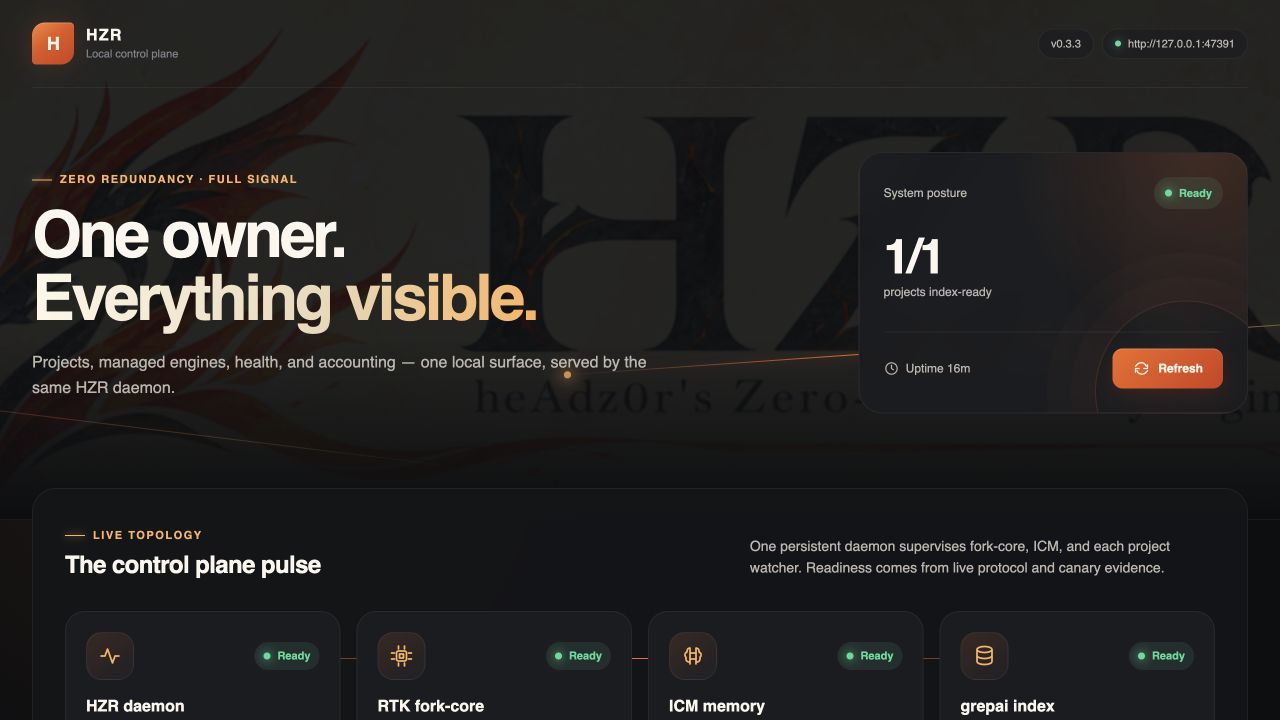
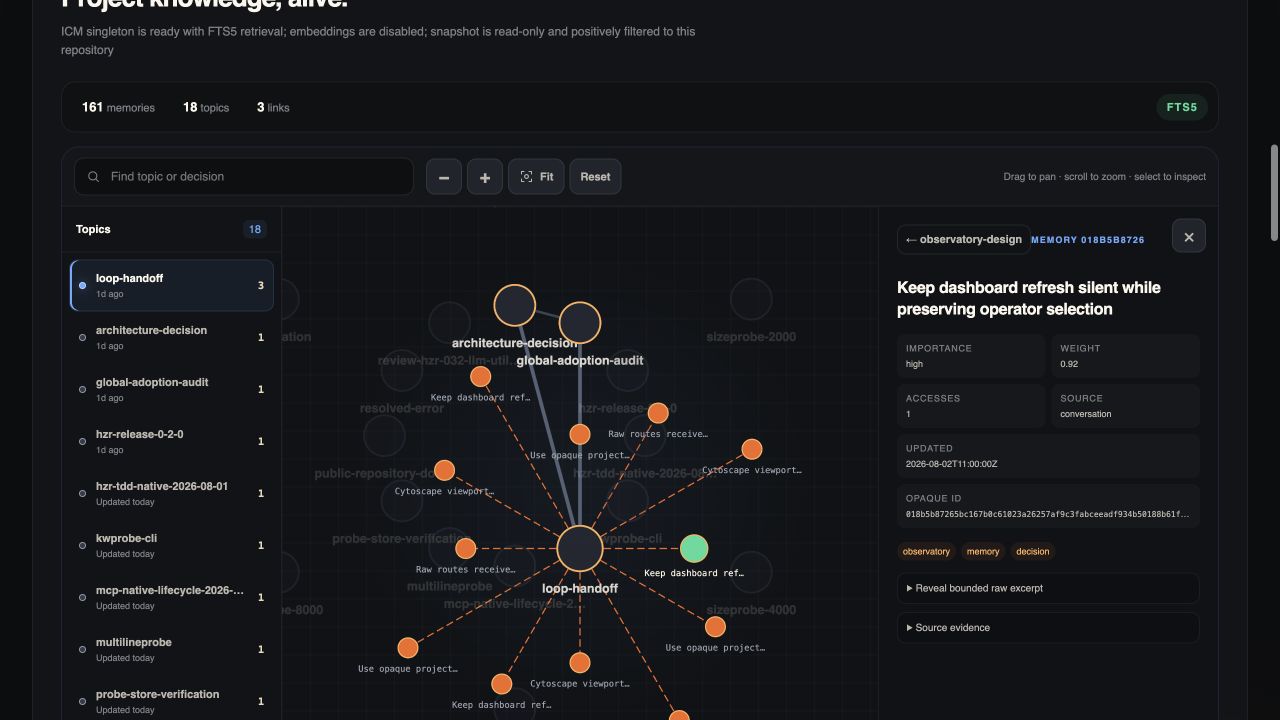
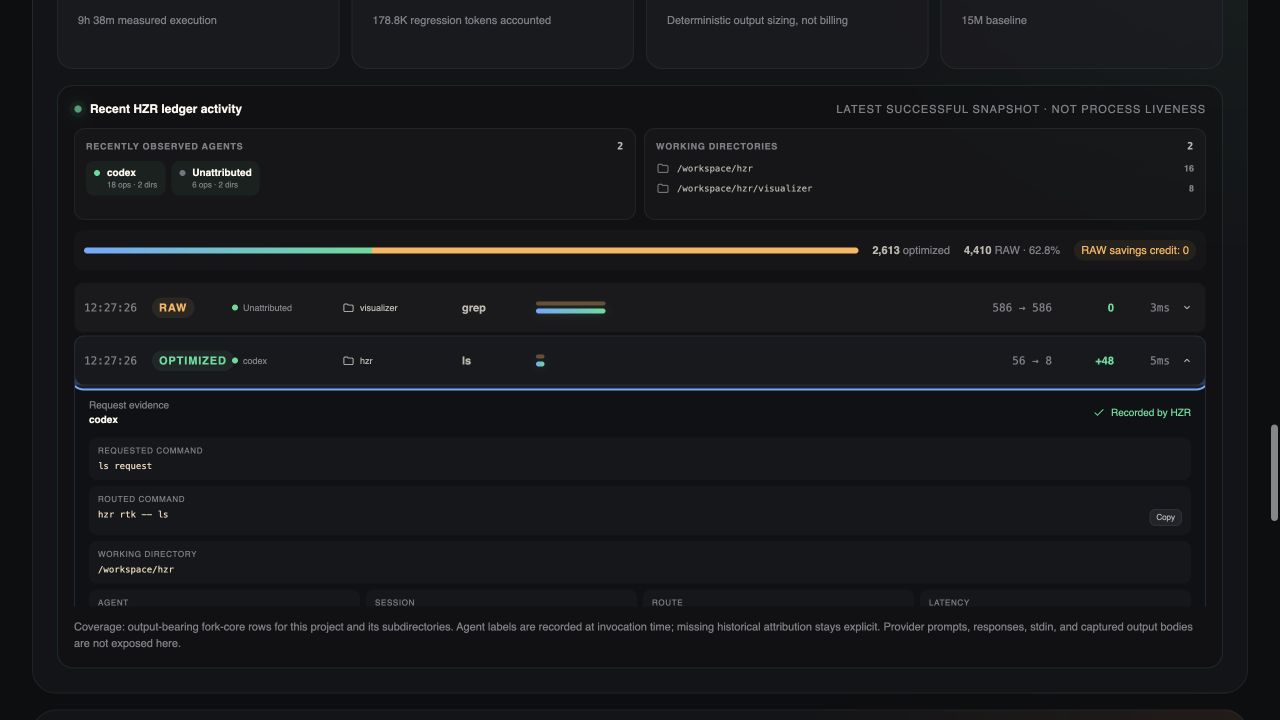
The screenshots use sanitized project paths and synthetic memory detail content against a live
HZR dashboard contract. Provider records, secrets, captured output, and canonical memory bodies
are intentionally excluded from the public assets.
hzr index status --workspace .
hzr search "where is command policy" --workspace .
hzr context plan "change command policy" --workspace .
hzr exec rewrite 'cargo test 2>&1 | tail -80'
hzr agent run "Implement the requested change" --workspace .
hzr stats
hzr stats --workspace .
The complete fork CLI remains available:
hzr rtk -- --version
rtk --version
Both commands reach private engines/rtk; alias rtk does not create a second control plane and does not use stock RTK fallback.
How the context is assembled
- HZR preserves the original intent and builds one structural plan with the complete fork IMG planner.
- One project-scoped recall runs concurrently against the centralized ICM.
- Evidence is normalized, deduplicated and placed under a hard token budget.
- The fork
rgaifallback is called only when the code plan is empty; semantic search uses the same canonical grepai store. - Managed caveman-code receives bounded context once and works only through allowlisted HZR tools.
- A short cache-stable response contract is added before generation; code, JSON, commands, paths, identifiers, numbers and diagnostics are protected from lossy rewrite.
Native memory, repo-map, RTK, hooks, compression, skills, and tools in caveman-code are disabled before the first model session and verified by a runtime test. This preserves caveman-code as an agent loop without turning it into a second control plane.
Activation modes
The default installation keeps the original all-projects behavior. Its installed SessionStart
hook runs hzr init --if-needed --quiet, so a project becomes HZR-backed on first use with no
manual step. Workspace identity has two bases:
| Project state | Identity basis | init outcome |
|---|---|---|
| Git repository | git common dir | initialized |
| Plain directory | canonical directory path | initialized_without_git |
Directory that later gets git init |
migrates to the git basis | relocated_to_git_identity |
Supporting plain directories matters because that is how most projects start. The trade-off
is explicit: a path-derived identity changes if the directory is renamed or moved. Sogit init is handled as a migration — HZR moves its own store to the git-derived identity
and re-points the symlink, keeping any index already built. That relocation only ever
touches a store inside HZR's own workspaces/ subtree; a symlink pointing anywhere else
stays foreign and is still refused.
Note that init registers the workspace and creates the symlink but does not build the
index. The first semantic query starts the watcher, and while that first scan runs, search
degrades to exact mode with a visible fallback_reason rather than blocking.
For a controlled comparison, install or switch to project-only activation from the project that
should use HZR:
HZR_PROJECT_ONLY=1 sh /tmp/hzr-install.sh
# or, after installing the bundle:
hzr install --project-only --dry-run
hzr install --project-only --force

hzr enable --workspace /path/to/another/project
hzr disable --workspace /path/to/project
hzr stats --workspace /path/to/project
Project-only activation is fail-closed:
- the one global Claude hook remains installed, but both
SessionStartandPreToolUseare no-ops
outside explicitly enabled repository/worktree identities; - managed
CLAUDE.mdandAGENTS.mdblocks are project-local, not user-global; - HZR-owned global Codex and Claude Desktop MCP registrations are removed, because a client-global
registration cannot prove which open project issued a call; - MCP refuses uninitialized and unselected workspace bindings before any project-scoped read or
write;hzr_codecremains workspace-independent; disableremoves only the local managed instruction blocks and activation entry. It preserves
the project's index and memory for a later re-enable.
The implementation and threat boundary are specified inPRD_HZR_PROJECT_ACTIVATION.md.
One index and one memory
<hzr-data>/
  runtime/                              # daemon token + singleton locks
  fork/                                 # derived fork caches, not an embeddings DB
  workspaces/<repo>/<worktree>/index/grepai/
  workspaces/<repo>/<worktree>/workspace.json       # private visualizer registration
  memory/icm/                           # one DB/process
  ledger/hzr.sqlite                    # unified usage + efficiency ledger
  migrations/<repo>/<worktree>/
.grepaiin a project can only be a verified symlink to the managed store.- One worktree owner lock prevents a second grepai watcher.
- ICM has one lifecycle and one physical DB; the repository namespace is set by HZR, not by the client.
- Fork
mem.dbremains derived structural cache. It is not a second embedding index or durable agent memory. - Legacy, nested and foreign stores are detected but never automatically removed. Dormant nested
stores are reported as adoctorwarning but do not block canonical search; HZR never launches a
watcher for them. An active nested writer, conflicting root placement, and ambiguous explicit
migration still fail closed.
Safe migration begins with a read-only scan:
hzr migrate scan --workspace .
hzr migrate apply --workspace .
hzr migrate history --dry-run
hzr migrate history --force
apply requires explicit invocation, saves a full-SHA backup, and verifies immutable prepared/applied manifests. Unsafe symlinks, special files, partial targets, and an active foreign owner block the operation.history snapshots platform RTK history through SQLite Online Backup in read-only mode,
imports each source row once, and saves the content-addressed snapshot with a JSON manifest.
Basic commands
hzr init                              workspace registry + data layout + visualizer service
hzr enable|disable                    project-only activation for one workspace
hzr activation status                 list activation mode and enabled workspaces
hzr install|uninstall                 adoption, hooks, instructions, and service startup
hzr hooks status
hzr mcp serve                         stdio MCP for clients without hooks
hzr mcp config [--apply] --client …   print or apply a pinned MCP registration
hzr mcp status                        native registration and lifecycle status
hzr doctor
hzr daemon serve|status|engines
hzr daemon service install|start|stop|restart|status
hzr engines status
hzr index status|init
hzr search|rgai
hzr context plan
hzr memory recall|store|forget|update|prune|status
                                      --scope project|global|project-and-global
hzr exec rewrite|run|approve|deny
hzr codec compile
hzr agent run
hzr tdd                                strict RED → GREEN → REFACTOR contract
hzr stats                              global cumulative efficiency ledger
hzr build <args>                       build YOUR project (token-optimized output)
hzr release --force                    rebuild and reinstall HZR itself
hzr update [--check]                   install a newer published HZR release; `--check` reports only
hzr migrate scan|apply|history|memory
hzr rtk -- <fork arguments>
hzr tdd is HZR's native, executable form of the upstream RTK project skill.
Run it before production changes. It requires an observed relevant RED, the
identical focused command passing at GREEN, refactoring while green, and the full
HZR workspace/all-features gate. Release bundles also ship the canonicalshare/hzr/skills/hzr-tdd/SKILL.md asset for agent integrations.
build and release are separate verbs deliberately. hzr build forwards to the
inherited fork wrapper that builds your project — the same verb RTK used, so existing
habits keep working. hzr release rebuilds HZR itself: it assembles the bundle,
installs it version-scoped, switches current atomically, restarts the daemon and then
verifies the reported version of all four engines, because checking hzr --version alone
previously allowed a stale bundle to look current.
hzr update queries the repository's published GitHub releases, selects a newer native
bundle for the current platform, verifies it against the release SHA256SUMS, and installs
it through HZR's versioned, atomic current switch. hzr update --check performs the same
release query and cache write without downloading or installing; it exits 0 when the check
succeeds (already current or update available) and non-zero only when the check itself fails. A check that finds no update is cached for
one hour, so a release published later that day is not hidden until tomorrow; a known newer
release remains cached for 24 hours. Claude SessionStart emits both a visible UI message and
agent context. Codex's mandatory HZR.md bootstrap performs the same bounded check and writes
the notice separately from byte-exact file output. The agent is told to inform the user once and
never install without explicit approval. Missing network access never blocks workspace startup
or tool use.
Read, write, and batch write
Default Markdown reads are bounded overviews. They explicitly identify the output as a digest,
report source and section coverage, and tell the agent how to recover exact evidence:
hzr rtk -- read README.md                         # self-described bounded overview
hzr rtk -- read README.md --level none            # byte-exact full content
hzr rtk -- read README.md --from 120 --to 180     # exact focused range
hzr rtk -- read README.md --outline                # Markdown heading tree + source spans
hzr rtk -- read src/main.rs -n                     # exact content + source coordinates
hzr rtk -- read README.md --max-lines 40           # exact first 40 lines
--outline is format-aware: Markdown uses ATX headings (# through ######), while
supported source files use their symbol extractor. Default -n reads exact content, and
ranges or tails preserve the original source coordinates instead of restarting at line 1.--max-lines N is an exact head operation; it does not replace omitted lines with a smart
truncation marker.
File mutations use one predictable contract with concise, quiet, or JSON v1 output:
hzr rtk -- write --output json replace app.rs --from old --to new --dry-run
hzr rtk -- write patch app.rs --old @/tmp/old.txt --new @/tmp/new.txt --cas --retry 2
hzr rtk -- write set config.json --key agent.enabled --value true --value-type bool
hzr rtk -- write create notes.md --content @/tmp/notes.md
hzr rtk -- write batch --plan '[{"op":"replace","file":"a.txt","from":"old","to":"new"}]'
batch applies operations for the same file in plan order and performs one atomic file commit
for that group. Independent file groups can succeed or fail separately; use the per-operation
result instead of assuming an all-files transaction.
Memory: one store, two scopes
Memory lives in one supervised database, reachable through two namespaces:
hzr memory store --scope global preferences "always prefer exact output for parsers"
hzr memory recall "budget planning"                # project + global (default)
hzr memory recall --scope global "preferences"     # only user-wide facts
Use project (the store default) for facts about this repository, and global for facts
about you — a preference or standing rule that should apply everywhere instead of being
restated in every project. Recall defaults to project + global so standing preferences
arrive alongside this project's history.
Another repository's memory is never reachable from any scope. The filter is positive: a
record is returned only because it provably belongs to this repository or to the global
namespace, so one physical database cannot leak between projects.
Records imported from the pre-namespace legacy store have no trustworthy project provenance.
HZR retains them for audit/migration but quarantines them from automatic project recall; it
never guesses that the repository performing the import owns every legacy record.
It is important to distinguish between two levels of installation:
- repository-level
install.shinstalls the entire versioned self-contained release bundle,
re-attests the same-version root, and starts the production user service; - the
hzr installCLI command configures a durable PATH entry, hooks, agent instructions,
HZR-owned MCP registrations, and ensures the installed daemon/visualizer service is running.
It supports--dry-run, requires--forcefor changes, and accepts--skip-servicefor
controlled installation/test environments. That opt-out is also written into the managedSessionStarthook, so a later project initialization cannot silently install the service;
rerun confirmedhzr installwithout--skip-serviceto re-enable automatic startup.--project-onlyinstead installs project-local instructions, enables the current workspace,
gates the hook by repository/worktree identity, and removes HZR-owned global MCP registrations.
MCP for clients without hooks
Claude Code receives HZR through hooks and CLAUDE.md. Codex app-server and Claude Desktop expose no equivalent hooks, so memory is available to them through MCP. Previously, each client registered icm serve directly. That created the second memory layer prohibited by §6.5 and left 8 orphaned icm serve processes after Codex sessions ended.
hzr mcp config --client codex           # prints the [mcp_servers.hzr] block
hzr mcp config --client claude-desktop  # prints the mcpServers block
hzr install --dry-run shows the transactional replacement of direct ICM registrations,
and the confirmed hzr install --force applies it with full-SHA backup/CAS. Thehzr mcp config command remains a read-only way to obtain a snippet for manual integration.hzr mcp status reports the native registration for each supported client.
In project-only mode HZR deliberately does not install a client-global MCP registration. A manual--workspace pin is safe at the HZR boundary — uninitialized or unselected projects are refused —
but the registration itself is still visible to every session using that client profile. Use a
separate client profile when MCP availability must also be invisible outside the experiment.
hzr init does not start an MCP process. It initializes configuration and the
current workspace, refreshes its visualizer registration, and is intentionally safe to run from every ClaudeSessionStart. Codex or Claude Desktop natively launches hzr mcp serve on
connection from the registration written by hzr install --force, then closes
the child through stdio EOF. Starting a persistent MCP process from init would
create one wrapper per session and defeat HZR's ownership model. The only persistent
service is hzrd; installed-bundle init and install ensure that same service is running.
The model-facing surface is deliberately small:
| Tool | Purpose |
|---|---|
hzr_context_plan |
Graph-first evidence planning across code structure, canonical search and durable memory. |
hzr_search |
Targeted semantic or exact repository search, with optional path and bounded snippets. |
hzr_memory_recall |
Recall project and explicitly global durable context. |
hzr_memory_store |
Add one durable decision, preference, resolved error or completed handoff. |
Daemon health, statistics, engine lifecycle and unrestricted command execution are
not model tools. They remain CLI/operator surfaces, avoiding unnecessary tool-choice
ambiguity and mutation authority. The gateway negotiates stable MCP 2025-11-25
with compatible older clients, validates JSON Schema 2020-12 inputs, and returns
typed structuredContent plus text for backward compatibility. The full agent
contract is in HZR.md.
Standards baseline: MCP 2025-11-25 lifecycle
and tool contracts.
The MCP layer in 0.3.8 is a stateless stdio gateway: it stores no data of its own
and does not spawn internal engines. Each client process terminates at EOF,
while durable ownership remains with production hzrd; the installer migrates direct ICM
registrations, and hzr doctor verifies the service lifecycle.
An isError: true result confirms that no fallback engine or store was used,
not that a dispatched network write was rolled back. Validation and daemon
connection failures happen before dispatch. If a store response is lost after
dispatch, recall before retrying because completion is unknown.
Legacy durable memory is transferred separately and without deleting the original DB:
hzr migrate memory --workspace "$PWD" --dry-run
hzr daemon service stop
hzr migrate memory --workspace "$PWD" --force
hzr daemon service start
The operation creates SQLite-consistent, content-addressed snapshots of the legacy and canonical databases,
imports durable memory rows into the repository namespace, writes a verifiable manifest, and
becomes a no-op on subsequent runs. Hook telemetry, raw pending extractions, and derived
code-area observations remain only in the saved snapshot.
Global Claude and Codex request/response paths are marked by hzr doctor asunintercepted: these hosts do not provide a secure global response hook. HZR does not
credit codec savings for this path; the codec applies only to managed hzr agent runs.
Parallel hzr mcp serve processes are safe while parallel icm serve processes are not: the adapter has no store of its own, routes everything to the single hzrd, and terminates at EOF on stdin, so it cannot outlive its parent. hzr doctor reports any remaining unmanaged icm serve or grepai watch process as an error, but never kills it automatically.
Build from source
Contributors need Rust 1.85+, Go (CI pin 1.24.2), Git, Bash, curl and standard Unix build utilities. System Node/npm is not needed for bundle build: the script downloads checksum-pinned Node.js 22.17.1 and uses it for production npm tree.
scripts/build-bundle.sh "$PWD/dist"
scripts/package-release.sh "$PWD/dist" "$PWD/dist-release"
HZR_RELEASE_ARCHIVE="$(find "$PWD/dist-release" -maxdepth 1 \
  -name 'hzr-v0.3.8-*.tar.gz' -print -quit)"
scripts/smoke-install.sh "$HZR_RELEASE_ARCHIVE" "$PWD/dist-release/SHA256SUMS"
The last artifact name depends on the normalized platform (darwin-arm64, darwin-x64, linux-arm64, linux-x64); use the actual name from dist-release/.
Supported gates:
cargo fmt --all --check
cargo clippy --workspace --all-targets --all-features -- -D warnings
cargo test --workspace --all-targets --all-features
cargo +1.85.0 check --workspace --all-targets --all-features
PATH="$PWD/dist/runtime/node/bin:$PATH" \
  "$PWD/dist/runtime/node/bin/npm" ci --prefix integrations/caveman-code
"$PWD/dist/runtime/node/bin/node" --test integrations/caveman-code/bridge.test.mjs
PATH="$PWD/dist/runtime/node/bin:$PATH" \
  "$PWD/dist/runtime/node/bin/npm" audit --omit=dev --audit-level=high \
  --prefix integrations/caveman-code
scripts/verify-fork-core.sh --test
Do not run cargo test directly inside fork-core/rtk: the official gate creates the synthetic Git history needed by the legacy test suite, and simultaneously checks the immutable baseline plus the current-engine manifest.
Verifiable guarantees and fair boundaries
| Guarantee | Status 0.3.8 |
|---|---|
| Full fork baseline and current engine have verifiable identity | implemented |
| Stock RTK is missing from the production path | implemented |
| Release bundle works without external Node/RTK/grepai/ICM | native clean-install smoke passes and enters the release gate |
| Actual usage does not mix with estimates | implemented |
| Paired provider-billed savings benchmark | not yet completed; 0/9 product metrics |
| Windows release artifact | absent |
Additional boundaries:
- ICM runs in FTS-only mode by default, so the first write does not trigger a hidden model load or fail on timeout. After provisioning the model, enable
engines.icm_embeddings = true; health output clearly distinguishes the two modes. - Before
hzrdstarts, the hook uses the same pinned fork-core, but daemon-free rewrites do not enter the SQLite ledger;doctorandstatsmark accounting as incomplete. - A hard
SIGKILLcan interrupt the final usage POST; a crash-safe outbox remains future work. - caveman-code creates an inactive upstream
cavemem --versionprobe. HZR blocks built-in resources and tools; fixing the probe itself requires a separate SDK patch. - Fresh installation and reinstallation of the same version verify the external checksum, internal manifest, mandatory layout, digests, and absence of symlink injection. A damaged root never becomes
current.
Further development
After stable schema negotiation and typed context planning, MCP development focuses
on cancellation/backpressure and end-to-end trace from client request tohzr stats. The invariant remains the same: MCP is a client-launched protocol
facade over HZR Core, and not a new service, index, memory store or control plane.
Documentation
RELEASE_NOTES.md— what the current release changes, and why. Start here before upgrading.CHANGELOG.md— public release history.docs/releases/— the notes each earlier release shipped with.CONTRIBUTING.md— development workflow and quality gates.SECURITY.md— supported versions and vulnerability reporting.- Benchmark methodology — reproducible RAW / upstream RTK / HZR comparison.
FORK_PARITY.md— fork provenance and regression contract.HZR.md— tool contract for coding agents.THIRD_PARTY_NOTICES.mdandNOTICE— bundled-engine attribution.
Origin and licenses
HZR is a new independent repository and product, not a fork of history. v0.1.0 captured the byte-for-byte baseline of the actual heAdz0r/rtk worktree: 516 entries, four tracked deletions and canonical snapshot v2 f4296ec4…. Starting from 0.2.0 the complete engine is developed only in fork-core/rtk inside HZR; baseline remains an immutable proof of origin.
The HZR control plane is distributed under Apache-2.0. Fork-core and bundled engines retain their own licenses and provenance; details are in THIRD_PARTY_NOTICES.md.
Yorumlar (0)
Yorum birakmak icin giris yap.
Yorum birakSonuc bulunamadi