zer0dex
Health Pass
- License — License: Apache-2.0
- Description — Repository has a description
- Active repo — Last push 0 days ago
- Community trust — 53 GitHub stars
Code Warn
- network request — Outbound network request in src/zer0dex/hook_example.ts
Permissions Pass
- Permissions — No dangerous permissions requested
No AI report is available for this listing yet.
zer0dex is a local dual-layer memory pattern for AI agents: a compressed, human-readable markdown index plus a vector store queried automatically before each message. Built for cross-project recall and cross-reference where flat memory files or vector-only RAG fall short. Local-first, low-latency. Reference implementation by Hermes Labs.
zer0dex
Long-running agents forget what matters because either everything is stuffed into one flat memory file or everything is left floating in a vector store with no map.
zer0dex is a local dual-layer memory pattern for AI agents: a compressed markdown memory index plus a vector store that is queried automatically before each message.
- "My agent technically has memory, but it still forgets cross-project context."
- "Vector search finds facts, but not how those facts relate to each other."
- "A giant MEMORY.md is cheap, but the agent still has to guess what matters."
- "I want local agent memory without a hosted memory product or another orchestration stack."
pip install zer0dex
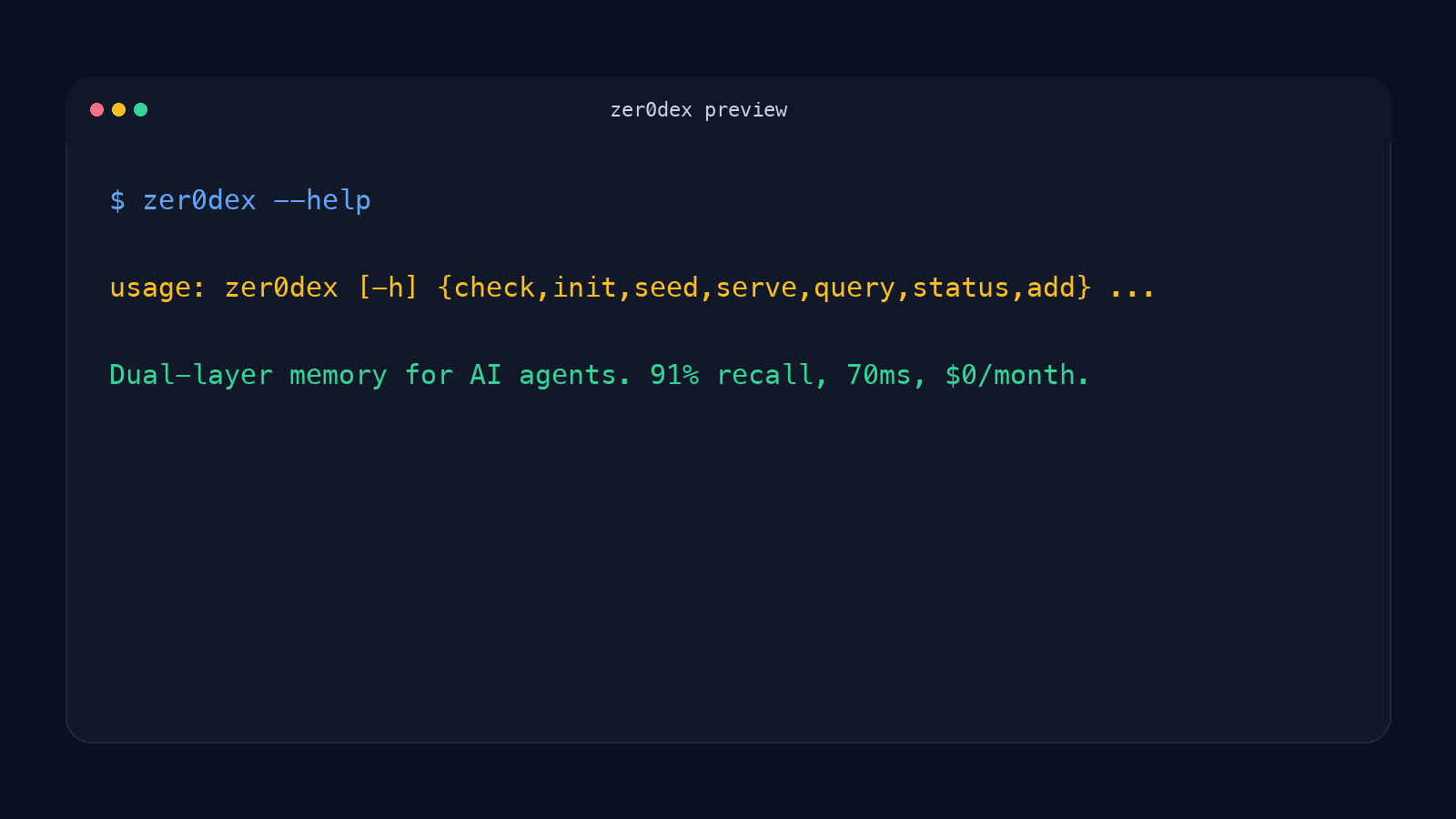
zer0dex --help
usage: zer0dex [-h] {check,init,seed,serve,query,status,add} ...

Dual-layer memory for AI agents. 91% recall, 70ms, $0/month.
When To Use It
Use zer0dex when you want a local persistent-memory layer for agents that need both fast recall and a lightweight human-readable index for cross-reference and navigation.
When Not To Use It
Do not use zer0dex if you need a hosted memory service, automatic policy governance, or proof that the benchmark will transfer unchanged to every workload. It is a local memory architecture and reference implementation.






A token-efficient memory architecture for persistent AI agents.
zer0dex combines a compressed human-readable index with a local vector store to give AI agents long-term memory that outperforms both flat files and traditional RAG.
Results (n=97)
| Architecture | Recall | ≥75% Pass Rate | Cross-Reference |
|---|---|---|---|
| Flat File Only | 52.2% | 41% | 70.0% |
| Full RAG | 80.3% | 77% | 37.5% |
| zer0dex | 91.2% | 87% | 80.0% |
Zero losses in head-to-head comparison. 70ms latency. $0/month (fully local).
The Problem
Persistent AI agents need memory across sessions. Current approaches all have gaps:
- Flat files (MEMORY.md, etc.) — cheap on tokens but poor retrieval. The agent has to "know what it knows."
- Full RAG (vector store only) — good retrieval but poor cross-referencing. Facts are "floating" with no structure.
- MemGPT/Letta — powerful but complex. The LLM manages its own memory paging, adding latency and cost.
The Architecture
zer0dex uses two layers:
Layer 1: Compressed Index (MEMORY.md)
A human-readable markdown file (~3KB) that acts as a semantic table of contents. It tells the agent what categories of knowledge exist without storing full details.
## Products
- **Little Canary** — prompt injection detection, 99% on TensorTrust
- mem0 topics: Little Canary, prompt injection, HERM
This index is always in context (~782 tokens). It provides navigational scaffolding — the agent knows where knowledge lives.
Layer 2: Vector Store (mem0 + chromadb)
A semantic fact store containing extracted details from daily logs, conversations, and curated notes. Queried via embedding similarity on every inbound message.
The Hook: Automatic Pre-Message Injection
A lightweight HTTP server keeps the vector store warm in memory. Every inbound message triggers a semantic query (70ms), and the top 5 relevant memories are injected into the agent's context automatically. No judgment call. No forgetting.
User: "How's the Suy Sideguy deployment going?"
    ↓
Hook queries mem0 → finds: "Suy: watching PID 76977, qwen3:4b judge"
    ↓
Agent sees: [message] + [Suy context from mem0] + [MEMORY.md index]
    ↓
Agent responds with specific details it otherwise wouldn't have
Why It Works
The compressed index solves the cross-reference problem. When a user asks "How does X relate to Y?", vector similarity finds X or Y, rarely both. But the compressed index contains cross-domain pointers — it's like a hyperlinked table of contents. The LLM uses the index to bridge domains that vector similarity alone can't connect.
| Query Type | Full RAG | zer0dex | Gap |
|---|---|---|---|
| Direct recall | 84.3% | 92.1% | +7.8pp |
| Cross-reference | 37.5% | 80.0% | +42.5pp |
| Negative (rejection) | 100% | 100% | 0pp |
Quick Start
Requirements
- Python 3.11+
- Ollama with
nomic-embed-textandmistral:7b - 8GB+ RAM
Install
pip install zer0dex

# Pull embedding + extraction models
ollama pull nomic-embed-text
ollama pull mistral:7b
1. Create Your Compressed Index
Create a MEMORY.md file — a compressed summary of what your agent knows:
# Agent Memory Index

## User
- Name: Alice
- Role: ML Engineer
- Topics in mem0: Alice, preferences, projects

## Projects
- **ProjectX** — NLP pipeline, deadline March 15
- Topics in mem0: ProjectX, NLP, deadlines
2. Initialize and Seed
zer0dex init
zer0dex check          # validate Ollama, models, deps
zer0dex seed --source MEMORY.md --source memory/
3. Start the Memory Server
zer0dex serve
4. Integrate with Your Agent
The server exposes a simple HTTP API:
# Query
curl -X POST http://localhost:18420/query \
  -H "Content-Type: application/json" \
  -d '{"text": "What is ProjectX?", "limit": 5}'

# Add memory
curl -X POST http://localhost:18420/add \
  -H "Content-Type: application/json" \
  -d '{"text": "ProjectX deadline moved to March 20"}'

# Health check
curl http://localhost:18420/health
For automatic injection, add a pre-message hook in your agent framework that queries the server before every LLM call.
Evaluation
Run the evaluation suite yourself:
python eval/evaluate.py --memories 86 --test-cases 97
See eval/README.md for methodology and detailed results.
Architecture Diagram
┌─────────────────────────────────────────────────┐
│                  Agent Context                   │
│                                                  │
│  ┌──────────────┐    ┌───────────────────────┐   │
│  │  MEMORY.md   │    │   mem0 Results (auto)  │  │
│  │  (compressed  │    │   [injected by hook]   │  │
│  │   index)      │    │                        │  │
│  │  ~782 tokens  │    │   ~104 tokens          │  │
│  └──────────────┘    └───────────────────────┘   │
│         ↑                       ↑                │
│    Always loaded          Pre-message hook        │
│    at session start       queries on every msg    │
└─────────────────────────────────────────────────┘
                              ↑
                    ┌─────────────────┐
                    │  mem0 HTTP Server │
                    │  (port 18420)     │
                    │  70ms avg query   │
                    └─────────────────┘
                              ↑
                    ┌─────────────────┐
                    │    chromadb      │
                    │  (local vector   │
                    │   store)         │
                    └─────────────────┘
How It Compares
| Feature | Flat Files | Full RAG | MemGPT/Letta | zer0dex |
|---|---|---|---|---|
| Recall | 52% | 80% | ~80%* | 91% |
| Cross-reference | 70% | 38% | Unknown | 80% |
| Latency | 0ms | ~15ms | ~500ms+ | 70ms |
| Token overhead | 782 | 104 | Variable | 886 |
| Cost/month | $0 | $0-50 | $0-50 | $0 |
| Complexity | Trivial | Moderate | High | Low |
| Auto-retrieval | No | On-demand | LLM-managed | Every message |
*MemGPT recall estimated; no published head-to-head comparison available.
If zer0dex is useful to you, please star the repo — it helps others find it.
Citation
@misc{bosch2026zer0dex,
  title={zer0dex: Dual-Layer Memory Architecture for Persistent AI Agents},
  author={Bosch, Rolando},
  year={2026},
  url={https://github.com/hermes-labs-ai/zer0dex}
}
License
Apache 2.0
Credits
Uses mem0 for vector storage, chromadb for the vector database, and Ollama for local embeddings and extraction.
About Hermes Labs
Hermes Labs builds AI audit infrastructure for enterprise AI systems — EU AI Act readiness, ISO 42001 evidence bundles, continuous compliance monitoring, agent-level risk testing. We work with teams shipping AI into regulated environments.
Our OSS philosophy — read this if you're deciding whether to depend on us:
- Everything we release is free, forever. MIT or Apache-2.0. No "open core," no SaaS tier upsell, no paid version with the features you actually need. You can run this repo commercially, without talking to us.
- We open-source our own infrastructure. The tools we release are what Hermes Labs uses internally — we don't publish demo code, we publish production code.
- We sell audit work, not licenses. If you want an ANNEX-IV pack, an ISO 42001 evidence bundle, gap analysis against the EU AI Act, or agent-level red-teaming delivered as a report, that's at hermes-labs.ai. If you just want the code to run it yourself, it's right here.
The Hermes Labs OSS audit stack (public, open-source, no SaaS):
Static audit (before deployment)
- lintlang — Static linter for AI agent configs, tool descriptions, system prompts.
pip install lintlang - rule-audit — Static prompt audit — contradictions, coverage gaps, priority ambiguities
- scaffold-lint — Scaffold budget + technique stacking.
pip install scaffold-lint - intent-verify — Repo intent verification + spec-drift checks
Runtime observability (while the agent runs)
- little-canary — Prompt injection detection via sacrificial canary-model probes
- suy-sideguy — Runtime policy guard — user-space enforcement + forensic reports
- colony-probe — Prompt confidentiality audit — detects system-prompt reconstruction
Regression & scoring (to prove what changed)
- hermes-jailbench — Jailbreak regression benchmark.
pip install hermes-jailbench - agent-convergence-scorer — Score how similar N agent outputs are.
pip install agent-convergence-scorer
Supporting infra
Reviews (0)
Sign in to leave a review.
Leave a reviewNo results found