CodeWhale
Health Gecti
- License — License: MIT
- Description — Repository has a description
- Active repo — Last push 0 days ago
- Community trust — 40820 GitHub stars
Code Basarisiz
- fs module — File system access in .github/scripts/release-workflows.test.js
- rm -rf — Recursive force deletion command in .github/scripts/update-homebrew-tap.sh
Permissions Gecti
- Permissions — No dangerous permissions requested
Bu listing icin henuz AI raporu yok.
Open-source, community-driven agent harness
Codewhale
An open source coding agent for your terminal — bring your own model.
Codewhale started as a native experience for DeepSeek. It has since grown into a
community-driven project: one coding harness that fits a growing international
community and supports as many models and providers as possible — open models
first, hosted or local, none privileged over the rest.
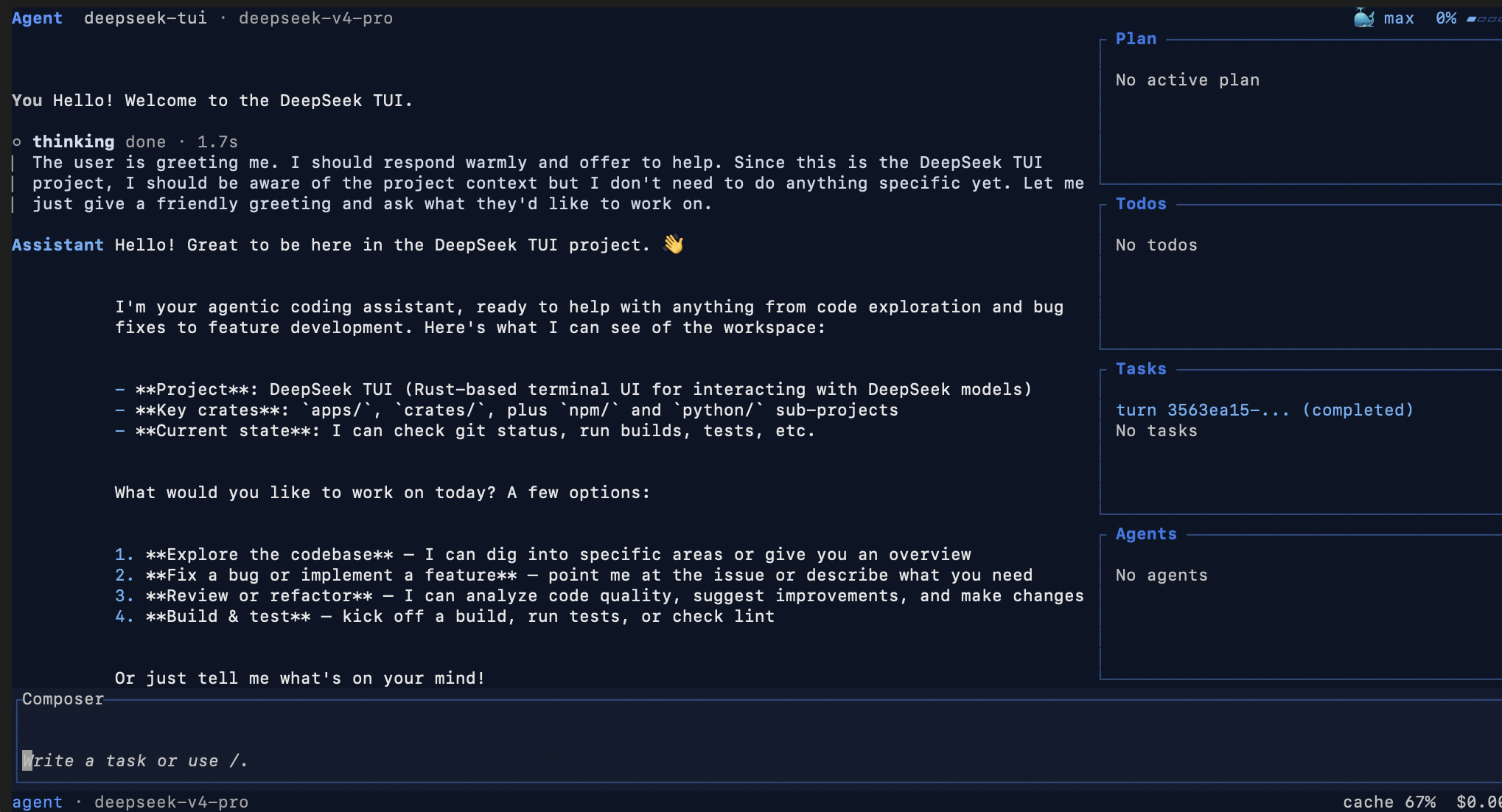
Give it a provider, a model, and a task. It reads your code, edits files, runs
commands, and checks its own work, then stops when the job is done or it needs
you. Switch models mid-task with /model. Work interactively in the TUI, or runcodewhale exec in scripts and CI. It's written in Rust, licensed MIT, and runs
on your machine.
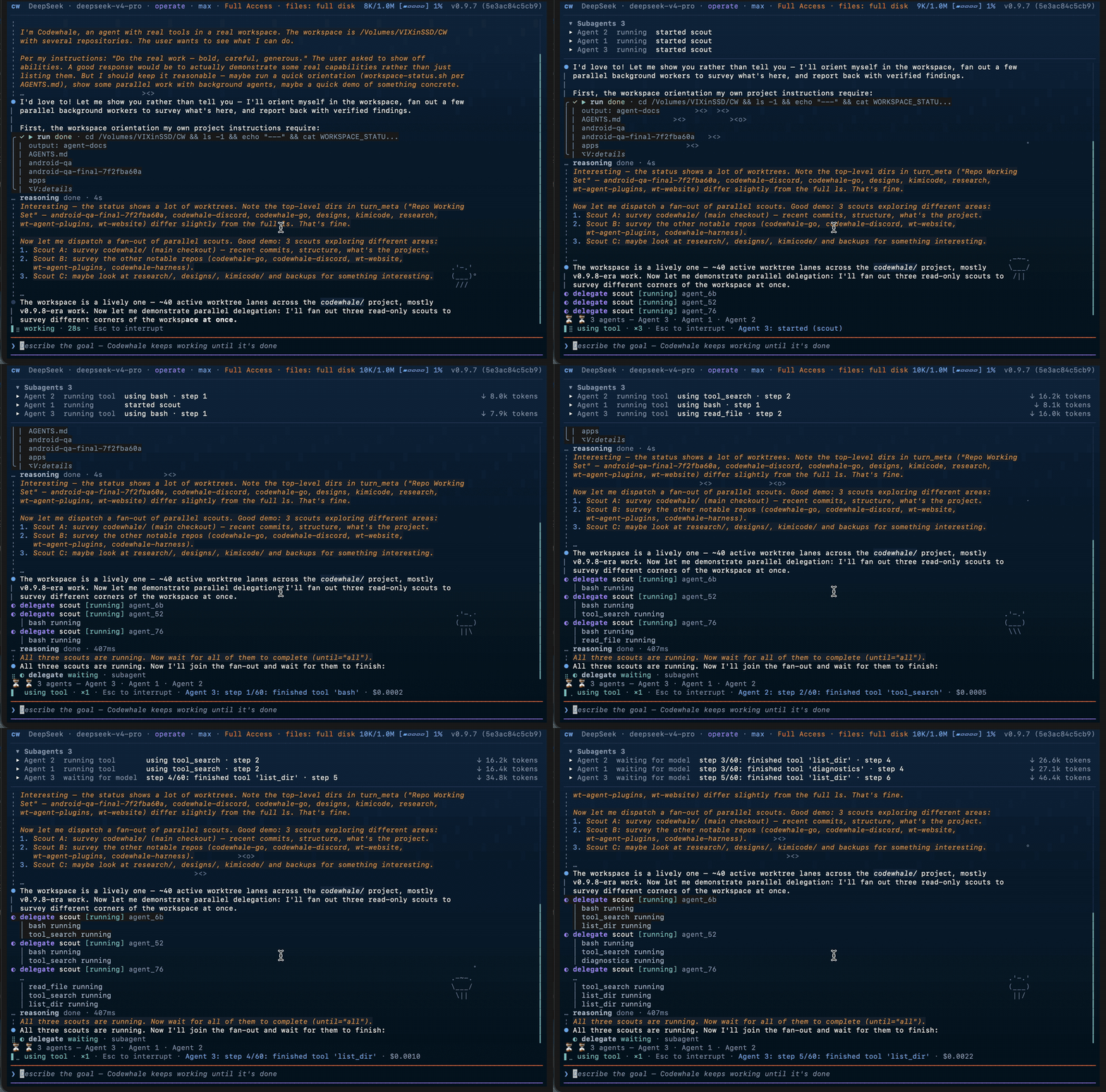
The part that isn't like other harnesses: you pick the model for each role,
and they don't have to match. A fleet pins a provider, a model, and a
reasoning tier per role — so a cheap fast model can direct an expensive
reasoning one, or a GLM builder can work the same job as a Kimi reviewer.
Write your own roles, your own constitution, and the harness is yours rather
than ours.
We're always looking for contributors and ways to improve. If a model or
provider you use is missing, or something breaks, telling us is one of the most
useful things you can do — see Contributing.
简体中文 · 日本語 · Tiếng Việt · Bahasa Indonesia · 한국어 · Español · Português · Русский · Українська · codewhale.net · Docs · Changelog · Discord




Install
npm install -g codewhale
Cargo, Docker, Nix, Scoop, prebuilt archives, Android/Termux, and a CNB mirror
for anyone who can't reach GitHub are covered in
docs/INSTALL.md. Coming from deepseek-tui? Your config and
sessions carry over — see docs/REBRAND.md.
Use
codewhale auth set --provider deepseek   # or export ANTHROPIC_API_KEY, etc.
codewhale                                # open the TUI
codewhale exec "fix the failing test"    # headless
codewhale web                            # local browser client on 127.0.0.1
In the TUI: /model switches provider and model together, /fleet builds and
runs the team — one role at a time, each with its own model — /undo reverts
the last turn, and /restore <N> rolls the workspace back to an earlier
snapshot (bare /restore lists them). Tab
cycles Plan / Work / Operate when the composer is empty — with text in it, Tab
completes slash commands and @ mentions instead. Shift+Tab cycles the
Ask / Auto-Review / Full Access permission posture at any time. ! runs a
shell command through the normal approval path.
What it does
- Any model, any provider — and any mix of them. DeepSeek, Claude, GPT,
Kimi, GLM, and 30+ providers, plus your own vLLM, SGLang, or Ollama with no
key, all through one runtime and one toolset. The catalog tracks each
provider's live lineup — DeepSeek's V4 Pro backend (labeledDeepSeek-V4-Pro-0813) stays callable asdeepseek-v4-pro, Grok 4.6 is the
direct xAI default, and OrcaRouter routes throughorcarouter/auto. A saved
role records itsprovider,model, and reasoning tier explicitly, so a
fleet can span vendors in a single run and a role's route never depends on
whichever provider happens to be active. Context limits and prices come from
the real route, and an unknown price shows as unknown rather than $0. - A harness you author. Roles are files you can read and edit — a model, a
tool posture, and standing instructions per role — kept in the project so the
team shares them, or beside your other personal settings so they follow you
between repos. A constitution records how you want the agent to behave across
every session, so the harness matches your practice instead of ours. - Read-only until you allow more. Plan mode can't change files, and
approvals gate risky commands. When an OS sandbox actually wraps a command,
Codewhale says so: Seatbelt on macOS where available, opt-in bubblewrap on
Linux. A repo'sconstitution.jsoncompiles into write holds that even Full
Access can't skip. - Work you can resume. A fleet records every step to an append-only ledger,
sofleet resumepicks up where you left off.
Learn more
- docs/PROVIDERS.md — every provider route: hosted,
gateway, and local - docs/FLEET.md — fleets, the ledger, and resume
- docs/WORKFLOW_EXPERIMENTAL_SEARCH.md — frozen, provider-neutral experimental search within Workflow
- docs/CONFIGURATION.md —
config.toml, hooks, and
the constitution - docs/AUTHORIZATION_ORDER.md — how modes,
hooks, permission rules, safety floors, repo law, approvals, and sandboxing
compose - docs/HOOKS.md — the eleven TUI lifecycle hook events, their
payloads, and which three of them can steer a turn (codewhale execand the
CLI subcommands do not fire hooks) - docs/WEB.md — the loopback-only browser client and its one-time
authentication boundary
Everything else — modes, keybindings, sandbox details, MCP, the runtime API,
and architecture — lives in docs and on
codewhale.net.
Contributing
Issues, PRs, repro steps, logs, and feature requests are all real project work,
and first contributions are welcome. When a PR can't merge as-is, maintainers
harvest what works and keep the author credited — in the commit, the changelog,
and docs/CONTRIBUTORS.md.
- Open issues — good first
contributions live here - CONTRIBUTING.md — dev setup and PR flow
- docs/CONTRIBUTORS.md — everyone who has shaped this
- Buy me a coffee
Thanks to DeepSeek for the models and support
that started the project, DataWhale 🐋 for
welcoming us into the Whale Brother family, and
OpenWarp and
Open Design for collaborating on the
terminal-agent experience.
License
MIT. An independent community project, not affiliated with any model
provider.
Yorumlar (0)
Yorum birakmak icin giris yap.
Yorum birakSonuc bulunamadi