horizun-revit-mcp
Health Pass
- License — License: Apache-2.0
- Description — Repository has a description
- Active repo — Last push 0 days ago
- Community trust — 12 GitHub stars
Code Pass
- Code scan — Scanned 12 files during light audit, no dangerous patterns found
Permissions Pass
- Permissions — No dangerous permissions requested
No AI report is available for this listing yet.
Open-source Model Context Protocol (MCP) server for Autodesk Revit 2023-2027: typed BIM automation, family authoring, interoperability and Power BI.
Horizun Revit MCP — an MCP server for Autodesk Revit






Point Claude — or Codex, Cursor, Cline, Windsurf, any MCP client — at a running
Autodesk Revit and let it read and write the model, under one contract:
A command never reports work it did not verify.
Every typed write is re-read from the model after the commit, so a silent
rollback becomes an error instead of a false success, and counts come from
reading the model again rather than from calls that did not throw. Free and
open source, Apache-2.0. Part of the Horizun Hub
ecosystem.
What this is. The bridge: transport, safety guards and a generic tool
surface over the Revit API, for Revit 2023 through 2027. Organisation-neutral by
design — no company's standards, catalogues or naming rules are compiled in;
where a command needs one, it is an input supplied at call time.
What this is not. A methodology. The standards, audit criteria and reporting
that turn these commands into delivery workflows live in
Horizun Hub. This repository is the socket; the Hub is
what plugs into it.
What you can ask it
Ordinary language on the left; what the bridge actually does on the right. None
of it is scripted in advance — the client picks the tools.
| You ask | What happens |
|---|---|
| "Which Revit are you talking to, and which document is open?" | horizun_health answers with the Revit year and build, the add-in version and commit, and the active document — or an explicit "none is active", never a blank title. |
| "How many walls on Level 2, with type and area, including the linked models?" | horizun_query_model walks the host and every loaded link, projects the parameters you named, and reports coverage plus which link each row came from. Unloaded links are listed, not silently skipped. |
| "Set the keynote of these 40 types to D021-A2-A14." | horizun_set_keynote first reports the blast radius — how many instances that type change touches — then writes, then re-reads every one. |
| "Add Level 3 at 7.20 m, a floor plan for it, and put it on a new sheet." | horizun_create_elements and horizun_manage_views compose in one ordered transaction group; a failure anywhere rolls the whole graph back. |
| "Split these multilayer walls into one wall per material layer." | horizun_split_multilayer_walls re-hosts doors and windows on the structural layer — and refuses curved walls instead of straightening them. |
| "Export the floor plans to PDF and the model to IFC." | horizun_export runs a dry run first and afterwards attributes only the changed, non-empty files that match what you asked for. |
| "Build me a parametric RFA from this profile." | horizun_create_family compiles a loadable family from an RFT — parameters, formulas, types, reference planes, dimensions, solids and voids — then verifies both the file and the loaded project family. |
| "Do X — and there is no tool for X." | The failed typed call returns fallback.allowed: true only when nothing was written. The client then writes minimal Revit Python for horizun_execute_python, whose results are labelled self-reported, never host-verified. |
Ninety per cent of the design is in the "no". A slab whose hosted families
cannot be put back rolls back alone; a clash count of zero is a zero you can
trust; an ambiguous request is refused with a reason instead of resolved by
guessing.
// horizun_health, abbreviated
{
  "status": "healthy",
  "horizun_version": "0.9.0",
  "horizun_commit": "ced1aa1",
  "built_from_clean_tree": true,
  "revit_version": "2026",
  "revit_build": "20250406_1515(x64)",
  "no_active_document": false,
  "active_document": { "title": "TORRE-A-EST.rvt", "is_workshared": true },
  "open_document_count": 3
}
Install
Windows, at least one Revit 2023–2027, and Revit closed. Everything else the
installer checks for you, and it changes nothing when it refuses.
1 · Get the installer and verify it
Download horizun-mcp-<version>-setup.exe and SHA256SUMS.txt from the
latest release,
then check the hash before running anything:
Get-FileHash .\horizun-mcp-<version>-setup.exe -Algorithm SHA256
Select-String -Path .\SHA256SUMS.txt -Pattern 'setup.exe'
Every installable release carries a payload manifest.json,package-hashes.json and an SBOM. Stable releases also
carry one live verification report per supported Revit year.
Read this before you run it. Automatic release installation requires a
publicly trusted, timestamped Horizun signature. While that identity is still
under review, the project publishes source/validation releases without
installers; source installation remains available. There is no unsigned binary
exception under the code signing policy. The intended open-source service is:
Free code signing provided by SignPath.io, certificate by SignPath Foundation.
The application is under review; this is not a claim that a signed download is
currently available.
If you would rather have the script do the same checks, one paste verifies the
complete SHA-256 against that same GitHub release, installs quietly and finishes
client registration:
irm https://raw.githubusercontent.com/HorizunGroup/horizun-revit-mcp/main/install-release.ps1 | iex
Download it first and pass -Version <tag> to pin a release, or -Interactive
for the Setup wizard. Quiet, latest and automatic client completion are the
defaults.
2 · Let it register your MCP client
Installation and registration are one user action. The installer deploys a
different add-in binary per installed Revit year plus the MCP server, then hands
off to a helper that waits for Claude or Codex to close rather than editing
the configuration underneath a running client — it makes timestamped backups,
preserves every other MCP entry, and verifies what it wrote. Durable status
lives in %LOCALAPPDATA%\Horizun\install-status.json, and Start-menu shortcuts
can resume or inspect it.
Use the exact path the installer printed. It is already expanded for your
machine, which matters: %LOCALAPPDATA% is expanded by cmd.exe and not by
PowerShell, so a config written with the variable silently points nowhere.
# after closing Claude Code — user scope makes it available across projects
claude mcp add --scope user horizun-revit -- "C:\Users\<YOU>\AppData\Local\Programs\Horizun\MCP\server\horizun-mcp.exe"

# after closing Codex
codex mcp add horizun-revit -- "C:\Users\<YOU>\AppData\Local\Programs\Horizun\MCP\server\horizun-mcp.exe"
# Codex timeouts — %USERPROFILE%\.codex\config.toml
[mcp_servers.horizun-revit]
command = 'C:\Users\<YOU>\AppData\Local\Programs\Horizun\MCP\server\horizun-mcp.exe'
args = []
startup_timeout_sec = 120
tool_timeout_sec = 600
// Cursor, Cline, Windsurf, Claude Desktop and other MCP clients
{
  "mcpServers": {
    "horizun-revit": {
      "command": "C:\\Users\\<YOU>\\AppData\\Local\\Programs\\Horizun\\MCP\\server\\horizun-mcp.exe"
    }
  }
}
TOML literal strings (single quotes) take Windows paths as they are; JSON needs
every backslash doubled. Raise your client's tool timeout if it has one: a
model scan or a batch open holds Revit's UI thread for minutes, and a 60-second
default gives up on work that is still running — the bridge then looks broken
while it is merely busy.
3 · Start Revit and check
Two things to expect on the first start, neither of them a fault:
- Revit can show a Security dialog when the publisher is not already trusted
— after verifying the build, choose Always Load. It can open on a monitor
you are not looking at: a Revit that seems stuck on startup with the CPU idle
is often this dialog hiding. - With a document open, a Horizun Hub tab appears in the ribbon. Its Estado
del puente button answers "is this working, and which version?" without
leaving Revit.
From your MCP client, horizun_health answers the same with the commit
included. A contract hash mismatch means one half is on an older build: close
Revit and install again.
Build from source instead
Nothing prebuilt is downloaded or run: everything is compiled on your machine
against the Revit already installed. You need the
.NET SDK — 8+ for Revit 2023–2026, 10+
to build for 2027.
git clone https://github.com/HorizunGroup/horizun-revit-mcp
cd horizun-revit-mcp
powershell -ExecutionPolicy Bypass -File .\install.ps1
It finds every Revit by its own RevitAPI.dll, builds the add-in for each of
those years and the MCP server, installs both, and reads every installed binary
back to prove it landed — stamped commit plus SHA-256 against what was staged. A
build failure changes nothing; a failure after that rolls back through its undo
ledger and tells you the exact state you are in. To update: git pull, close
Revit, run it again.
Or hand the whole thing to an agent — paste this into Claude Code or
Codex in any folder:
Clone https://github.com/HorizunGroup/horizun-revit-mcp into this folder, read its
AGENTS.md, and follow the install procedure there. Install and verify the binaries,
then confirm the automatic completion status. Do not edit an active client's
configuration; let the installed helper finish registration after that client exits.
Both pick up AGENTS.md automatically once they are inside the
repository. It carries the prerequisites, the failure modes and the two
surprises worth knowing before the first Revit start.
Architecture
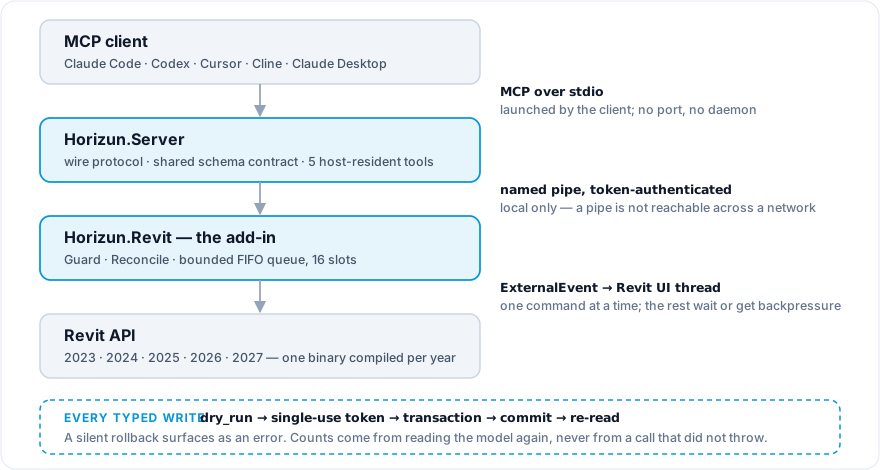
Horizun.Revit— the add-in.App(IExternalApplication) starts a
named-pipe server and publishes a discovery file;Dispatchercrosses each
request onto Revit's UI thread viaExternalEvent;GuardandReconcileare
the "cannot lie" commit contract; commands live underCommands/.Horizun.Server— the MCP server. The wire format is hand-rolled from the
open MCP spec, with no third-party SDK: it discovers the pipe, speaks MCP over
stdio and forwards to the plugin. Schemas and behavioural effects live in one
shared contract, sotools/listanswers with Revit closed without drifting
from the add-in. It negotiates MCP through 2025-11-25; exposes standard Tools,
Resources, Prompts, Completions, opt-in Logging and durable Tasks; and returns both
backward-compatible text andstructuredContent. Five tools are
host-resident — they answer inside the server and never touch Revit.- One command at a time. Concurrent calls wait in a bounded 16-slot FIFO
queue; a full queue applies explicit backpressure instead of dropping work.
Every reply carries what Revit raised while the command ran — warnings, errors
and modal dialogs — on success and on failure.
Capabilities
Grouped by what you would actually be doing. The complete reference — every
tool, and what each one refuses — is in docs/TOOLS.md.
| Group | What it covers |
|---|---|
| Session | Health and target selection across two open Revit versions, document open/save/relinquish, session inspection, view capture as an image. |
| Query | Composable queries and paginated inventory across host and loaded links, model census, quantities, clash, native schedule read. |
| Write | Parameter writes, keynotes, deletion with the cascade counted, transforms, atomic creation of levels, grids, walls, floors, roofs, rooms, MEP runs and structural framing. |
| Views & sheets | Dependency-aware plans, sections, elevations, 3D and drafting views, templates, sheets, viewports, schedules and annotation. |
| Families | RFT → RFA compilation with parameters, formulas, types, dimensions, nested instances, solid/void forms and MEP connectors; system-type duplication with complete compound structures. |
| Interoperability | PDF, DWG, configurable IFC, Navisworks NWC, multi-view FBX, images, schedules, .xlsx written over the OPC package, and direct Power BI push ingestion. |
| Model surgery | Layer splitting, floor-loop splitting, ungroup/regroup by parameter, slab elevation copying, toposolid embedding and grading, wall rectangularisation. |
| Orchestration | Up to 100 typed writes in one ordered plan with ${key.path} references, plus durable background jobs polled without touching Revit. |
horizun_power_bi_push uses Microsoft's push semantic-model REST endpoint; it
does not automate Power BI Desktop. Credentials are configured in the
environment of the MCP server, never in a tool call:
# Option A: short-lived OAuth access token
$env:HORIZUN_POWER_BI_ACCESS_TOKEN = '<token with Dataset.ReadWrite.All>'

# Option B: Entra service principal; Horizun obtains the access token
$env:HORIZUN_POWER_BI_TENANT_ID = '<tenant-guid>'
$env:HORIZUN_POWER_BI_CLIENT_ID = '<application-guid>'
$env:HORIZUN_POWER_BI_CLIENT_SECRET = '<secret>'
The destination is fixed to api.powerbi.com; dataset and workspace ids must be
GUIDs; values are primitive JSON only; the union is limited to 75 columns,
strings to 4,000 characters and each call to 10,000 rows, following Microsoft's
push semantic-model limitations.
Run with the default dry_run: true, then apply with a new idempotency_key. An
identical retry replays the stored answer; a connection loss after upload is
reported in_doubt and is never sent again automatically.
Status and evidence
Working and in production use. Stable promotion is governed by published,
release-scoped evidence rather than by a local success claim.
- Revit-free suites are enforced in CI, and only those. A hosted runner has
noRevitAPI.dll, so building the add-in there would be a lie; the
Revit-bound half is verified live withscripts/verify-live.ps1and published
per release. A skipped job that says why is worth more than a green tick that
covered less than it appeared to. - Built for five Revit years — 2023 through 2027, each compiled against its
own API. The server and the add-in hash one shared contract and ship together;
there is no partial deployment. - Live evidence is release-scoped. Stable promotion requires a published
report for every supported year. If an artifact is absent, local experience or
a compiled DLL is not substituted for it. See the
release policy. - Known limits, stated:
excel_write_rowsappends below an Excel Table
without expanding the table's range (reported per call); a catalog that is
neither UTF-8 nor Latin-1 is decoded as Latin-1 and says so; cancelling a
request prevents it only while it is still queued — once Revit starts the
command, cancellation stops you waiting but cannot interrupt the Revit API on
its UI thread. General creation of in-place families is not available in the
public Revit API, so Horizun creates loadable RFA families and
project-resident system types instead of driving the modal family editor by UI
automation.
The public comparison is task-based rather than tool-count based: a feature
scores only when its schema is typed, invalid input is refused before mutation,
and the claimed result is measured after the operation. Cases, scoring rules and
current results are in docs/BENCHMARK.md.
dotnet build src/Horizun.Revit -c Release -p:RevitYear=2026   # one year at a time
dotnet build src/Horizun.Server -c Release                    # the MCP server (Revit-free)
dotnet test tests/Horizun.Core.Tests
dotnet test tests/Horizun.Server.Tests
pwsh scripts/verify-live.ps1 -Year 2026 -OldFile <a model saved in another Revit>
Security
horizun_execute_python runs arbitrary Python inside Revit with the rights of
the signed-in user, and it is disabled by default. A fresh install reads aspermission_profile: "safe_write": verified typed edits inside the active model
are available, while arbitrary code, document-session changes and external
writes require an explicit owner decision.
An explicit choice in %USERPROFILE%\.horizun\settings.json is always
respected — read_only, safe_write, full_write orenable_execute_python: false keep arbitrary code off, allowed_tools anddenied_tools narrow any profile, and a settings file that exists but cannot be
parsed falls closed (read_only, Python off) so a corrupted restriction
never reads as consent. The Python ON/OFF button in Revit grants a visible
60-minute exception without permanently elevating the profile; pressing it
again revokes the permission immediately. scripts/enable-execute-python.ps1
remains the explicit administrative path for a durable developer setup and
reverts with -Disable. The server emits notifications/tools/list_changed when
the effective permission changes, so compatible clients update automatically;
clients that ignore the notification need one restart.
There is no inbound network listener: named pipes are not reachable across a
network, and the server speaks stdio to whatever launched it. The optionalhorizun_power_bi_push makes bounded outbound HTTPS calls only to fixed
Microsoft Entra and api.powerbi.com endpoints, and accepts no URL or
credential in tool arguments. There is no telemetry and no maintainer-operated
data collection.
The full threat model — what is defended, and what deliberately is not — is in
docs/security-model.md, and it is written to be argued
with. Local state and user-requested network operations are described in the
privacy policy. To report a vulnerability, see
SECURITY.md. The exact line between source-candidate evidence and
external certification is maintained in
production readiness.
Horizun Hub
Horizun Hub is the product ecosystem this bridge
belongs to: PowerBIM Exporter for Revit and Civil 3D, PowerBIM Online,
BuildMotion, CopyToExcel and Family Browser; PowerBIM + AI training; 4D/5D
quantification templates; Power BI dashboards and .pbit templates; agents and
MCP workflows for standardising families and auditing models; and APS
extraction into Power BI.
The MCP stays organisation-neutral: company standards, catalogues and audit
rules are supplied by those workflows or by the caller, never compiled into the
bridge. docs/HORIZUN-HUB.md draws the full line between
the open-source gateway and the Hub.
Contributing
Issues and pull requests are welcome — bug reports, Revit-year compatibility
findings and capability proposals each have a form. Start with
CONTRIBUTING.md and the
code of conduct; AGENTS.md is the
machine-readable version of the same rules, and llms.txt is the
discovery summary for indexers and AI systems.
License
Apache License 2.0 — see LICENSE and NOTICE.
Third-party components remain under their own licenses, listed with versions in
THIRD-PARTY-NOTICES.md.
The Autodesk Revit API is referenced at build time and never redistributed.
Revit, Autodesk and Autodesk Docs are trademarks of Autodesk, Inc. This project
is not affiliated with, endorsed by, or sponsored by Autodesk, Inc.
Reviews (0)
Sign in to leave a review.
Leave a reviewNo results found