claude-shard
Health Warn
- No license — Repository has no license file
- Description — Repository has a description
- Active repo — Last push 0 days ago
- Low visibility — Only 6 GitHub stars
Code Pass
- Code scan — Scanned 2 files during light audit, no dangerous patterns found
Permissions Pass
- Permissions — No dangerous permissions requested
No AI report is available for this listing yet.
Parallel Claude Code workers in isolated git worktrees — fire tasks, auto-land merges, deploy-safe push throttle
claude-shard
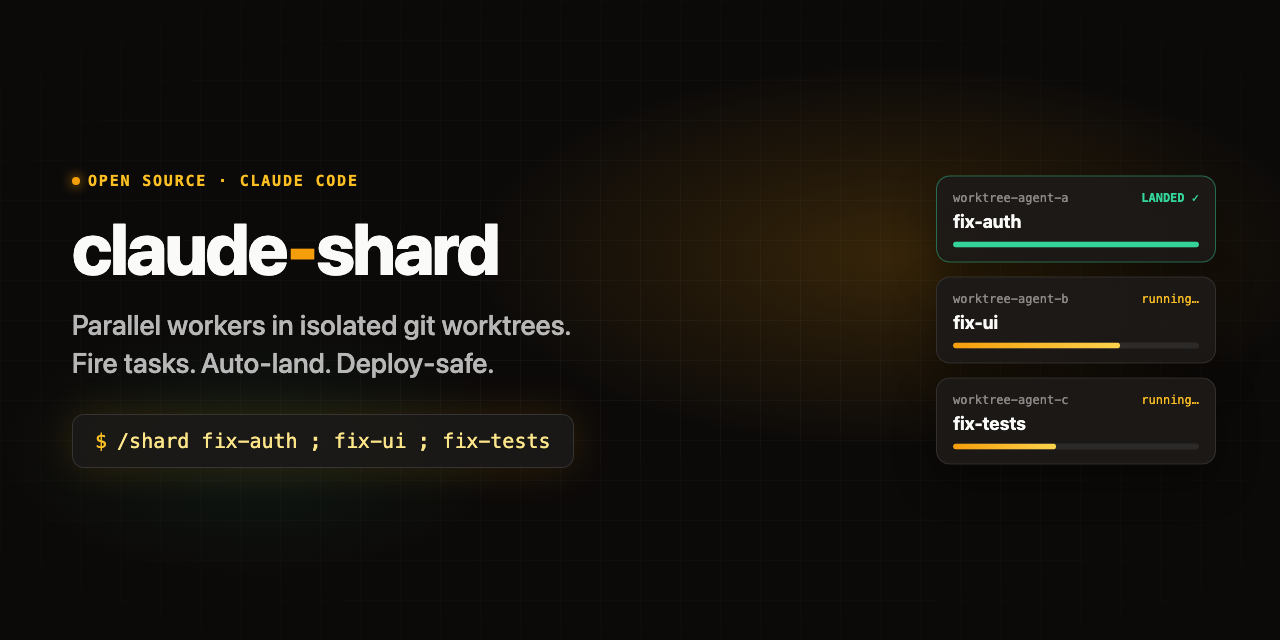
Claude Code skill: parallel workers in isolated git worktrees — fire, land, done.
Primary audience: you run Claude Code as your main coding agent (one window is the driver).
This is not a Grok plugin, not an MCP, not a peer-review slash. It is a Claude Code skill + agent that sits on top of stockAgent+isolation: worktree+ background.
When it is worth installing
Install if most of these are true:
- Claude Code is your main entry — you live in one (or a few) Claude sessions, not multi-CLI peer slash.
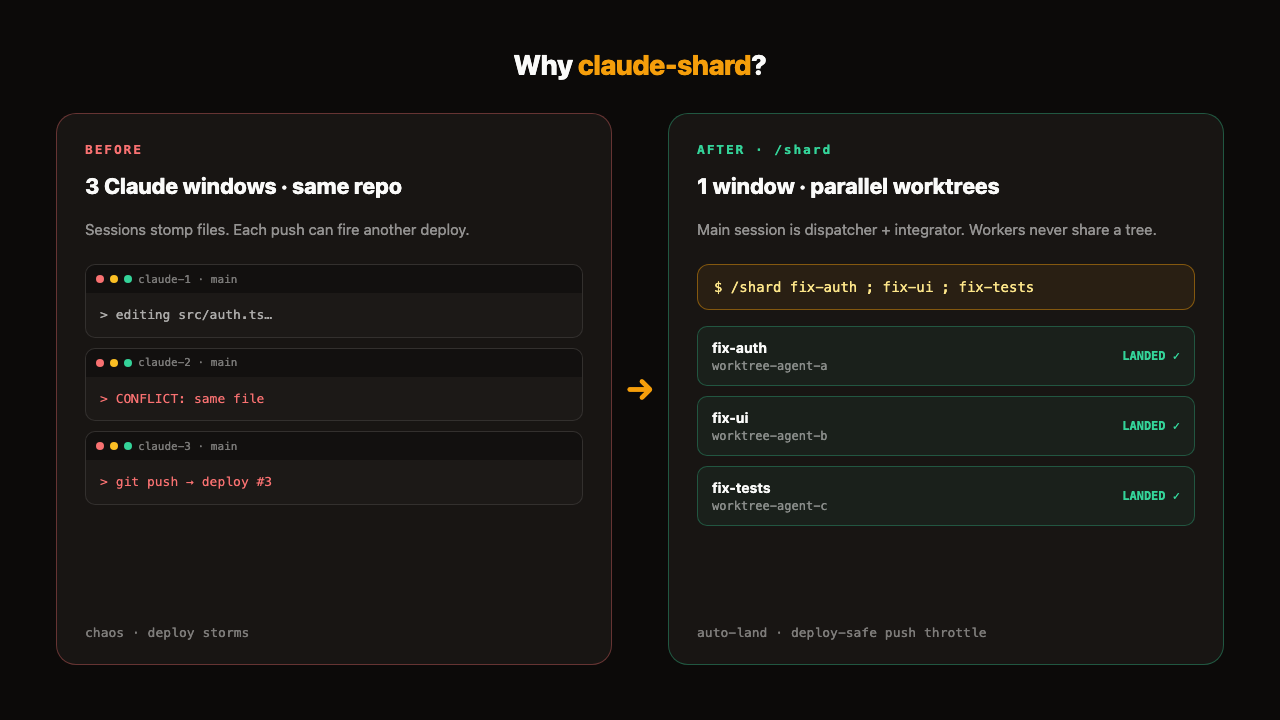
- You keep opening 2–3 Claude windows on the same repo and they stomp the same files / confuse each other.
- You want the main session to stay dispatcher + integrator — force the split with a command, not hope the model “uses subagents.”
- Finishing work means mergeable git units, not paste-back text: rebase → tests → merge or PR.
- The same repo is deploy-connected (Railway / Vercel / push-to-deploy) and every push can mean a deploy — you need push throttle so parallel shards don’t chain-deploy.
Skip install if you only need:
| Need | Use stock Claude Code instead |
|---|---|
| Short parallel explore / analysis | Multiple Agent calls in one message |
| Conversation fork (keep working both sides) | /fork (background session copy) |
| Large mechanical multi-file change → one PR per unit | Built-in /batch |
| Sync second opinion (Codex / Kimi) | Peer tools / MCP — not /shard |
Stock Claude already has worktrees, background agents, /tasks, and /batch.
Shard does not replace those. It adds what is still missing for your workflow: you force the split, disk manifest as SoT, auto land rules, same-repo land lock, deploy-safe push batching.
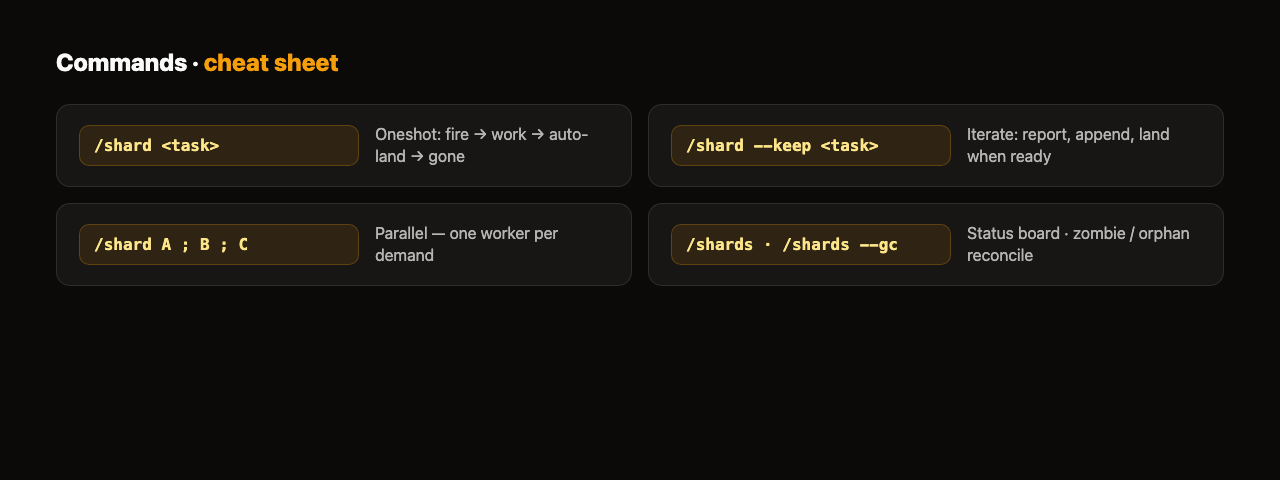
What you get (Claude Code only)
| Command | What it does |
|---|---|
/shard <task> |
Mode A (oneshot): fire → worker finishes → completion notice auto-lands → gone |
/shard --keep <task> |
Mode B (iterate): report after each unit, no land; append freely; say land <id> to integrate |
/shard A ; B ; C |
Parallel tasks — one worker per demand |
/shards |
Status board: in-flight / stuck / open for follow-up (worktree/branch alive?, age, zombie flags) |
/shards --gc |
Three-way reconcile: zombie manifests / orphan worktrees / leftover worktree-agent-* branches (read-only report) |
Not peer review: /kimi and /codex are sync second opinions. /shard is async background implementation with git land.
Install (Claude Code)
git clone https://github.com/howardpen9/claude-shard.git
cd claude-shard
./install.sh   # symlink skills + agent → ~/.claude, create ~/.claude/shards/
Then start a new Claude Code session (skills load at session start).
- This directory is the source of truth;
~/.claude/skills/shardetc. are symlinks. - Runtime state lives under
~/.claude/shards/(manifests,policy.json, locks) — not in git.
Monorepo dogfood (ops workspace): if you develop inside coding-agent-mcps, install from that tree instead:
cd /path/to/coding-agent-mcps/claude-shard && ./install.sh
Why not only stock Claude Code?
Claude Code already has subagents (Agent + background + isolation: worktree), /tasks, /fork, and /batch. Shard does not reimplement the runtime — it adds forced split by the user and the last mile of git landing.
/tasks (built-in) |
Raw subagent (built-in) | /batch (built-in) |
/shard |
|
|---|---|---|---|---|
| Who initiates the split | Model bookkeeping | You describe dispatch; model decides | Skill plans 5–30 units | You force: /shard A ; B ; C — main session must not do the work |
| Work unit | One-line description | One agent, text reply | worktree + PR per unit | worktree + branch + manifest = mergeable unit |
| After finish | Checkbox | Paste result; merge ad hoc | Open draft PRs | Auto land: rebase → tests → merge or PR per policy |
| State lifetime | In-session | Dies with the agent | Session / PR URLs | Manifest on disk; /shards anytime |
| Deploy awareness | None | None | None | Policy registry + push throttle (“push = one deploy”) |
Built-ins are passive parts — every dispatch needs prompt persuasion and every return needs improvised merge. Shard makes them active verbs: split is a command, land is a ruleset. One Claude Code window becomes dispatcher + integrator.
How it works
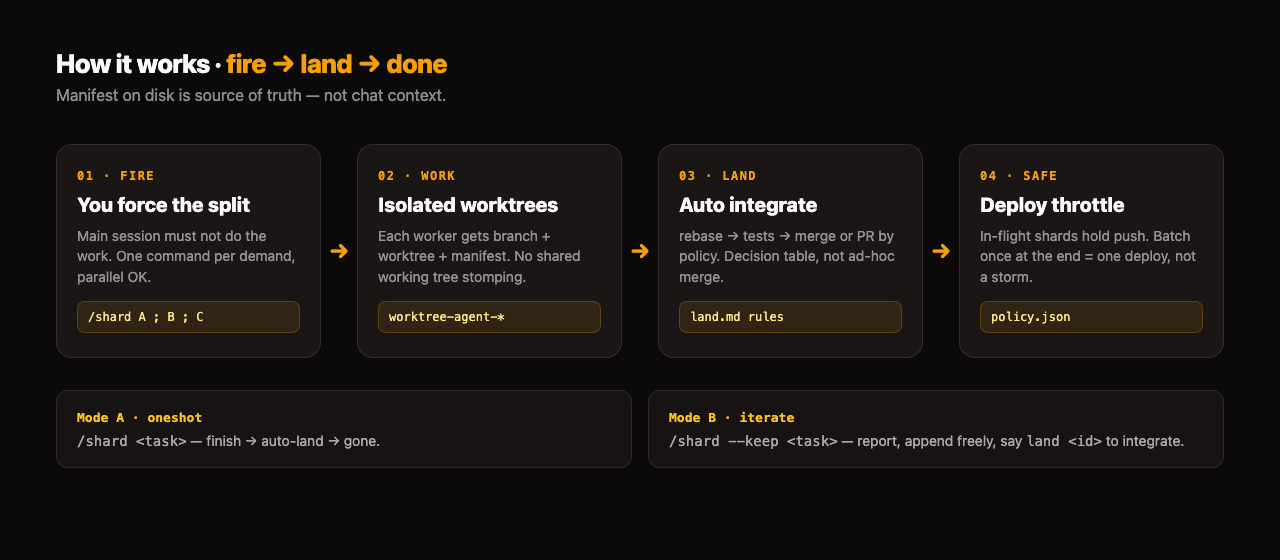
1. Manifest is source of truth
Each shard writes ~/.claude/shards/<agentId>.json (repo, base, mode, status, timestamps, agentHistory). Land and iterate read the file, not chat context — context gets compressed and forgotten. Schema: skills/shard/SKILL.md.
2. Land decision table (statements, not questions)
“Is there a conflict?” and “should we merge?” never interrupt you by default. Automatic: rebase conflicts (resolve in worktree; large ones spawn a resolve-worker), red tests (one fix-worker pass), dirty tree (try fast-forward). Only three interrupt classes: first land-policy pick for a new repo, push/merge that would deploy (one batch ask), guard block / delete unmerged work. Full table: skills/shard/land.md.
3. Same-repo parallel safety (stop deploy chains)
- Per-repo land lock (
mkdiratomic): two sessions never land the same repo at once - Rebase inside the worktree: workers can resolve conflicts; also fixes harness worktrees pinned to a stale session snapshot (
rebase --onto) - Push throttle: if the same repo still has shards in flight → merge locally only, hold push; when all are done, batch-ask once = one deploy
4. Per-repo land policy registry
~/.claude/shards/policy.json: local-merge | merge-no-push | pr. First land on a new repo detects deploy signals (Railway / Vercel / workflows) → suggests a policy, asks once, stores it. pr never merges to main locally (avoids accidental deploys on deploy-connected repos).
Layout
skills/shard/SKILL.md            # /shard fire flow + manifest schema
skills/shard/land.md             # land: decision table, lock, rebase, push throttle, iterate/discard
skills/shards/SKILL.md           # /shards board + interpretation rules
skills/shards/scripts/board.py   # reality-check + --gc reconcile (read-only)
agents/worker.md                 # background worker (isolation: worktree + background: true)
install.sh                       # symlink into ~/.claude
docs/assets/                     # README concept art
MONOREPO.md                      # coding-agent-mcps workspace note (if present)
Harness gotchas (why land logic exists)
- Stale worktree base: harness worktrees pin to the session start snapshot → naive
merge --ff-onlyfails; usegit rebase --onto BASE $(git merge-base BASE WB) WB. - git-guard hook:
branch -D/reset --hardblocked; auto flows never smuggle#guard-ok. Workers stay on one branch → safebranch -dafter merge. - Stale
index.lock: rebase then immediateswitch/mergeraces the lock; land steps run separately; on lock,pgrep -fl gitthen retry.
Backlog
- Mode B cross-session revive (SendMessage fail → re-fire from
worktreeBranch) not live-tested - Full
prpush+PR path not live-tested on a real repo - resolve-worker / fix-worker paths not battle-tested
- Auto-detect post-land verify commands; large diffs auto-attach
/code-reviewgate
Reference value outside Claude Code
Even if your main agent is Grok Build / Codex / Cursor:
- Manifest-as-SoT, land decision table, and push throttle are reusable design for any worktree-parallel setup.
- Grok’s
/fork --worktree/spawn_subagent(isolation: worktree)cover the split primitive; they do not ship this land/policy layer. - In the coding-agent-mcps monorepo this folder is kept as an ops example of “dispatcher + integrator” — see monorepo
docs/PLAYBOOK.mdandAGENTS.md.
Keywords
Claude Code, git worktree, parallel agents, background subagent, multi-agent workflow, auto land, deploy-safe merge, Railway push throttle, agent orchestration, dispatcher pattern
Reviews (0)
Sign in to leave a review.
Leave a reviewNo results found