void-agent
Health Uyari
- License — License: MIT
- Description — Repository has a description
- Active repo — Last push 0 days ago
- Low visibility — Only 8 GitHub stars
Code Gecti
- Code scan — Scanned 12 files during light audit, no dangerous patterns found
Permissions Gecti
- Permissions — No dangerous permissions requested
Bu listing icin henuz AI raporu yok.
Write an agent the way you write code: every capability is a tool, every workflow a function.
void-agent
 _    __      _     __     ___                    __
| |  / /___  (_)___/ /    /   | ____ ____  ____  / /_
| | / / __ \/ / __  /    / /| |/ __ `/ _ \/ __ \/ __/
| |/ / /_/ / / /_/ /    / ___ / /_/ /  __/ / / / /_
|___/\____/_/\__,_/    /_/  |_\__, /\___/_/ /_/\__/
                             /____/
Session remembers · Turn runs · Model schedules · Tool executes & asks · Human answers · Message wakes.
void-agent lets you write an agent the way you write code: every capability
is a tool, every workflow is a function, and every question — an approval
or an answer — goes straight to the person from wherever it arose.
- Everything is a tool, mounted as the agent needs. Workflows,
sub-agents, MCP tools, Markdown skills, and the person — the same.tool(...)call mounts any of them. - Workflows are code. A plain async function takes typed input and an
EventSenderand invokes its own tools. No graph DSL — code already
expresses control flow. - The channel is direct. The stream flows straight out as Vercel AI SDK
UI messages. Agents and tools at any depth ask the person for approval or
answers through the same channel. The answer returns to the frame that
asked, with no parent relay. - Approval is mechanical.
approvalreads this call's validated input
and decides in code, before the handler. The person says yes or no; the
model never decides. - A session is a conversation. The messages are the state — one
projection for the UI, one for the model. No task, no journal, no resume. - About 2,000 lines, pydantic only. One concept per file; provider
SDKs behind optional extras.
The framework
Install
Python 3.12+. Extras: openai, anthropic, mcp — keep the ones you need
in the brackets, or none for the pydantic-only core.
Online, nothing to download. pip fetches the wheel from the release:
pip install "void-agent[openai,anthropic,mcp] @ https://github.com/hoyipyik/void-agent/releases/download/v0.1.0/void_agent-0.1.0-py3-none-any.whl"
From a wheel. Download void_agent-<version>-py3-none-any.whl from
Releases: pure Python,
one wheel for every OS, CPU and Python.
pip install "./void_agent-0.1.0-py3-none-any.whl[openai,anthropic,mcp]"
From source. Clone and install the checkout:
git clone https://github.com/hoyipyik/void-agent && cd void-agent
pip install ".[openai,anthropic,mcp]"       # or `uv sync` to hack on it, then `make check`
The checkout also builds that wheel, with the sdist:
uv build # dist/
Usage
A weather agent in a script: one tool that asks Open-Meteo
(no key needed), one question, one answer. The model is whichever key is in
the environment — an OpenAI-compatible endpoint or an Anthropic-compatible
one.
import asyncio
import json
import os
from typing import Any
from urllib.parse import urlencode
from urllib.request import urlopen

from pydantic import BaseModel

from void_agent import Agent, Answer, Llm, Message, tool


class City(BaseModel):
    city: str


def get_json(url: str, **params: object) -> dict[str, Any]:
    with urlopen(f"{url}?{urlencode(params)}") as response:
        return json.load(response)


@tool(description="Current weather for a city.")
async def weather(input: City) -> dict[str, object]:
    found = await asyncio.to_thread(
        get_json, "https://geocoding-api.open-meteo.com/v1/search", name=input.city, count=1
    )
    place = found["results"][0]
    now = await asyncio.to_thread(
        get_json,
        "https://api.open-meteo.com/v1/forecast",
        latitude=place["latitude"],
        longitude=place["longitude"],
        current="temperature_2m,relative_humidity_2m,wind_speed_10m,weather_code",
    )
    return {"place": f"{place['name']}, {place['country']}", **now["current"]}


def model() -> Llm:
    if os.environ.get("ANTHROPIC_API_KEY"):
        from void_agent.providers.anthropic import AnthropicLlm

        return AnthropicLlm("claude-sonnet-5")
    from void_agent.providers.openai import OpenAiLlm

    # reasoning-tier models take function tools on Chat Completions only with this
    return OpenAiLlm("gpt-5.6-luna", extra={"reasoning_effort": "none"})


agent = (
    Agent(model(), "weather", "answers weather questions")
    .prompt(lambda question: [Message.user(question)])
    .tool(weather)
)


async def main() -> None:
    result = await agent.run("What's the weather in Tokyo right now?")
    assert isinstance(result, Answer)
    print(result.value)


asyncio.run(main())
Models
Two adapters. Each reads its key from the environment and speaks to every
endpoint compatible with its API.
| Adapter | Extra | Construct | Environment |
|---|---|---|---|
OpenAiLlm — OpenAI and any Chat Completions-compatible endpoint |
openai |
OpenAiLlm("gpt-5.6-luna", extra={"reasoning_effort": "none"}) |
OPENAI_API_KEY; OPENAI_BASE_URL for another host, e.g. Ollama at http://localhost:11434/v1 with any key |
AnthropicLlm — Anthropic and any Messages-compatible endpoint |
anthropic |
AnthropicLlm("claude-sonnet-5") |
ANTHROPIC_API_KEY; ANTHROPIC_BASE_URL for another host |
Reasoning-tier OpenAI models reject function tools on Chat Completions
unless reasoning_effort is "none"; leave extra out for other models.
MCP
An MCP server's tools mount on an agent exactly like local ones. What the
server does not bring is the approval: whether a call must be signed by the
person is declared on your side, per tool name. It needs the mcp extra.
from void_agent.mcp import McpServer


def must_sign(input: dict[str, object]) -> str | None:
    return f"writing {input['path']} is not reversible"  # a reason, or None to let it run


async def with_files() -> None:
    async with McpServer.stdio(
        "npx", "-y", "@modelcontextprotocol/server-filesystem", "/data"
    ) as files:
        assistant = Agent(model(), "files", "a file assistant").prompt(
            lambda question: [Message.user(question)]
        )
        for capability in files.tools(approvals={"write_file": must_sign}):
            assistant.tool(capability)
        print(await assistant.run("What is in /data?"))
McpServer.stdio(command, *args, env=…)runs a server as a subprocess;McpServer.http(url, headers=…)connects to a hosted one,headers
carrying its token. Keep theasync withopen for as long as the agent
may run: the connection is a lifecycle, not a call.files.nameslists the tools;files.describe(name)is the server's own
descriptor;files.tool(name, approval=…)mounts one;files.tools(approvals={…}, prefix="files__")mounts them all, namespaced
so two servers can both offersearch.- A gated call is put to whoever attends the run (
agent.run(…, human=…)).
With nobody attending, the turn ends with the card open instead of running
it — the model never decides whether a side effect runs.
The terminal UI
There is also a terminal UI, for trying the framework before writing a
line and for using an agent day to day. void is the same runtime in a
terminal: one binary per platform, nothing to install — the UI, the
agents, the MCP SDK and ripgrep inside.
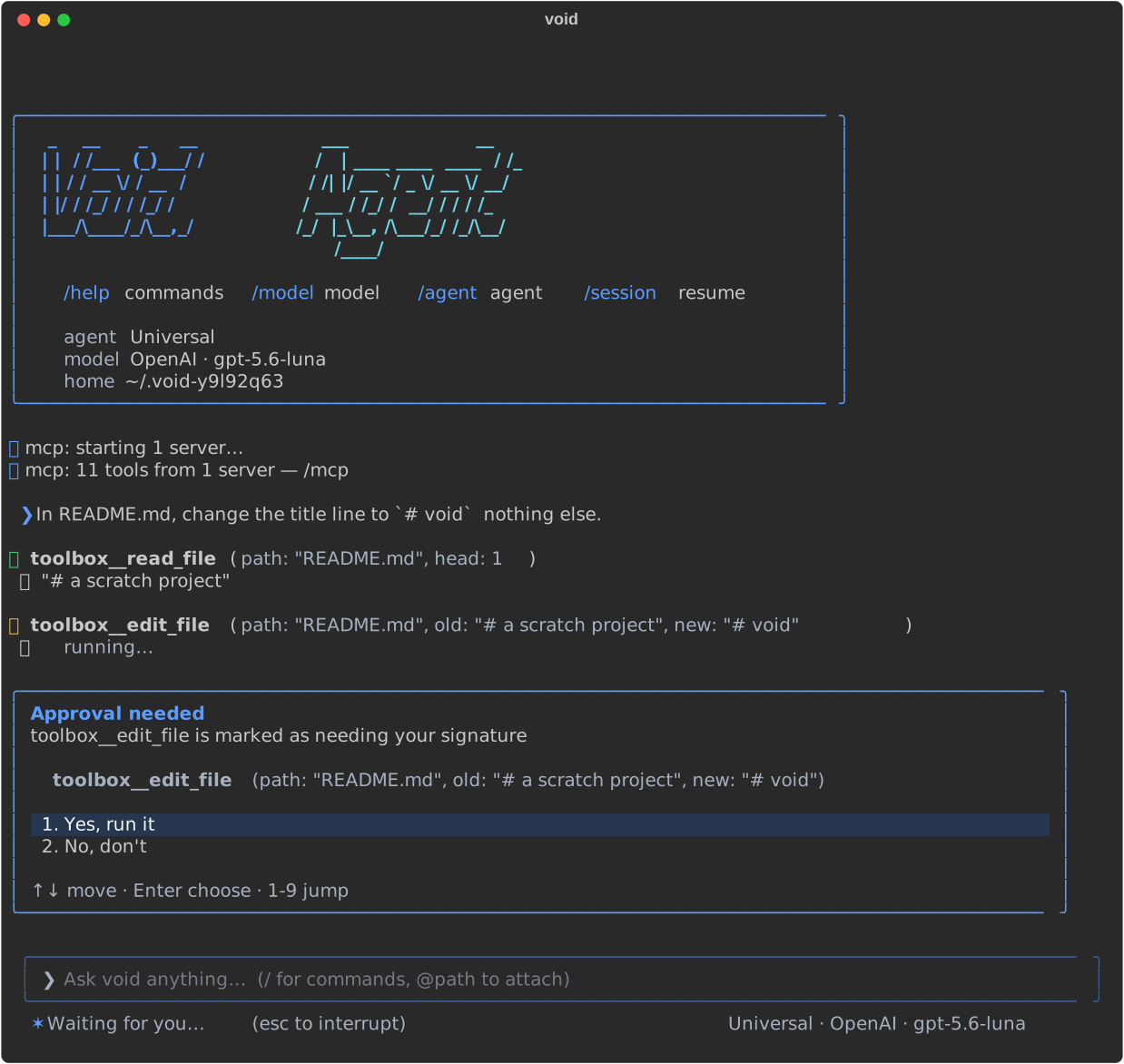
Four ways in.
The binary. Download void-agent-cli-<platform> from
Releases — Linux x86_64
and arm64, macOS Intel and Apple Silicon, Windows — and run it:
chmod +x void-agent-cli-macos-arm64 && ./void-agent-cli-macos-arm64
macOS asks once the first time: right-click → Open, orxattr -d com.apple.quarantine void-agent-cli-macos-arm64.
From a checkout. uv installs the CLI's dependencies with the rest:
git clone https://github.com/hoyipyik/void-agent && cd void-agent
make setup                  # uv sync, .env from .env.example
make cli                    # reads .env for the key; the same as `uv run python -m cli`
With your own agents. A folder of them, one module each, anybuild_agent(llm) -> Agent; ~/.void/agents is read on its own, a
workspace when named, and --agent picks the one to start on:
./void-agent-cli-macos-arm64 --workspace ./agents --agent researcher
As your own binary. The same packer the release runs:
make cli-build # dist/void, this checkout's ripgrep inside; FETCH=1 fetches the official one
On first start it asks for a provider and a key — or readsANTHROPIC_API_KEY, OPENAI_API_KEY or OLLAMA_MODEL from the
environment. /model lists the Anthropic and OpenAI models, then whatever
a local Ollama has installed. Sessions and the config live under ~/.void;VOID_HOME moves them.
Three agents come built in; /agent switches:
- universal — the model, a live plan, reflection,
ask_user, and every
tool the process mounted: void's own toolbox over the directory you
started in (read, list, search with ripgrep, write, edit, move, run),
whatever~/.void/mcp.jsonnames, and whatever skills~/.void/skills
holds. Every mounted tool is a switch in/mcpand/skill: on, signed,
or off. The toolbox startssigned: each call shows you a card first.
Editmcp.jsonwhile the shell runs: the next/mcppicks it up. - weather — below.
- dummy_weather — the weather agent replayed on a scripted model and
canned data: no key, no network, the whole protocol on screen. - Yours — a file in a folder; below.
/ opens the command menu: /model, /key, /agent, /mcp, /skill,/session, /new, /clear, /attach <path>, /paste, /status,/help, /quit. Drop a file into the composer or write @path to attach
it; ⌘V / ctrl+v pastes an image from the clipboard. ↑ in an empty composer
rewinds to an earlier message to edit and resend. Esc stops a turn.
Your own agents
Agents are files, and the one thing a file must have is a build_agent:
a function that takes the model and returns the Agent. That function is
the registration — there is no list to add to, the folder is the
registry. It is a function rather than an Agent at the top of the
module because the model is the session's choice (/model), handed in
fresh at every turn: an Agent(...) written at module level has no model
to be built on, and is not listed. Put such a module under~/.void/agents, or in any folder you name with --workspace, and/agent lists it: the file's stem is its name, the first line of its
docstring the blurb, and every agent in the pool can call every other by
name. What the scan does with a folder, in order:
- Takes every
name.pyand everyname/__init__.pyone level down, by
name, skipping anything that starts with_or.. - Imports it. One that will not import is listed anyway, with the error
on its row; the rest go on. - Looks for
build_agent. Present, the module is an agent calledname; absent, it is a helper — importable by its siblings, never
listed. - Reads the builder's signature:
build_agent(llm)is handed the model,build_agent(llm, agents)the model and the pool. - Runs every builder once on a scripted model, so a name that is not
there, a cycle, or a builder that crashes shows on its row at start.
Each turn then builds the chosen one again on the real model.
# ~/.void/agents/writer.py
"""writes a short piece from the notes it is given"""

from void_agent import Agent, Llm


def build_agent(llm: Llm) -> Agent:
    # A sub-agent takes typed input — a string here — as its opening message.
    return Agent(llm, "writer", "writes a short piece from notes", input_type=str).with_system(
        "Write it up in three paragraphs, plainly."
    )
# ~/.void/agents/researcher.py
"""finds sources and hands them to the writer"""

from void_agent import Agent, Llm


def build_agent(llm: Llm, agents) -> Agent:
    return (
        Agent(llm, "researcher", "finds and summarises sources")
        .with_system("Find what the question needs, then hand it to the writer.")
        .tool(agents("writer"))  # writer.py beside it, built on the same model
    )
Select an agent
●  1. universal      built-in        the model, a plan, a question — and whatever MCP you mounted
   2. dummy_weather  built-in        the weather agent replayed on a scripted model and canned data — no key, no network
   3. weather        built-in        Open-Meteo: forecasts, hours, history — ask it anything about the weather
   4. researcher     ~/.void/agents  finds sources and hands them to the writer
   5. writer         ~/.void/agents  writes a short piece from the notes it is given
Pick researcher, ask it something, and its writer call renders in the
log like any tool's: the question goes to the model, the researcher hands
the notes over, the writer's answer comes back as the call's result. The
rules, all of them:
- A builder that takes a second argument is handed the pool.
agents("writer")is the writer beside the caller if there is one, else
the pool's by name — every agent loaded, from every folder, built on the
same model.agents.mountedis every tool the process mounted (the
toolbox,mcp.json, skills) for a sub-agent that should have them; the
agent you talk to gets them regardless. - A module without
build_agentis a helper, never listed; its
siblings import it asfrom . import helper, a sub-folder asfrom .shared import tools. - A name taken by an earlier folder is suffixed, never replaced. Two
writer.pyarewriterandwriter-1, both rows with their source, andagents("writer-1")reaches the second from anywhere. The built-in
three come first, then~/.void/agents, then each--workspacein
order. - What cannot run is on its row, in red, before you pick it: a file
that will not import, a name that is not there, a cycle (a → b → a).
Every builder runs once at scan on a scripted model, so a broken graph
shows at start, not on the first turn. - A new file shows on the next
/agent; an edit needs a restart. The
working directory is never scanned — importing a module runs it, and
only a folder you named is yours.
The weather agent
Five thin tools over Open-Meteo — geocode,current, hourly, daily, history — no key, and the model as the
scheduler. Each tool is one request; the intelligence is in how the model
schedules them, so the questions can be as awkward as you like:
- Which of Taipei, Osaka and Singapore is coolest this weekend, and will
any of them get rain? — three places resolved in one step, threedaily
calls in the next, then a table. - When tomorrow does the wind in Berlin drop below 20 km/h? —
hourly
for the right date in Berlin's own timezone, then the model reads the
hours. - How much warmer is London this week than the same week last year? —
dailyandhistoryside by side, the difference computed in the answer. - What's it like in Springfield? —
geocodereturns several; the agent
asks you which, on a card, and carries on with your answer.
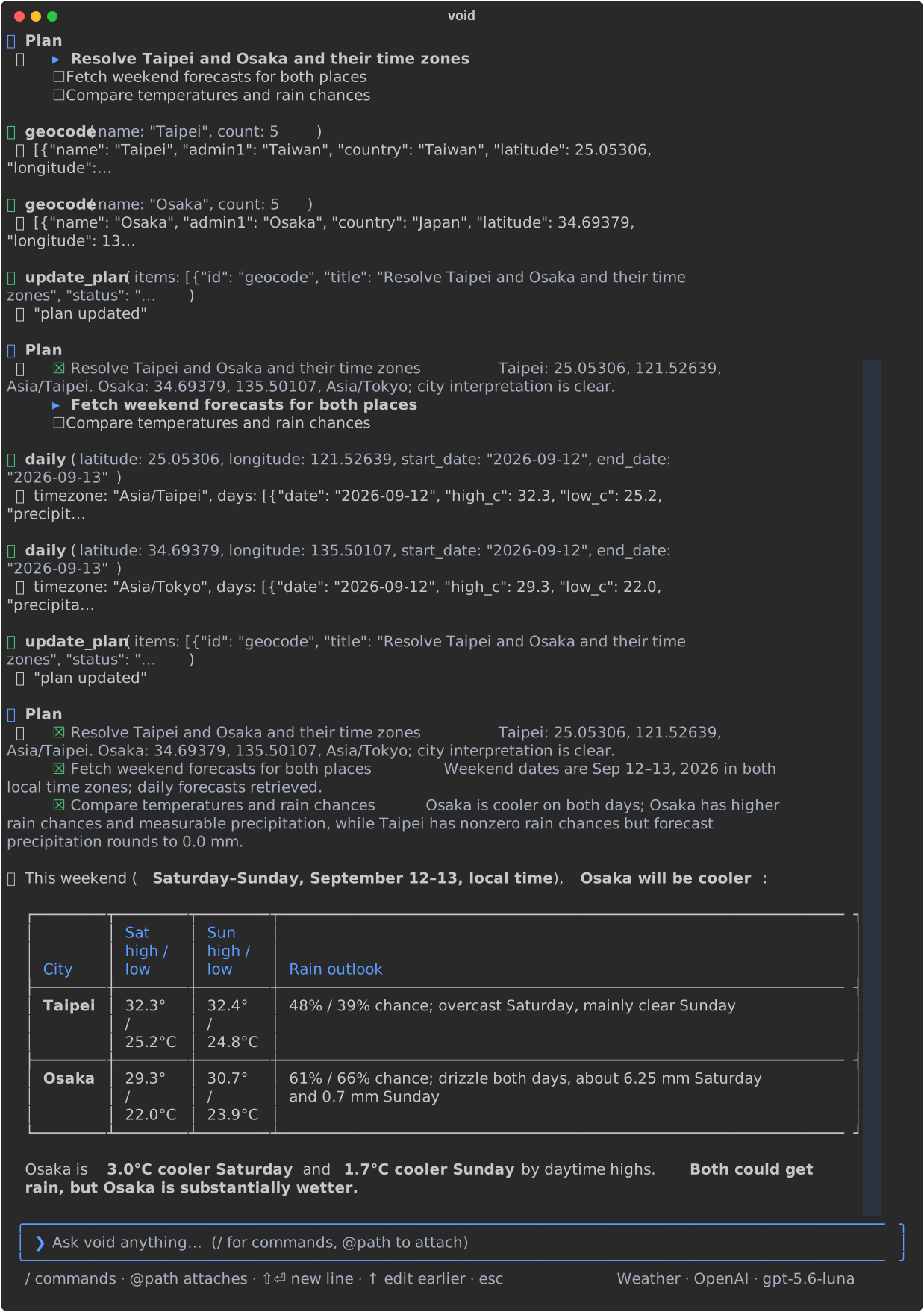
The plan updates as it goes; when a result surprises it, it reflects
before continuing. cli/agents/weather.py is the whole thing: the tools, the
system prompt, build_agent; dummy_weather.py beside it is the same agent
on a scripted model.
License
MIT
Yorumlar (0)
Yorum birakmak icin giris yap.
Yorum birakSonuc bulunamadi