fluidbox
Health Uyari
- License — License: MIT
- Description — Repository has a description
- Active repo — Last push 0 days ago
- Low visibility — Only 5 GitHub stars
Code Basarisiz
- rm -rf — Recursive force deletion command in .github/workflows/ci.yml
Permissions Gecti
- Permissions — No dangerous permissions requested
Bu listing icin henuz AI raporu yok.
Control plane that runs AI agents in governed, disposable sandboxes — Rust control plane, policy-gated tools, human approvals, append-only audit ledger, cost budgets
fluidbox
The control plane for AI agents.
Connect any event on the web to an agent that runs sandboxed, policy-gated, and audited.
Open source. Written in Rust.




Try it · Hosted multi-user · Connect an event · How it works · Kubernetes · Contributing
Agents can act. The hard part is deciding when they may run, what authority they receive, where they execute, and what evidence remains afterward.
fluidbox is the authority layer between an external event and an AI agent. Register a versioned agent once, then borrow it from a pull request, a schedule, a scoped API call, a webhook, or a manual run. Every invocation becomes the same governed run: its configuration is frozen, its workspace is isolated, its actions meet policy, and its outcome is recorded and delivered.
Agent definition + invocation context + optional workspace = governed run.
 PR opened       cron        API / webhook       Slack or ServiceNow*
     \             |               |                       /
      \____________|_______________|______________________/
                                   |
                         ┌─────────▼─────────┐
                         │     fluidbox      │
                         │ freeze authority  │
                         │ gate actions      │
                         │ audit outcomes    │
                         └─────────┬─────────┘
                                   |
                    fresh Docker container or K8s Pod
                         Claude Agent SDK or Codex
                                   |
                diff · cost · signed callback · PR result · ledger

 * Any service can invoke a subscription-scoped API today. GitHub is the
   first native event adapter; Slack is next, while ServiceNow can use the
   scoped API path today.
fluidbox is not another chat UI, and a trigger is not a second execution system. Manual, API, schedule, and event-driven invocations all converge on one Rust control plane and one immutable run contract.
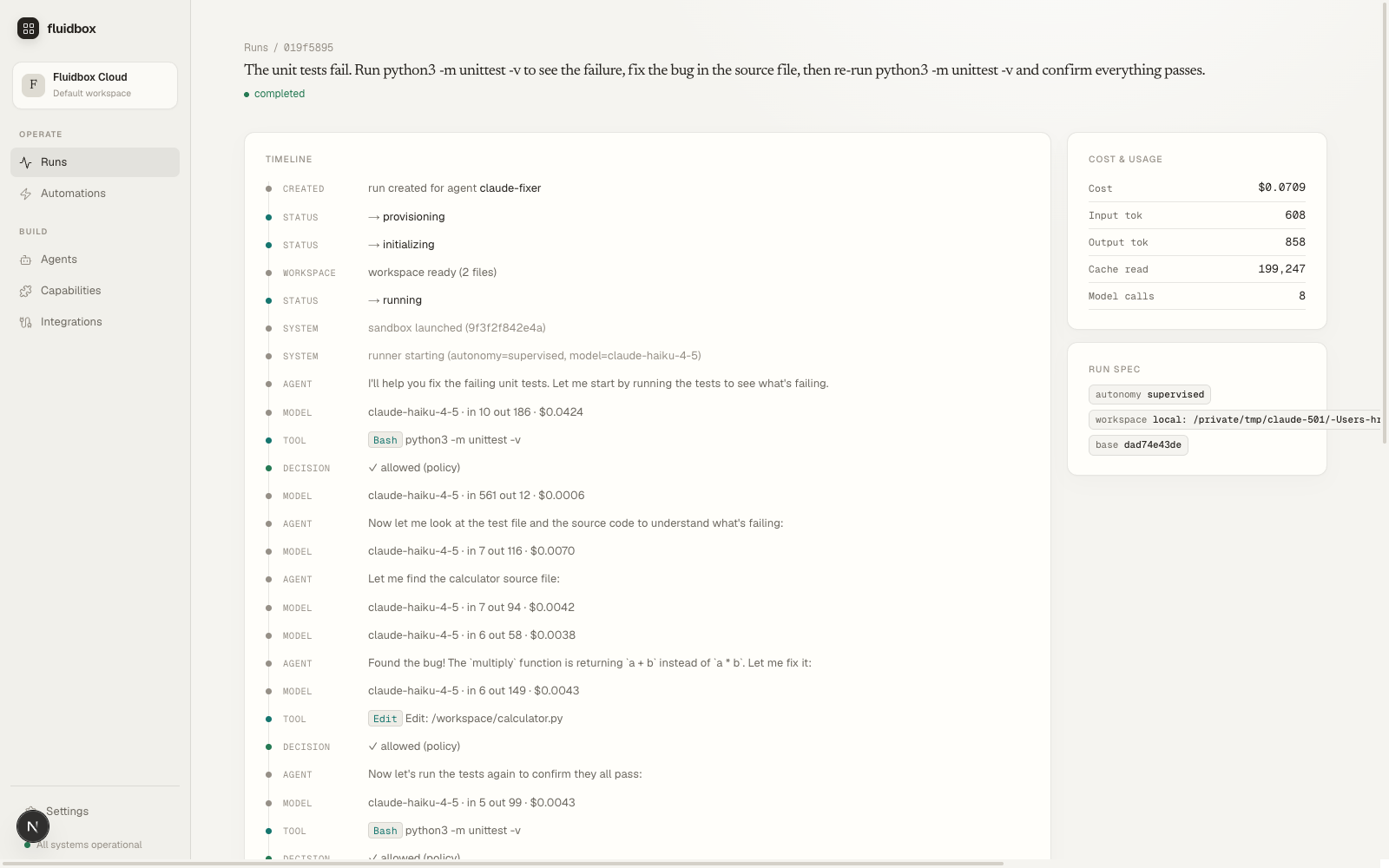
A real run: the agent fixes a failing test in an isolated workspace while fluidbox records tool decisions, model usage, lifecycle events, and the final result.
Why fluidbox
| Concern | Ad hoc agent execution | fluidbox |
|---|---|---|
| Invocation | A prompt starts an untracked process | An event borrows a registered, versioned agent |
| Authority | The agent inherits ambient machine credentials | The sandbox receives a session token; upstream credentials stay control-plane-side |
| Runtime | The agent shares a developer machine or long-lived worker | Every run gets a fresh Docker container or Kubernetes Pod |
| Control | The model decides what to attempt | Frozen capabilities, policy, trust tier, approvals, and budgets bound the run |
| Evidence | Logs explain part of what happened | Frozen RunSpec, append-only events, decisions, usage, artifacts, and delivery history |
| Automation | Each integration invents its own worker path | UI, CLI, API, cron, webhook, and GitHub all call the same create_run path |
One event, one governed run
- Define the agent. Choose the harness, model, system prompt, policy, budgets, optional workspace, and MCP capability bundles. Changes append a new revision; old revisions remain intact.
- Connect the event. Start it manually, invoke a subscription-scoped endpoint, add a cron schedule, or bind a GitHub App event. Production automations can pin an exact agent revision.
- Freeze the authority. fluidbox resolves the invocation into an immutable
RunSpec: agent revision, task, policy snapshot, capability schemas, budget ceilings, trust tier, workspace, trigger context, and result destinations. - Prepare the workspace. Credentialed repository access happens on the control-plane side. The agent receives only a disposable copy; the original repository is never the working tree.
- Run and decide. A fresh sandbox starts the Claude Agent SDK or Codex runner. Canonical tool intents and MCP calls flow through the server-side decision gate for capability, trust, policy, approval, and budget checks.
- Finalize and deliver. fluidbox settles the runner, collects a bounded diff, records cost and audit events, transitions the run, then publishes signed callbacks or GitHub results. Delivery failure never changes the run's outcome.
The same lifecycle holds whether the run came from a button, a PR opening, a Monday-morning schedule, or a ServiceNow automation calling the scoped endpoint.
What ships today
| Layer | Included |
|---|---|
| Event sources | Manual UI/CLI, subscription-scoped API, cron schedules, webhook-style invocation, native GitHub PR events |
| Agent harnesses | Claude Agent SDK and Codex behind one runner contract |
| Execution providers | Docker for local/self-hosted runs; Kubernetes-native Pods and Helm chart in v0.2.0 |
| Capabilities | Versioned MCP bundles; sandbox-local stdio tools and control-plane-brokered remote tools |
| Identity | Single-admin mode by default; opt-in per-organization OIDC, server-side sessions, personal API tokens, and RBAC |
| Connections | Organization- and user-owned grants, sealed static credentials, OAuth with PKCE, GitHub App installation flow, connector catalog, and custom MCP servers |
| Governance | YAML policies, managed per-tool overrides, human approvals, autonomous fallbacks, budgets, fork-PR read-only trust |
| Evidence | Frozen RunSpec, live SSE timeline, append-only redacted ledger, model usage and cost, diff artifacts, delivery attempts |
| Results | Dashboard/CLI result, HMAC-signed callback, GitHub PR comment, GitHub check |
| Dashboard | Admin and SSO modes, responsive navigation, light/dark themes, draft recovery, visibility-aware polling, and explicit offline/retry states |
| Operations | Prometheus metrics, configurable database pools, S3-compatible archives, multi-replica coordination primitives, and a guarded load harness |
Native Slack and ServiceNow adapters do not ship yet. Events from either can reach the scoped trigger API today, and a future native adapter only needs to verify and normalize the event before handing it to the existing run path.
Hosted multi-user mode
The release/multi-user-mcp-control-plane branch contains the merged Phase A–F implementation work and acceptance tooling for an opt-in hosted control plane while preserving the existing single-admin deployment as the default.
| Area | What this branch adds |
|---|---|
| Identity and authorization | Per-organization OIDC login, JIT membership, server-side browser sessions, personal API tokens (fbx_pat_), role mapping, and an operator-only /v1/admin/* break-glass surface |
| Connection authority | Connector definitions separated from organization- or user-owned credentials; agent revisions declare requirements and run creation freezes the exact connection, generation, and tool snapshot |
| Secret and data isolation | Per-tenant envelope encryption with static or AWS KMS KEKs, tenant-scoped LiteLLM virtual keys, tenant-scoped repositories, and PostgreSQL RLS as defense in depth |
| Broker and runtime hardening | Destination admission and redirect refusal, audience-scoped sandbox credentials, server-side MCP argument validation, durable tool-execution claims, budget reservations, and governed upstream sessions |
| Multi-replica operation | Session leases and epoch fencing, cross-replica approval wakeups and delivery claims, durable egress governance, S3-compatible shared archives, workload-address binding, and operational metrics |
Hosted mode is a deployment posture, not a single feature flag. Before admitting users:
- Set
FLUIDBOX_REQUIRE_SSO=1on the server andFLUIDBOX_WEB_MODE=ssoon the dashboard. - Run the application pool through a non-owner, non-
BYPASSRLSFLUIDBOX_RUNTIME_ROLE; multi-user boot refuses an unsafe role unless the operator explicitly overrides the guard. - Enable KMS envelope sealing and per-tenant LiteLLM keys, then complete the documented re-seal and key-custody checks.
- Rebuild and pin both runner images from this branch. Multi-replica deployments additionally require the S3 archive backend; stage workload identity through
observebeforeenforce.
Start with the hosted product boundary, then follow the rollout gates and KMS/RLS operations runbook. The implementation and automated acceptance machinery are present, but the real 60/150/300-concurrent-run exercises have not been executed. This branch therefore does not claim a proven 300-run production ceiling; capacity and residual-risk sign-off remain deployment gates.
Try fluidbox
Docker — fastest path
No Rust toolchain, Node installation, or external Postgres required:
git clone https://github.com/hrishikeshdkakkad/fluidbox.git
cd fluidbox
docker compose -f deploy/docker-compose.eval.yml --profile runners pull
ANTHROPIC_API_KEY=sk-ant-... docker compose -f deploy/docker-compose.eval.yml up -d
Open http://localhost:3000. The eval stack uses bundled Postgres and a well-known admin token, and leaves credential-backed integrations and webhook ingress disabled. It is for trying the run loop, not for exposing to a network.
Develop from source
Prerequisites: Rust, Docker, just, Node 24 + pnpm, and a direct-connection Postgres database. Neon is the blessed hosted path.
git clone https://github.com/hrishikeshdkakkad/fluidbox.git
cd fluidbox

just setup          # generate local secrets, install web deps, build the Claude runner
just neon-setup     # provision Neon and write its direct DATABASE_URL
$EDITOR .env        # add ANTHROPIC_API_KEY; add OPENAI_API_KEY for Codex runs
just codex-build    # optional: build the second harness
just dev            # LiteLLM gateway + Rust control plane + dashboard
Open http://localhost:3000, or start a manual run from the CLI:
cargo run -p fluidbox-cli -- run \
  --repo /path/to/repository \
  --task "find and fix the failing test"
If setup drifts, just doctor checks the documented failure points—database mode, bind address, key shape, runner images, dashboard token sync, web dependencies, and auth-mode coherence—and prints the concrete fix.
Local SSO (browser login against a real IdP)
The local default is admin mode: no login wall, the dashboard proxy injects the operator token, and /login redirects into the app. To exercise the real browser-login experience locally (e.g. against Dex, as scripts/identity-e2e.sh does), all three pieces must agree — a partial setup degrades silently to the open admin dashboard:
FLUIDBOX_WEB_MODE=ssoinapps/web/.env.local— flips the dashboard to cookie passthrough and turns on the login wall (a sessionless browser is redirected to/loginserver-side).FLUIDBOX_PUBLIC_URL=http://localhost:3000in.env— the browser-facing/v1/auth/*legs must ride the dashboard origin (served there by the dev/v1rewrite) so the__Host-login cookies land where the browser started. Pointing this at:8787makes every callback refuse.FLUIDBOX_REQUIRE_SSO=1in.envfor the full multi-user posture (confines the admin token to/v1/admin/*), plus an organization + IdP config registered via/v1/admin/orgs.
just doctor flags every incoherent combination of these.
Everyday commands
| Command | Purpose |
|---|---|
just dev |
Start the gateway, control plane, and dashboard; one Ctrl-C stops them |
just doctor |
Validate the local environment and explain failures |
just check |
Run format, Clippy with -D warnings, Rust tests, and the web build |
just e2e |
Drive the full acceptance suite against a real local stack |
just sandbox-build |
Rebuild the Claude Agent SDK runner image |
just codex-build |
Rebuild the Codex runner image |
just k8s-dev |
Prepare the local kind + Calico Kubernetes development path |
just policy-sync |
Publish policies/*.yaml; active runs keep their frozen snapshot |
Connect an event
Create an automation in the dashboard or with POST /v1/triggers. fluidbox returns a token whose entire authority is one subscription. An external system can then invoke that agent without receiving admin access:
curl -X POST "$FLUIDBOX_URL/v1/triggers/$SUBSCRIPTION_ID/invoke" \
  -H "authorization: Bearer fbx_trig_..." \
  -H "idempotency-key: servicenow-INC-4711" \
  -H "content-type: application/json" \
  -d '{"context":{"ticket":"INC-4711"}}'
The same token may poll only the runs it created. Idempotency keys make retries safe; task and workspace overrides are opt-in and narrowing-only. Add a callback URL to receive the terminal result with an HMAC signature, or attach a schedule to the same subscription.
For the full request shapes and signature-verification recipe, see Triggers, schedules, and signed results.
Architecture
 event sources                                      governed execution
 ─────────────────────────────────────────────────────────────────────────────
 dashboard · CLI · scoped API · cron · webhooks · GitHub App
                            |
                            v
 ┌──────────────────── fluidbox control plane · Rust ────────────────────────┐
 │ ingress / scheduler ──> create_run ──> immutable RunSpec                  │
 │                                      │                                    │
 │ policy + trust + capability + budget gate <──── runner tool intents       │
 │ approvals · SSE · append-only ledger · durable finalizer · deliveries     │
 │                                                                            │
 │ credential boundary: git fetch · LLM facade · OAuth custody · MCP broker  │
 └──────────────────────────────┬───────────────────────────────┬─────────────┘
                                │ session-scoped runner contract│
                    ┌───────────▼────────────┐                  │
                    │ execution provider     │                  ├──> models
                    │ Docker or Kubernetes   │                  ├──> git hosts
                    │                        │                  └──> remote MCP
                    │ fresh sandbox          │
                    │ Claude SDK or Codex    │
                    │ optional workspace     │
                    │ no upstream secrets    │
                    └────────────────────────┘
The control plane is the authority; the sandbox is workload-only. Both execution providers implement the same ExecutionProvider trait, and both harnesses implement the same HTTP runner contract. Adding an event source does not add a new run type.
Core objects
| Object | Meaning |
|---|---|
| Agent revision | Versioned definition of harness, model, prompt, policy, budgets, workspace default, and capabilities |
| Trigger subscription | Standing permission for an event source to borrow an agent |
| Connector definition | Operator-admitted description of a remote tool source and its authentication contract |
| Connection | Organization- or user-owned credential grant for git, GitHub, OAuth, or a brokered MCP server |
| Agent connection requirement | A revision's named need for a connector and tool surface, without selecting a user's credential |
| Run resource binding | Immutable resolution of a requirement to one connection, credential generation, and tool snapshot for a run |
| Capability bundle | Versioned photograph of sandbox-local tools that may exist for an agent; attaching does not allow them |
RunSpec |
Immutable evidence of the exact agent, authority, context, and limits resolved for one run |
| Session | The live lifecycle and audit identity of that run |
Security boundaries
fluidbox is pre-1.0 security software. Its guarantees come from explicit boundaries, not from the agent behaving well:
- No real upstream credential is placed in a sandbox. The runner gets a short-lived session token. Model credentials remain behind the LLM facade, repository credentials are used during control-plane materialization, and brokered MCP credentials are unsealed only for the upstream call.
- Isolation is provider- and profile-specific. Kubernetes defaults to a
zeroEgresssandbox namespace and blocks run admission until a probe proves the cluster's CNI enforces NetworkPolicy. Docker hardened mode uses an internal bridge. Docker's defaulthost-devmode is intentionally convenient and is not a structural zero-egress boundary. - Authority is frozen before spend. Policy, capability schemas, trust tier, budgets, workspace, agent revision, and invocation are stored in the
RunSpec; later edits affect future runs only. - Attach does not mean allow. A capability must exist in the frozen set and still pass trust, policy, approval, and budget checks at call time. Fork PRs lose their MCP surface and receive a read-only trust floor that approvals cannot widen.
- Audit is redacted by construction. The append path accepts only
Redacted<EventEnvelope>values. The ledger keeps digests, decisions, usage, cost, lifecycle, and artifact metadata—not raw model prompts, secrets, or brokered tool payloads. - Finalization is durable. Terminal intent is persisted before acknowledgement; artifact collection precedes the terminal transition; interrupted finalizations are recovered after restart.
The default deployment model is self-hosted and effectively single-tenant, with one admin bearer token. The opt-in hosted multi-user posture adds identity, ownership, custody, RLS, broker hardening, and multi-replica coordination, but production promotion still depends on the documented rollout gates and accepted residuals. Single-admin behavior is unchanged when SSO is off. Read SECURITY.md and the hosted threat model before operating fluidbox outside a local environment.
Kubernetes
v0.2.0 adds a Kubernetes-native provider alongside Docker. One run becomes one bare Pod in a dedicated sandbox namespace: workspace init container, unmodified agent runner, and an in-pod collector. Per-run Secrets are owner-referenced for garbage collection, artifact collection uses a pristine git baseline, and reconciliation adopts or terminates resources after control-plane restarts.
The Helm chart is published as an OCI artifact:
# First create the required `fluidbox-secrets` Secret and a values file.
helm show values oci://ghcr.io/hrishikeshdkakkad/charts/fluidbox \
  --version 0.2.0 > fluidbox-values.yaml

helm install fluidbox oci://ghcr.io/hrishikeshdkakkad/charts/fluidbox \
  --version 0.2.0 \
  --namespace fluidbox \
  --create-namespace \
  --values fluidbox-values.yaml

# Required acceptance check: proves +:8788 internal reachability and
# -:8787 public-plane isolation from the sandbox namespace.
helm test fluidbox --namespace fluidbox
Start with the chart's annotated values.yaml and the EKS/GKE/AKS/DOKS/kind presets under deploy/helm/fluidbox/values/. Production should pin image digests and supply credentials through the existing Secret; the chart never generates credential material.
Full walkthrough → Kubernetes deployment guide. Zero to a certified, run-serving cluster: the generic recipe, per-cloud setup and gotchas (EKS/GKE/AKS/DOKS), secrets, network-enforcement certification, verifying a run end to end, node sizing and cost, safe audited teardown, and a troubleshooting table — all from a live cloud acceptance.
Live EKS acceptance evidence: 2026-07-17 — v0.2.0 release chart and images, AWS-audited zero-orphan teardown · 2026-07-22 — current-branch images on arm64/Graviton nodes with the runtime-role RLS split active.
Repository map
crates/fluidbox-core          domain types, policy engine, state machine, events
crates/fluidbox-db            sqlx repositories, migrations, LISTEN/NOTIFY
crates/fluidbox-server        axum API, orchestrator, gate, broker, workers
crates/fluidbox-provider      Docker execution provider
crates/fluidbox-provider-k8s  Kubernetes execution provider
crates/fluidbox-workspace     safe workspace archive and diff primitives
crates/workspaced             in-sandbox workspace init and artifact collector
crates/fluidbox-cli           thin command-line client
apps/web                      presentation-only Next.js dashboard
images/sandbox-runner         Claude Agent SDK runner
images/codex-runner           Codex runner
images/runner-lib             shared runner contract and MCP gate shims
deploy/                       Docker Compose, LiteLLM, images, and Helm chart
migrations/                   embedded Postgres schema
policies/                     versioned seed policy YAML
Read next
- Architecture — the run flow, trust boundaries, and extension seams.
- Authoritative plan — north star, convergence invariants, decisions, and milestones.
- Roadmap and changelog — what is next and what shipped.
- Writing policies — ordered rules, approvals, autonomy, and managed overrides.
- Triggers and schedules — scoped invocation, cron, callbacks, and GitHub events.
- MCP capabilities — sandbox versus brokered tools, pinning, and connector custody.
- Hosted product boundary — multi-user compatibility, network architecture, connector admission, threat model, rollout gates, and KMS/RLS operations.
- Multi-user control-plane design — identity, ownership, frozen binding, custody, isolation, and scaling invariants.
- Kubernetes deployment guide — deploy to kind, EKS, GKE, AKS, or DOKS: recipe, per-cloud gotchas, certification, verifying a run, cost, and safe teardown.
- Kubernetes provider design — Pod lifecycle, network enforcement, archive transport, finalization, and reconciliation.
Project status
fluidbox is early, usable, and moving quickly. v0.1.0 shipped the governed vertical slice; v0.2.0 added Kubernetes-native execution and hardened finalization while keeping Docker fully supported. The acceptance suites cover the Rust control plane, dashboard, both harnesses, event paths, connectors, and provider-specific isolation checks.
Expect breaking changes before v1.0. Near-term work includes the native Slack event vertical, AWS Lambda MicroVM/BYOC execution, customer-built signed runner images, and brokered git writes. See the changelog for release evidence and the roadmap for sequencing.
Contributing
Contributions are welcome: code, integrations, policies, documentation, bug reports, and security hardening. Start with CONTRIBUTING.md, run just check, and run just e2e for changes that touch a governance path. Architectural changes must preserve the convergence invariants in PLAN.md §2.
Please report vulnerabilities privately through GitHub Security Advisories, not a public issue.
License
MIT © fluidbox contributors.
Yorumlar (0)
Yorum birakmak icin giris yap.
Yorum birakSonuc bulunamadi