hotplex-legacy
Health Gecti
- License — License: MIT
- Description — Repository has a description
- Active repo — Last push 0 days ago
- Community trust — 11 GitHub stars
Code Gecti
- Code scan — Scanned 12 files during light audit, no dangerous patterns found
Permissions Gecti
- Permissions — No dangerous permissions requested
This tool is a high-performance runtime designed to transform terminal-based AI tools (like Claude Code) into production-level services. It achieves this by using persistent process pooling and secure execution isolation.
Security Assessment
The light code scan of 12 files passed, revealing no dangerous patterns, hardcoded secrets, or requests for excessive permissions. However, the installation process relies on piping a remote bash script directly to the shell (`curl | bash`), which is a common vector for supply chain attacks if the repository is ever compromised. Functionally, the tool is explicitly designed to execute shell commands and manage AI processes via PGID isolation, and it makes network requests to support WebSocket, HTTP, and SSE communications. Given its core functionality requires deep system access, the inherent risk is higher than a simple utility, but no malicious behavior was detected. Overall risk rating: Medium.
Quality Assessment
This specific repository is archived and no longer maintained, having been superseded by the actively developed `hrygo/hotplex` repository. Despite its archived status, the project is in good standing: it uses the permissive MIT license, has passing CI workflows, provides comprehensive documentation, and holds 11 GitHub stars.
Verdict
Use with caution: the legacy version is safe but deprecated, so users should rely on the actively maintained successor at `hrygo/hotplex` while remaining vigilant about its deep system execution requirements.
Archived - see https://github.com/hrygo/hotplex for active development
⚠️ This project has been superseded by HotPlex Gateway.
The active development has moved tohrygo/hotplex(formerlyhotplex-worker).
This repository is archived and no longer maintained.
HotPlex
High-Performance AI Agent Runtime
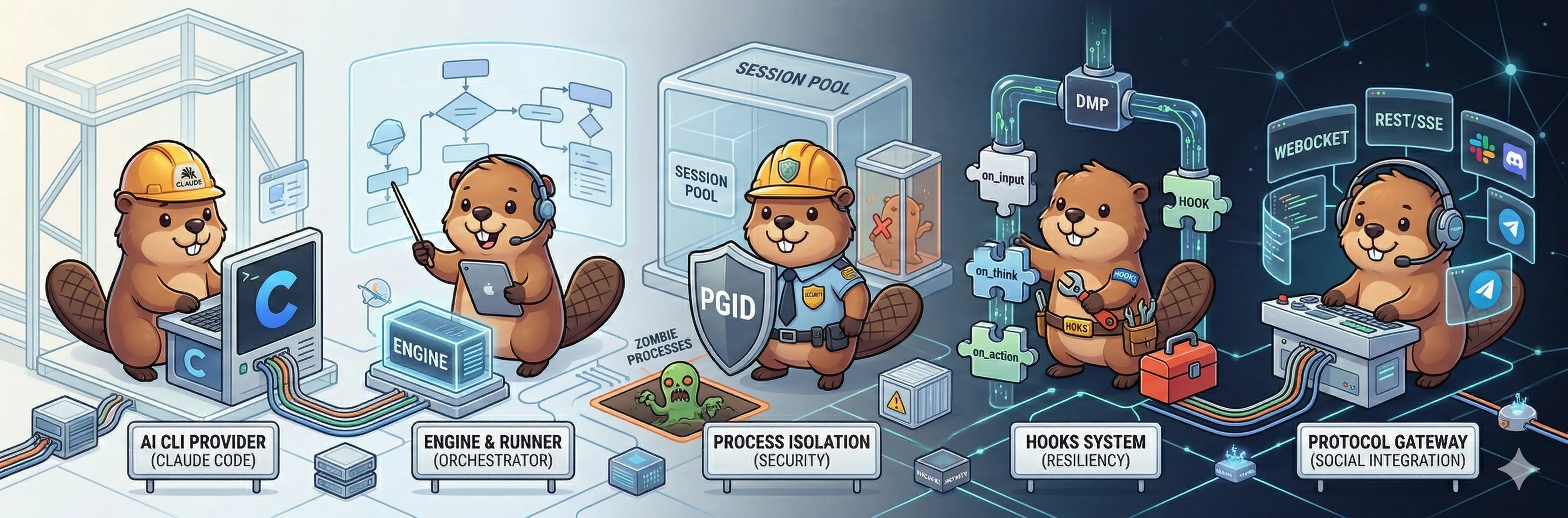
HotPlex transforms terminal AI tools (Claude Code, OpenCode) into production services. Built with Go using the Cli-as-a-Service paradigm, it eliminates CLI startup latency through persistent process pooling and ensures execution safety via PGID isolation and Regex WAF. The system supports WebSocket/HTTP/SSE communication with Python and TypeScript SDKs. At the application layer, HotPlex integrates with Slack and Feishu, supporting streaming output, interactive cards, and multi-bot protocols.




Quick Start · Features · Architecture · Docs · Discussions · 简体中文
Table of Contents
- Quick Start
- Core Concepts
- Project Structure
- Features
- Architecture
- Usage Examples
- Development Guide
- Documentation
- Contributing
⚡ Quick Start
# One-line installation
curl -sL https://raw.githubusercontent.com/hrygo/hotplex/main/install.sh | bash

# Or build from source
make build

# Start the daemon
./hotplexd start -config configs/server.yaml

# Start with custom environment file
./hotplexd start -config configs/server.yaml -env-file .env.local
Requirements
| Component | Version | Notes |
|---|---|---|
| Go | 1.25+ | Runtime & SDK |
| AI CLI | Claude Code or OpenCode | Execution target |
| Docker | 24.0+ | Optional, for container deployment |
First Run Checklist
# 1. Clone and build
git clone https://github.com/hrygo/hotplex.git
cd hotplex
make build

# 2. Copy environment template
cp .env.example .env

# 3. Configure your AI CLI
# Ensure Claude Code or OpenCode is in PATH

# 4. Run the daemon
./hotplexd start -config configs/server.yaml
🧠 Core Concepts
Understanding these concepts is essential for effective HotPlex development.
Session Pooling
HotPlex maintains long-lived CLI processes instead of spawning fresh instances per request. This eliminates:
- Cold start latency (typically 2-5 seconds per invocation)
- Context loss between requests
- Resource waste from repeated initialization
Request 1 → CLI Process 1 (spawned, persistent)
Request 2 → CLI Process 1 (reused, instant)
Request 3 → CLI Process 1 (reused, instant)
I/O Multiplexing
The Runner component handles bidirectional communication between:
- Upstream: User requests (WebSocket/HTTP/ChatApp events)
- Downstream: CLI stdin/stdout/stderr streams
// Each session has dedicated I/O channels
type Session struct {
    Stdin  io.Writer
    Stdout io.Reader
    Stderr io.Reader
    Events chan *Event  // Internal event bus
}
PGID Isolation
Process Group ID (PGID) isolation ensures clean termination:
- CLI processes are spawned with
Setpgid: true - Termination sends signal to entire process group (
kill -PGID) - No orphaned or zombie processes
Regex WAF
Web Application Firewall layer intercepts dangerous commands before they reach the CLI:
- Block patterns:
rm -rf /,mkfs,dd,:(){:|:&};: - Configurable via
security.danger_wafin config - Works alongside CLI's native tool restrictions (
AllowedTools)
ChatApps Abstraction
Unified interface for multi-platform bot integration:
type ChatAdapter interface {
    // Platform-specific event handling
    HandleEvent(event Event) error
    // Unified message format
    SendMessage(msg *ChatMessage) error
}
MessageOperations (Optional)
Advanced platforms implement streaming and message management:
type MessageOperations interface {
    StartStream(ctx, channelID, threadTS) (messageTS, error)
    AppendStream(ctx, channelID, messageTS, content) error
    StopStream(ctx, channelID, messageTS) error
    UpdateMessage(ctx, channelID, messageTS, msg) error
    DeleteMessage(ctx, channelID, messageTS) error
}
Module Analysis
1. Engine & Session Pool (internal/engine)
The engine layer is the brain of HotPlex, coordinating all AI interactions.
- Deterministic ID Mapping: Generates UUID v5 using platform metadata, ensuring that the corresponding Claude CLI process can be retrieved even after
hotplexdrestarts. - Health Detection: 500ms frequency
waitForReadypolling combined withprocess.Signal(0)detection ensures that sessions assigned to users are 100% available. - Cleanup Mechanism: Dynamically adjusts the cleanup interval (Timeout/4), balancing resource utilization and response speed.
2. Security & Protection (internal/security)
HotPlex acts as a WAF for the local system.
- Multi-level Filtering: Pre-configured with over 50 dangerous command patterns, ranging from simple
rmto complexsudo bashreverse shells. - Evasion Defense: Specifically designed for LLM-generated content, it includes automatic markdown code block stripping and real-time detection of malicious control characters (e.g., null bytes).
3. Communication Server (internal/server)
- Protocol Translation: The core
ExecutionControllerserializes complex CLI events into standard streaming JSON for consumption by upstream platforms. - Admin API: Provides complete session audit logs (Audit Events) and export interfaces.
4. Native Brain (brain & internal/brain)
- "System 1" Abstraction: Providing lightweight intent recognition and safety pre-audit interfaces, supporting multiple LLM model routing.
- Resiliency: Built-in circuit breakers and automatic failover logic to ensure core capabilities remain available even if the primary model is down.
5. Telemetry & Monitoring (internal/telemetry)
- OpenTelemetry: Deeply integrated OTEL, not only tracking request latency but also tracing every "Permission Decision" made by the AI.
- Monitoring Metrics: Exports Prometheus-compatible metrics covering session success rates, token costs, and security interception frequency.
- Deep Token & Context Telemetry: Real-time tracking of input/output tokens, prompt caching efficiency, and context window utilization (supporting 200K to 1M+ windows).
6. Management Tools (Management CLI)
hotplexd is not just a daemon; it is also a full-featured management tool:
status: View engine load, active session count, and memory usage in real-time.session: Provides fine-grained session control includinglist(list),kill(kill), andlogs(view logs).doctor: Automatically diagnoses the local environment, checkingclaudeCLI connectivity, permission settings, and Docker status.config: Validates and renders the current merged configuration tree, supporting both local and remote validation.cron: Schedule and manage background AI tasks with standard cron syntax and history tracking.relay: Configure cross-platform bot-to-bot relaying and binding.
📂 Project Structure
hotplex/
├── [cmd/](./cmd)                  # CLI & Daemon entrypoints
│   └── [hotplexd/](./cmd/hotplexd)  # Main daemon implementation
├── internal/               # Core implementation (private)
│   ├── engine/             # Session pool & runner
│   ├── server/             # WebSocket & HTTP gateway
│   ├── security/           # WAF & isolation
│   ├── config/             # Configuration loading
│   ├── sys/                # OS signals
│   ├── telemetry/          # OpenTelemetry
│   └── ...
├── brain/                  # Native Brain orchestration
├── cache/                  # Caching layer
├── [provider/](./provider)        # AI provider adapters
│   ├── [claude_provider.go](./provider/claude_provider.go)      # Claude Code protocol
│   ├── [opencode_provider.go](./provider/opencode_provider.go)  # OpenCode protocol
│   └── ...
├── [chatapps/](./chatapps)        # Platform adapters
│   ├── slack/              # Slack Bot
│   ├── feishu/             # Feishu Bot
│   └── base/               # Common interfaces
├── types/                  # Public type definitions
├── event/                  # Event system
├── plugins/                # Extension points
│   └── storage/            # Message persistence
├── sdks/                   # Language bindings
│   ├── go/                 # Go SDK (embedded)
│   ├── python/             # Python SDK
│   └── typescript/         # TypeScript SDK
├── docker/                 # Container definitions
├── configs/                # Configuration examples
└── docs/                  # Architecture docs
Key Directories
| Directory | Purpose | Public API |
|---|---|---|
types/ |
Core types & interfaces | ✅ Yes |
event/ |
Event definitions | ✅ Yes |
hotplex.go |
SDK entry point | ✅ Yes |
internal/engine/ |
Session management | ❌ Internal |
internal/server/ |
Network protocols | ❌ Internal |
provider/ |
CLI adapters | ⚠️ Provider interface |
✨ Features
| Feature | Description | Use Case |
|---|---|---|
| 🔄 Deterministic Sessions | Precise mapping based on UUID v5 (SHA1) to ensure cross-platform context consistency | High-frequency AI collaboration |
| 🛡️ Secure Isolation | Unix PGID and Windows Job Objects isolation to completely eliminate zombie processes | Production-grade security |
| 🛡️ Regex WAF | 6-level risk assessment system to prevent command injection, privilege escalation, and reverse shells | System hardening |
| 🌊 Streaming Delivery | 1MB-level I/O buffer + full-duplex Pipe for sub-second Token response | Real-time interactive UI |
| 💬 Multi-platform Adaptation | Native support for Slack and Feishu with $O(1)$ session lookup via secondary indexing | Enterprise-level communication |
| 🛡️ Cross-platform Relay | Secure bot-to-bot message routing between different chat platforms | Multi-agent collaboration |
| ⏰ Background Cron | Native scheduling for periodic AI tasks with failure recovery and webhooks | Automation & Monitoring |
| Packaged Go SDK | Zero-overhead embedded engine for direct integration into Go business logic | Custom Agents |
| 🔌 Protocol Compatibility | Full OpenCode HTTP/SSE protocol support for seamless frontend integration | Cross-language frontend |
| 📊 Deep Telemetry | Built-in OpenTelemetry tracing and Real-time Context Window/Token Tracking | Production monitoring & Cost Control |
| 🐳 BaaS Architecture | Docker 1+n containerization scheme with pre-installed major language environments | Rapid deployment |
🏛 Technical Architecture
HotPlex employs a decoupled layered architecture to ensure high reliability from chat platforms to the execution engine.
1. Engine & Session Pool
- Deterministic ID Mapping: Uses
UUID v5 (SHA1)to mapNamespace + Platform + UserID + ChannelIDto a persistentproviderSessionID. This ensures that as long as the user metadata remains the same, the session can be accurately recovered after a daemon restart. - Cold/Warm Start Logic: Features a 500ms polling
waitForReadymechanism combined with Job Markers for state recovery and stale session detection.
2. Isolation & Security
- Process Group Isolation: Utilizes PGID (Process Group ID). Upon session termination, a signal is sent to the negative PID, forcing the removal of the entire process tree and eradicating orphan processes.
- Dual-Layer WAF: Performs a 6-level risk assessment before commands reach the CLI. Includes evasion protection (blocking null bytes/control chars) and automatic markdown stripping (reducing false positives).
3. Communication & Flow Control
- OpenCode Compatibility: Real-time mapping of internal events to
reasoning,text, andtoolparts. - I/O Multiplexing: Full-duplex pipes with 1MB dynamic buffers to prevent accidental blocking during large concurrent read/write operations.
- Management Plane: Provides both direct local CLI access and a remote Admin API (port 9080) for session management, diagnostics, and metrics.
4. Module Structure
- Provider System: Plug-in architecture supporting Claude Code's
~/.claude/projects/directory management and permission synchronization. - ChatApp Adapter: Built-in secondary indexing for $O(1)$ session lookup based on
user + channel.
graph TD
    User([User / ChatApps]) -- WebSocket / HTTP --> Gateway[hotplexd Gateway]
    Gateway -- Event Map --> Pool[Session Pool]
    Pool -- ID Mapping --> Runner[Runner/Multiplexer]
    Runner -- PGID Isolation --> CLI[AI CLI Process]

    subgraph Security Layer
    WAF[Regex WAF] .-> Runner
    Auth[API Key / Admin Auth] .-> Gateway
    end

    subgraph Persistence
    Marker[Session Marker Store] .-> Pool
    Log[Session Logs] .-> Runner
    end
📖 Usage Examples
Go SDK (Embeddable)
import (
    "context"
    "fmt"
    "time"

    "github.com/hrygo/hotplex"
    "github.com/hrygo/hotplex/types"
)

func main() {
    // Initialize engine
    engine, err := hotplex.NewEngine(hotplex.EngineOptions{
        Timeout:     5 * time.Minute,
        IdleTimeout: 30 * time.Minute,
    })
    if err != nil {
        panic(err)
    }
    defer engine.Close()

    // Execute prompt
    cfg := &types.Config{
        WorkDir:   "/path/to/project",
        SessionID: "user-session-123",
    }

    engine.Execute(context.Background(), cfg, "Explain this function", func(eventType string, data any) error {
        switch eventType {
        case "message":
            if msg, ok := data.(*types.StreamMessage); ok {
                fmt.Print(msg.Content)  // Streaming output
            }
        case "error":
            if errMsg, ok := data.(string); ok {
                fmt.Printf("Error: %s
", errMsg)
            }
        case "usage":
            if stats, ok := data.(*types.UsageStats); ok {
                fmt.Printf("Tokens: %d input, %d output
", stats.InputTokens, stats.OutputTokens)
            }
        }
        return nil
    })
}
Slack Bot Configuration
# configs/base/slack.yaml
platform: slack
mode: socket

provider:
  type: claude-code
  default_model: sonnet
  allowed_tools:
    - Read
    - Edit
    - Glob
    - Grep
    - Bash

engine:
  work_dir: ~/projects/hotplex
  timeout: 30m
  idle_timeout: 1h

security:
  owner:
    primary: ${HOTPLEX_SLACK_PRIMARY_OWNER}
    policy: trusted

assistant:
  bot_user_id: ${HOTPLEX_SLACK_BOT_USER_ID}
  dm_policy: allow
  group_policy: multibot
WebSocket API
// Connect
const ws = new WebSocket('ws://localhost:8080/ws/v1/agent');

// Listen for messages
ws.onmessage = (event) => {
  const data = JSON.parse(event.data);
  switch (data.type) {
    case 'message':
      console.log(data.content);
      break;
    case 'error':
      console.error(data.error);
      break;
    case 'done':
      console.log('Execution complete');
      break;
  }
};

// Execute prompt
ws.send(JSON.stringify({
  type: 'execute',
  session_id: 'optional-session-id',
  prompt: 'List files in current directory'
}));
OpenCode Compatible API (HTTP/SSE)
# 1. Create session
curl -X POST http://localhost:8080/session

# 2. Send prompt (async)
curl -X POST http://localhost:8080/session/{session_id}/message \
  -H "Content-Type: application/json" \
  -d '{"prompt": "Hello, AI!"}'

# 3. Listen for events (SSE)
curl -N http://localhost:8080/global/event
💻 Development Guide
Common Tasks
# Run tests
make test

# Run with race detector
make test-race

# Build binary
make build

# Run linter
make lint

# Build Docker images
make docker-build

# Start Docker stack
make docker-up
[!TIP]
The version information displayed byhotplexd versionis injected viaLDFLAGSduring build. If you rungo runorgo builddirectly without LDFLAGS, it will show the defaultv0.0.0-dev. Usingmake buildis recommended for compilation.
Adding a New ChatApp Platform
- Implement the adapter interface in
chatapps/<platform>/:
type Adapter struct {
    client *platform.Client
    engine *engine.Engine
}

// Implement base.ChatAdapter interface
var _ base.ChatAdapter = (*Adapter)(nil)

func (a *Adapter) HandleEvent(event base.Event) error {
    // Platform-specific event parsing
}

func (a *Adapter) SendMessage(msg *base.ChatMessage) error {
    // Platform-specific message sending
}
- Register in
chatapps/setup.go:
func init() {
    registry.Register("platform-name", NewAdapter)
}
- Add configuration in
configs/base/:
platform: platform-name
mode: socket  # or http
# ... platform-specific config
Adding a New Provider
- Implement the Provider interface in
provider/:
// provider/custom_provider.go
type CustomProvider struct{}

func (p *CustomProvider) Execute(ctx context.Context, cfg *types.Config, prompt string, callback event.Callback) error {
    // Implement provider-specific logic
}
- Register the new type in
provider/factory.go.
📚 Documentation
| Guide | Description |
|---|---|
| 🚀 Deployment | Docker, production setup |
| 💬 ChatApps | Slack & Feishu integration |
| 🛠 Go SDK | SDK reference |
| 🔒 Security | WAF, isolation |
| 📊 Observability | Metrics, tracing |
| ⚙️ Configuration | Full config reference |
🤝 Contributing
We welcome contributions! Please follow these steps:
# 1. Fork and clone
git clone https://github.com/hrygo/hotplex.git

# 2. Create a feature branch
git checkout -b feat/your-feature

# 3. Make changes and test
make test
make lint

# 4. Commit with conventional format
git commit -m "feat(engine): add session priority support"

# 5. Submit PR
gh pr create --fill
Commit Message Format
<type>(<scope>): <description>

Types: feat, fix, refactor, docs, test, chore
Scope: engine, server, chatapps, provider, etc.
Code Standards
- Follow Uber Go Style Guide
- All interfaces require compile-time verification
- Run
make test-racebefore submitting
📄 License
MIT License © 2024-present HotPlex Contributors

Built for the AI Engineering community
Yorumlar (0)
Yorum birakmak icin giris yap.
Yorum birakSonuc bulunamadi