agent-design-patterns
Health Pass
- License — License: MIT
- Description — Repository has a description
- Active repo — Last push 0 days ago
- Community trust — 64 GitHub stars
Code Fail
- Hardcoded secret — Potential hardcoded credential in action/b-plan-and-execute/example.py
Permissions Pass
- Permissions — No dangerous permissions requested
No AI report is available for this listing yet.
A 7×6 framework for agent architecture. 28 patterns, each placed at a coordinate, runnable Python code with verified engineering slices from Claude Code, Aider, OpenHands, DeerFlow. Companion to Designing AI Agents (Manning) by Jia Huang.
Agent Design Patterns
A 7×6 framework for agent architecture. 28 patterns, each placed at a coordinate, each with runnable code and a verified engineering slice from real production codebases.
The model spends. The harness budgets. This repo is the vocabulary you can put in your project tomorrow.
简体中文 README · Manning · Designing AI Agents · Paper · arXiv:2605.13850 · 极客时间专栏 · Newsletter · Author site
Looking for the full Argus running example as one evolving
codebase, organized by book chapter? See the companion repo
huangjia2019/designing-ai-agents
— Argus grows module by module from Ch2 to Ch10, with each chapter'spatterns/+argus/side by side. That repo follows the book's
narrative; this repo is the standalone pattern catalog.
The book
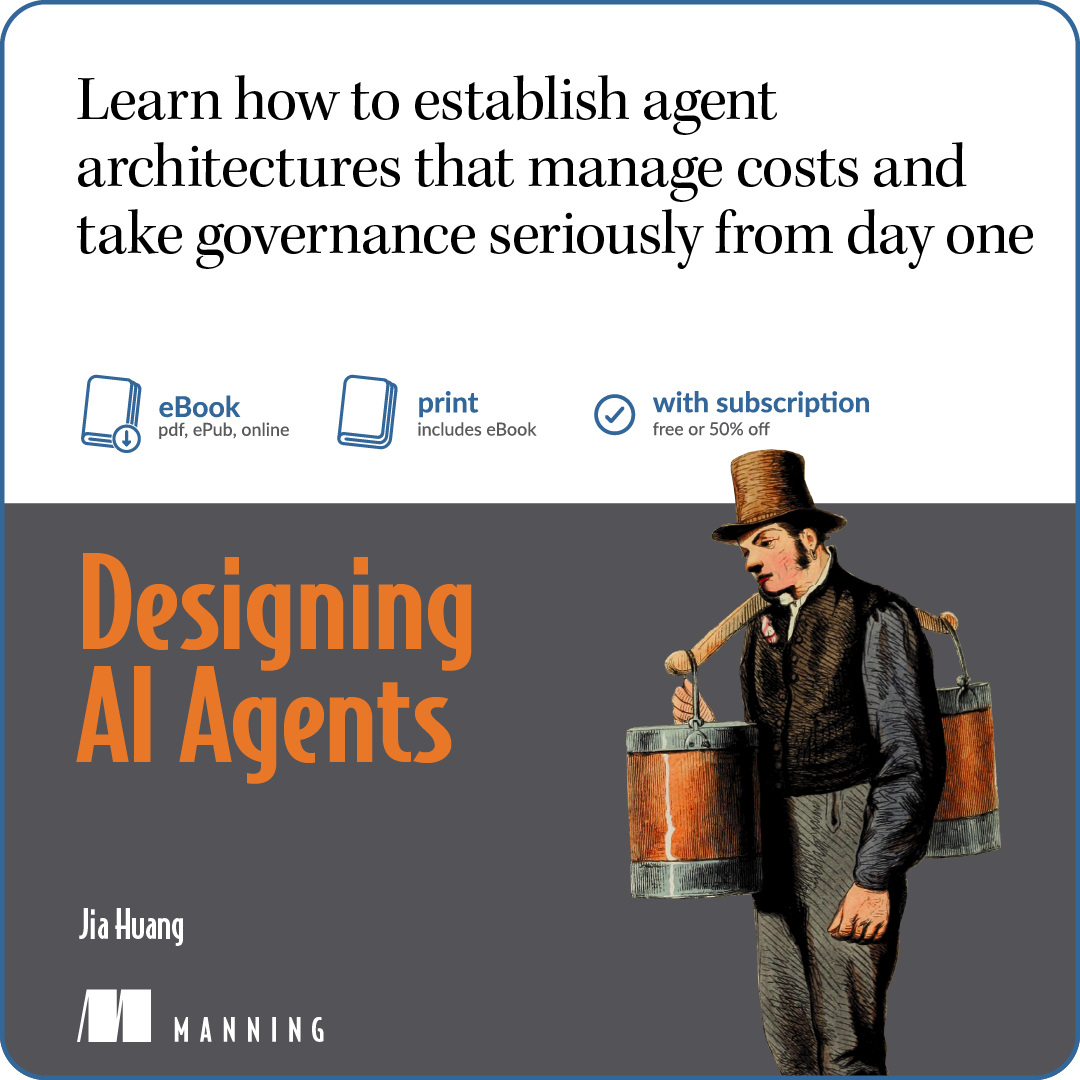
Designing AI Agents — the design-pattern catalogue for production AI agents. (Manning)
The framework comes from a paper
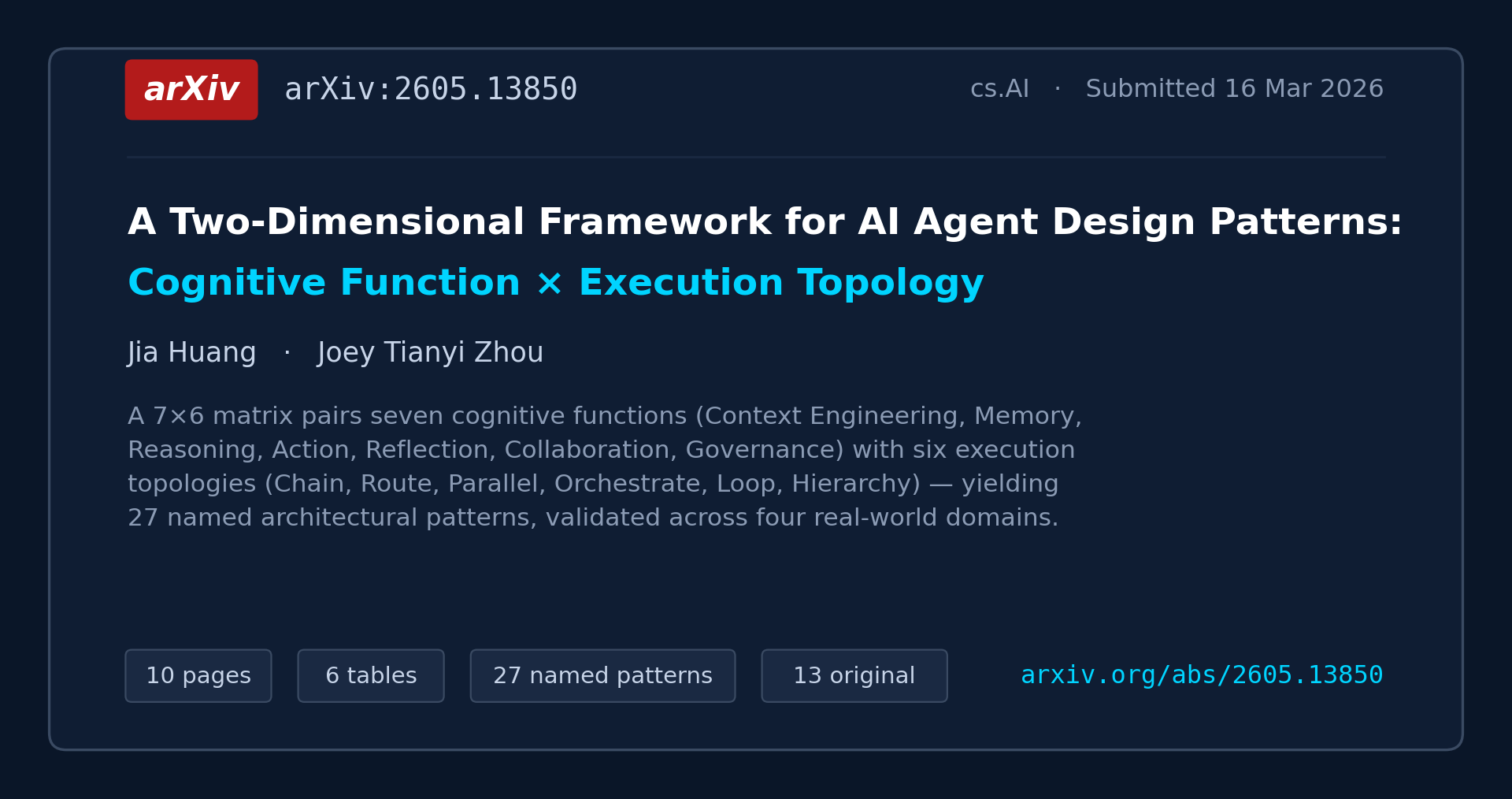
The two-axis framework, the 27 named patterns, and the five
pattern-selection laws are introduced in A Two-Dimensional Framework
for AI Agent Design Patterns: Cognitive Function × Execution
Topology (Huang & Zhou,
arXiv:2605.13850). This repository is the runnable companion to the
paper.
Why this exists
Most "agent architecture" guides give you a flat list — Reflection, ReAct,
Multi-Agent, Tree of Thoughts, Reflexive Metacognitive, and so on. A flat
list answers what patterns exist. It does not answer where my problem
sits, and which pattern lives at that coordinate.
A loan-evaluation agent crashes not because Reflection is missing but
because Perception-stage budget allocation dropped the disqualifying
document. A multi-agent code reviewer drifts not because ReAct is wrong
but because two Reflection critics contradict each other and there is no
governance gate to resolve it. These are not different patterns — they
are patterns sitting at specific coordinates in a structured design
space. Without the coordinates you can't see them.
This repo gives you the coordinates.
The two-axis framework
Every agent pattern sits at the intersection of two orthogonal axes.
- Cognitive function — what the agent is doing
↳ perceive · remember · reason · act · reflect · collaborate · govern - Execution topology — how the work is laid out at runtime
↳ single-step · sequential · parallel · loop · router · hierarchy
Seven × six = 42 cells. The 28 cells where interesting patterns live are
the chapters of Designing AI Agents (Manning) and the lectures of the
极客时间 column.
The framework's claim is not that everything fits the matrix. The claim
is that giving a pattern a coordinate forces an answer to "why is this
pattern here and not somewhere else". A flat list lets you skip the
question. A matrix does not.
The matrix — click into any pattern
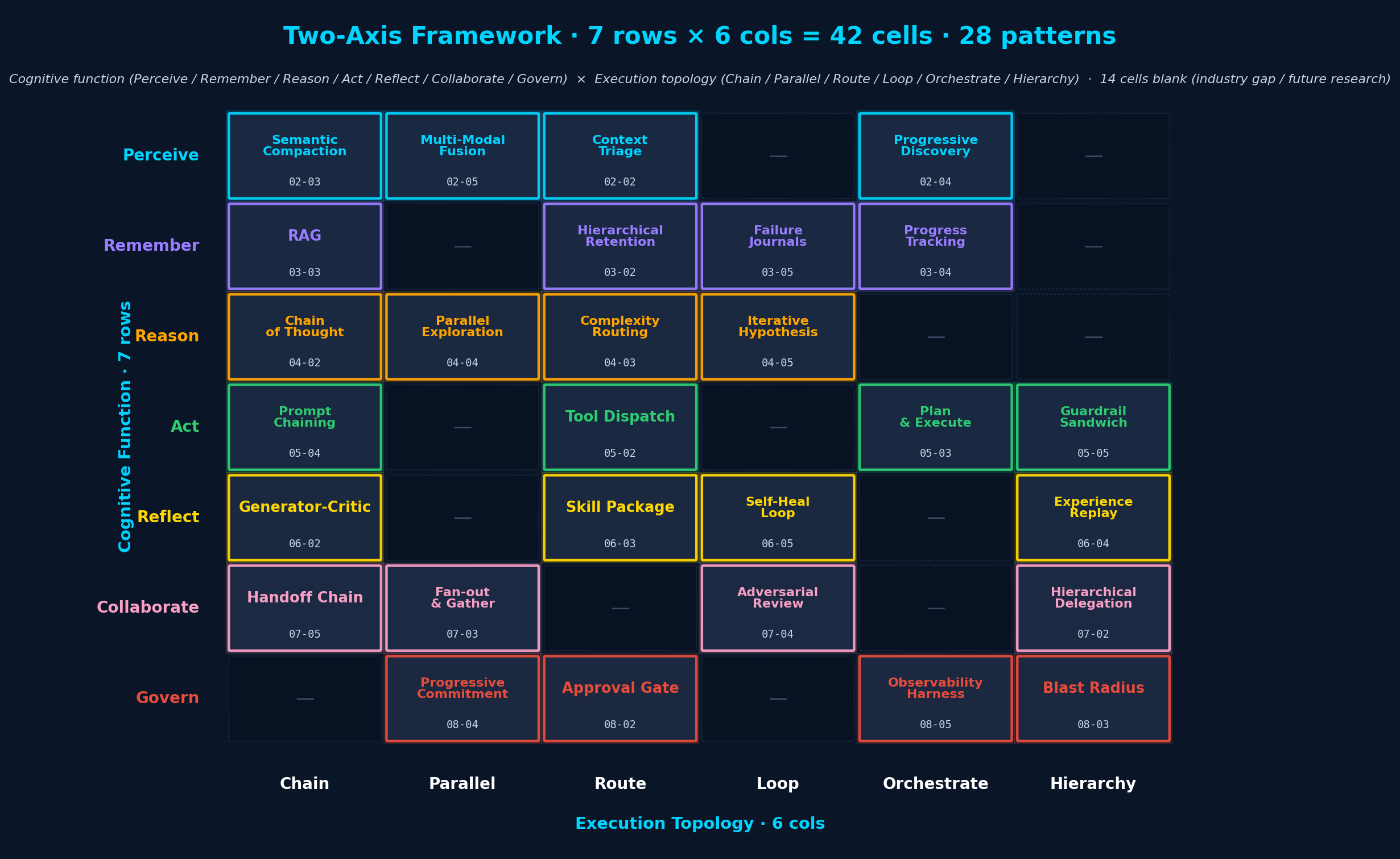
Every pattern below lives at one coordinate. Click any pattern name to
enter that folder's code and README. Cells marked ✅ have runnable code;
cells marked 🟡 are scaffolded.
| Chain | Parallel | Route | Loop | Orchestrate | Hierarchy | |
|---|---|---|---|---|---|---|
| Perceive | Semantic Compaction ✅ | Multi-Modal Fusion ✅ | Context Triage ✅ | — | Progressive Discovery ✅ | — |
| Remember | RAG ✅ | — | Hierarchical Retention ✅ | Failure Journals ✅ | Progress Tracking ✅ | — |
| Reason | Chain of Thought ✅ | Parallel Exploration ✅ | Complexity Routing ✅ | Iterative Hypothesis ✅ | — | — |
| Act | Prompt Chaining ✅ | — | Tool Dispatch ✅ | — | Plan & Execute ✅ | Guardrail Sandwich ✅ |
| Reflect | Generator-Critic 🟡 | — | Skill Package 🟡 | Self-Heal Loop 🟡 | — | Experience Replay 🟡 |
| Collaborate | Handoff Chain 🟡 | Fan-out & Gather 🟡 | — | Adversarial Review 🟡 | — | Hierarchical Delegation 🟡 |
| Govern | — | Progressive Commitment 🟡 | Approval Gate 🟡 | — | Observability Harness 🟡 | Blast Radius 🟡 |
Composition (putting patterns together):
Pattern Selection Card ·
Six-Step Methodology ·
Argus Full Case Study ·
Checklist Benchmark Case
The 14 empty cells mark either industry gaps no production harness has
filled yet, or topology-function combinations whose patterns haven't
crystallized.
Each pattern folder follows the same shape: pattern.py (the minimal
honest reference, 50–250 lines), example.py (a real-scenario case that
runs without API keys), test_pattern.py (the invariants the pattern
must hold), and bilingual README.md / README.zh-CN.md.
Engineering slices — verified, not hallucinated
Every pattern's README cites real production code. Citations are
file-and-line in upstream open-source projects, verified at the time of
writing. If you find a citation that no longer matches the upstream code,
open an issue — that's a bug, not a documentation choice.
The eight production harnesses the framework tracks: Claude Code,
Codex CLI, Aider, OpenCode, OpenClaw, Hermes Agent, DeepAgents, DeerFlow,
OpenHands. Each pattern's README pulls from at least one of these to
show the pattern in real production form, not toy form.
What this repo is not
- Not a framework. Use LangGraph,
agno,
DeerFlow, or
OpenHands for a production
runtime. This repo is the design vocabulary you apply on top of any of
them. Switching frameworks does not change the matrix. - Not a flat catalog. A list answers what patterns exist. The matrix
answers where a problem sits and which patterns are wrong for that
position. - Not toy code. Every
pattern.pyis small (50–250 lines) on
purpose, but it is honest code with real invariants and tests. Eachexample.pyruns on data shaped like production. Engineering slices
in the READMEs cite verified upstream files.
Quickstart
git clone https://github.com/huangjia2019/agent-design-patterns.git
cd agent-design-patterns
python -m venv .venv && source .venv/bin/activate
pip install -e ".[dev]"

# Run a pattern's case
python perception/a-context-triage/example.py
python perception/b-semantic-compaction/example.py

# Run all invariant tests
pytest
Each pattern folder is self-contained. No central framework, no plugin
system to learn. Read the folder's README, look at pattern.py, runexample.py, read the tests.
How to read a pattern folder
<pattern-folder>/
  README.md                # The why — what failure mode this pattern catches
  README.zh-CN.md          # 中文版
  pattern.py               # The minimal honest implementation
  example.py               # A runnable case on production-shaped data
  test_pattern.py          # The invariants the pattern must hold
Read the README first — it's the why and the upstream slice. Then readpattern.py to see the smallest amount of code that solves it. Runexample.py to see it work on data with shape. Tests pin the invariants
you must not break when adapting.
The thesis behind the framework
Three lines from the book:
- Designing an agent is solving a constrained allocation problem.
- A fixed token budget must be distributed across competing cognitive
demands under non-deterministic execution paths. - The model is the spender. The harness is the budgeter. The patterns
are the strategies.
Every pattern in the matrix is a strategy for one of those three roles —
how the harness budgets, how the patterns allocate, how the model is
positioned to spend. The matrix is what makes the strategies discussable
as a system rather than as a flat list.
Book · Column · Newsletter
| Manning · Designing AI Agents | The design-pattern catalogue for production AI agents. 27 patterns across 7 cognitive functions and 6 topologies. |
| 极客时间 · 《Agent 设计模式之美》 | Chinese-language video column. Pattern-by-pattern walkthrough with engineering slices from real production harnesses. |
| Substack · Agent Design Patterns | Free English newsletter, one essay every 1–2 weeks. Structural observation, not hype. |
| 极客时间 · Claude Code 工程化实战 | Published Chinese-language video column on the engineering practice of building agents on Claude Code. |
The book gives you the theory. The column gives you the lectures. This
repo gives you runnable code.
Author
Jia Huang (黄佳) — Lead Research Engineer at A*STAR
Singapore, formerly senior consultant at Accenture Singapore.
Twenty years across NLP, LLMs, and AI applications in MedTech and
FinTech. Author of two forthcoming English-language books (Designing AI
Agents with Manning, RAG from First Principles with Packt) and six
Chinese-language books on machine learning, GPT, AI agents, RAG, and
data analysis with cumulative readers in the hundreds of thousands.
The two-axis framework is the author's original contribution; the
constituent elements (seven cognitive functions, six execution
topologies) are not new — the contribution is the orthogonal organization.
kage-ai.com · LinkedIn · Substack · [email protected]
Contributing
Issues welcome. Particularly useful:
- Citation drift — a verified engineering slice in a README points at
a file or line that no longer matches upstream - Invariant violations — a test misses a case that you've seen the
pattern fail in production - New language ports — TypeScript / Go ports of any pattern, opened
as a separate top-level folder - New engineering slices — a production harness you've worked with
shows the pattern in a form not yet documented in the README
Pull requests for new patterns: please open an issue first to discuss
where the pattern sits in the matrix.
Citation
If this framework is useful in your work, please cite the paper:
@misc{huang_zhou_2026_dual_axis,
  author        = {Huang, Jia and Zhou, Joey Tianyi},
  title         = {A Two-Dimensional Framework for AI Agent Design Patterns:
                   Cognitive Function and Execution Topology},
  year          = {2026},
  eprint        = {2605.13850},
  archivePrefix = {arXiv},
  primaryClass  = {cs.AI},
  doi           = {10.5281/zenodo.19036557},
  url           = {https://arxiv.org/abs/2605.13850}
}
License
MIT. See LICENSE.
Reviews (0)
Sign in to leave a review.
Leave a reviewNo results found