agentd
Health Warn
- License — License: Apache-2.0
- Description — Repository has a description
- Active repo — Last push 0 days ago
- Low visibility — Only 7 GitHub stars
Code Fail
- exec() — Shell command execution in src/agentd/backends/deepgemm.py
Permissions Pass
- Permissions — No dangerous permissions requested
No AI report is available for this listing yet.
An agent that gets better without being trained — JitRL-style test-time RL (no gradients, no GPU), multi-model councils, real SSH ops with a live server screen, human-approved destructive commands. 无需训练、越用越好的自托管运维 Agent
agentd
English · 中文
agentd is a server agent that gets better as it works. No training, no GPU.
Three things you can do with it:
- Put LLMs to work on your servers. Point it at any model — an OpenAI-compatible
endpoint (your own relay counts) or native Anthropic / Gemini. Models act through real
tools: SSH, shell, files. Dangerous commands pass a safety gate and wait for your click. - Watch it work. A real interactive terminal, a live view of the machine's screen, and
a step-by-step trace, all in one browser console. One SSH tunnel reaches it; the server
exposes no public ports. - Let it improve. It records what each action earned and does better next time in
similar situations. You can verify that mechanism yourself with no API key at all.
Pick your path:
- Want to run it now → 60 seconds
- Want the numbers → Measured results
- Want the mechanism → How it works
It runs on a $5 VPS.




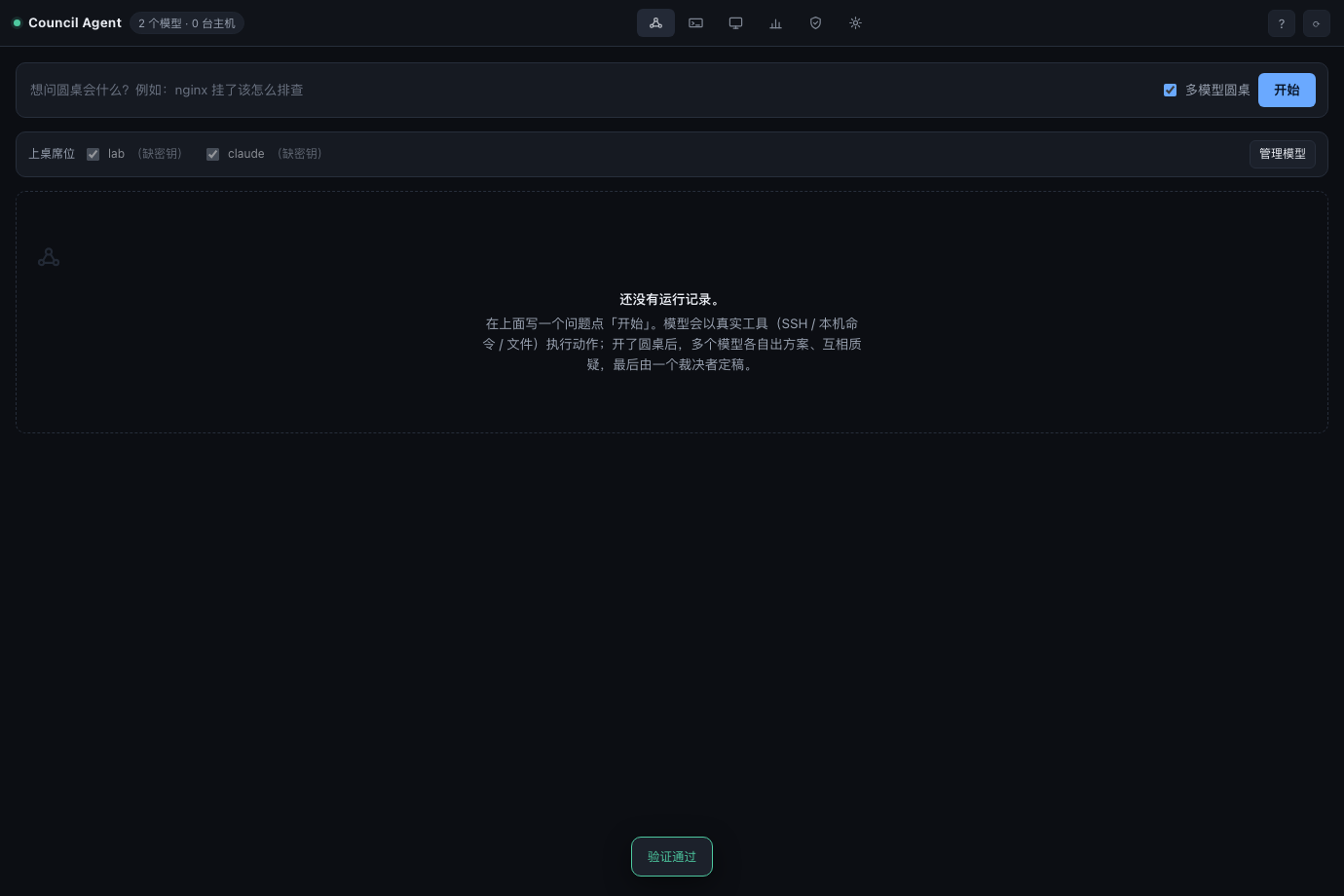
Desktop client (Tauri, macOS Intel + Apple Silicon, Windows) plus the browser console
served by the agent itself: hue913/council-agent.
60 seconds
Install it, then two commands to watch it learn. No API key, no network.
git clone https://github.com/hue913/agentd && cd agentd
python3.11 -m venv .venv && . .venv/bin/activate
pip install -e ".[api]"

agentd demo                     # watch memory flip decisions, keyless
agentd bench --episodes 40      # success rate with and without memory
You will see two lines:
learning OFF (control)   1/40 (  2.5%)    1st half  5.0%   2nd half  0.0%
learning ON  (JitRL)    11/40 ( 27.5%)    1st half  0.0%   2nd half 55.0%
How to read it: without memory, the control arm wins 1 of 40 episodes. With memory, 11 —
and the second-half success rate climbs. That is the memory working. For results beyond a
single seed, see Measured results.
What it can do
| Learns while running | (state, action, discounted_return) triplets in SQLite; n-gram retrieval with an inverted index; advantage re-ranking; verbal self-critique stored and recalled. Per-memory credit accounting shows which memories actually get adopted |
| Any model you want | one base_url + api_key + model — an OpenAI-compatible endpoint or a native Anthropic / Gemini seat. Seats are managed live from the console or POST /api/providers; a capability probe picks the decode tier per endpoint; a missing key makes that seat abstain out loud, never fail silently |
| Operates your servers | SSH through the system ssh/scp (inherits ~/.ssh/config, agent, ProxyJump), an interactive PTY terminal served over WebSocket, resumable uploads with md5 reconciliation |
| An agent loop that acts | open goals (kind:"ops") run through the tool bus: the model proposes real calls — ssh.exec {"host":"self","command":"df -h"}, ssh.exec df -h, finish {...} — and every one passes the safety gate before execution |
| You can see it work | Xvfb + x11vnc + noVNC reached only through an SSH tunnel; the screen panel states plainly when no vision model is attached |
| Refuses to destroy things | every command is classified before execution; rm -rf, mkfs, DROP TABLE, force-push, curl | sh etc. need a human approval, with the pending request showing command, reasons and host |
| Multi-model councils | independent proposals → cross-examination under a boundary → adjudication. Dissent is rendered as its own block and never averaged into a fake consensus |
| Extensible four ways | built-in tools, drop-in Python plugins, SKILL.md skill packs, and any MCP server — plus agentd itself is an MCP server |
| Costs you less | stable prompt prefix for provider-side caching, observation compaction, a per-step token ledger you can reconcile against your bill, cheap/strong tier routing |
| Recurring work | dependency-free cron evaluator (agentd schedule), with one-shot catch-up after downtime |
| Shareable experience | agentd memory export writes a signed .agentdmem pack and human-readable Markdown; import is idempotent and warns when provenance differs |
Using it
1. Any model — three decode tiers
The council and the agent loop both need a score per candidate action. Not every endpoint
provides what scoring needs, so agentd probes the endpoint first and steps down
automatically:
| tier | endpoint gives | how the score is obtained |
|---|---|---|
token |
logprobs + top_logprobs |
the probability of the decision token, exactly as in the paper's formula (see How it works) |
n_sample |
logprob of the sampled token only | k independent samples; frequency becomes the score |
verbalized |
nothing | the model grades each option 0–100 |
agentd probe --base-url http://127.0.0.1:8080/v1 --model qwen3-8b
# → { "reachable": true, "decode_mode": "token", "notes": "top_logprobs at decision position …" }
The reference implementation reads a fixed token position (logprobs.content[-2]). If a
chat template emits a different number of trailing tokens — reasoning models do — that
position goes wrong. agentd locates the decision token every time, which is what makes
swapping models safe.
2. Hand it a server
Register a host, probe it, and route everything through one SSH tunnel:
agentd host add --label prod-1 --host 10.0.0.5 --user ops --key ~/.ssh/id_ed25519
agentd host probe --label prod-1        # arch / RAM / disk / docker / WebArena-viability, in one call
agentd viewer install                   # Xvfb + x11vnc + noVNC, loopback-only
agentd serve                            # HTTP API + SSE on 127.0.0.1:8765
API, PTY WebSocket and screen all travel through this one tunnel. The server exposes no
public ports besides 22:
ssh -N -L 8765:127.0.0.1:8765 -L 8766:127.0.0.1:8765 -L 6080:127.0.0.1:6080 root@your-server
# console   http://127.0.0.1:8765/
# screen    http://127.0.0.1:6080/vnc.html?autoconnect=true&resize=scale
3. The council: who sits at the table is yours
One model makes mistakes. Several models that draft, then challenge each other, make fewer.
Seats are not pinned to any vendor:
curl -X POST http://127.0.0.1:8765/api/providers -H "Authorization: Bearer $TOKEN" \
  -d '{"name":"lab","kind":"openai_compat","model":"qwen3-8b",
       "base_url":"https://your-relay.example/v1","api_key_env":"AGENTD_LAB_KEY","tier":"cheap"}'
Then run an open goal with the members you choose:
POST /api/session
{ "task": "nginx 挂了该怎么排查", "kind": "ops", "council": true,
  "members": ["claude", "lab"], "max_steps": 12 }
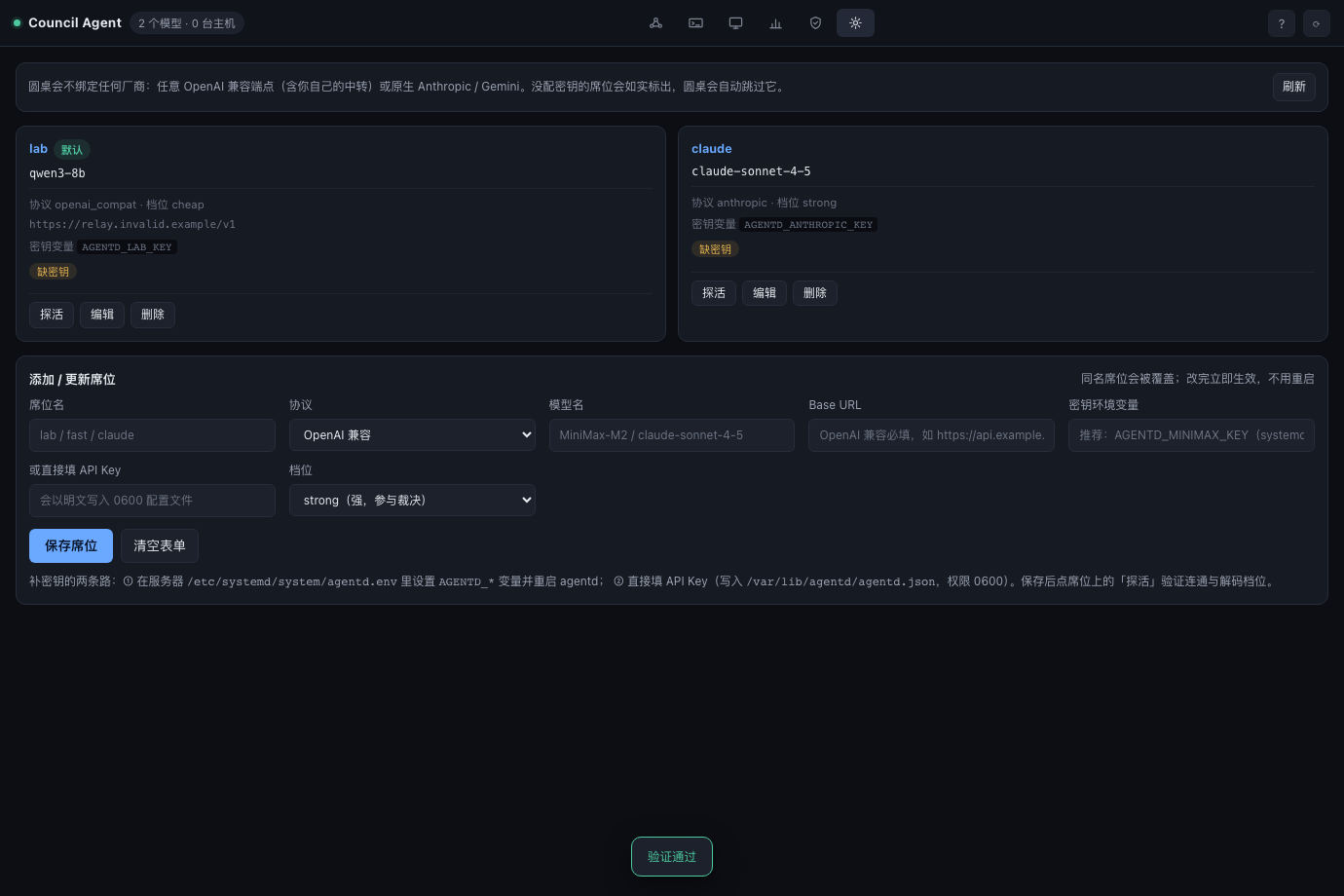
The rules of the table:
- Independent proposals first. Every member scores the candidate actions on its own.
- Cross-examination inside a boundary. Members may only flag problems with someone
else's proposal — never rewrite the plan. The critique phase sees prior output as
untrusted input and cannot change tool permissions. - Learned trust. Each member's weight is its historical win rate in states like this
one. The council discovers that model A is right about nginx and model B is right about
gitlab, instead of trusting the same vendor forever. - Dissent is kept. Objections become risk rows (
object/split/unavailable) and
render as their own block. A seat whose key is missing abstains with a recorded reason;
the outcome is visibly thinner, never quietly wrong. - Conditional by default. Deliberation fires on a thin margin between the top two
options, a dangerous action, or a task you pin. Confident steps cost one call.
4. Console & desktop client
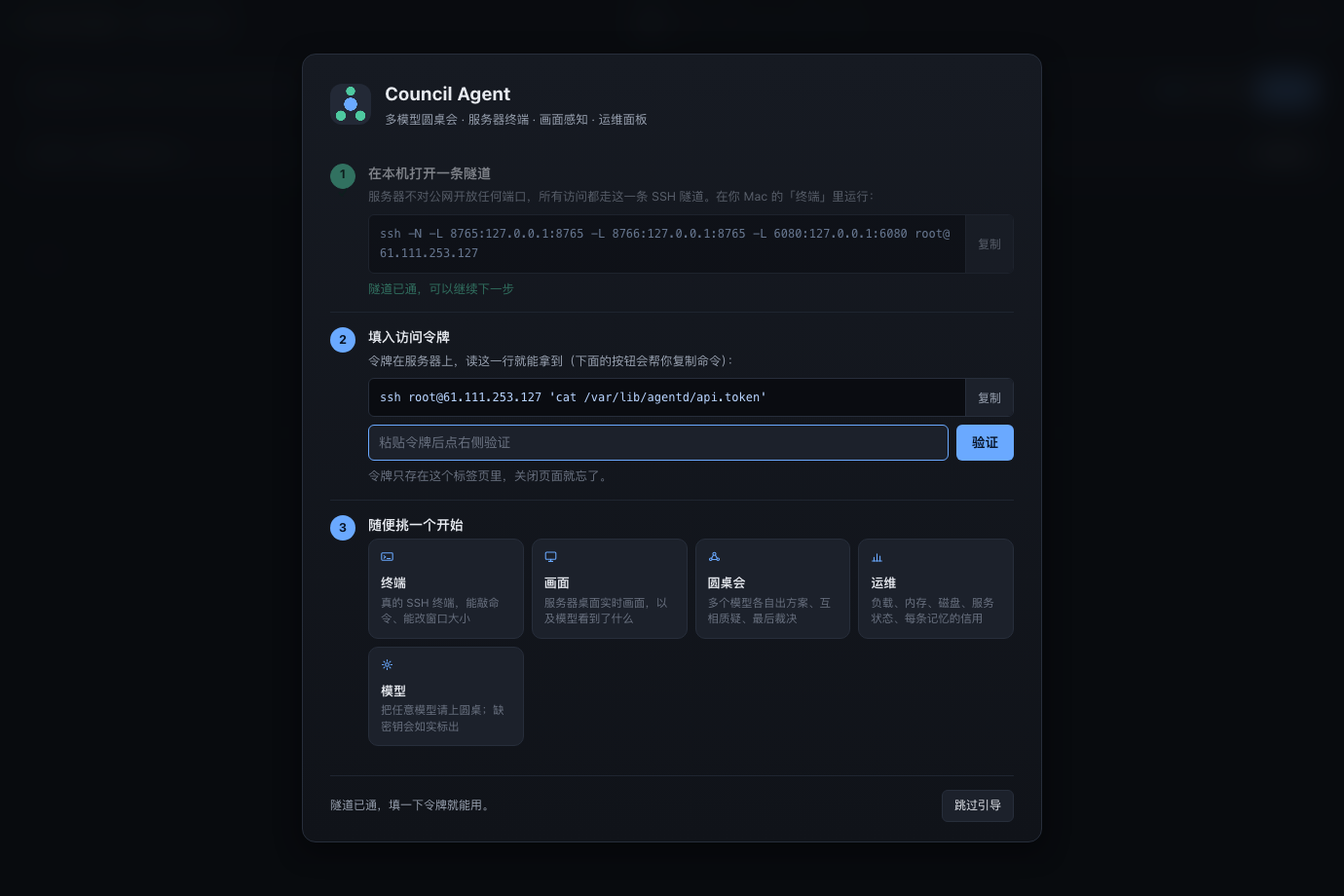
There are two clients, and they are independent:
- The browser console: a single no-build bundle served by agentd itself at
/. Open it
in a browser over the SSH tunnel. - The desktop client (Tauri, in the companion repo): a separate implementation that does
not load this bundle — no UI code is shared between them today. It opens and supervises
the SSH tunnel and adds tray presence.
Desktop builds: macOS universal (Intel + Apple Silicon) and Windows. Windows builds run via
GitHub Actions — Tauri cannot cross-compile a Windows bundle from a Mac.
5. Recurring work
Let the agent work on a schedule, with one automatic catch-up run after downtime:
agentd schedule add --name nightly-ops --cron "17 3 * * *" --task nginx-down
agentd schedule daemon
agentd run --suite web --policy model          # measure with your real endpoint
Measured results
Every number below reproduces on your own laptop. Bench output labels which policy produced
the numbers, so the baseline and a real model never get mixed up.
| suite | policy | scale | memory OFF | memory ON | delta |
|---|---|---|---|---|---|
| ops (scripted chains) | synthetic noisy model | 40 eps × 12 seeds | mean 1.1/40 | mean 14.4/40 | better in 11/12 seeds |
| ops, default seed | same | 40 eps | 1/40 (2.5%) | 11/40 (27.5%) | 2nd half 55% |
| web (real Chromium) | lexical baseline (not an LLM) | 60 eps × 3 seeds | mean 18.7/60 | mean 23.7/60 | +0.08, one seed negative |
Reproduce the ops suite seed by seed:
for s in $(seq 1 12); do agentd bench --episodes 40 --seed $s | sed -n 3,4p; done
Three notes for reading the tables:
- The ops suite varies a lot across seeds (0 to 30). Read the trend: learning is better in
11 of 12 seeds, and the twelfth is a tie where neither arm ever succeeds. - The web suite drives actual Chromium through Playwright over six MiniWoB-shaped tasks
(numbered elements, one goal, reward decided by a DOM checker on the page). Its gains are
modest and seed-dependent; why, see Honest limits. - Cross-machine reproducibility: a 2 vCPU Xeon deployment server (Ubuntu) reproduces the
laptop's seed-7 numbers exactly (1/40 vs 11/40). The measurement is seed-deterministic,
not machine-dependent.
Deliberately not measured here: full WebArena. The official shape is 4 vCPU / 16 GB /
1000 GB + 7 self-hosted sites; this project's reference box is a 2 GB VPS, so the web suite
above is the MiniWoB-shaped compromise. agentd host probe tells you in one command whether
your box could host the real thing.
Also from the live box (the exact deploy walkthrough is in docs/DEPLOY.md):
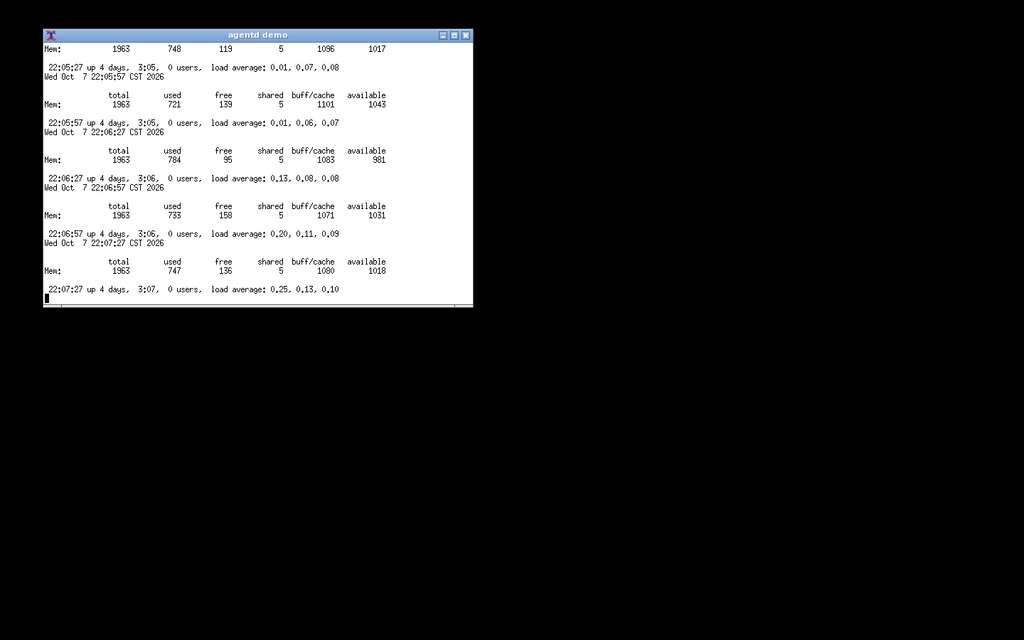
The screen panel's capture path, unedited: Xvfb → x11vnc → agentd → JPEG, fetched through
the tunnel. What the model sees is what you see here.
How it works
Why "without training" is the point
Deployed LLM weights are frozen, so the same mistakes repeat forever. Conventional RL fixes
that, but it costs two things a small box cannot pay: compute, and room for catastrophic
forgetting.
JitRL (Just-In-Time Reinforcement Learning, arXiv:2601.18510)
moves the RL to inference time: a dynamic, non-parametric memory of <state, action, reward>
triplets, retrieval of similar past trajectories, an on-the-fly advantage estimate, and a
direct additive modulation of the output logits. The paper proves this additive update is
the exact closed-form solution to the KL-constrained policy objective. On WebArena it beats
the strongest fine-tuning baseline (WebRL) without any training, at a thirtieth of the cost.
The core formula is one line:
z'(s,a) = z(s,a) + β·Â(s,a)
The model's own next-token score is z. agentd retrieves similar past situations, computes
the advantage  for each option — how much that option tended to earn in situations like
this one — and adds it to z with a coefficient β. That is the whole learning: one table
lookup and one addition. No gradients, no fine-tuning.
The loop: observe → enumerate/propose candidates → models score → kernel retrieves history and biases → argmax → execute via the tool bus → record (state, action, return) → reflect.
The end of each episode is Reflexion-shaped: the agent writes itself a two-sentence critique
tied to specific actions, stores it, and recalls it the next time a similar situation
appears.
Where this implementation differs from the paper's
agentd is an independent, productised implementation of the JitRL idea, built for operators.
Where it deviates from the reference implementation:
- Retrieval is lexical: Jaccard n-grams over an inverted index, zero embedding calls. The
paper uses a full BM25 + embedding + LLM-scored stack; this is a deliberate cheap subset,
labelled as such. - The advantage and exploration terms follow the published equations, including the
"recompute-baseline" detail and the fixed ε=0.05 the published path actually uses.
flowchart LR
    subgraph clients [Clients]
        B[Browser console]
        D[Tauri desktop<br/>Intel · Apple Silicon · Windows]
    end
    subgraph tunnel [One SSH tunnel — the whole security model]
        T1[8765 API + SSE]:::p
        T2[8766 PTY WebSocket]:::p
        T3[6080 noVNC]:::p
    end
    subgraph agentd [agentd · 127.0.0.1 only]
        API[FastAPI + bearer token]
        LOOP[Agent loop]
        KERNEL[JitRL kernel<br/>memory · retrieval · advantage · credit]
        COUNCIL[Council<br/>draft → critique → adjudicate]
        BUS[Tool bus<br/>builtin · plugins · skills · MCP]
        GATE[Safety gate + approvals + audit]
        PROV[Providers<br/>token / n_sample / verbalized]
    end
    subgraph targets [What it operates]
        SSH1[Your servers<br/>via system ssh]
        SCR[Xvfb screen<br/>x11vnc]
    end
    B & D --> T1 & T2 & T3 --> API --> LOOP
    LOOP --> KERNEL & COUNCIL & PROV
    LOOP --> BUS --> GATE --> SSH1
    API --> SCR
    classDef p fill:#eef,stroke:#88a;
Repo map:
src/agentd/
  kernel/      JitRL: store, retrieval, advantage, credit, memory packs
  providers/   openai_compat · anthropic (native) · gemini (native) · capability probe
  council.py   three-phase deliberation with learned member weights
  loop.py      the agent loop, Reflexion-style reflection
  envs/        scripted bench tasks · real tool tasks · web (MiniWoB) · SSH · PTY
  toolbus/     builtin tools · plugins · skills · MCP client
  safety/      command classification · audit log
  api/         HTTP + SSE + PTY WebSocket + console serving
  screen/      capture · change detection · perception · gated synthetic input
  sysinfo/     ops panel metrics (no request data ever reaches a shell)
ui/            the console, served same-origin by agentd
tests/         ~300 tests; platform-specific ones skip with a stated reason
Deploy to a small VPS
# on the target, as root — installs uv + CPython 3.11, creates /opt/agentd/.venv,
# writes a 0600 config, runs doctor + the keyless demo, installs a hardened systemd unit
bash deploy/install_server.sh /path/to/agentd
The unit runs agentd serve --host 127.0.0.1 and caps memory. It also dropsAGENTD_AUTO_APPROVE from the environment on purpose: the lab-only auto-approve switch can
never reach a deployed service. The full worked example — including the mistake (a briefly
public noVNC port, and the status check that now fails loudly instead of staying quiet) —
is in docs/DEPLOY.md.
Extending
# a tool in one file
cp examples/plugins/cert_days.py ~/.config/agentd/plugins/

# a skill pack: SKILL.md + scripts, loaded as tools
cp -r examples/skills/nginx-triage ~/.config/agentd/skills/

# agentd is also an MCP server for other agents
agentd mcp
Config lives in one file (agentd.json, 0600) plus environment variables. Keys are
referenced as api_key_env, so they stay in your systemd environment — not in the repo,
not in the browser.
Security model, stated plainly
- Loopback + tunnel. agentd binds
127.0.0.1and refuses non-loopback without an
explicitAGENTD_ALLOW_PUBLIC=1. Remote reach is onessh -N -L. - Fail-closed auth. Protected routes require a bearer token; with no token configured
they answer 503, not "open". - The gate decides, not the model. Commands are classified before execution.
Destructive intents need a human click that a disconnected socket can never auto-answer. - Audit without secrets. The PTY records a rolling digest of what was typed — never the
raw bytes. An append-only log is exactly where secrets would end up. - Honest failure everywhere. Unreachable endpoint, missing key, refused command,
blocked approval: each is rendered as itself. Nothing in this project fabricates a
success.
Honest limits
- The council's trust weights need a few hundred episodes before they mean anything; early
runs are deliberately neutral (0.5). - Lexical retrieval is weaker than the paper's embedded retriever on large memories. It is
fast, free, dependency-zero, and labelled as a subset. - The web-suite gains are small (see the table in Measured results).
Why: the advantage term can only amplify successes the base policy occasionally reaches,
and three of the six tasks are beyond the lexical baseline entirely. For benchmark-grade
numbers, run--policy modelwith your own endpoint on real WebArena hardware. - One agent, one box. There is no cluster mode, and agentd does not pretend to be a
general-purpose coding agent. It operates servers, deliberately.
Acknowledgments
The paper this project exists because of. agentd is an independent implementation of
JitRL — Just-In-Time Reinforcement Learning: Continual Learning in LLM Agents Without
Gradient Updates (arXiv:2601.18510, ICML 2026
Spotlight). Thank you to its authors — Yibo Li, Zijie Lin, Ailin Deng, Xuan Zhang, Yufei
He, Shuo Ji, Tri Cao, and Bryan Hooi — for the method, the theorems, and for publishing a
reference implementation (liushiliushi/JitRL) that
made it possible to check this codebase against the source of truth. No code from that
repository is included here; the attribution is for the method and the ideas.
Borrowed ideas, credited:
- open-project-council — the round-table
protocol this project's council descends from: independent proposals, bounded critique,
adjudication, and the insistence that unresolved dissent is shown, not averaged away. - Reflexion (Shinn et al.) — verbal reinforcement via
stored self-reflection, the training-free critique the loop performs at episode end. - WebArena (Zhou et al.) — the evaluation philosophy
of real environments and functional correctness; the web suite here is the small-box
descendant of it. - WebRL (Qi et al.) — the strongest fine-tuning
baseline JitRL is measured against; its existence is why "training-free" is worth
claiming.
Standing on: xterm.js · FastAPI
· uvicorn · Playwright ·
Xvfb / x11vnc / noVNC · Tauri ·
SQLite.
License
Apache-2.0. The artefacts you build with it are yours; credentials never enter
the repo, and the audit trail is designed not to accumulate secrets.
If this project is useful to you, the best thanks are a star, an issue with your setup, and
a bench run against your own model — those numbers are the ones worth having.
Reviews (0)
Sign in to leave a review.
Leave a reviewNo results found